RAG vs Fine-Tuning: What Should You Choose?
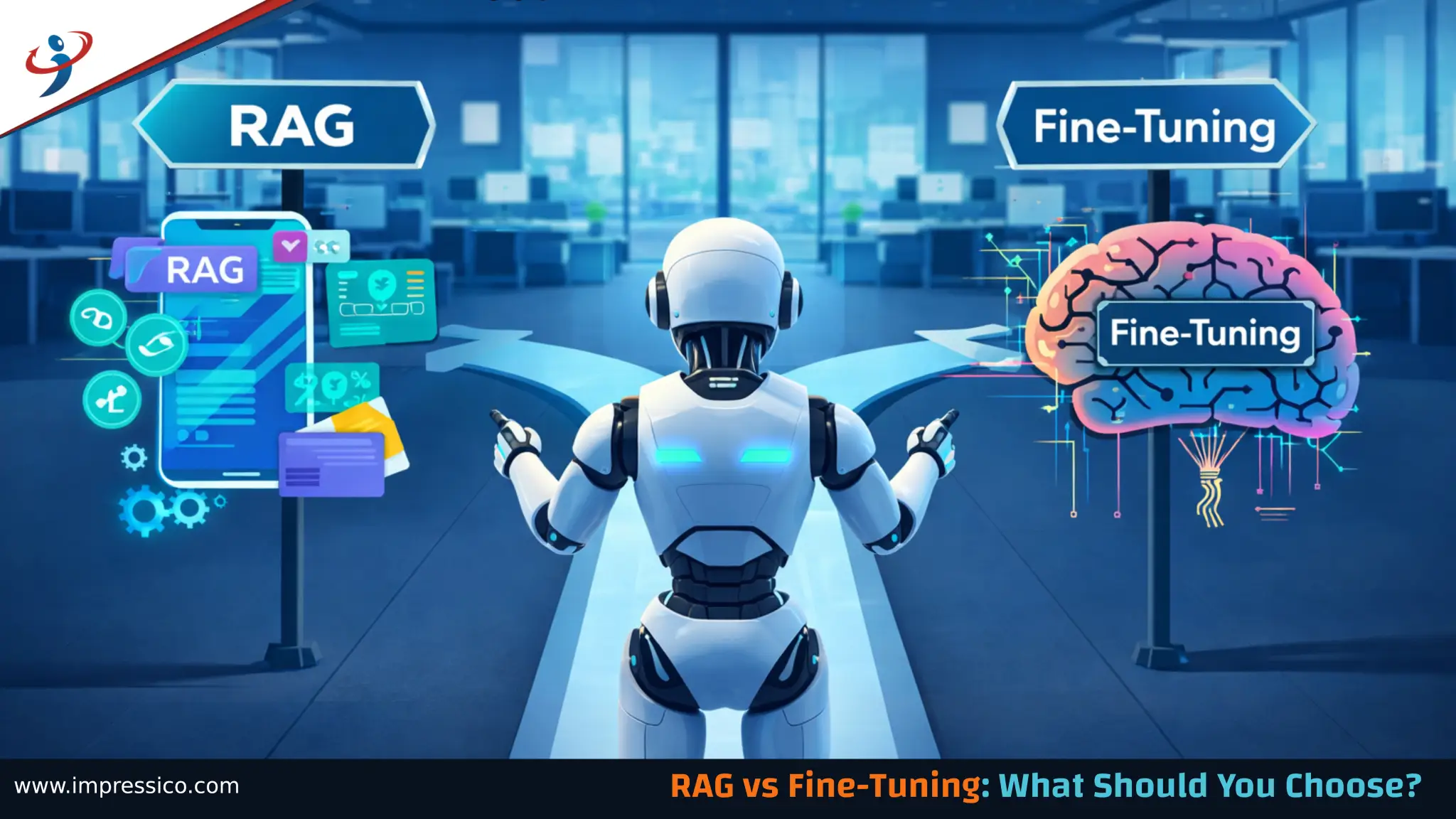
Table of Contents
- →Introduction
- →What Is RAG? (Retrieval-Augmented Generation)
- →What Is Fine-Tuning?
- →Key Difference: How They Use Knowledge
- →Detailed Comparison: RAG vs Fine-Tuning
- →When Should You Choose RAG?
- →When Should You Choose Fine-Tuning?
- →The Hybrid Future: Getting the Best of Both
- →Practical Use Cases in Enterprise
- →Conclusion
Key Differences, Costs & How to Choose for Your AI Project
A comprehensive guide to understanding when to use Retrieval-Augmented Generation vs. Fine-Tuning for your AI projects
Artificial intelligence is transforming the way businesses respond to business issues. There are two major ways through which firms are currently enhancing AI models: retrieval augmented generation vs. fine-tuning. RAG and Fine-Tuning have a prominent role in the latest generative AI architecture consulting services for firms to adopt AI. RAG and Fine-Tuning assist AI models to offer improved solutions and help cater to diverse business needs.
What Is RAG?
RAG stands for Retrieval-Augmented Generation. RAG is a technique applied in a generative AI model in which the model retrieves information from external sources to respond to a query. Large language models are trained on a wide range of general knowledge, but sometimes this training does not include the latest or enterprise-specific knowledge. That’s exactly why a Retrieval-Augmented Generation is beneficial for a comparison between RAG vs. fine-tuning for internal knowledge bases.
RAG assists with searching documents or data sources related to the query, which ultimately helps with better relevance and accuracy. This capability is central to many RAG implementation services used by enterprises.
🔄
How RAG Works
Key Advantage: Since RAG requires external data during execution, it is always updated without any training. This is a major advantage when evaluating when to use RAG vs fine-tuning.
What Is Fine-Tuning?
Fine-tuning is a different approach. It involves taking a pre-trained model and training it further on a specific dataset. This allows the model to learn domain terminology, patterns, and business-specific language. Fine-tuning is commonly offered through LLM fine-tuning services.
Think of it as teaching a general AI to specialize in your company’s domain. After fine-tuning, the knowledge is embedded within the model. This difference is key when comparing fine-tuning LLM vs RAG.
Fine-tuning happens before deployment. Once trained, the model generates answers directly without retrieving external documents.
⚖️
Key Difference: How They Use Knowledge
Retrieves external data when answering a question. It does not change the model’s internal learning.
Embeds domain knowledge into the model itself. It changes the model’s weights so that it remembers domain-specific information even without retrieval.
Comparison: RAG vs Fine-Tuning
When Should You Choose RAG?
If your business deals with data that changes every day, RAG is a good fit. Examples include regulatory updates, product catalogs, or support documentation.
When your business needs to provide answers from large document collections like customer support systems, legal research, or knowledge management systems.
If time is a priority and you want a working system fast, RAG can often be built and deployed faster than fine-tuning.
When Should You Choose Fine-Tuning?
If your business works with stable knowledge that does not change often, fine-tuning is powerful. Examples include legal document classification or domain-specific report generation.
Fine-tuned models often respond faster because they do not run a retrieval step for every query. Ideal for high-traffic systems needing fast response times.
When you need the AI to follow a strict tone, format, or style, fine-tuning helps the model internalize that style. Essential for branding or precise language needs.
The Hybrid Future: Getting the Best of Both
For many enterprises, the future is not just RAG or fine-tuning. It is both together. A hybrid approach gives you rich domain insight from fine-tuning combined with up-to-date facts from RAG, resulting in better accuracy and lower hallucination risk.
Example: A legal assistant could use a model fine-tuned on thousands of legal documents for deep understanding and style, while RAG pulls the latest case law or regulatory updates for current context.
Conclusion
Whether to use RAG or Fine-Tuning as a solution largely depends on your business needs, your timelines, or the dynamics of your data. Both methods are very effective; however, understanding their power and limitations can ensure that companies make informed decisions to develop reliable and useful AI solutions.
- You require brand-new knowledge
- You need quick deployment
- Information changes frequently
- You need simple upgrades
- You need high behavioral accuracy
- Working with stable domains
- Require offline tasks
- Need style control
- You want accuracy and current information
- You need both domain expertise and freshness
- Working on complex enterprise solutions
- Budget allows for both approaches
Get expert guidance on choosing the right AI approach for your specific business needs. Our team of AI specialists can help you implement RAG, Fine-Tuning, or a hybrid solution tailored to your requirements.
Need help deciding between RAG and Fine-Tuning?
Contact our AI experts today →