How Agile and DevOps Turbocharge Legacy System Modernization
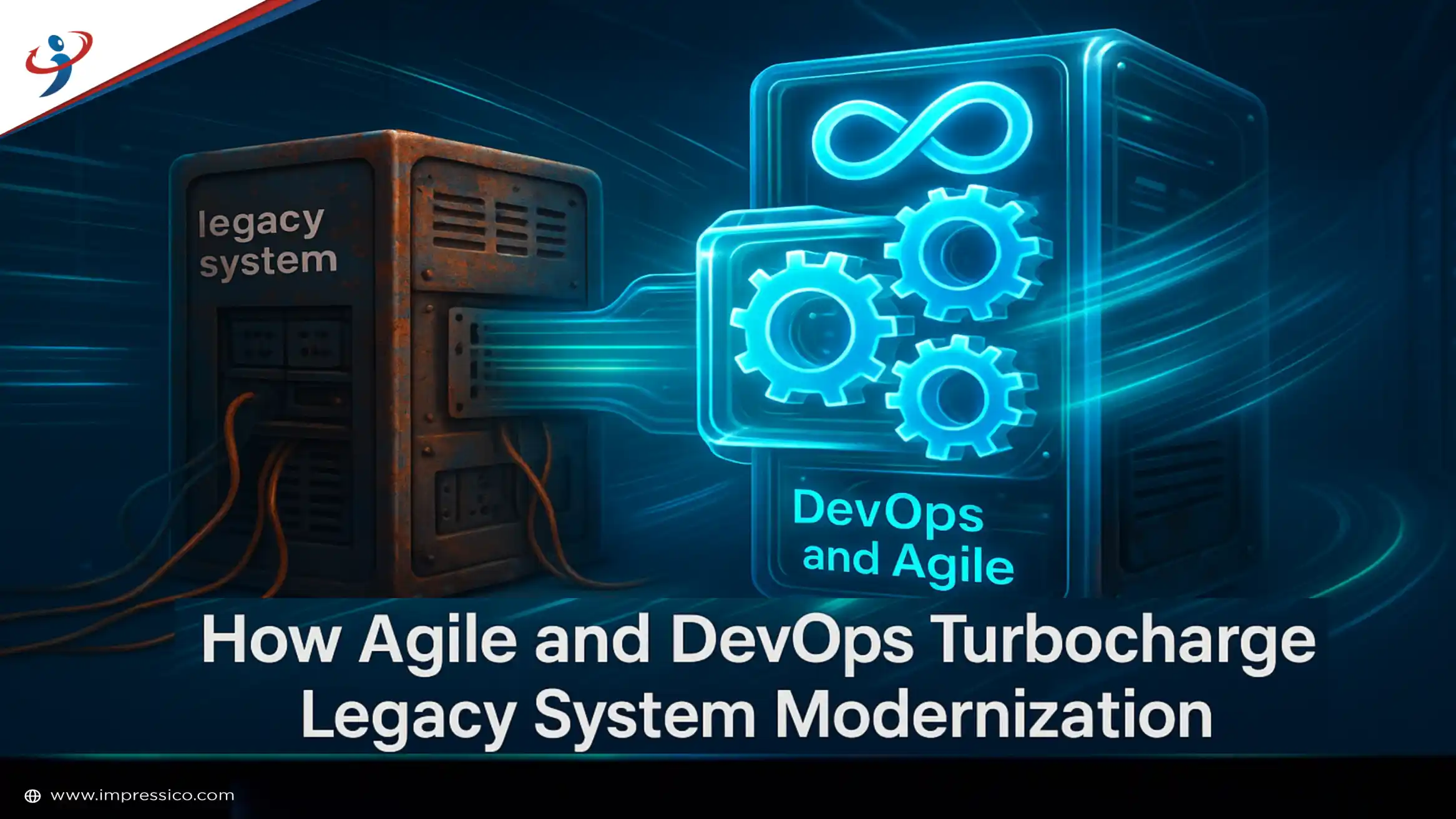
In the rapidly evolving digital landscape of today, businesses cannot afford to be weighed down by outdated, inflexible technology. Yet, many organizations remain with legacy systems – software built decades ago. While these systems may still ‘function,’ they actively hinder innovation, scalability, and the ability to respond to customer needs.
You could consider these systems as the ground floor of a house that is still standing, but not strong enough to bear new additions. They can perform simple tasks, but in terms of flexibility, speed, and affordability, they constrain companies.
This is where DevOps and Agile emerge as the engine for rolling modernization – enabling organizations to modernize legacy systems piece by piece, without closing down operations or risking enormous amounts.
As opposed to an unsafe “big bang” rewrite, today’s modernization is about incremental upgrades that add value step by step.
Why the “Big Bang” Rewrite No Longer Works
In the past, businesses often tried to replace entire legacy systems in one go. These “big bang” projects sounded promising at first—tear out the old, install the new, and move forward. But reality told a different story.
These projects were long, expensive, and risky. Many failed before they even went live, wasting years of effort and millions of dollars. Even when they succeeded, the transition was painful for employees and customers.
Now, the wiser method is ongoing modernization. This implies building up systems bit by bit while continuing to operate the business as normal. It’s like restoring a home one room at a time, rather than demolishing it and remaking it from the ground up.
With DevOps and Agile, businesses don’t need to bet the farm on one date. Rather, they can modernize incrementally, learning and responding as they go.
The Strangler Fig Pattern: A Safer Road
One of the most reliable methods of modernizing is referred to as the Strangler Fig Pattern. That’s named after the way a strangler fig tree gradually envelops its host tree until it takes its place.
Here’s how it applies to modernizing:
- Rather than replacing the entire system, teams begin by rewriting one small feature as a new service.
- The new service coexists with the legacy system.
- Gradually, additional components are replaced such that the legacy system is completely changed.
This approach is safer, allowing businesses to test, validate, and refine each incremental step before moving forward. If there is an error, the rest of the system continues to function.
Agile facilitates this by dividing work into phases of small sprints, and DevOps enables every modification to be tested, released, and tracked safely.
For instance, a bank that has a 20-year-old core system will begin by overhauling its customer log-in service. Once that is working well in the new environment, it progresses to transactions, then to reporting, and so on. Every step makes things safer while delivering value.
DevOps: The Safety Net of Modernization
Agile might dictate the rhythm, but DevOps offers the guardrails. Without DevOps practices, modernization can still go wrong even with a good attitude.
This is the way DevOps reinforces modernization:
-
Infrastructure as Code (IaC):
Servers, databases, and networks can be created with code by teams and easily replicated, scaled, or repaired.
-
CI/CD Pipelines:
Continuous delivery and integration ensure new updates are smoothly introduced into production without downtime or eleventh-hour surprises.
-
Automated Testing:
Each new component of the system is immediately tested, catching mistakes before they hit customers.
-
Monitoring & Feedback:
DevOps tools continuously monitor performance, so that teams can respond promptly if problems emerge.
In other words, DevOps provides a safety net. Modernization is less risky and more incremental progress.
Industry analysts consistently highlight the burden of legacy systems. It’s frequently cited that a overwhelming majority of enterprises—often estimated at over 70%—consider their legacy technical debt a primary barrier to agility and innovation. While exact figures vary, the consensus is clear: outdated infrastructure is one of the top impediments to digital transformation.
The Real ROI: Business Agility
Modernization is not merely a matter of replacing old technology with new. The real return on investment (ROI) lies in business agility.
With each modernized component of the legacy system, the business achieves increased flexibility:
-
Speedier launches:
Features reach the customers more quickly.
-
Innovation space:
The teams can test without fear of crashing the entire system.
-
Improved scalability:
Systems scale with the demand, rather than getting bogged down in peak usage.
-
Enhanced user experience:
New platforms enable a smoother, quicker, and more tailored customer experience.
For instance, a consumer goods company that overhauls its order management system can now instantaneously introduce new channels to sell, like mobile apps or AI chatbots, without years of planning.
Simply put, Agile + DevOps make modernization a competitive differentiator—not merely a tech project.
Culture Is the Key to Success
No amount of advanced tooling can save a modernization project with a dysfunctional culture. Agile and DevOps foster collective ownership, in which development, operations, and security all work together.
This culture shift is essential. In older deployments, silos bring everything to a crawl. Developers code, operations deploy, and security screens it afterwards. The tit-for-tat stalls progress and generates frustration.
With DevSecOps, security is integrated into the process from day one. Teams work together, trust one another, and own responsibility for both speed and safety.
At its core, modernization is less about tech and more about people working differently—faster, smarter, and together.
The Role of Platform Engineering
By 2025 and onward, platform engineering is turning into a foundation for modernization. Rather than requesting each team to master intricate tools, organizations create in-house developer platforms with pre-built toolkits for constructing, testing, and launching services.
This brings numerous advantages:
-
Consistency:
Each team has the same greatest practices.
-
Speed:
Developers are concentrating on fixing business issues rather than struggling with infrastructure.
-
Reliability:
Automated configurations eliminate human mistakes.
Imagine platform engineering to provide each builder with the same high-quality toolset. With them, teams can modernize quickly and with fewer errors.
Cloud-Native Development: The Destination
The majority of modernization projects seek to make systems cloud-native. That is, applications built for the cloud from the ground up—scalable, adaptable, and simpler to support.
Cloud-native systems employ contemporary technologies such as:
-
Containers (Docker):
To package applications and execute anywhere.
-
Kubernetes:
To manage and scale those containers automatically.
-
Service Mesh (Istio, Linkerd):
To handle secure communication between different services.
By moving toward cloud-native development, businesses escape the limits of old monolithic systems. Instead, they get modular, future-ready architectures that evolve with the market.
Real-World Example: Step-by-Step Success
Consider the world’s biggest insurance firm operating on a 25-year-old system. Updating the entire thing in one go would cost billions and jeopardize operations. That’s not what they do, however. They employ Agile and DevOps to update incrementally.
- Phase 1: Rewrite the customer portal as an up-to-date web application, with the old system still running in the background.
- Phase 2: Update claims processing with microservices.
- Phase 3: Move policy management into a cloud-native platform.
Within two years, the company can implement new products more quickly, integrate with digital partners, and reduce downtime by half—all without a risky system-wide shutdown.
The challenge is well-documented. Gartner routinely identifies ‘technical debt’ as a top impediment to transformation, placing legacy modernization among the highest priorities for CIOs. The cost of maintaining old systems isn’t just financial; it’s the opportunity cost of missed innovation.
Final Thoughts
Legacy systems don’t have to be a drag. By marrying Agile practices and DevOps culture, organizations can modernize step by step—reducing risk, releasing new opportunities, and remaining competitive in today’s digital-first economy.
At Impressico Business Solutions, our philosophy is that modernization is a perpetual journey, not an occasional project. With the right combination of culture, tools, and strategy, your business can transition smoothly while maintaining day-to-day business strength.
If your organization is poised to begin its modernization journey, Agile and DevOps can provide you with the engine to drive forward—safely, steadily, and successfully.
FAQs – Agile and DevOps Legacy System Modernization
-
What is the first step in planning a legacy modernization project?
The first step is a collaborative assessment to understand your business goals and technical landscape. We map your current system, identify key pain points, and define a clear, prioritized roadmap for modernization that aligns with your strategic objectives, ensuring we solve the right problems from the start.
-
What are the risks of NOT modernizing our legacy systems?
The risks include severe security vulnerabilities, skyrocketing maintenance costs, an inability to compete or innovate, and the potential for a catastrophic system failure. Ultimately, the greatest risk is the opportunity cost of being left behind while more agile competitors capture your market.
-
How does modernization fit into a broader digital transformation strategy?
Modernization is the essential foundation for digital transformation. It replaces rigid, outdated systems with agile, cloud-native architectures, enabling all other strategic goals like data analytics, seamless customer experiences, and rapid innovation. You can’t transform digitally on top of a crumbling tech base.
-
What role do APIs play in a legacy modernization project?
APIs act as crucial bridges, allowing new, modern applications to safely communicate with and extract data from old legacy systems. This enables incremental modernization, letting you build new features without a risky “big bang” rewrite, by gradually strangling the old monolith.
-
Will there be business disruption or downtime during the modernization process?
With an incremental approach, the goal is to have minimal to no disruption. The old system remains operational throughout the process, while new components are built and tested separately. Traffic is only switched to the new services once they are proven stable, avoiding downtime.
-
Do you offer legacy system assessment and modernization roadmap services?
Yes, we provide a comprehensive assessment and roadmap service. Our experts analyze your systems to deliver a prioritized, actionable plan that outlines the phases, technologies, estimated investment, and strategy for a successful and low-risk modernization journey.
-
Can Impressico provide resource augmentation to complement our existing IT team?
We provide resource augmentation services where we embed our experts within your teams to fill skill gaps and accelerate development. Our specialists can also mentor your team in modern technologies like cloud and DevOps, ensuring a successful partnership and knowledge transfer.
-
What kind of ongoing support and maintenance do you offer for modernized systems?
We offer flexible managed services, including 24/7 monitoring, performance optimization, security patching, and cost management. This ensures your modernized environment remains reliable, secure, and efficient, allowing your team to focus on core business innovation.
-
How does your Software Quality Assurance process integrate into a DevOps-led modernization?
Our QA is fully integrated into the DevOps process from the beginning. QA engineers work alongside developers to build automated tests into the pipeline, enabling continuous testing to catch bugs early and ensure every release is stable and secure, making quality a shared responsibility.