The Complete DevOps Automation Framework for SaaS Companies
Table of Contents
- →Why SaaS Companies Need Specialized DevOps Automation
- →The Real Benefits of DevOps Automation for SaaS Platforms
- →DevOps Automation Framework: Core Components
- →DevOps Automation Readiness Assessment
- →How to Automate DevOps for SaaS: A Decision Framework
- →Implementation Roadmap
- →ROI of DevOps Automation for SaaS Platforms
- →Frequently Asked Questions
Modern SaaS platforms run on distributed systems, cloud native infrastructure, and constantly shifting workloads. Releases no longer happen once a month. They happen daily—or even multiple times a day. In this environment, DevOps automation is not just about moving faster. It’s about building systems that can scale safely, recover quickly, and stay reliable as customer demand grows.
Most SaaS companies don’t struggle with DevOps because they lack tools. They struggle because critical delivery decisions still depend on people remembering what to do next often under pressure.
As customer usage grows, release cycles get tighter. Downtime becomes expensive. Even small mistakes show up fast. Teams start slowing down not because they want to, but because they are trying not to break things.
This is where a DevOps automation framework for SaaS starts to matter. Automation removes guesswork. It lets teams move forward without pausing every time a release goes out.
At Impressico, we see this pattern often. In this guide, we walk through what a practical DevOps automation framework for SaaS looks like, why DevOps for SaaS companies needs a different approach, and how CI/CD automation for SaaS supports real-world growth.
Why SaaS Companies Need Specialized DevOps Automation
Traditional models assumed longer release windows and controlled environments. SaaS breaks those assumptions. Features ship continuously. Infrastructure scales daily. Customers expect things to work all the time.
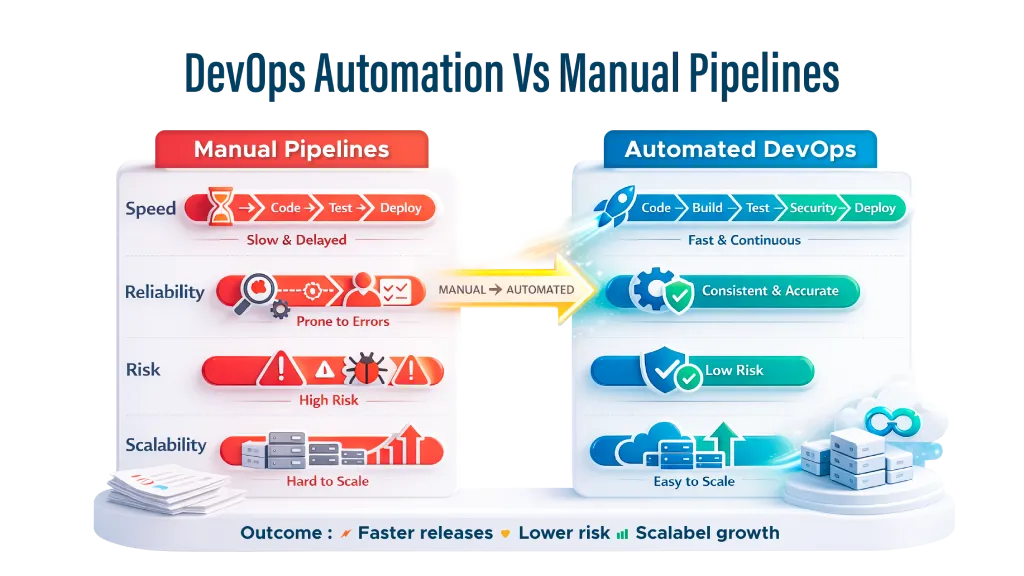
This is why DevOps automation vs manual pipelines is now a real business conversation, not just a tooling debate. Manual steps introduce delay and risk at the same time. People get tired. Steps get skipped. Issues surface later, usually when traffic is high.
Many teams run into the same DevOps automation challenges for SaaS:
- Microservices that change independently
- Rapid customer onboarding and unpredictable usage spikes
- Strict uptime and SLA expectations
- Ongoing compliance and security needs
Key Insight
For DevOps for SaaS companies, automation directly affects revenue and trust. Faster recovery, stable releases, and predictable delivery reduce churn and support load.
For DevOps for SaaS companies, automation directly affects revenue and trust. Faster recovery, stable releases, and predictable delivery reduce churn and support load.
Industry data from DORA (Accelerate State of DevOps Report) consistently shows that teams with mature automation deploy more often, recover faster, and fail less frequently.
The Real Benefits of DevOps Automation for SaaS Platforms
Faster Releases Without Chaos
DevOps automation removes manual handoffs from the release process. With automated CI/CD pipelines, SaaS teams can ship smaller updates more frequently. This keeps delivery fast without turning every release into a stressful event.
Built-In Scalability
Automation supports scalability by design. Infrastructure scales based on demand, not assumptions. With Infrastructure as Code and cloud native infrastructure, environments grow with the business without adding operational complexity or headcount.
Improved Stability and Reliability
Automated testing, monitoring, and rollback mechanisms reduce production failures. When issues do occur, teams detect and resolve them faster—often before customers are impacted. This directly protects uptime and brand reputation.
Lower Operational Costs Over Time
Manual processes do not scale well. Automation reduces repeated effort, limits human error, and cuts down on firefighting. Over time, SaaS companies see lower infrastructure waste, fewer emergency fixes, and better use of engineering resources.
Security Built Into the Delivery Flow
DevOps automation allows security checks to run automatically as part of CI/CD pipelines. Vulnerability scans, compliance controls, and policy enforcement become consistent instead of last-minute add-ons.
Higher Team Confidence and Ownership
When pipelines are reliable, teams trust the system. Engineers spend less time worrying about deployments and more time building value. Clear automation improves ownership—everyone understands what happens next and why.
DevOps Automation Framework: Core Components
A sustainable automation setup is more than just a stack of scripts. It’s a complete system.
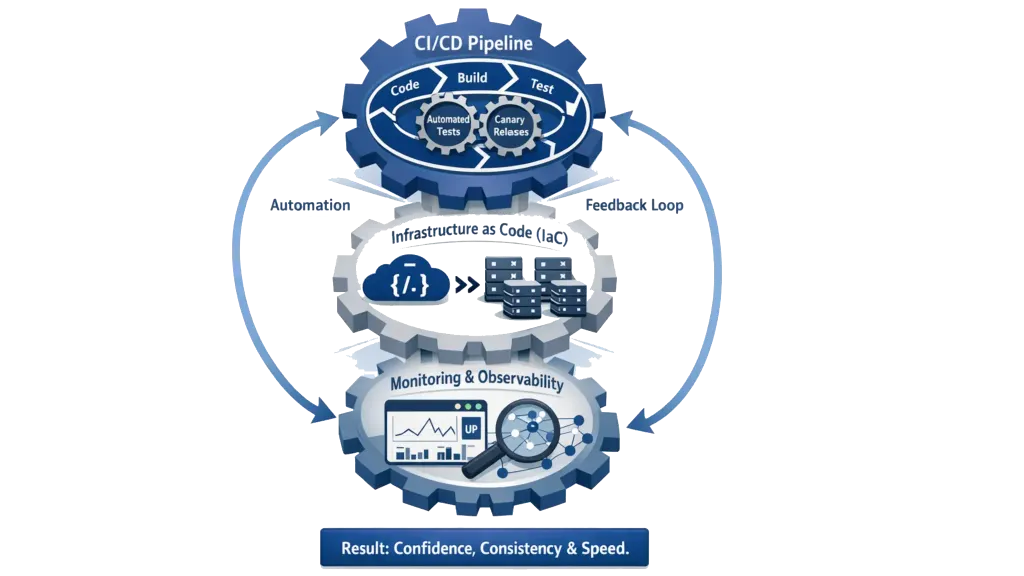
A properly planned DevOps automation framework synchronizes tools, processes, and teams to deliver consistent results. At the center of this is a well-defined DevOps automation architecture that supports continuous delivery while keeping operational risk under control.
At Impressico, we often see environments where automation exists, but teams don’t fully trust it. In most cases, this points to a framework that was built over time without a clear plan.
CI/CD Pipeline Architecture for SaaS
SaaS teams need pipelines that move quickly without compromising production quality.
A well-defined CI/CD pipeline automation supports development, staging, and production environments while enforcing consistent behavior. CI/CD automation ensures that every change goes through the same checks, tests, and controls.
The main elements of effective CI/CD pipeline automation usually include:
- Automated unit, integration, and regression tests
- Policy-based approvals for sensitive deployments
- Deployment strategies such as blue-green and canary releases
When done properly, CI/CD automation for SaaS reduces stress around releases. Teams deploy smaller changes more frequently and recover faster when issues occur. These practices align with proven DevOps automation best practices followed by high-performing SaaS teams.
Infrastructure as Code (IaC) Implementation
Infrastructure should never be a mystery.
IaC brings consistency across environments. For SaaS platforms that are scaling, this becomes essential sooner rather than later. DevOps automation at scale requires infrastructure to be created, audited, and updated through code.
A strong DevOps automation strategy around IaC also helps manage cloud costs. Standardized setups reduce over-provisioning and remove the fear of making changes in production.
At Impressico, we frequently see cost savings once infrastructure is no longer managed manually.
Monitoring and Observability Automation
Automation is not just about deployment; it goes beyond that.
The reliability of SaaS hinges on real-time monitoring, meaningful alerts, and quick remediation. Observability platforms are the ones to connect system behavior with business outcomes and not just server metrics.
This marks the completion of the DevOps automation framework, and it also supports modern SRE practices, wherein the focus is no more on continuous firefighting but rather on fostering long-term resilience.
Impressico often helps teams to adjust the alerts such that the engineers are concerned with the real issues rather than attending to the noise.
DevOps Automation Readiness Assessment
Before automation succeeds, an honest evaluation of readiness is required.
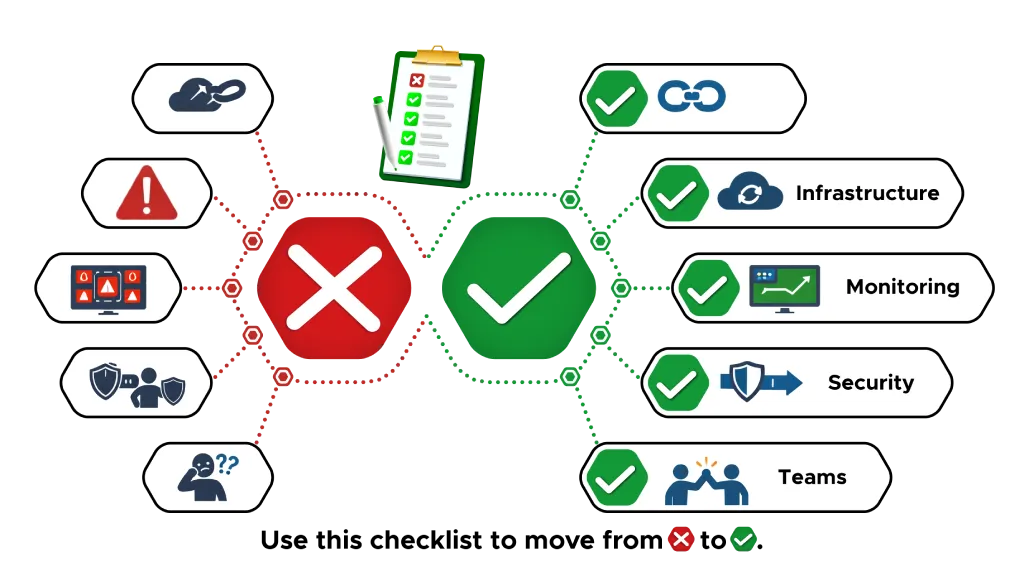
A structured assessment identifies gaps in tools, skills, or processes very clearly and thus prevents wasting effort. A DevOps automation readiness checklist helps the teams to recognize their present condition and what should be dealt with first.
For the leadership teams evaluating how to automate DevOps for SaaS, readiness assessments offer a very practical starting point by showing where automation will produce the fastest effect.
DevOps Automation Readiness Checklist
- CI/CD: Are builds and deployments automated end to end?
- Infrastructure: Can environments be recreated without manual steps?
- Monitoring: Do alerts point to real problems?
- Security: Are checks part of the delivery flow?
- Teams: Is ownership clear and shared?
Using a readiness checklist helps teams plan automation based on reality, not assumptions.
How to Automate DevOps for SaaS: A Decision Framework for Leaders
How to automate DevOps for SaaS is not about automating everything at once. It’s about making the right decisions at the right stage of growth.
For leadership teams, the decision usually comes down to three questions:
Where are failures costing us the most today?
Look at recent incidents and delays. Were issues caused by manual deployments, inconsistent environments, or slow rollbacks? Automation should start where human dependency creates the highest operational risk.
What needs to scale without adding headcount?
If releases, infrastructure changes, or compliance checks require more people every quarter, automation becomes a growth requirement rather than an efficiency improvement.
What level of risk are we willing to accept during change?
Many SaaS companies delay automation until problems become visible. A more sustainable approach is to automate before growth amplifies small mistakes into recurring incidents.
When leaders ask how to automate DevOps for SaaS, the answer is rarely “everything.” It’s about sequencing—starting with reliable CI/CD, then infrastructure consistency, followed by observability and cost control.
At Impressico, we help teams align automation decisions with business impact, so effort is focused where it delivers measurable results.
Implementation Roadmap
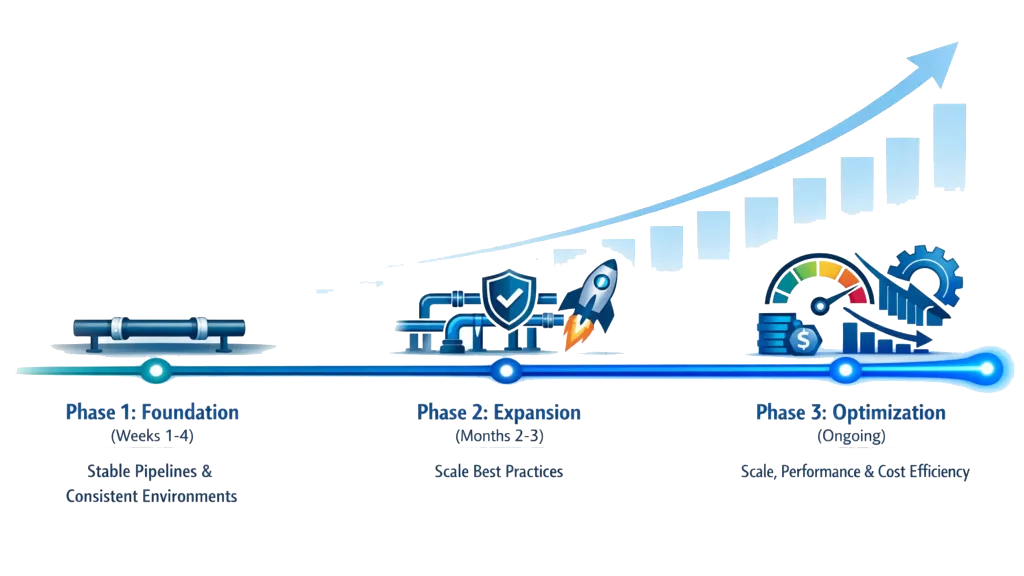
Phase 1: Foundation (Weeks 1–4)
Start with the basics. Establish stable pipelines and consistent environments. Avoid rushing into complexity too early.
Phase 2: Expansion (Months 2–3)
DevOps automation best practices become standard across teams. Security checks, improved deployment strategies, and shared workflows are introduced.
Phase 3: Optimization (Ongoing)
At this stage, DevOps automation at scale focuses on performance tuning, cloud cost control, and overall operational efficiency.
ROI of DevOps Automation for SaaS Platforms
Automation decisions ultimately come down to return on investment.
For SaaS companies, DevOps automation ROI typically shows up in three areas:
- Reduced downtime costs: Faster recovery and safer releases directly protect revenue.
- Lower operational overhead: Automation limits the need for manual intervention as systems scale.
- Improved delivery confidence: Teams release faster without adding risk or process friction.
Understanding how to automate DevOps for SaaS with ROI in mind ensures automation investments support growth instead of creating long-term complexity.
Common Challenges for SaaS Companies
Automation does not remove all friction.
As platforms grow, DevOps automation challenges for SaaS continue to evolve. Multi-tenant architectures increase deployment risk. Compliance adds overhead. Teams need time to adapt.
Knowing when to implement DevOps automation matters. For DevOps automation for high-growth SaaS, waiting too long often leads to rushed fixes later.
Measuring DevOps Automation Success
Success should be visible.
Deployment frequency, lead time, and recovery time remain useful because they reflect how teams actually work. These metrics align with proven DevOps automation best practices.
A strong DevOps automation strategy also tracks outcomes leadership cares about—fewer incidents, faster releases, and stronger customer trust.
When to Consider Professional DevOps Consulting
Some situations benefit from an outside perspective.
Large migrations, compliance-heavy environments, or aggressive timelines often justify DevOps consulting for SaaS. External experts help teams move faster without repeating common mistakes.
Focused DevOps automation services and CI/CD consulting services are especially useful when internal teams are stretched. Many growing SaaS companies turn to DevOps consulting for SaaS to stabilize delivery during expansion.
Impressico works closely with teams during these moments, helping them move forward without disrupting active development.
Conclusion
SaaS products cannot scale on manual processes.
A practical DevOps automation framework for SaaS gives teams confidence, consistency, and speed while reducing operational risk.
As systems evolve, a clear DevOps automation strategy helps teams stay aligned. The right time to assess readiness is before operational pressure turns into ongoing stress.
FAQs
- How does DevOps automation differ for monolithic vs microservices SaaS architectures?
- A greater reliance on automation is necessary in the case of microservices because the services run independently and evolve by themselves.
- What are the cost implications for early-stage vs. enterprise SaaS?
- Early stage emphasizes maximum efficiency, whereas the concern of enterprises is largely reliability and compliance.
- How do we handle compliance automation (SOC2, HIPAA, GDPR) within DevOps pipelines for SaaS?
- Through the use of automated checks available in the delivery process.
- What’s the typical timeline for achieving full DevOps automation maturity in a SaaS company?
- The majority of SaaS development teams usually produce outstanding results within a year.
- How does DevOps automation impact SaaS pricing models and customer SLAs?
- Reliability can now be expressed at a much higher level. This leads to stronger SLAs and, therefore, long-term customer trust.
Ready to Transform Your DevOps Automation?
Get expert guidance on implementing a DevOps automation framework tailored to your SaaS company’s needs and growth stage.