


February 16, 2026
End to End Generative AI Architecture Explained
Enjoying this article?
Share it with the world!


How enterprise generative AI systems actually work in real companies
| ⚡ Quick Answer An end-to-end generative AI architecture is the full pipeline behind an enterprise AI system, not just the model. Data is ingested securely, cleaned and chunked, converted into embeddings and stored in a vector database. A user query triggers retrieval, context is injected into a prompt, the model generates a response, guardrails validate it, and the result is integrated into business systems. Monitoring, cost control and human review continue after launch. Each layer has a job; weak layers show up as hallucinations, runaway cost or a demo that never reaches production. |
Generative AI is now part of many business discussions. Companies want chat assistants, smart search tools, content generation, code helpers, and document automation. Many leaders ask a simple question. What is an end to end generative AI architecture and how does it actually work in a real company?
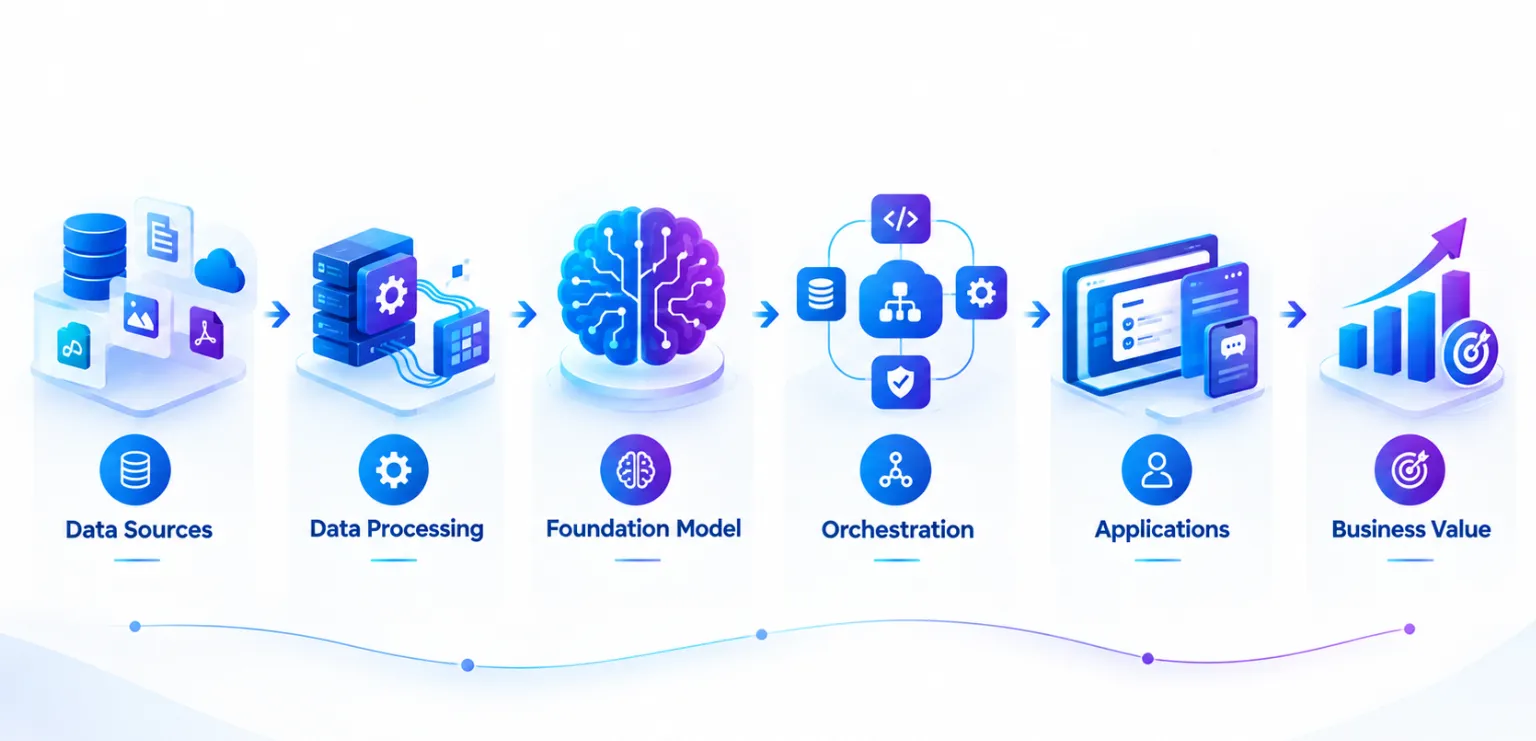
An end to end generative AI architecture is a full pipeline. It covers everything. Data comes in. Data is cleaned. Models are selected. Context is added using retrieval. Outputs are checked. Systems are connected. Results are deployed to real users. Monitoring and cost control continue after launch.
Impressico Business Solutions helps enterprises build such systems through Generative AI consulting services and enterprise generative AI architecture services. Let us break down each layer step by step.
Introduction to End to End Generative AI Architecture
Generative AI architecture is not just a large language model. Many people think adding a chatbot means AI is ready. Real enterprise systems are much more detailed.
🏗️ End to End Generative AI Architecture Includes:
|
|
| |||
|
|
| |||
|
|
|
This structure is often called a generative AI pipeline architecture. Each layer has a clear role. When designed well, the system becomes reliable and scalable.
Enterprise generative AI architecture must handle privacy, security, cost, and performance. A simple demo is not enough.
Data Sources and Ingestion Layer
Every AI system starts with data. Enterprises have many data sources.
|
|
|
| ||||
|
|
|
|
Data ingestion means collecting this information safely. Access control is very important. Not everyone should see every document. Secure ingestion ensures that only approved data enters the system. Data may come in two ways: batch ingestion collects data at fixed times, while real time ingestion processes data instantly as it arrives.
Standardization is needed because data formats differ. Some files are PDFs. Some are spreadsheets. Some are plain text. Data must be converted into a common structure. This stage forms the base of the generative AI system architecture. Weak data leads to weak results — which is why data readiness is assessed before anything is built.
Data Preprocessing and Transformation
Raw data is messy. It may contain errors, duplicates, or irrelevant content. Cleaning removes noise and improves quality. Text is broken into smaller chunks. Chunking helps models process information properly. Large documents are divided into manageable parts.
Next step is embedding. Embedding converts text into numerical form. These numbers represent meaning. Similar ideas get similar number patterns.
Structured formatting also helps. Clear metadata such as document type, date, author, and category improves search accuracy.
Preprocessing ensures that data is ready for retrieval and model reasoning. This stage is one of the core components of a generative AI architecture.
Vector Database and Knowledge Storage
Embeddings are stored in a vector database. This is a special storage system designed for semantic search. Vector database architecture allows fast similarity matching. When a user asks a question, the system searches for related chunks based on meaning, not just keywords.
Role of vector databases in generative AI architecture is critical. They provide context grounding. This reduces hallucination and improves relevance. When someone asks about a company policy, the system retrieves related documents. Then the model generates an answer based on those documents.
Vector database consulting services help enterprises choose the right storage engine based on scale and performance needs — our comparison of Pinecone, Weaviate, Qdrant and pgvector sets out the trade-offs.
RAG Architecture for Context
What is RAG architecture in generative AI? RAG stands for Retrieval Augmented Generation. RAG architecture combines retrieval and generation. First, relevant information is fetched from the vector database. Then the language model uses that information to generate a response. This approach keeps answers accurate and aligned with business data — covered in depth in our guide to enterprise RAG architecture.
RAG implementation services are often needed because context design requires careful planning. Chunk size, retrieval limits, ranking strategy, and prompt injection rules must be balanced. Where content mixes exact identifiers with natural language, hybrid search usually outperforms pure vector retrieval. RAG is a major part of LLM based generative AI architecture explained in enterprise use cases.
| For a detailed comparison of RAG vs Fine-Tuning, see our dedicated guide: RAG vs Fine-Tuning: What Should You Choose? → |
Model Selection Strategy
Model choice depends on business needs. Options include open source models, fine tuned private models, and commercial foundation models.
|
|
|
|
LLM architecture consulting helps organizations evaluate these trade offs. Generative AI architecture consulting services often guide enterprises in choosing models based on cost, privacy, latency, and accuracy goals.
| For detailed model comparison, see our guide: Generative AI Architecture: LLMs, RAG and AI Agents Explained → |
| Designing your architecture from scratch? Most enterprise GenAI systems fail at a layer nobody scoped — ingestion permissions, chunking, or cost control. Impressico maps all fourteen layers against your data, systems and constraints before any build begins. |
Prompt Engineering and Orchestration
Prompt design guides model behavior. A poorly written prompt produces inconsistent answers. Good prompts include clear instructions, role definitions, format guidelines, and context injection. Templates are often used to maintain consistency.
Orchestration logic manages multi step workflows. For example, a customer support assistant may retrieve documents, summarize them, generate a draft response, and then format the output. Chaining logic ensures that each step flows into the next one smoothly. Prompt engineering is a key element in generative AI architecture design.
Fine Tuning and Customization
Fine tuning adapts a model to a specific domain. A healthcare organization may train the model on medical terminology. A legal firm may train on contracts. Fine tuning improves tone, accuracy, and task specific performance.
Enterprises also customize output style. Brand voice consistency is important. Generative AI implementation consulting often includes domain specific tuning for enterprise grade reliability.
Guardrails and Safety Controls
AI must operate responsibly, with clear guardrails in place to prevent misuse and ensure ethical deployment.
|
|
|
|
Together, these safety measures form the foundation of enterprise generative AI architecture, reinforcing responsible AI practices and building lasting trust with users. For autonomous systems the bar rises further — see governance and safety for autonomous AI agents and the AI TRiSM framework.
Integration with Enterprise Systems
AI outputs must connect to real systems:
|
|
|
|
APIs allow smooth communication between AI modules and enterprise applications. Automation workflows trigger actions. A support ticket can be auto drafted and logged. A sales summary can be stored in CRM. Integration transforms AI from a demo into a business tool. Enterprise generative AI architecture services focus heavily on system integration.
Cost Optimization and Scaling Strategy
|
|
|
|
Generative AI can become expensive if not managed properly. Scaling strategy ensures performance remains stable during peak demand. How to design scalable generative AI architecture depends on smart cost management — and on measuring it against a baseline, as set out in our generative AI ROI framework.
Human in the Loop Governance
| ▪ Human review improves trust ▪ Experts validate outputs before final approval ▪ Feedback loops help retrain and refine ▪ Approval workflows reduce risk in legal/financial use cases |
Human involvement strengthens accountability. Enterprise generative AI architecture must include governance layers.
Deployment and MLOps for GenAI
Deployment requires structure and discipline. Continuous integration and delivery pipelines automate updates. Version control tracks model and prompt changes. Rollback mechanisms allow recovery if issues arise. Environment separation is important—development, testing, and production environments must remain isolated. The same discipline that governs CI/CD pipelines applies here.
|
|
|
Monitoring, Observability and Continuous Evaluation
Deployment is not the final step in the AI lifecycle. It marks the beginning of continuous monitoring and improvement. Once the system is live, it must be observed daily to ensure steady performance and reliability.
Monitoring continues throughout the entire lifecycle of the solution. Production level metrics need careful tracking to maintain quality at scale.
Accuracy measures how well outputs match validation benchmarks and business expectations. Latency tracks response time and ensures users receive answers without delay. Uptime reflects system availability and overall reliability. Token usage highlights consumption patterns and helps control resource utilization. Cost trends show how spending changes over time, which is critical for long term sustainability. Error rates reveal system failures, integration issues, or breakdowns in workflows. User feedback provides direct insight into satisfaction, trust, and output usefulness.
|
|
| |||
|
|
|
Observability dashboards bring all these signals into one unified view. Teams can quickly detect model drift, performance degradation, unusual token spikes, or rising infrastructure costs. Early detection allows faster correction and prevents larger operational issues.
Evaluation frameworks compare generated outputs against ground truth datasets and predefined benchmarks. Continuous improvement cycles then refine prompts, retrieval logic, model configurations, and guardrails.
Strong monitoring protects performance, controls budget, and ensures the system remains reliable as usage grows. It is a critical component of end to end generative AI system design for enterprise adoption and long term success.
How Generative AI Architecture Works End to End
| The Full Pipeline, Step by Step
|
That is how generative AI architecture works end to end.
| Retrieval · Guardrails · Observability Already built, but not production-ready? Most stalled GenAI systems have one or two weak layers — retrieval quality, guardrails or observability. We review an existing architecture layer by layer and show which gaps are blocking production. |
Final Thoughts
Enterprise AI success depends on structure. A strong generative AI architecture design ensures reliability, safety, and scale.
Impressico Business Solutions provides AI architecture consulting services and generative AI consulting and POC development to help enterprises build secure and scalable systems.
Generative AI architecture consulting is not about installing a chatbot. It is about building a complete pipeline that connects data, models, safety, integration, and monitoring into one cohesive system.
When designed correctly, end to end generative AI architecture becomes a strategic business asset. It improves efficiency. It supports decisions. It enhances customer experience.
But architecture gaps are costly. Systems that skip retrieval design, guardrails or observability tend to stall between pilot and production — the pattern examined in the PoC-to-production gap and why generative AI initiatives fail.
Generative AI system architecture must be practical, secure, and aligned with business goals. Careful planning at every layer ensures long term success.
Enterprises ready to move forward need the right reference architecture for generative AI systems and experienced partners who understand real world challenges — our guide on when to hire a generative AI consulting partner covers that decision.
Impressico Business Solutions stands ready to support organizations in building future ready AI systems through structured design, responsible deployment, and continuous optimization.
| Key Takeaways
|
| Ready to build your generative AI architecture? Get expert guidance on designing and implementing enterprise-grade generative AI systems — architecture consulting, RAG implementation, LLM integration and MLOps for GenAI. Schedule an architecture review → |
Enterprise generative AI architecture consulting · RAG implementation · LLM integration · MLOps for GenAI

IBS
Similar articles

Chunking Strategies for RAG: What Actually Works in Production
September 16, 2026
Vector Databases Compared: Pinecone vs Weaviate vs Qdrant vs pgvector for Enterprise RAG
September 14, 2026
RAG at Scale: Enterprise Retrieval-Augmented Generation Architecture
September 11, 2026
7 Signs Your Organization Is Ready for AI Agents
August 14, 2026
Governance and Safety for Autonomous AI Agents: A Practical Guide for Enterprises
August 3, 2026
Designing Multi-Agent Systems: Orchestration, Tools & Guardrails
July 24, 2026
