
April 27, 2026
Key DevOps Metrics Every CTO Should Track
Enjoying this article?
Share it with the world!


Top DevOps KPIs Every CTO Should Track
At a small scale, software delivery feels predictable. A few services, a manageable pipeline, and a team that can track most things manually.
But as systems evolve into distributed architectures — with microservices, cloud environments, and continuous deployments — the complexity increases faster than visibility.
This is where most engineering teams start to struggle.
Releases become harder to predict. Failures take longer to trace. Small issues in pipelines begin to impact production. And despite having dashboards full of data, there is still no clear answer to what’s actually slowing things down.
This is exactly where DevOps metrics for CTOs become critical.
Not as a reporting layer, but as a control system.
The right metrics help you understand how your delivery pipeline behaves under pressure, how reliably your systems recover from failure, and how efficiently your teams are actually working. Without them, decisions are based on assumptions. With them, patterns become visible.
| According to the official DORA research, a small set of DevOps metrics can reliably predict software delivery performance and overall organizational success. |
The challenge is not tracking more metrics. The challenge is knowing what DevOps metrics should CTOs track to make better technical and business decisions — especially in fast-moving SaaS environments where speed and stability must coexist.
What DevOps Metrics Actually Help You Understand
Most teams already track something.
The problem is, not all metrics help in decision-making.
Good DevOps performance metrics are the ones that answer practical questions:
| ▪ Are we releasing faster than before? ▪ Are we breaking things more often? ▪ Are we improving stability over time? |
Metrics should reduce confusion, not add to it.
Measuring Delivery Speed in Real Systems
Speed is usually the first thing teams try to improve.
But speed is not just about releasing quickly. It is about how consistently teams can move changes into production.
This is where deployment frequency metrics become useful.
If deployments happen regularly and smoothly, it usually means the system is stable. If deployments are delayed or avoided, it often signals deeper issues.
For teams wondering how to track deployment frequency and lead time, the simplest approach is to measure:
|
|
These two signals alone reveal a lot about delivery health.
Stability Matters More Than Speed
Fast releases do not mean much if systems break often.
Many teams increase deployment speed but ignore stability. This creates more incidents, more rollbacks, and more pressure on engineering teams.
This is where DevOps reliability metrics come in.
Metrics like failure rate and recovery time help teams understand whether their systems are actually dependable.
| Reliable systems are not the ones that never fail. They are the ones that recover quickly and consistently. |
Understanding Efficiency Inside Engineering Teams
Efficiency problems are not always visible.
Sometimes teams appear busy, but work still moves slowly. Tasks stay in progress for too long. Releases get delayed without clear reasons.
This is where DevOps efficiency metrics become important.
They help identify:
| ▪ Delays between stages. ▪ Unnecessary approvals. ▪ Repetitive manual work. |
For CTOs looking at DevOps metrics for scaling engineering teams, efficiency is often the hidden bottleneck.
Monitoring Systems Before Users Notice Problems
Many issues in SaaS systems are not sudden. They build up over time.
Latency increases. Error rates slowly rise. Small failures start appearing across services.
Without proper tracking, these signals go unnoticed.
This is why DevOps monitoring metrics are critical.
They provide visibility into system behavior before customers are affected. This is especially important when focusing on DevOps metrics for uptime and reliability, where even small disruptions can impact user experience.
The Core DevOps KPIs That Actually Matter
Not every metric needs to be tracked.
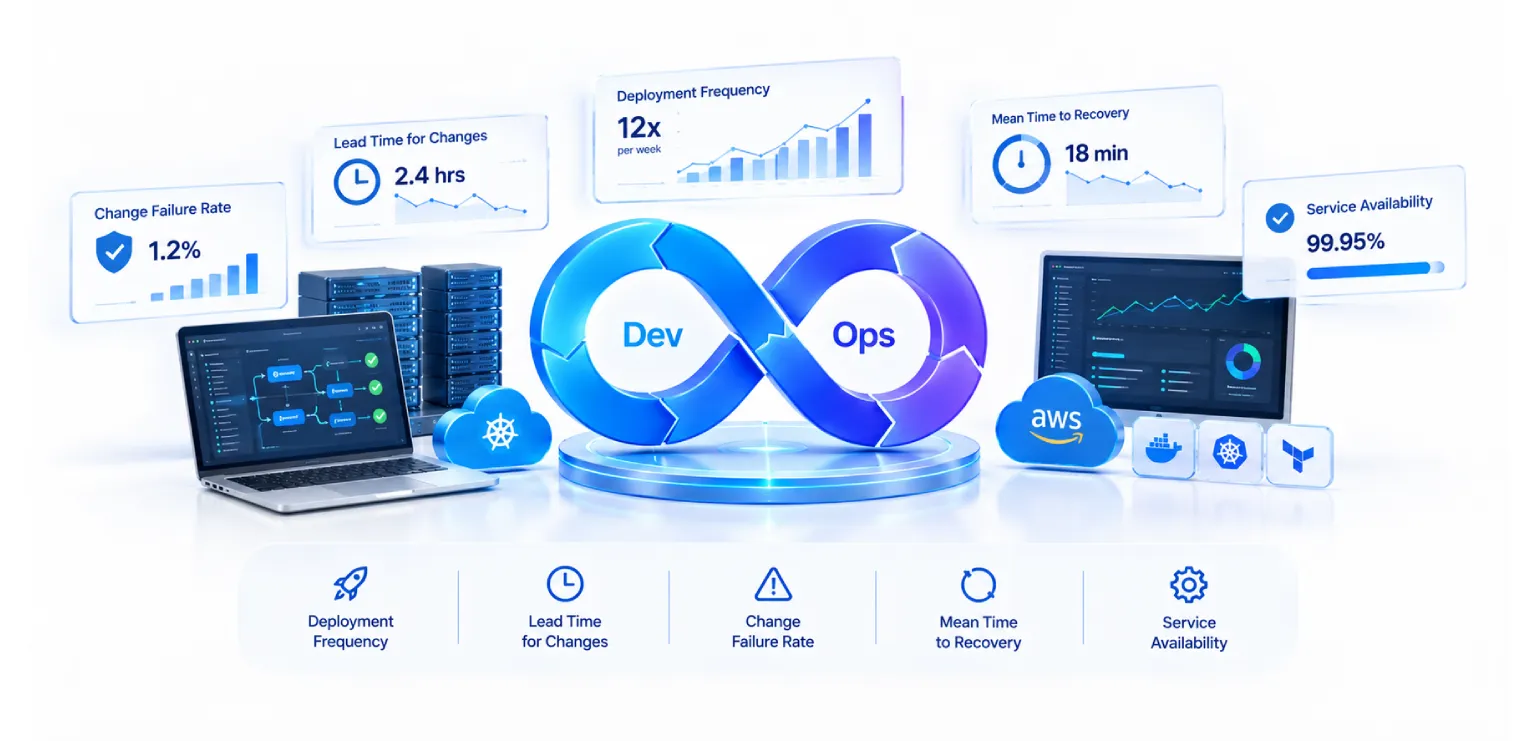
A small set of key DevOps KPIs is usually enough to understand overall performance:
These are practical DevOps KPIs for enterprise teams because they balance speed, quality, and reliability.
When these improve, the system improves.
| Optimize Your Pipeline Need to optimize your DevOps metrics? Trusted by SaaS leaders to improve delivery speed and stability. Get a focused assessment of your current pipeline performance. |
Measuring DevOps in SaaS Environments
SaaS systems operate differently from traditional applications.
They run continuously. Updates happen frequently. Feedback is immediate.
Because of this, DevOps performance in SaaS requires a continuous approach.
Most high-performing teams rely on:
|
|
|
A key part of this is tracking CI/CD performance metrics, which show how efficiently code moves through the pipeline.
When pipelines are stable, releases become predictable.
A Simple Example of Metrics Making a Difference
| According to the DORA State of DevOps Report, high-performing teams deploy up to 200 times more frequently than low-performing teams, showing how strongly the right metrics impact delivery performance. |
A mid-sized SaaS company once struggled with delayed releases.
Deployments were happening once every two weeks, and even those releases carried risks. Teams avoided pushing updates unless absolutely necessary.
After tracking a few DevOps success metrics, they identified two problems:
| ▪ Long lead times. ▪ Frequent pipeline failures. |
By improving their CI/CD process and reducing manual steps, they moved to multiple deployments per week.
Nothing dramatic changed overnight. But over time, releases became smoother, and incidents reduced.
This is how small improvements in metrics create a large operational impact.
When SaaS Teams Need External DevOps Support
As systems grow, internal teams often reach a point where managing everything becomes difficult.
Pipelines expand. Infrastructure spreads across environments. Debugging issues takes longer.
At this stage, many teams explore DevOps consulting services USA to get a clearer view of their current setup. As SaaS environments grow, challenges around automation, scaling, and system reliability become more visible — something we’ve covered in detail in our blog on DevOps automation framework for SaaS.
Some SaaS businesses also consider looking into DevOps consulting for SaaS companies if they are seeking ways to enhance their release cycle or solve any scaling issues.
Alternatively, structured methodologies such as conducting a DevOps readiness audit or DevOps implementation consulting allow organizations to streamline their operations and proceed with more assurance.
It is not about adding more tools to the process but making things simpler for everyone involved.
Conclusion
DevOps metrics are not just technical indicators. They are signals that show how well your system is functioning.
Tracking the right metrics helps teams move faster, reduce failures, and improve overall system reliability.
But the real value does not come from tracking itself.
It comes from understanding what the metrics are telling you — and acting on it.
When used correctly, DevOps metrics do not just measure performance. They improve it.
| Ready to Improve Performance? Turn DevOps metrics into measurable outcomes. From pipeline assessment and tooling to scaling SaaS reliability — our DevOps specialists help engineering leaders move from data to decisions. |

IBS
Similar articles

Shift-Left Security in CI/CD Pipelines: A Practical Playbook
September 4, 2026
DevSecOps: Shifting Security Left Without Slowing Delivery
September 2, 2026
Is Your Engineering Team Ready for Platform Engineering? A Readiness Checklist
August 12, 2026
Measuring Platform Engineering ROI: DORA and SPACE Explained
July 31, 2026
Internal Developer Platforms: Building a Golden Path for Engineering Teams
July 22, 2026
AIOps in Practice: Using AI to Cut Incidents and MTTR
July 6, 2026