Generative AI Architecture: LLMs, RAG and AI Agents Explained
Table of Contents
- →Introduction: The Critical Role of AI Architecture
- →High-Level Overview of Generative AI Architecture
- →Large Language Models (LLMs): The Core Engine
- →Retrieval Augmented Generation (RAG): Grounding AI in Your Data
- →AI Agents: From Answers to Autonomous Action
- →How LLMs, RAG, and AI Agents Work Together
- →Enterprise Use Cases Across Business Functions
- →Build vs. Buy: Strategic Decisions for AI Implementation
- →Governance, Security, and Responsible AI
- →Future Outlook and Conclusion
Gen AI Architecture: LLMs, RAG, and AI Agents
Building scalable, secure AI systems that move from experimentation to enterprise impact
$2.6T
to $4.4T annual value potential (McKinsey)
Top Cause
Poor data quality & architecture cause AI failures (Gartner 2025)
63+
High-value use cases across industries
Generative AI has jumped from being a trend to being an actual tool for businesses. Various organizations use this AI to generate content, respond to queries, automate work, and help make better decisions. Most businesses, though, struggle with this technology since they only focus on the “tool” and not the “architecture.”
⚠️ Gartner 2025 Research Warning
“Lack of AI-ready data puts AI projects at risk”, with organizations reporting that poor data quality and architecture are among the top causes of AI project failures.
In this regard, for success, it is important that leaders understand what generative AI architecture entails and why it is important. Generative AI refers to more than an AI model or a chatbot, for that matter. Rather, it consists of many interlocked pieces that form a larger system.
In today’s world, businesses apply Generative AI solutions to increase speed, lower costs, and discover insights in their own data. This explains why enterprise generative AI architecture and the role of generative AI architecture consulting have become so important in digital transformations.
⚠️ McKinsey’s Analysis
Generative AI could add $2.6 trillion to $4.4 trillion annually across 63 use cases.
🏗️
High Level Overview of Generative AI Architecture
At a high level, Generative AI works as a layered system. Each layer has a specific role and responsibility. Together, these layers define modern generative AI system design.
5
Applications Layer
Chatbots, copilots, internal dashboards, workflow automation tools
4
AI Agents Layer
Plan actions, make decisions, interact with tools and APIs autonomously
3
Augmentation Layer (RAG)
Retrieval augmented generation, security filters, business rules, access controls
2
LLM Layer
Core reasoning engine, understands language, generates responses
1
Data Foundation Layer
Structured databases, unstructured documents, emails, PDFs, knowledge bases
The foundation of the system is data. Enterprise data is the most valuable asset, but it must be used carefully. When these layers work well, AI can be trusted, secure, and scalable. However, when they do not, AI generates confusion, risk, and wasted investment.
Above the data layer sits the large language model architecture. This is the core reasoning engine. The LLM understands language, interprets questions, and generates responses.
Next comes the augmentation layer. This includes retrieval augmented generation architecture, security filters, business rules, and access controls. This layer ensures that the AI uses trusted data and follows company policies.
Then there are AI agents. These agents can plan actions, make decisions, and interact with tools and APIs.
At the top are applications. These include chatbots, copilots, internal dashboards, and workflow automation tools. Together, these layers define modern generative AI system design.
🧠
Large Language Models as the Core Engine
Large Language Models, or LLMs, are the heart of Generative AI. They are trained on massive amounts of text and learn how language works. This allows them to understand questions and generate human-like responses.
LLM Capabilities
- Understand natural language queries
- Generate human-like responses
- Summarize complex documents
- Explain technical concepts
- Draft emails and reports
LLM Limitations
- Hallucination: Generate confident but incorrect answers
- Data Blindness: Don’t know your company data
- Compliance Gap: No built-in security rules
- Context Limits: Limited memory for long conversations
Enterprise Insight: In an enterprise setting, LLMs act as reasoning engines. They summarize reports, explain complex topics, draft emails, and answer questions in natural language. This is why LLM integration architecture is so important in AI system design.
LLMs are powerful, but they are not perfect. One major limitation is hallucination. This means the model can generate answers that sound confident but are not correct. Another challenge is that LLMs do not know your company data unless you connect it. They also do not automatically understand compliance or security rules.
Because of these limits, enterprises cannot rely on LLMs alone. They need additional layers to make AI safe and useful.
🔍
Retrieval Augmented Generation and Why It Matters
Retrieval Augmented Generation, or RAG, solves one of the biggest problems of LLMs. It grounds AI responses in real enterprise data, improving accuracy, reducing hallucinations, and supporting compliance.
RAG Architecture Flow
1
User Query
Natural language question
2
Semantic Search
Across vector databases
3
Retrieve Context
Relevant enterprise data
4
LLM Generation
Grounded in retrieved data
RAG Architecture
- ✓Keeps model general
- ✓Connects to fresh data
- ✓More flexible & easier to maintain
- ✓Reduces hallucinations
- ✓Supports compliance
Fine-Tuning Architecture
- ⚡Changes model itself
- ⚡Requires more time & cost
- ⚡Complex maintenance
- ⚡Model can become outdated
- ⚡Higher technical expertise needed
In a typical RAG flow, the system performs a semantic search across vector databases where enterprise data is stored as embeddings. This retrieval step ensures that the most contextually relevant information is selected, rather than relying on simple keyword matches. The retrieved trusted data is then passed to the LLM, which generates a response grounded in this enterprise knowledge.
This approach improves accuracy, reduces hallucinations, and supports compliance. It also keeps sensitive data inside the enterprise environment.
Many organizations compare RAG vs fine tuning architecture. Fine tuning changes the model itself and requires more time and cost. RAG keeps the model general and connects it to fresh data. For most enterprises, RAG is more flexible and easier to maintain.
If you are asking when to use RAG vs AI agents, RAG is best when the goal is to provide correct, explainable answers from trusted sources.
Decision Guide: For most enterprises, RAG is more flexible and easier to maintain. If you’re asking when to use RAG vs AI agents, RAG is best when the goal is to provide correct, explainable answers from trusted sources.
🤖
AI Agents and Autonomous Systems
AI agents represent the next step in the evolution of Generative AI. Unlike traditional chatbots, agents do more than simply respond to user queries. They can plan tasks, make decisions, take actions, and interact autonomously with tools, systems, and APIs to achieve specific goals.
AI Agent Architecture Components
🎯
Goal/Objective
Clear task or outcome to achieve
🧠
Reasoning Engine
LLM-based planning & decision making
🧰
Tools & APIs
Access to external systems & data
🛡️
Guardrails
Safety controls & human oversight
AI agent architecture includes reasoning capabilities and access to tools. To ensure enterprise safety, these agents operate within defined architectural guardrails and human-in-the-loop checkpoints to prevent unauthorized or unintended actions.
⚠️ LangChain’s Framework
The document shows how agents can orchestrate complex workflows.
An AI agent architecture usually includes a goal, memory, reasoning capability, and access to tools or APIs. This allows agents to perform multi-step workflows without constant human input.
For example, an AI agent in IT support can diagnose an issue, reset a password, create a ticket, and notify the user. In operations, an agent can monitor systems and trigger actions automatically.
AI agents are especially valuable when processes are complex and cross multiple systems. They bring automation and intelligence together.
IT Support Agent
- Diagnose technical issues
- Reset passwords automatically
- Create and update support tickets
- Notify users of resolution
Operations Agent
- Monitor system health
- Trigger automated responses
- Generate incident reports
- Coordinate with teams
Enterprise Safety: To ensure enterprise safety, these agents operate within defined architectural guardrails and human-in-the-loop checkpoints to prevent unauthorized or unintended actions.
How LLMs, RAG and AI Agents Work Together
The true power of Generative AI comes from combining LLMs, RAG, and AI agents into a single system. The LLM provides language understanding and reasoning. RAG supplies accurate enterprise context. AI agents turn insights into actions.
Complete Enterprise AI Architecture
🧠
LLM = Reasoning
🔍
RAG = Context
🤖
Agents = Action
Together, they form a complete enterprise AI architecture that is scalable and reliable. This combined design supports advanced use cases like enterprise copilots and intelligent automation. This approach also helps with scaling generative AI architectures across departments while maintaining governance and control.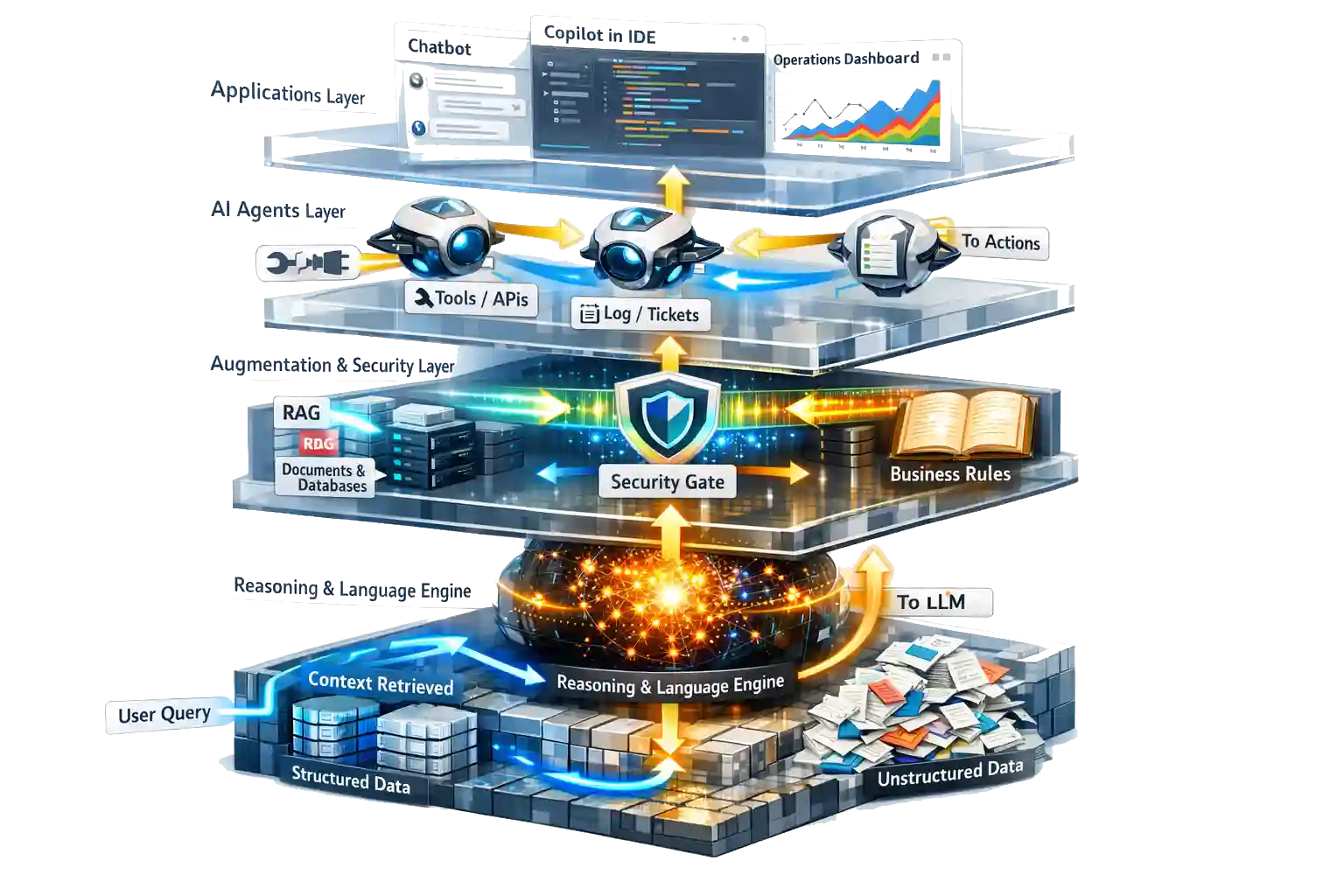
💼
Enterprise Use Cases Across Business Functions
Generative AI is transforming every part of the enterprise. Each of these use cases depends on strong generative AI architecture for enterprises.
👔
Leadership
Summarize reports, analyze trends, support strategic decisions with AI-powered insights
💻
IT Teams
Troubleshooting, monitoring, knowledge management with AI agents and RAG systems
🤝
Customer Support
RAG-powered chat assistants providing accurate answers from enterprise knowledge bases
👥
HR Teams
Onboarding, policy queries, employee learning with AI-powered guidance systems
📈
Sales Teams
Generate proposals, insights, and follow ups with AI-assisted content creation
⚙️
Operations
Manage workflows, handle exceptions, automate processes with AI agents
Build vs Buy Decisions
One of the biggest questions leaders face is whether to build custom AI systems or buy off the shelf solutions. Buying is faster and easier. It works well for common use cases with low customization needs. Building takes more effort but offers better control, security, and flexibility.
Factors like data sensitivity, integration complexity, and long term scale should guide the decision. Many organizations start with a generative AI POC architecture and then expand.
Leaders should also consider Model Agnosticism. A modular, custom-built architecture allows enterprises to swap underlying LLMs (e.g., from GPT-4 to Llama or Claude) as better or more cost-effective models emerge. This prevents vendor lock-in and ensures long-term flexibility as the generative AI tech stack evolves.
Enterprise AI Architecture
This is where enterprise AI architecture services, AI solution architecture consulting, and AI system design consulting add value.
Buy Off-Shelf Solutions
- Faster time-to-value
- Vendor support included
- Lower maintenance overhead
- Proven solutions
Build Custom Systems
- Full control & customization
- Enhanced security & compliance
- Model agnosticism
- Long-term flexibility
🎯
Key Decision Factors
🔒
Data Sensitivity
Highly sensitive data may require custom solutions
🔗
Integration Complexity
Complex integrations often need custom development
📈
Long-term Scale
Consider growth plans and scalability needs
🔄
Model Agnosticism
A modular, custom-built architecture allows enterprises to swap underlying LLMs
🤖
GPT-4
GPT-4
→
🦙
Llama
Llama
→
🤖
Claude
Claude
This prevents vendor lock-in and ensures long-term flexibility as the generative AI tech stack evolves.
Governance, Security and Responsible AI
Governance is essential for enterprise trust. A secure generative AI architecture must include access controls, data encryption, monitoring, and audit trails.
A secure architecture prioritizes Data Sovereignty. By processing data within private environments, organizations ensure their proprietary information is never leaked to public training sets.
Organizations must address privacy, compliance, and ethical use. Human review should be part of critical workflows. This reduces risk and improves accountability.
Gen AI Architecture
Addressing generative AI architecture challenges early helps prevent issues later. Security and responsibility should be built into the design, not added later.
Responsible AI Principles
Addressing privacy, compliance, and ethical use
👥
Human Review
Human review should be part of critical workflows. This reduces risk and improves accountability.
⚖️
Regulatory Compliance
EU AI Act guidelines provide a regulatory framework that many enterprises now follow.
🚫
Bias Prevention
Regular audits for bias and fairness in AI models and training data.
Security by Design
Addressing generative AI architecture challenges early helps prevent issues later. Security and responsibility should be built into the design, not added later.
⏰
Early Integration
Prevent issues before they occur
🚀
Future Outlook and Conclusion
Generative AI is evolving rapidly. The future includes multi-agent systems, enterprise copilots, and smarter automation. These trends will rely on strong foundations. A well-designed generative AI tech stack enables innovation while maintaining control.
In Conclusion
Understanding LLMs, RAG, and AI agents is essential for modern enterprises. Together, they form the backbone of scalable and secure Generative AI systems.
Impressico Business Solutions helps organizations design, build, and scale secure Generative AI systems tailored to business needs. From generative AI POC architecture to full scale deployment, our experts provide generative AI architecture consulting, enterprise AI architecture services, and AI solution architecture consulting that deliver real value.
If you are exploring how to design generative AI systems, scale AI responsibly, or modernize your enterprise AI landscape, Impressico Business Solutions is ready to support your journey.