Leveraging AI, Mobile and Cloud for Predictable Business Growth
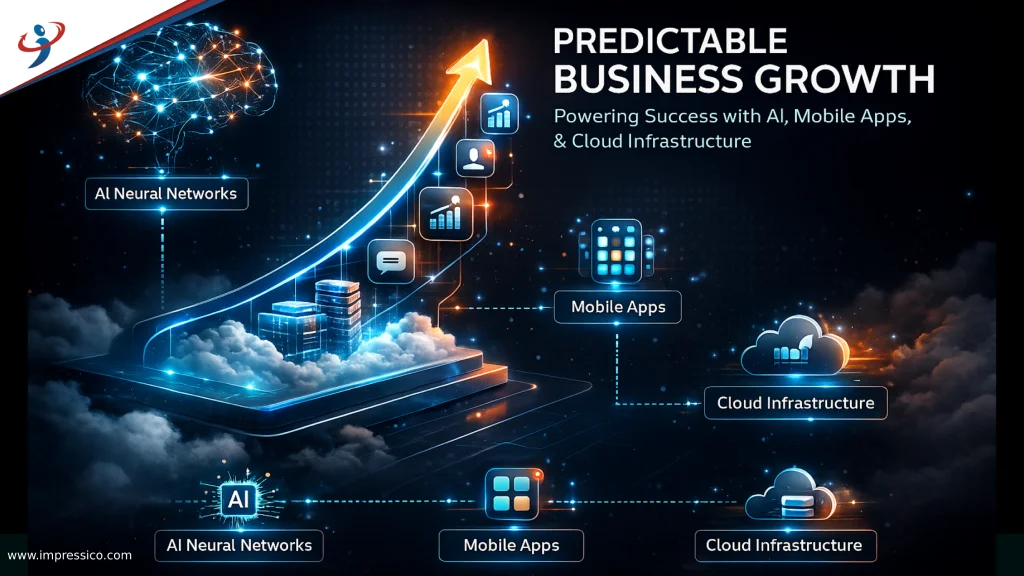
Every business leader today asks the same question. How can we turn technology cost into steady and predictable growth? Many companies spend money on tools but do not get stable results. This leads to doubt and slow progress.
A 2023 Gartner survey revealed that nearly 65% of technology leaders are concerned about the marginal return on their digital investments. This concern is well-founded, as Gartner’s latest CIO Report highlights that over 60% of AI projects are predicted to fail without proper foundations, and 59% of applications suffer from poor technical or business fit—clear outcomes of siloed, tactical implementations.
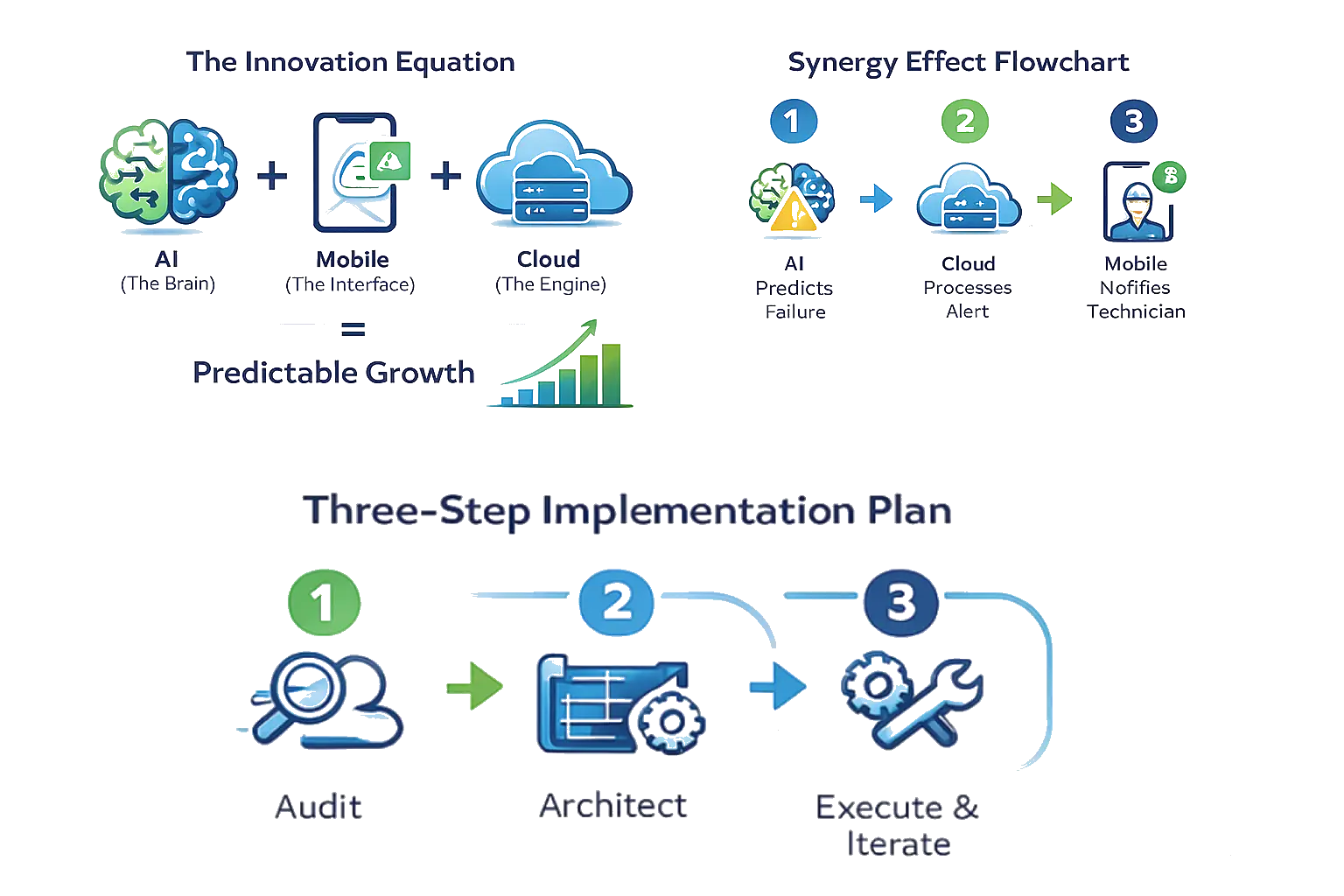
A simple way to understand this is through what we call the Innovation Equation:
AI + Mobile + Cloud = Predictable Growth
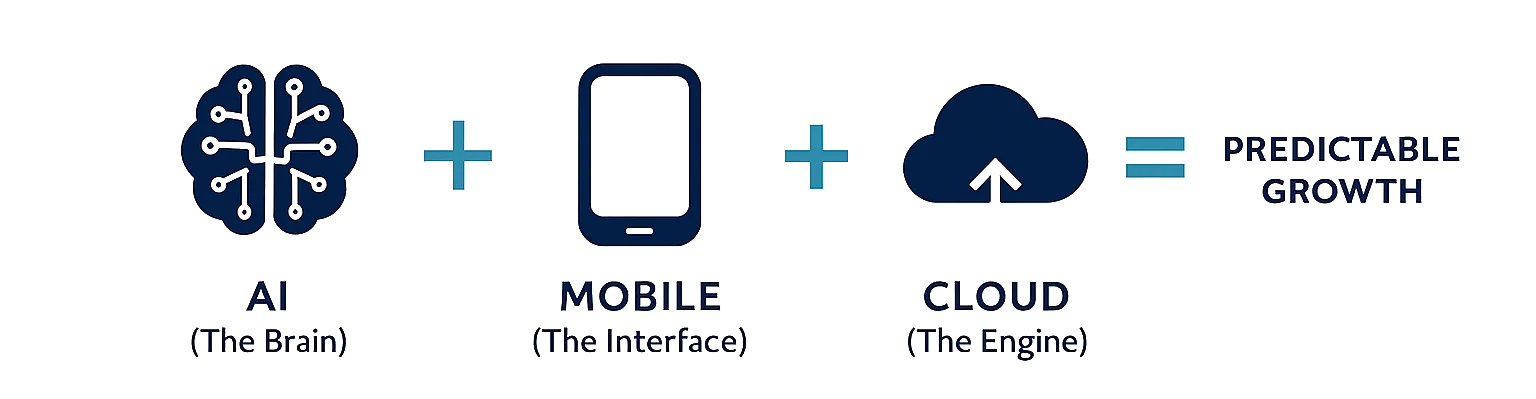
This article explains this equation. You will see how these three parts work together and how they help companies reduce risk and build a model that supports continuous growth.
Why “Predictable Growth” Is the Ultimate Competitive Advantage
The market today shifts fast. New customer needs appear every week. Old project-based digital plans are no longer enough. Businesses now need ongoing, outcome-driven innovation. When a company builds a strong system around AI, Mobile, and Cloud, it moves toward predictable growth instead of random results.
Predictability helps leaders plan budgets with confidence. It also improves investor trust and team clarity. Companies that do not have this integrated tech base often face slow systems, random failures, and disconnected data. Their growth becomes unstable.
McKinsey’s research on ‘AI high performers’ companies deriving over 20% of EBIT from AI reveals they are five times more likely to heavily reinvest and focus on revenue creation, not just cost savings. This proven ability to generate value and operate predictably makes them far more attractive for strategic investment.
This is why predictable growth has become the biggest competitive edge. And the Innovation Equation helps businesses reach this state.
Deconstructing the Innovation Equation
Let us break down the three key variables. They work as one system, not as separate tools.
AI = The Brain
It brings intelligent automation and smarter decision making.
Cloud = The Engine
It gives cloud scalability and reliable power.
Mobile = The Interface
It provides real time access and a seamless user experience.
This full system supports long term and steady growth.
Variable 1: Artificial Intelligence – The Engine for Intelligent Automation
AI is the most powerful driver of modern business. With intelligent automation, AI reduces repetitive work and speeds up complex processes. Through Generative AI and predictive analytics, businesses can study patterns, understand customers better, and get AI-driven insights that help teams make better decisions.
AI also helps with process optimization. It predicts demand, stock requirements, customer behavior, and risks. This means companies can act before problems happen.
At Impressico, we use Generative AI to automate content and service workflows. We also build custom AI models for predictive inventory and dynamic pricing. These solutions give measurable ROI and help companies unlock new revenue streams through AI-driven insights.
Variable 2: Strategic Mobile Solutions – The Gateway to Your Ecosystem
Mobile apps are now the main touch point for users. With enterprise mobile solutions, companies can connect with customers and employees instantly. A seamless user experience keeps users engaged and improves satisfaction.
Data from data.ai’s (formerly App Annie) ‘State of Mobile 2024’ report shows the average user spends over 4 hours per day on mobile devices, cementing its role as the primary digital interface.
Mobile apps supported by IoT integration allow businesses to collect real time data and act quickly. They help teams access information from anywhere, improving decision making and customer engagement.
At Impressico, we create mobile apps that form the front door of your digital ecosystem. Our apps support IoT integration for real time monitoring and use AI recommendations to guide users. We build enterprise mobile solutions that increase customer engagement and deliver a seamless user experience.
Variable 3: Cloud and DevOps – The Foundation for Scalability and Speed
AI and mobile apps work well only when the foundation is strong. This is where the cloud comes in. Cloud scalability helps systems handle more users without downtime. It also cuts costs by offering a cost-optimized infrastructure. The DevOps culture improves teamwork between developers and operations.
Investing in a modern cloud foundation is not just an IT upgrade—it’s a strategic financial decision. Forrester’s Total Economic Impact™ (TEI) studies, which use a rigorous, decades-old methodology of independent customer interviews and primary financial modeling, consistently quantify this value. For instance, one such analysis found that a well-architected cloud foundation can reduce infrastructure costs by up to 30% while improving deployment agility by orders of magnitude.
With CI/CD pipelines, updates move fast from idea to live use. This supports operational agility and increases the speed of innovation. A strong cloud and DevOps setup ensures your business stays secure, fast, and always available.
At Impressico, our Cloud and DevOps solutions help companies build a reliable foundation. We design secure CI/CD pipelines on AWS, Azure, or GCP. This ensures global scale, strong performance, and operational agility. We turn a DevOps culture into real business value instead of a buzzword.
The Synergy Effect: Why the Whole Is Greater Than the Sum of Its Parts
The real power appears when AI, Cloud, and Mobile work together. Their combined impact is much greater than that of each of them working separately.
Here is a simple example:
An AI model predicts a possible machine failure using predictive analytics. This information moves to the cloud where it is processed with high reliability. A notification is sent to a technician’s mobile app. The mobile app shows repair steps, part numbers, and real time data access. The technician fixes the machine before it stops working. This reduces downtime and protects revenue.
This is predictable growth at work. Problems are solved early. Cost goes down. Efficiency goes up. Everything becomes smoother and more reliable.
Solving for X: How to Implement Your Growth Equation
Here is a simple three step plan for leaders who want to start using this model.
Step 1: Audit
Choose one process that has a lot of data and a strong impact on business results. It could be sales, supply chain, customer service, or field operations, or anything else important to your business
Step 2: Architect
Design a solution that uses AI, Cloud, and Mobile together. Avoid treating each one as a separate project. Build a connected workflow with intelligent automation, cloud scalability, and a mobile interface.
Step 3: Execute and Iterate
Start small. Launch a pilot version. Gather feedback. Improve the solution. Scale it step by step across the company.
This reduces risk and ensures success at every stage.
The Bottom Line: From Capital Expense to Reliable Value Generation
The Innovation Equation changes the way companies think about technology. It transforms technology spends into a steady source of value. With intelligent automation, mobile engagement, and cloud scalability, companies can build a cycle of efficiency and insight that supports long term growth.
The goal is simple. Not just to grow. But to grow predictably.
Ready to calculate your company’s growth potential?
Let Impressico architect your Innovation Equation.
Frequently Asked Questions: How to Achieve Predictable Business Growth:
-
We have legacy systems. How do we start integrating AI, Mobile, and Cloud without a big and disruptive “rip and replace” project?
You do not need to throw away everything you have. Start small and build slowly.
The first step is to pick one business process that gives you enough data and has a clear impact on revenue or customer experience. Then add cloud or AI services around your old system instead of removing it. These are called “wrapper” or “bridge” solutions.
Over time, you can move piece by piece to modern tools without stopping your daily operations. This reduces risk, saves money, and keeps things smooth.
-
Do we need a special team or new roles to manage this combined AI + Mobile + Cloud model?
Yes, but it does not have to be a big team. You mainly need a small cross-functional group that works together instead of working in separate silos.
A simple setup can include:
- A business owner who understands the goal
- A cloud or DevOps expert
- An AI or data specialist
- A mobile or UX expert
- A project lead to bring everyone togetherThis team ensures that AI, Mobile, and Cloud are built as one system, not three different projects.
-
How do we measure success and ROI for this approach? What KPIs should we track?
Success here is not only about “finishing a project.” It is about steady and predictable results.
Common KPIs include:
- Drop in manual work and task time
- Increase in customer satisfaction scores
- Faster feature releases or deployment cycles
- Higher app usage and engagement
- Reduction in downtime or errors
- Increase in revenue from AI-led or mobile-led improvementsTracking these numbers month by month helps you see predictable growth clearly.
-
What are the risks of depending too much on AI, and how do we add human oversight?
AI is powerful, but it can make mistakes if data is wrong or unclear. Over-reliance can also lead to wrong decisions in areas like pricing, fraud detection, or customer support.
To avoid this, you should keep a “human-in-the-loop” model. This means:
- Humans approve critical AI decisions
- Teams review AI predictions regularly
- AI models are updated with new data
- Clear rules are set for when humans must step inThis balance keeps AI smart and safe.
-
We do not have in-house AI or cloud experts. Should we build skills, hire, or partner with someone?
There is no single answer. It depends on how fast you want to move.
- Build skills if you want long-term internal strength, but it takes time.
- Hire experts if you need deeper knowledge but it can be expensive.
- Partner with a tech company if you want fast results with low risk.Most companies use a mix of all three. Working with a partner first also helps your internal team learn faster.
-
Is this “Innovation Equation” useful for all industries, or does it change by business type?
The model works for all business types, but the priorities change.
- B2B manufacturing may focus more on cloud scalability, IoT data, and AI for predictive maintenance.
- Retail and B2C services may focus more on mobile apps, customer experience, and AI-driven recommendations.
- Logistics and field service teams may rely more on mobile access, real-time data, and cloud integration.The core equation is the same, but each industry chooses which part to start with.