


January 28, 2026
Generative AI for Business Automation, ROI, and Scale
Enjoying this article?
Share it with the world!


Generative AI for Enterprise Automation: A 2026 Guide
| ⚡ Quick Answer Generative AI automates work that traditional rules-based automation cannot handle: drafting, summarising, answering and interpreting unstructured language. Adoption is now near-universal — 88% of organisations use AI in at least one function — but only about 37% report any measurable EBIT impact from it. The gap is not the technology. It is scope, data readiness, workflow redesign and governance. Start with a bounded use case that has a measurable baseline, prove the value, then scale. |
Businesses today are facing numerous challenges simultaneously. Expenses are increasing. Customers demand quicker service. Employees are overworked. This is where generative AI is beginning to make a difference – enabling businesses to automate tasks that previously required human intervention.
Generative AI Is No Longer Experimental
It is becoming part of normal business operations
|
Adoption is widespread; measurable enterprise impact is not yet.
| Read the numbers carefully Adoption figures describe how many organisations are using generative AI, not how many are getting a financial return. In the same McKinsey survey that puts adoption at 88%, only around 37% of organisations report any positive EBIT contribution from AI, and roughly 6% attribute more than 5% of EBIT to it. Plan against the second number, not the first. |
Business Overview of Generative AI for Enterprise Automation
🏢
Practical applications beyond technology hype
Generative AI can generate content, answers, and summaries based on the learning that it does from data. In simpler words, it is able to read, write, and describe information in a human-like manner. If the underlying concept is new to your team, our explainer on what generative AI is is a good starting point.
|
|
|
|
| Key Insight Employees do not need great technical skills. They simply interact with AI like they would with a helpful assistant, making generative AI for business automation easy to adopt. For a wider view of where it applies, see top generative AI use cases across industries. |
Traditional Automation vs Generative AI Capabilities
⚡
Why enterprises are moving toward AI-driven automation
|
|
The two are complements rather than replacements: rules-based automation still wins where processes are stable and structured. Our comparison of AI agents, copilots and RPA sets out which approach suits which kind of work.
High-Impact Use Cases Across Enterprise Functions
🎯
Value delivery across all business departments
| 🤖 By 2029: 80% autonomous resolution Leading to a 30% reduction in operational costs (Gartner) Agentic AI will autonomously resolve common customer service issues without human intervention, significantly reducing response times and enhancing customer satisfaction. What that requires in practice is covered in agentic AI for enterprises and agentic AI use cases. |
|
|
|
|
Customer service is where most enterprises begin, largely because volume makes even small handling-time reductions material. The progression from scripted bots to autonomous agents is traced in from chatbots to AI agents.
| Which function should you automate first? The right first use case has high volume, tolerable error cost and a measurable baseline you already track. Impressico can review your functions against those three tests and recommend where to start. |
ROI Levers: Cost, Revenue, and Time to Value
📈
Where the value comes from — and how to prove it
Generative AI creates value through three levers. The size of each depends entirely on the process you apply it to, your data quality and how much of the surrounding workflow you are willing to change — so treat the categories below as a structure for your own business case rather than as benchmarks.
|
|
|
| What the evidence actually shows Published survey data is far more sober than most vendor ROI claims. McKinsey’s 2026 State of AI survey found around 37% of organisations report any positive EBIT contribution from AI, and only about 6% attribute more than 5% of EBIT to it. MIT’s NANDA research reported that only about 5% of enterprise generative AI pilots reach measurable P&L impact. The distinguishing factor in the McKinsey data is not tooling: roughly three-quarters of the organisations seeing real impact had fundamentally redesigned workflows, against about a quarter of everyone else. |
That is the practical lesson for an automation programme. Deploying a model into an unchanged process produces individual time savings that rarely reach the income statement. Capture a baseline before the pilot, redesign the workflow around the capability, and measure against that baseline afterwards — the approach set out in our generative AI ROI framework.
It is also why so many pilots stall. The common causes — unclear scope, data that is not ready, and no agreed measure of success — are examined in the PoC-to-production gap and why generative AI initiatives fail.
Scaling Beyond the First Use Case
📈
From a working pilot to enterprise-wide adoption
Scaling is where most automation programmes either compound or stall. The organisations that get past the first success tend to do three things deliberately.
|
Fix the data foundation before scaling A pilot can succeed on one clean dataset. Enterprise-wide rollout exposes inconsistent, inaccessible or ungoverned data. Assess it early — see generative AI data readiness. |
|
Standardise the platform, not just the pilot Repeatable architecture, shared components and common evaluation prevent every team rebuilding from scratch. Our end-to-end generative AI architecture guide covers the layers involved. |
|
Sequence adoption against readiness Expand where the process is ready and the value is measurable, not where enthusiasm is highest. The GenAI adoption checklist and our enterprise AI automation strategy guide provide a sequence. |
| Data · Workflow · Measurement Pilot worked, but value has not scaled? That is the position most organisations are in — widespread adoption, limited measurable impact. The blocker is usually data readiness or unchanged workflows rather than the model. We assess both before recommending the next phase. |
Governance, Security, and Responsible AI
🛡️
Balancing innovation with security and compliance
| 🔐 87% of senior leaders report barriers to agentic AI adoption In EY’s US AI Pulse Survey of senior decision-makers, cybersecurity concerns, data privacy issues, gaps in regulation and missing company policy were among the most frequently cited obstacles — making governance a delivery dependency, not an afterthought. |
|
|
|
For autonomous systems the bar rises again: decide who owns the outcome, what is logged and where a human must approve, before deployment rather than after. See governance and safety for autonomous AI agents and the AI TRiSM governance framework.
How Impressico Business Solutions Helps
🏆
Turning generative AI into real business outcomes
|
|
|
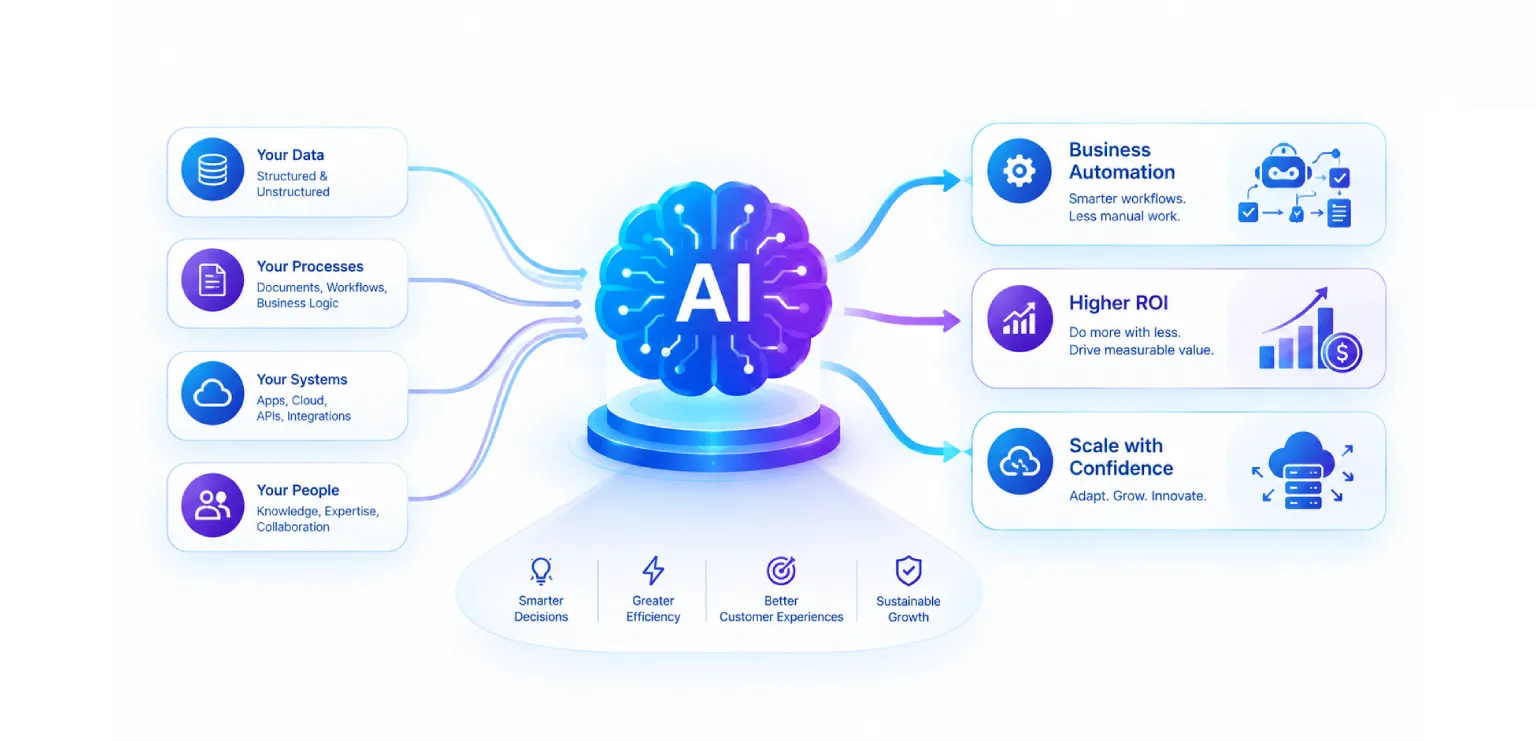
We focus on value, ROI, and long-term success. Our approach ensures AI supports people, processes, and business goals. If you are weighing whether to build internally or bring in help, our guide on when to hire a generative AI consulting partner sets out the trade-offs.
| 💡 “The future of enterprise automation is not about automation replacing people. It is about people working smarter and more efficiently.” Impressico Business Solutions |
| Key Takeaways
|
| Ready to transform your business with generative AI? Start with a free AI automation assessment. We identify where automation can remove manual work in your organisation, what the measurable baseline is today, and which use cases can realistically show a return — before any build begins. 🚀 Schedule a free AI assessment |
Impressico Business Solutions — Helping enterprises turn generative AI into measurable business outcomes.

IBS
Similar articles

Hybrid Search: Combining Semantic and Keyword Retrieval for Better RAG Results
September 21, 2026
Chunking Strategies for RAG: What Actually Works in Production
September 16, 2026
Vector Databases Compared: Pinecone vs Weaviate vs Qdrant vs pgvector for Enterprise RAG
September 14, 2026
RAG at Scale: Enterprise Retrieval-Augmented Generation Architecture
September 11, 2026
7 Signs Your Organization Is Ready for AI Agents
August 14, 2026
Governance and Safety for Autonomous AI Agents: A Practical Guide for Enterprises
August 3, 2026
