


November 12, 2025
How AI, IoT, and DevOps Converge to Drive Market Leadership
Enjoying this article?
Share it with the world!


How AI, IoT and DevOps Converge Into One Connected System
| |
| For a long time, companies have spent money on all kinds of tools: one for customer management, another for order management, and a third for analytics. Each tool sounds helpful, but together they often create confusion instead of clarity. When systems don’t connect and data stays locked in separate places, teamwork slows down, and progress takes a hit — which is why data integration and application integration sit underneath almost every modernization effort. In the next few years, real market leaders will be the companies that fix this problem. They’ll combine Artificial Intelligence (AI), the Internet of Things (IoT), and DevOps into one connected setup. When these three work together, they become like the body’s nervous system, collecting information, thinking fast, and taking action instantly. |
The Limiting Reality of the Siloed Technology Approach
🧩
Why more tools has stopped producing more capability
Many organizations still depend on a mix of software systems that don’t communicate with one another. The sales team uses one program, operations uses another, and finance runs something different. This setup traps useful data in separate silos, so no one sees the full picture. Often the root cause is age rather than choice — the signs that a legacy application is holding the business back are usually visible long before anyone acts on them.
When systems aren’t connected, it’s hard to automate entire processes or make quick, data-driven decisions. Teams waste hours maintaining different tools and juggling multiple vendors, which raises costs. Meanwhile, digital-first competitors that use integrated platforms move quickly. They can update apps faster, react to market changes immediately, and improve the customer experience all the time.
| The Reality The old, disconnected way of working slows everyone down. The future belongs to companies that bring together AI for intelligence, IoT for awareness, and DevOps for speed—creating one smart, flexible system that connects every part of the business. |
The Power of Convergence: A Synergy That Transforms Business
🔗
One analogy that makes the architecture obvious
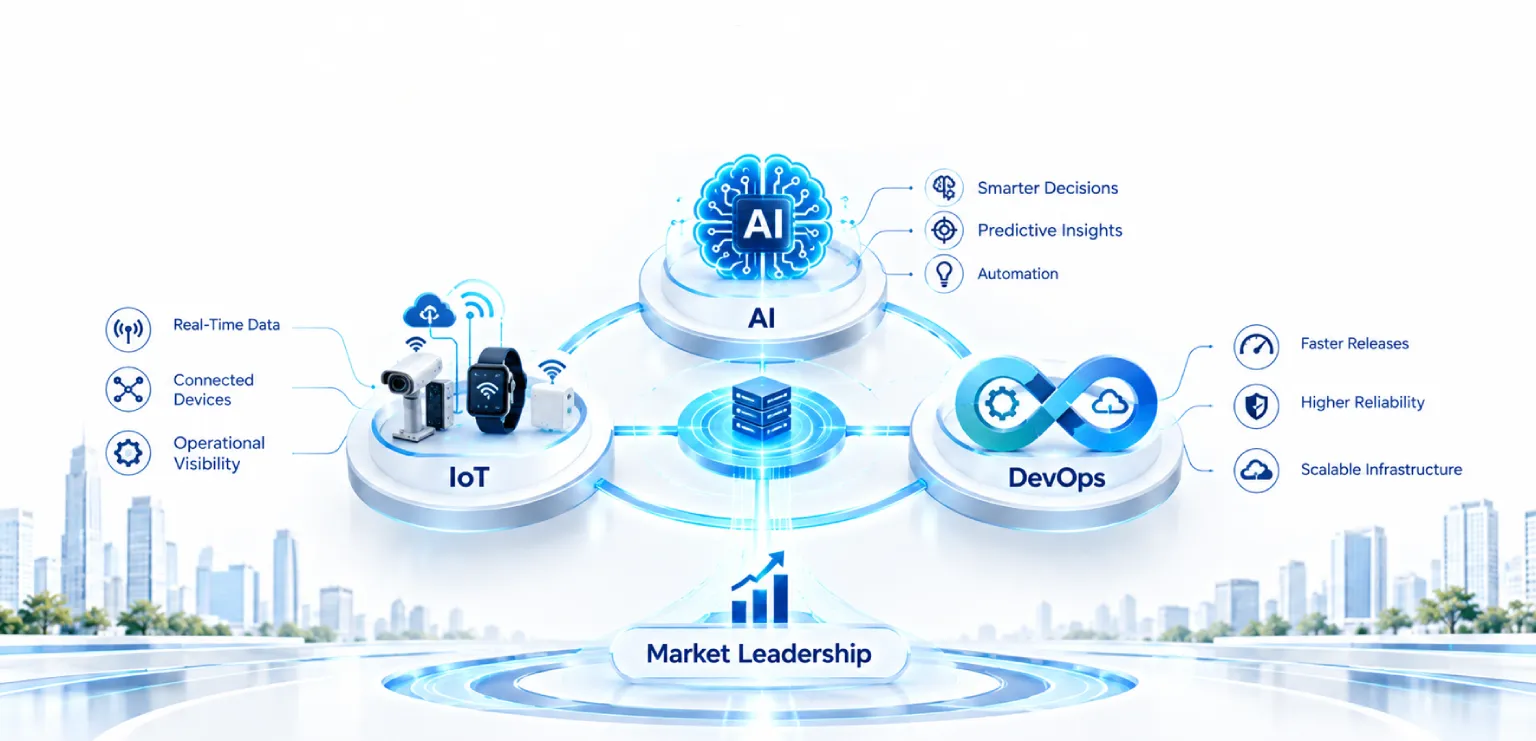
Think of your business like a living body. DevOps is the circulatory system—it keeps everything flowing and alive. IoT is the sensory network—it collects signals and reports what’s happening in the physical world. AI is the brain—it studies the data and makes smart choices.
| The Business as a Nervous System
Powerful separately — transformative when wired into one loop |
Each one is powerful on its own, but when they work together, the result is a connected, intelligent organization that can sense change, think ahead, and respond immediately. This mix of speed and awareness is what helps a business move from surviving to leading. The same principle drives our AI + Mobile + Cloud innovation equation and the C-suite blueprint for intelligent operations.
The AI Brain: Making Intelligent Decisions at Scale
🧠
From raw signals to decisions taken before the problem lands
AI is the decision-making center of a modern company. It gathers information from machines, sensors, software systems, and customer interactions. Then it turns that raw data into useful insights — provided the underlying data is actually AI-ready.
Using predictive models, AI can warn you about things before they happen—like when a machine might break down, when customer demand will spike, or how to balance inventory. With Generative AI, it can also create quick reports, summaries, and insights to support smarter decisions. Our guide to generative AI for business automation covers the operating model, and the top generative AI use cases across industries show where it lands first.
This kind of operational AI makes business smoother. Instead of reacting after something goes wrong, companies can take action early and avoid problems altogether.
From Predictive Insights to Generative Reports
At Impressico, we build the AI brain for your business. Our solutions include Generative AI tools that automate reports and predictive AI models that prevent equipment failure or streamline supply chains. We help you turn data into smart, fast decisions that open new opportunities — measured against a clear ROI framework from the start.
| Which process should sense, think and act first? Most organizations have one workflow where the three layers already almost touch. Finding it is usually a single discovery session, not a six-month assessment. |
The IoT Sensory Network: Connecting the Physical and Digital Worlds
📡
The layer that tells you what is true right now
If AI is the brain, then IoT is the eyes and ears. The IoT sensory network connects devices, sensors, and machines to gather live information from the physical world. It tells you what’s happening right now—whether it’s the vibration of a factory robot, the temperature of a shipment, or energy use in a building. We have covered the business case in five ways IoT and big data help your business and the clinical case in how IoT is transforming healthcare.
This steady stream of real-time data connects the physical side of a company to its digital systems. With edge intelligence, data can be processed closer to where it’s created, allowing instant responses to problems instead of waiting for cloud systems to react — the trade-off we set out in edge computing vs cloud computing.
Real-Time Data and Edge Intelligence
At Impressico, we help companies build IoT networks that link their operations with the digital world. Whether it’s tracking logistics, monitoring cold storage, or improving production lines, our IoT solutions deliver accurate, real-time data. For the wider picture, see edge computing and its applications across industries, and the role of Apache Kafka in modern data pipelines for moving those streams at scale.
The DevOps Circulatory System: Powering Speed, Security, and Scale
⚙
The layer that turns a decision into a deployed change
Even the smartest AI and IoT systems need a solid base to run smoothly. That’s where DevOps and Cloud solutions come in. DevOps brings speed, automation, and dependability. It acts as the circulatory system, keeping new updates, insights, and fixes flowing through your organization — a role we distinguish carefully in platform engineering vs DevOps vs SRE.
With CI/CD automation (Continuous Integration and Continuous Deployment), DevOps helps teams test and launch updates quickly. Using infrastructure as code, it’s easy to scale up or down as needed. The cloud keeps everything secure and flexible, supporting your business as it grows. If you are building that now, our walkthroughs on automating a CI/CD pipeline and choosing Terraform for infrastructure as code are practical starting points.
CI/CD Automation and Cloud Infrastructure
Impressico’s DevOps and Cloud experts build the strong, automated foundation your systems need. We set up CI/CD pipelines, secure cloud environments, and scalable frameworks to make sure your AI and IoT applications work properly — including the Kubernetes layer that AI and ML workloads now depend on, with cloud spend kept under control as the system grows.
The Virtuous Cycle of Convergence: A Real-World Example
🔄
One vibration, traced from sensor to repaired machine
Here’s how all this works in a real situation:
| The Convergence Loop
IoT senses → AI thinks → DevOps acts → the outcome makes the next prediction better |
In a large factory, an IoT sensor on a machine picks up a strange vibration. Instead of waiting for someone to notice, it sends the data straight to an AI model that predicts machine behavior. The AI finds that the part could fail within two days.
Then DevOps automation steps in. A pre-set pipeline automatically installs a diagnostic update on the equipment and creates a maintenance ticket. The repair team fixes the issue before any real damage happens, saving half a million dollars in downtime. Making that reduction repeatable is exactly what DevOps automation for downtime and AIOps in practice are built for.
| Key Takeaway The data from this incident goes back into the AI model, improving it for next time. This loop IoT sensing, AI thinking, and DevOps acting—creates a living system that keeps learning and getting better. |
| Convinced by the loop, unsure about the starting point? You do not need to replace the estate to build it. The usual route is one process, instrumented and automated end to end, with the rest of the stack left exactly where it is. |
The Executive Impact: From Operational Efficiency to Market Disruption
💼
The same architecture, read from three different chairs
The benefits of connecting AI, IoT, and DevOps go way beyond technology—they change how a company grows and competes.
|
Driving Innovation and New Business Models This integration opens the door to new business models and faster innovation. It helps the company stay flexible and lead the market instead of chasing it. |
|
Building a Scalable and Secure Foundation It creates a strong, scalable tech base that’s easier to manage and upgrade, cutting down technical debt. |
|
Reducing Costs and Unlocking New Revenue It lowers costs through predictive maintenance and automation while unlocking new ways to earn from data insights. |
A connected ecosystem gives leaders a clear view across every part of the business. It helps them plan smarter, reduce risk, and make confident moves that drive profits and growth. The DevOps metrics every CTO should track and a monitoring strategy worth the name are how that view stays honest.
Building Your Converged Stack: A Phased Approach
🧱
Big programme, small steps, value proved early
Bringing AI, IoT, and DevOps together may sound big, which it is, and it’s best done one step at a time. A simple phased plan can make it easy.
|
Phase 1: Audit & Blueprint Start small. Choose one process—like maintenance or logistics—and plan how AI, IoT, and DevOps can improve it. A structured enterprise AI strategy keeps the blueprint tied to business outcomes. |
|
Phase 2: Pilot & Prove Build a small working model that uses all three. Test it and track the results. |
|
Phase 3: Scale & Integrate Once it works, roll it out across more areas of the business. Over time, you’ll build a fully connected, intelligent ecosystem. |
This gradual approach keeps change manageable while proving value early. It is the same sequencing behind our five pillars of a resilient, AI-driven enterprise.
Conclusion: Integration Is the New Innovation
🎯
The advantage is no longer the tools — it is the wiring between them
Innovation today isn’t just about having more tools; it’s also about making the right ones work together. When AI, IoT, and DevOps connect, they create a single smart system that can sense change, think fast, and take action in seconds.
For businesses aiming to lead, this integration is no longer optional—it’s essential. Companies that combine these technologies will stay ahead of the competition and redefine what market leadership really means.
| Key Takeaways
|
| Ready to build your connected tech stack? Partner with Impressico Business Solutions to design and create the integrated platform that drives your market leadership. 🚀 Schedule Your Strategy SessionThe AI + Mobile + Cloud Equation → 30-minute strategy session · no commitment |
Frequently Asked Questions: AI, IoT and DevOps Convergence
❓
What leaders ask before committing to a converged stack
| What does “convergence” of AI, IoT and DevOps actually mean in practice? It means the three stop being separate programmes with separate owners and budgets, and start operating as one loop. An IoT signal triggers an AI decision, and that decision triggers a DevOps action — automatically, without a person copying data between systems. In practice, convergence is measured by how far a signal travels without human intervention. If a sensor reading still ends up in somebody’s inbox, the three layers are connected on a slide but not in production. Application integration is usually the first gap to close. |
| Do we need all three from day one, or can we start with one? Start with one process, not one technology. The phased approach in this article exists precisely because a single instrumented workflow — maintenance, logistics, cold chain — can exercise all three layers at small scale. Picking one technology instead of one process is the more common mistake. An IoT rollout with no AI to interpret the data produces dashboards nobody reads, and an AI model with no DevOps pipeline behind it produces recommendations nobody ships. |
| How is this different from the digital transformation work we have already done? Most digital transformation replaced manual processes with digital ones — paper logs became software records. That creates visibility, not intelligence. A dashboard still waits for a person to look at it. Convergence adds the two missing halves: a system that interprets what it sees, and a pipeline that acts on the interpretation. We draw the distinction in full in the C-suite blueprint for intelligent operations. |
| What are the main risks, and how do we control them? The significant risk is automation acting on a wrong or low-confidence prediction. A model that mis-reads a vibration signature and triggers an unnecessary shutdown costs more than the failure it was meant to prevent. The controls are well understood:
We go deeper on this in governance and safety for autonomous AI agents. |
| What should we measure to know convergence is working? Track the loop, not the components. Three numbers tell you most of what you need:
On the delivery side, the standard DevOps metrics still apply — if deployment frequency is low, the “act” half of the loop is the bottleneck. |
Impressico Business Solutions — AI, IoT and DevOps engineering for organizations that want their systems to sense, think and act as one.

IBS
Similar articles

What are the Benefits of the Internet of Things for Businesses?
October 23, 2022
5 Ways IoT Big Data Could Help Your Business
September 15, 2022
Automation in the IT Industry: Everything you Need to Know
March 31, 2022
A Look into Trends Governing The Future Manufacturing In Industry
February 27, 2022
How Does The Internet Of Behaviour Change Our Perspective Of Data Collection?
May 28, 2021
