

April 29, 2026
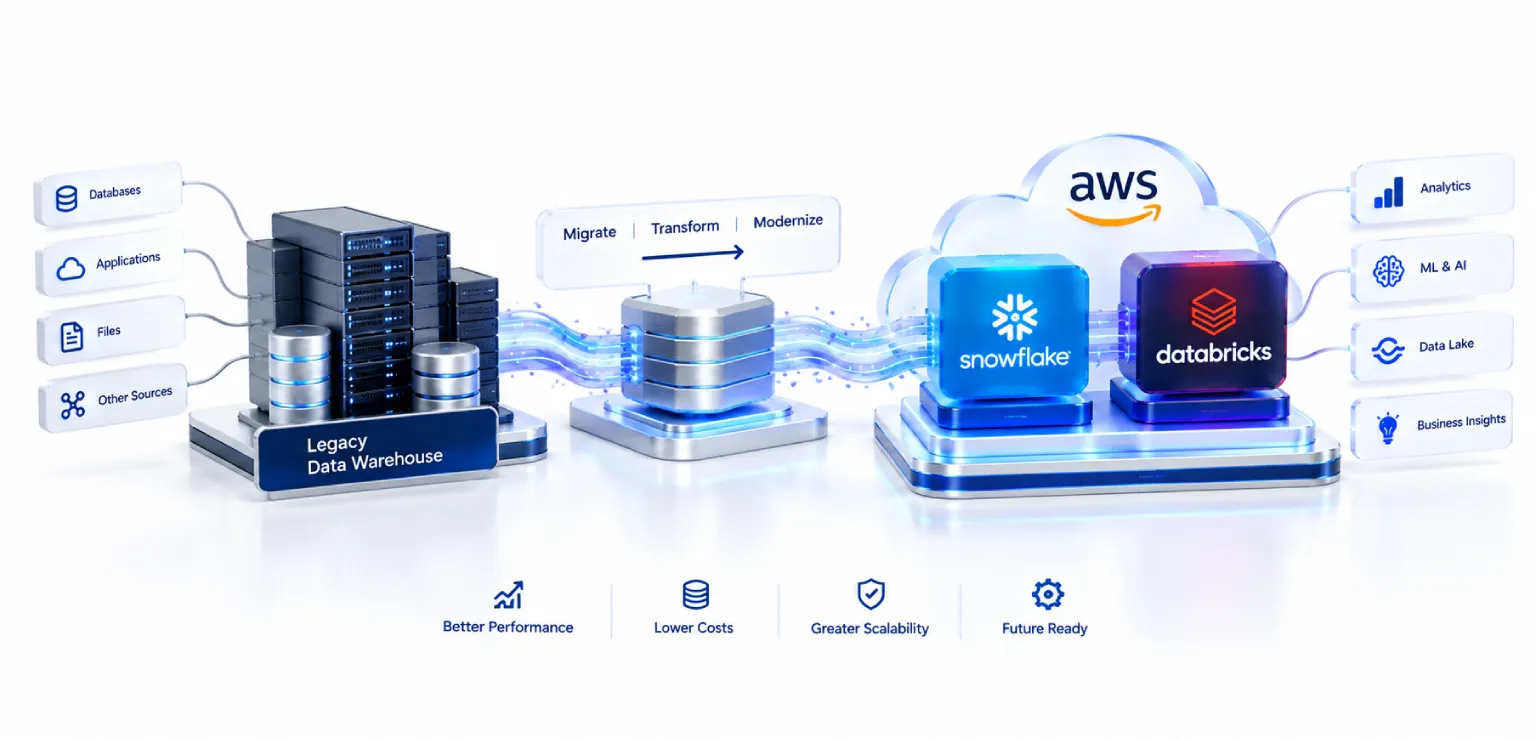
Legacy Data Warehouse Modernization: A CIO’s Guide to Moving to Snowflake & Databricks on AWS
Enjoying this article?
Share it with the world!


Modernize Your Data Warehouse with Snowflake & Databricks on AWS
There’s a point every CIO reaches—usually not announced, but clearly felt.
Reports that used to take minutes now take hours. Teams start building their own data workarounds. Business leaders begin questioning numbers instead of acting on them. And suddenly, your data warehouse—the system that once powered decisions—becomes the bottleneck.
We’ve seen this pattern across industries. What worked five or ten years ago simply can’t keep up with today’s expectations. Real-time insights, AI-driven forecasting, and scalable analytics are no longer “nice to have.” They’re baseline requirements.
And yet, many enterprises are still running on rigid, expensive systems that weren’t designed for this level of demand.
This is where data warehouse modernization on AWS becomes more than just a technical upgrade—it becomes a business decision.
| This trend is not slowing down anytime soon either. As reported by Gartner, the spending on public clouds will cross the $723 billion mark by 2025. |
The Real Problem with Legacy Data Warehouses
Most organizations don’t realize how much their legacy systems are costing them—not just in dollars, but in missed opportunities.
A typical legacy setup looks stable on the surface. But underneath, it’s struggling with:
| ▪ Slow query performance during peak hours. ▪ High maintenance and licensing costs. ▪ Limited scalability. ▪ Complex ETL pipelines that break often. ▪ Delayed insights that impact decision-making. |
The issue isn’t just technology. It’s the inability to adapt. Fragile pipelines are a common symptom — modern streaming architectures exist largely to solve them.
That’s why legacy data warehouse modernization is no longer optional. It’s the only way to move from reactive reporting to proactive decision-making. The same reasoning applies across the application estate, as covered in our CIO’s guide to legacy application modernization.
Modernization is Not Migration & It's a Shift in Thinking
An issue frequently observed relates to mistaking modernization for a simple data migration exercise. Simply put, transferring data to a new system does nothing but scratch the surface of the problem.
Enterprise data warehouse modernization is an attempt at redesigning all aspects related to how data is accessed, analyzed, and processed.
The approach requires a well-thought-out data warehouse transformation strategy, which should be based on enterprise objectives rather than the capabilities of the IT department.
Modern technologies offer high flexibility that enables scaling operations according to needs, integrating additional sources of data, and implementing analytical tools without having to constantly rebuild the architecture. Deciding between a data lake and a data warehouse is often the first architectural fork in that redesign.
AWS data warehouse solutions are the exact example of what modernized architecture can offer.
Why AWS Has Become the Go-To Foundation
There’s a reason most modernization journeys today are centered around AWS.
It’s not just about cloud storage. It’s about the ecosystem.
With AWS, you get:
|
| ||
|
|
For organizations planning a cloud data warehouse migration, AWS provides the flexibility to move at your own pace while minimizing risk.
You can explore more about How the Cloud and DevOps Help in Business Growth in our detailed blog.
Snowflake vs Databricks: Choosing What Actually Fits
This is one of the most common questions we hear from CIOs: Should we go with Snowflake or Databricks?
The honest answer—it depends on what you’re trying to achieve.
When evaluating Snowflake vs Databricks for data warehouse modernization, here’s how we typically break it down:
In many cases, organizations don’t choose one over the other—they use both, depending on the workload.
A Practical Approach: Steps That Actually Work
Modernization doesn’t have to be overwhelming. What matters is taking the right steps in the right order.
Here’s a simplified version of what works:
|
Step 1 Start with a Clear Assessment Understand your current architecture, bottlenecks, and business needs. |
|
Step 2 Define What Success Looks Like Are you aiming for faster reporting, cost reduction, or advanced analytics? |
|
Step 3 Choose the Right Platform This is where decisions around how to modernize legacy data warehouses to Snowflake or migrating data warehouses to Databricks on AWS come into play. |
|
Step 4 Plan the Migration Carefully A structured approach to steps to migrate legacy data warehouse to cloud helps avoid downtime and data loss. |
|
Step 5 Test, Optimize, and Scale Modernization doesn’t end after migration. Continuous improvement is key. |
| Talk to a Specialist Ready to modernize your data warehouse? From assessment to migration on Snowflake or Databricks — our AWS data specialists help CIOs build modern, scalable data architectures without disrupting the business. |
Challenges You'll Likely Face (And Should Plan For)
Every transformation comes with its own set of hurdles.
Some of the most common challenges in legacy data warehouse migration include:
| ▪ Data inconsistency and quality issues. ▪ Unexpected cost spikes during migration. ▪ Skill gaps within internal teams. ▪ Resistance from business users comfortable with old systems. |
The key is not to avoid these challenges—but to plan for them early. Data quality in particular is worth assessing before migration begins, not during — see Is Your Data Ready for Generative AI? for a practical readiness framework.
What You Actually Gain from Modernization
The benefits are not theoretical—they show up quickly when done right.
Organizations that invest in benefits of modernizing legacy data warehouse often see:
| ▪ Faster query performance and real-time insights. ▪ Reduced infrastructure costs. ▪ Better collaboration between teams. ▪ The ability to support AI and advanced analytics. ▪ Greater agility in responding to market changes. |
In short, data becomes an enabler—not a limitation.
Building a Strategy That Works Long-Term
A strong data warehouse modernization strategy for enterprises focuses on sustainability, not just speed.
That means:
| ▪ Taking a phased approach instead of a risky big-bang migration. ▪ Aligning IT initiatives with business outcomes. ▪ Ensuring proper governance and security. ▪ Building internal capabilities alongside external support. |
Modernization is not a one-time project. It’s an ongoing capability. The 6 Rs of application modernization offer a useful framework for sequencing that phased approach.
A Real-World Snapshot
We recently worked with a mid-sized enterprise struggling with reporting delays of over 24 hours.
Their legacy system couldn’t handle growing data volumes, and business teams were making decisions based on outdated insights.
By moving to AWS and implementing a combination of Snowflake and Databricks, they were able to:
|
|
|
The biggest shift wasn’t technical—it was cultural. Teams started trusting their data again.
How CIOs Are Approaching This Today
The mindset has changed.
Today, how CIOs plan data warehouse modernization on AWS is less about technology selection and more about business impact.
We’re seeing:
| ▪ Increased focus on data as a strategic asset. ▪ Greater investment in cloud data engineering consulting services. ▪ Adoption of hybrid and multi-platform architectures. ▪ Faster decision cycles driven by real-time insights. |
How We Can Help You Move Forward
At this juncture, most businesses are past the stage where any further theoretical discussion would be beneficial. The issue at hand is that some kind of change is necessary, but it must be carried out in such a manner that the process itself does not cause chaos within an organization.
We at Impressico Business Solutions have the experience and expertise required to identify those areas within your current operations that are not working as expected and determine the improvements that need to be made. In doing so, we use a simple methodology to avoid unnecessary complications. If you are searching for data warehouse modernization services USA, we are well-equipped to translate your search into a tangible process that will not overwhelm you.
Moreover, when it’s time for implementation, from planning to migration, we can draw on our background in AWS data migration consulting services.
Conclusion: Waiting is the Costliest Decision
Most legacy systems don’t fail overnight. They slowly lose relevance until the business outgrows them. That slow accrual is what technical debt in legacy applications looks like in practice.
The question is not if you should modernize—it’s how soon.
Because in today’s environment, the ability to act on data in real time is what separates leaders from followers.
| Let’s Get Started Build a roadmap to modernize your business, not just your technology. When your system holds you back, it’s time to start thinking about your data architecture differently. Our AWS, Snowflake, and Databricks specialists are ready to help. |

IBS
Similar articles

Modernize, Rebuild or Retire? A Decision Framework for Enterprise Leaders
August 5, 2026
The Hidden Cost of Technical Debt in Legacy Applications
July 27, 2026
Breaking the Monolith: Migrating Legacy Apps to Microservices on the Cloud
July 10, 2026
Rehost, Replatform, Refactor, Rebuild: Choosing the Right Modernization Path (the 6 R’s)
July 1, 2026
Legacy Application Modernization: A CIO’s Guide to Replatforming & Cloud-Native Transformation
June 22, 2026
Application Modernization on AWS: From Legacy Monoliths to Cloud-Native Systems
May 29, 2026
