


July 30, 2025
How AI and ML Are Transforming Business Process Services
Enjoying this article?
Share it with the world!


AI and Machine Learning in BPS: Efficiency and Cost Cuts
| ⚡ Quick Answer AI and machine learning change Business Process Services in six ways: they automate repetitive work such as data entry and invoice processing, predict problems like churn and supply delays before they land, decide on variables too complex for if-then rules, personalize service so support costs fall rather than rise, improve themselves as they take in more data, and scale on cloud so you pay for use rather than hardware. The shift is from cheaper labour to compounding efficiency. |
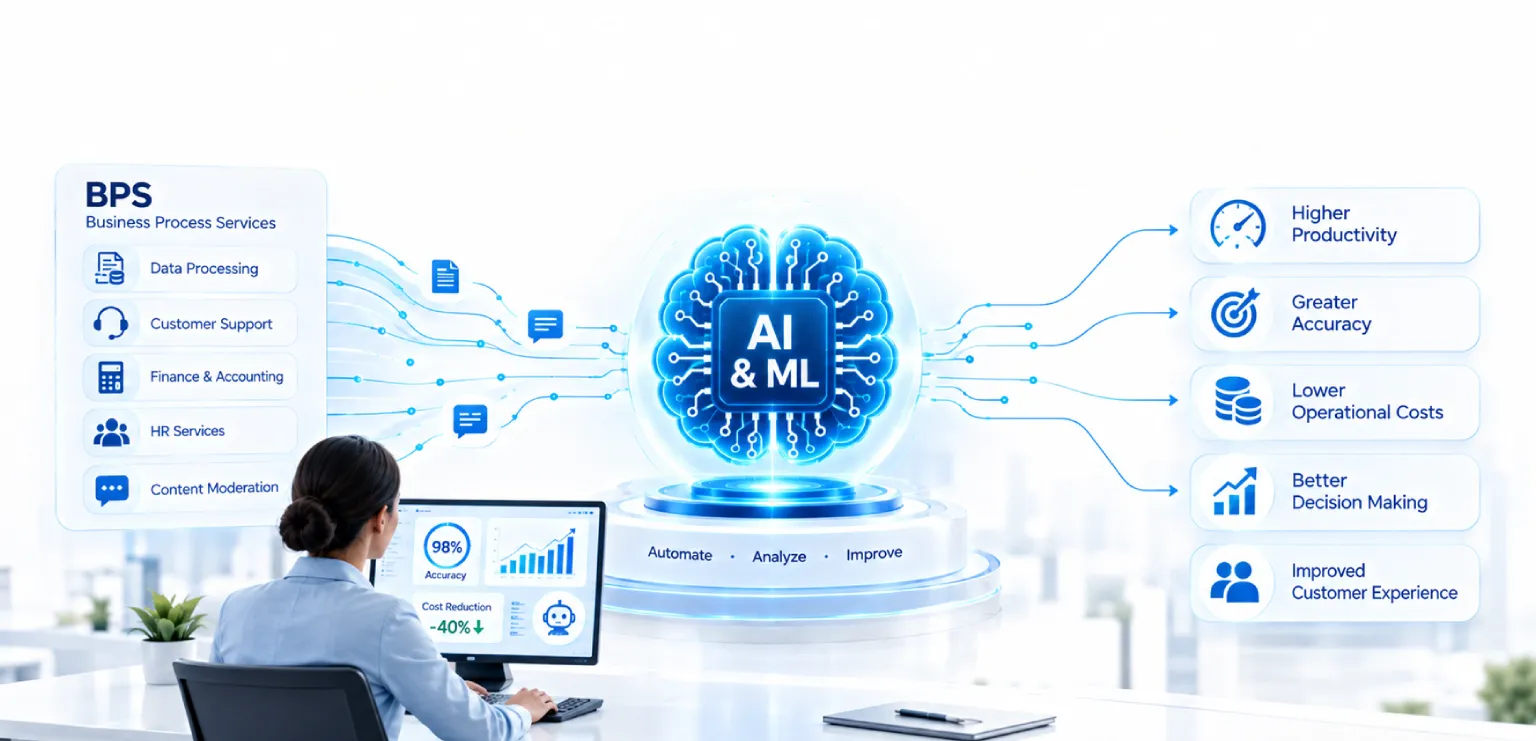
In today’s ultra-competitive business world, cutting costs isn’t just a smart move; it’s necessary for survival. If companies don’t take steps to run leaner and smarter, they’ll find themselves left behind. Business Process Services (BPS), once thought of as just outsourced admin work, has entered a new era. With Artificial Intelligence (AI) and Machine Learning (ML) in play, BPS is no longer about shifting work to cheaper labor; it’s about intelligent automation, real-time data insights, and long-term cost efficiency. We have covered the foundations separately in how Business Process Services drive efficiency.
At Impressico Business Solutions, we don’t just follow tech trends; we harness them to deliver powerful, measurable outcomes for our clients. Our BPS solutions are powered by intelligent automation and tailored to help businesses do more with less.
| Let’s Explore How AI and ML are reshaping the landscape of BPS and helping enterprises stay ahead of the curve. |
1. Automating the Repetitive: Streamlining Routine Tasks
Traditional BPS meant hiring teams to perform repetitive jobs like data entry or processing invoices. That’s no longer the case. With robotic process automation (RPA) and machine learning, many of these tasks can now be handled by smart systems that work faster and with fewer errors. Which tool fits which job is the subject of AI agents vs copilots vs RPA.
What can be automated today:
| Data entry and validation | |
| Invoice processing and payment reconciliation | |
| Insurance claims handling | |
| Basic customer service AI software like chatbots for answering FAQs |
| Industry Insight A McKinsey analysis of workplace automation found that as many as 45% of the activities individuals are paid to perform can be automated by adapting currently demonstrated technologies — activities that represent about $2 trillion in annual wages in the United States. (McKinsey, 2015) |
For a current view of where that automation actually lands function by function, see generative AI for business automation and automation in the IT industry.
2. Predictive Analytics: Stop Problems before They Start
Thanks to machine learning in finance and accounting and other business areas, companies can now predict what might go wrong before it actually happens. By analyzing patterns in large datasets, AI helps identify risks and opportunities early on — the pattern our intelligent operations blueprint calls predictive awareness.
Real-world applications include:
| 👤 Churn prediction Spotting customers at risk of leaving | 🚚 Supply chain Forecasting supply chain delays to avoid lost sales | 🔧 Maintenance Anticipating machine breakdowns to reduce downtime |
That’s not just savings, it’s a competitive edge. The analytics foundation behind it is covered in how big data analytics impact business decision-making and the role of data analytics and BI in organizational success.
| Which of your processes is ready to automate first? The usual answer is a high-volume, rules-heavy workflow that nobody enjoys owning. Finding it takes a short discovery session, not a long assessment. |
3. Smarter Decision-Making: AI Goes Beyond If-Then Rules
Forget basic automation. Today’s AI systems are smart enough to make decisions based on complex, changing variables. This is a game-changer for how businesses operate.
Examples of intelligent decision-making:
| Dynamic pricing that adapts in real time | |
| Automated loan risk assessments | |
| AI-powered fraud detection in finance |
Decisions of that consequence need a control framework around them — which is why AI governance and the TRiSM framework matters more the more autonomous the system becomes. Where the returns are clearest is set out in agentic AI use cases that deliver measurable ROI.
4. Hyper-Personalization: Cutting Customer Service Costs Smartly
Using AI-driven customer experience tools, companies can stop wasting money on one-size-fits-all services. Instead, they can offer personalized support that actually resonates with the customer—and drives sales.
Benefits of AI personalization:
| Higher customer retention | |
| Faster support and lower service costs | |
| More effective marketing campaigns |
It’s about delivering value efficiently; and keeping your customers happy. Personalization only works on connected data, which is the argument behind the data fabric layer and getting your data AI-ready in the first place.
5. AI Gets Smarter Over Time
One of the biggest advantages of AI BPS solutions is that they improve with use. Unlike traditional systems that need manual updating, modern AI tools get smarter overtime.
How this works:
| 📊 More data Machine learning models get better as they receive more data | 🎯 Reinforcement Reinforcement learning improves performance based on real-world outcomes | 💬 NLP Natural Language Processing (NLP) enhances chatbot accuracy with less human intervention |
That compounding effect is the same feedback loop described in how AI, IoT and DevOps converge and in the five pillars of a resilient, AI-driven enterprise.
6. Cloud + AI — Scale without the Expense
Today’s most effective BPS platforms combine AI with cloud computing. This setup offers the best of both worlds: flexibility and cost savings.
Why cloud-native BPS matters:
| You only pay for what you use | |
| No need to invest in expensive hardware | |
| Services can be accessed globally with minimal overhead |
| Industry Insight IDC predicts that by 2027, 75% of enterprise AI workloads in Asia/Pacific will run on hybrid, fit-for-purpose infrastructure. The goal? To optimize performance without overpaying. |
Keeping that spend honest is a discipline of its own — see how DevOps reduces cloud infrastructure costs and the case for an AWS consulting partner.
| Worried automation means replacing your BPS team? In practice the headcount moves rather than disappears — out of data entry and into exception handling, quality review and the judgement calls that machines still get wrong. |
7. The Cost of Doing Nothing
Let’s be real, companies that ignore these trends are setting themselves up for failure. Delaying AI and intelligent automation in BPS can lead to:
| 💸 Wasteful spending on manual processes | 📉 Losing market share to AI-native competitors | 🚪 High employee turnover due to outdated tools | 🔴 Shrinking margins and falling behind |
| The Reality Waiting isn’t cautious, it’s risky. Now’s the time to act, or risk becoming irrelevant. |
The same arithmetic applies to the systems underneath — see the hidden cost of technical debt in legacy applications. And when projects do move, knowing why AI initiatives fail is the cheapest insurance available.
Final Thoughts: Why Impressico Is Your Ideal BPS Partner
At Impressico, we believe that cost optimization isn’t just about saving money, it’s about transforming how your business runs. With the power of AI and machine learning, we help you unlock efficiencies that lead to long-term growth, not just short-term gains — measured against a clear ROI framework and aligned to a structured enterprise AI strategy.
We’re not talking about band-aid solutions. We’re talking about real, scalable results—from faster processing and fewer errors to smarter decisions and better customer engagement. It is the same equation we describe in leveraging AI, mobile and cloud for predictable growth.
The future of BPS is already here. And it’s powered By AI from Impressico.
| Key Takeaways
|
| Ready to make BPS a source of efficiency, not overhead? Impressico designs AI-powered Business Process Services around the processes where cost and error rates are highest — and proves the return before scaling. 🚀 Schedule Your Strategy SessionWhen to Hire a GenAI Partner → 30-minute strategy session · no commitment |
Frequently Asked Questions: AI and ML in Business Process Services
| Is AI-powered BPS just cheaper offshoring with extra steps? No — the economics work differently. Labour arbitrage saves a fixed percentage once and then stops; the cost curve is flat after the move. Automation compounds. Each process automated lowers the marginal cost of the next, models improve as they process more volume, and the savings keep accruing without renegotiating anything. The distinction matters at contract renewal, when an arbitrage-based provider has nothing left to give and an automation-based one is still finding savings. |
| What does this mean for our existing BPS headcount? In most engagements the roles change rather than vanish. Automation absorbs the volume work — keying, matching, routing — and leaves the exceptions, which are where the judgement is. The practical consequence is that the remaining team needs different skills: exception handling, quality assurance on model output, and the escalation calls a system should not make alone. Plan for retraining alongside the technology, not after it. |
| How long before AI-powered BPS pays for itself? It depends far more on process selection than on technology. A high-volume, rules-heavy, well-documented process with clean data can show return inside a quarter. A low-volume process with scattered data and frequent exceptions may never justify the build. This is why the first exercise is choosing the process, not choosing the platform. Our ROI framework covers baselining before you start, which is what makes the return provable rather than asserted. |
| Our data is messy. Can we still start? Yes, but narrow the scope. Rules-based automation of a single well-structured workflow — invoice matching, for instance — tolerates messy data elsewhere in the estate because it never touches it. What messy data blocks is the predictive and personalization work in sections 2 and 4, which depends on patterns across sources. Those need the connected foundation described in is your data ready for generative AI? and the data fabric blueprint. |
| Which processes should not be automated? Three categories are usually worth leaving alone:
The third category is not permanently off-limits, but it needs the controls described in AI governance and the TRiSM framework before it goes anywhere near production. |
Impressico Business Solutions — AI-powered Business Process Services for enterprises that need to do more with less.

IBS
Similar articles

Chunking Strategies for RAG: What Actually Works in Production
September 16, 2026
Vector Databases Compared: Pinecone vs Weaviate vs Qdrant vs pgvector for Enterprise RAG
September 14, 2026
RAG at Scale: Enterprise Retrieval-Augmented Generation Architecture
September 11, 2026
7 Signs Your Organization Is Ready for AI Agents
August 14, 2026
Governance and Safety for Autonomous AI Agents: A Practical Guide for Enterprises
August 3, 2026
Designing Multi-Agent Systems: Orchestration, Tools & Guardrails
July 24, 2026
