May 14, 2026
Platform Engineering: The Next Evolution Beyond DevOps for High-Growth SaaS
Enjoying this article?
Share it with the world!


Platform Engineering vs DevOps 2026: A CTO's Guide
There comes a point in almost every growing SaaS company when DevOps stops feeling like a competitive advantage and starts feeling like something your teams are constantly trying to hold together.
At first, everything works. A few engineers. A handful of services. One cloud account. Some scripts. A CI/CD pipeline stitched together over time. Releases are fast. Communication is simple. Problems get solved in Slack.
Then growth happens.
The engineering team doubles. Then triples. More products get added. More customers come in. Enterprise contracts introduce compliance requirements. Uptime expectations become stricter. Cloud bills become harder to explain. New developers take weeks instead of days to become productive. And suddenly, the very DevOps practices that once gave you speed begin creating friction.
Platform engineering is increasingly being used by high-growth SaaS organizations because scaling involves complexity that existing DevOps practices were never intended to solve on their own.
That is the reason why platform engineering for SaaS is one of the most critical discussions in contemporary software leadership today.
| ⓘ Industry Insight According to Gartner, by 2026, 80% of software engineering organizations will establish platform teams as internal providers of reusable developer services. That is not a tooling trend. That is an operating model shift. |
For high-growth SaaS businesses, the question is no longer whether DevOps works.
The main question is:
| Can DevOps alone still scale your business in 2026? |
For many organizations, the answer is becoming increasingly clear: no—platform engineering is what comes next.
And if you are scaling products, teams, infrastructure, and customer expectations at the same time, understanding platform engineering for SaaS may be one of the most important strategic decisions you make this year.
The Scale Problem DevOps Was Never Designed to Solve
When automation creates inconsistency instead of speed
|
When DevOps Starts Slowing Down Instead of Speeding Up
DevOps created speed. Platform engineering becomes necessary when that speed starts creating operational inconsistency across growing engineering teams.
DevOps changed software delivery forever.
It brought development and operations together. It introduced automation. It made continuous integration, infrastructure as code, monitoring, and continuous delivery part of modern engineering.
And for years, it worked extremely well.
The truth is that most of these practices, which make up the basis of SaaS operations today, like CI/CD, automation of infrastructure, DevSecOps, observability, and microservices, are still relevant and fundamental today. In fact, your team probably employs many of these practices themselves since they continue to be crucial for achieving software quality and consistency in deployments. If your foundation still needs strengthening here, our DevOps & Cloud Services are built to help SaaS teams get these fundamentals right before scaling further.
But DevOps was never designed to solve one very specific problem.
| What happens when dozens of engineering teams need to perform the same infrastructure work at scale? |
This is where things begin to break.
We see the same patterns across high-growth SaaS organizations:
| ▪ | Every team builds its own deployment templates. |
| ▪ | Security controls are implemented differently across products. |
| ▪ | Logging standards vary. |
| ▪ | Kubernetes clusters are configured differently. |
| ▪ | Onboarding depends on tribal knowledge. |
| ▪ | Developers spend more time navigating infrastructure than building products. |
Eventually, engineering leaders realize something uncomfortable.
| Critical Insight: Their developers are not moving slowly because they lack talent. They are moving slowly because their systems are asking them to solve the same operational problems over and over again. |
This is where platform engineering for SaaS enters the conversation.
What Is Platform Engineering for SaaS?
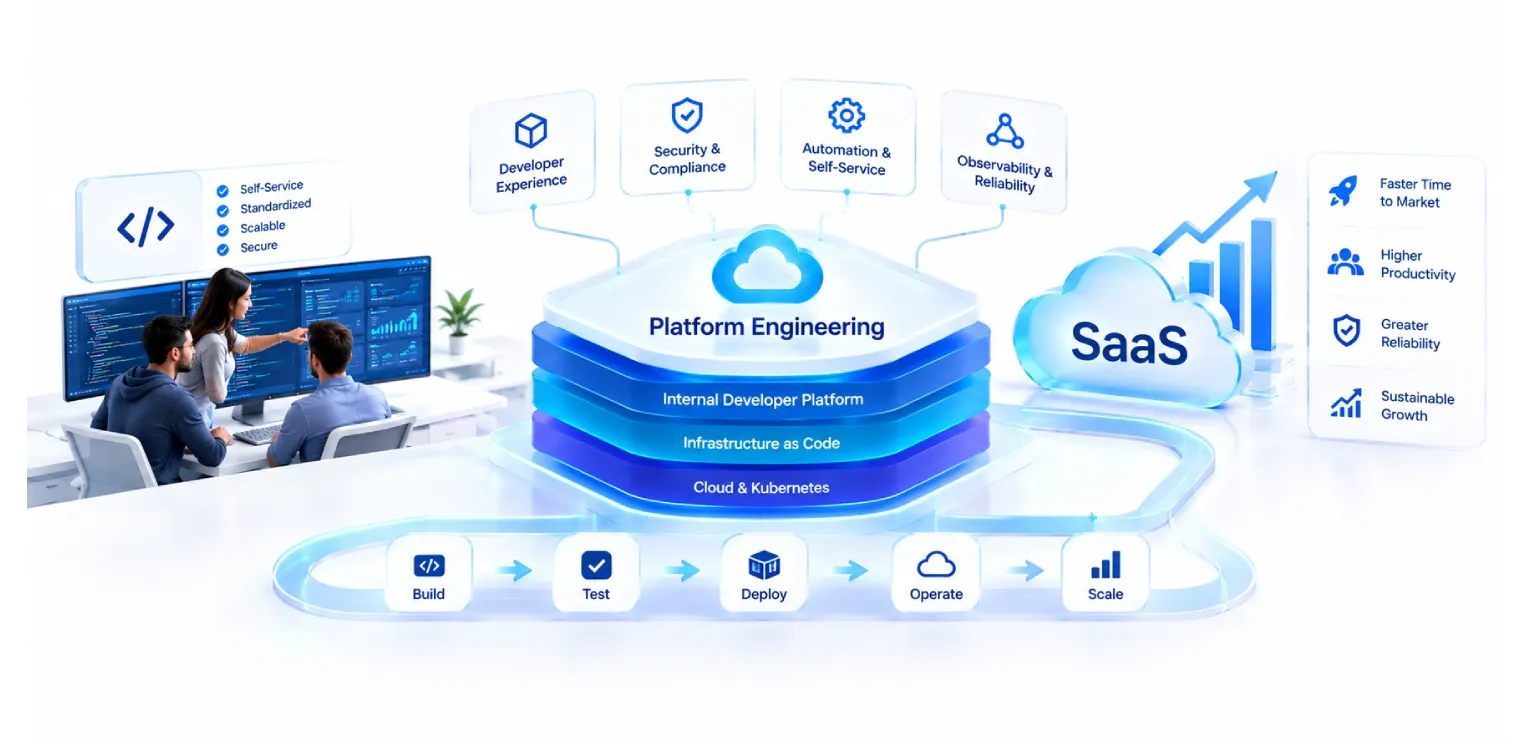
Platform engineering for SaaS is the practice of creating reusable internal systems that help developers ship software faster, safer, and with less operational friction.
At its core, platform engineering for SaaS is the practice of building reusable internal products that make software delivery simpler, safer, and faster for developers.
Instead of every team reinventing infrastructure, deployment pipelines, observability setups, and security policies independently, platform teams create standardized self-service experiences.
Think of it this way:
|
|
Red Hat describes platform engineering as the creation of internal platforms that reduce developer complexity while improving consistency, governance, and delivery speed.
That definition aligns perfectly with what modern SaaS organizations actually need.
Because once you move beyond one product and one team, speed alone is no longer enough.
| ▪ | You need repeatability. |
| ▪ | You need governance. |
| ▪ | You need standardization. |
| ▪ | You need self-service. |
And above all, you need developers focused on customers—not infrastructure.
Platform Engineering vs DevOps 2026
What actually changed — and what every CTO needs to know
The conversation around platform engineering vs DevOps 2026 is not about replacing DevOps.
It is about scaling it.
| ▪ | DevOps gave us culture. |
| ▪ | Platform engineering gives us product thinking. |
| ▪ | DevOps helped teams automate workflows. |
| ▪ | Platform engineering creates reusable internal systems that every team can use without becoming infrastructure experts. |
Here is what that evolution looks like:
TechTarget describes platform engineering as an evolution of DevOps that focuses on creating reusable internal platforms to improve developer productivity.
That distinction matters.
Because in platform engineering vs DevOps 2026, the winning organizations are not asking:
| “How do we automate more?” |
They are asking:
| “How do we make automation reusable across every team?” |
| The Foundation Comes First Before you build an internal platform, your DevOps fundamentals have to be solid. Our DevOps & Cloud Services help SaaS teams standardize delivery, automation, and governance — the groundwork platform engineering depends on. |
Why High-Growth SaaS Companies Are Moving Toward Platform Engineering
High-growth SaaS companies invest in platform engineering to reduce delivery friction, developer cognitive load, and operational duplication at scale.
Growth creates complexity.
And complexity creates cognitive load.
Every new microservice.
Every new environment.
Every new compliance requirement.
Every new customer integration.
Every new cloud region.
Every new release.
All of it adds operational weight.
At first, engineers absorb that complexity.
Then they start slowing down.
Then hiring more engineers no longer increases output.
That is the real cost of scale.
| ⓘ Industry Insight According to the 2024 State of DevOps research from Google Cloud DORA, elite engineering organizations consistently outperform others by reducing delivery friction and improving developer flow, not simply by adding more tooling. |
This is what platform engineering for SaaS enables.
Instead of every team solving infrastructure problems independently, organizations create one trusted platform that handles:
|
The result?
Developers stop building plumbing.
And start building products.
The Rise of the Internal Developer Platform for SaaS
At the center of platform engineering sits something called an internal developer platform for SaaS.
An Internal Developer Platform—or IDP—is not just another DevOps tool.
It is a self-service engineering experience.
It gives developers access to pre-approved infrastructure, deployment patterns, observability tools, security controls, and operational guardrails through a consistent interface.
| ▪ | Instead of opening tickets. |
| ▪ | Instead of waiting for approvals. |
| ▪ | Instead of copying old scripts. |
Developers simply use the platform.
A mature internal developer platform for SaaS typically includes:
| ▪ | Infrastructure templates |
| ▪ | CI/CD automation |
| ▪ | Container deployment standards |
| ▪ | Policy-as-code |
| ▪ | Secret management |
| ▪ | Monitoring integrations |
| ▪ | Cost governance |
| ▪ | Developer documentation |
For engineering leaders evaluating whether their current delivery model can scale, our guide on DevOps Maturity Model: How to Assess and Scale Your Engineering Operations offers a practical framework for identifying operational friction, measuring maturity, and preparing teams for platform-led growth.
A Real SaaS Scenario
Before and after platform engineering
We have seen this repeatedly.
A Series B SaaS company grows from 20 engineers to 85.
At first, velocity looks healthy.
Then the cracks start appearing:
|
|
Leadership assumes they need more engineers.
But the real issue is not capacity.
It is platform maturity.
After implementing platform engineering for SaaS, the same company sees the gains shown above.
| Key Takeaway: That is not a tooling win. That is an operating model win. |
| Quick Self-Check Is your engineering org seeing the same warning signs? If 10-day environment provisioning, cross-team fire drills, and ticket backlogs sound familiar, you may already be ready for an internal developer platform. Talk to our engineers about a focused readiness review. |
Platform Engineering Roadmap 2026
A successful platform engineering roadmap 2026 usually does not begin with tools.
It begins with friction.
The strongest platform teams start by identifying where developers are losing time.
A practical platform engineering roadmap 2026 usually looks like this:
|
Audit Engineering Friction Measure: Provisioning delays · Deployment bottlenecks · Incident frequency · Onboarding time · Approval dependencies |
|
Identify Repeatable Operational Work Find the tasks every team is duplicating: CI/CD pipelines · Infrastructure templates · Monitoring dashboards · Security scans |
|
Standardize Golden Paths Create reusable workflows for: Service deployment · Environment creation · Secret management · Incident response |
|
Build an MVP Platform Start small. One product. One team. One workflow. |
|
Measure Adoption Track: Deployment frequency · Developer satisfaction · MTTR · Lead time · Platform usage |
That is how platform engineering becomes a business capability—not another internal initiative.
Common Mistakes That Slow Platform Adoption
Even smart companies make predictable mistakes.
We see three repeatedly.
|
|
|
The real metrics are:
| ▪ | Developer velocity |
| ▪ | Deployment confidence |
| ▪ | Recovery speed |
| ▪ | Onboarding time |
| ▪ | Business delivery impact |
Platform teams that forget this often build systems no one actually wants to use.
Is Your SaaS Business Ready for Platform Engineering?
If your organization is experiencing any of these signals:
| ▪ | Releases are becoming harder as teams grow |
| ▪ | Cloud costs are rising without visibility |
| ▪ | New developers take weeks to become productive |
| ▪ | Teams build duplicate automation |
| ▪ | Security reviews slow delivery |
| ▪ | Operational knowledge lives in individuals instead of systems |
Then your DevOps foundation may not be broken.
It may simply be ready for its next evolution.
And that evolution is platform engineering.
FAQs
| What is platform engineering for SaaS? Platform engineering for SaaS focuses on creating reusable internal platforms that reduce developer friction, standardize delivery, and improve scalability across engineering teams. |
| Is platform engineering replacing DevOps in 2026? No. In platform engineering vs DevOps 2026, platform engineering builds on DevOps principles and makes them scalable across multiple teams and products. |
| What is an internal developer platform for SaaS? An internal developer platform for SaaS provides developers with self-service infrastructure, deployment automation, observability, security controls, and governance through standardized workflows. |
| What should a platform engineering roadmap 2026 include? A strong platform engineering roadmap 2026 should include friction audits, workflow standardization, golden paths, platform adoption metrics, governance automation, and continuous optimization. |
Ready to Assess Your Platform Readiness?
High-growth SaaS companies do not lose momentum because they lack engineers.
They lose momentum because engineering systems stop scaling with business ambition.
If you want to understand whether your current DevOps model can support your next stage of growth, start with Impressico‘s Platform Readiness Diagnostic.
Because in 2026, the competitive advantage will not belong to teams that simply deploy faster.
It will belong to teams that make delivery scalable.
| Key Takeaways
|
| Let’s Build What Comes Next Make your delivery scalable, not just fast. Whether you are strengthening DevOps fundamentals or laying the groundwork for an internal developer platform, our specialists help high-growth SaaS teams evolve their engineering operating model with confidence. Explore DevOps & Cloud Services |

IBS
Similar articles
Shift-Left Security in CI/CD Pipelines: A Practical Playbook
September 4, 2026
DevSecOps: Shifting Security Left Without Slowing Delivery
September 2, 2026
Is Your Engineering Team Ready for Platform Engineering? A Readiness Checklist
August 12, 2026
Measuring Platform Engineering ROI: DORA and SPACE Explained
July 31, 2026
Internal Developer Platforms: Building a Golden Path for Engineering Teams
July 22, 2026
AIOps in Practice: Using AI to Cut Incidents and MTTR
July 6, 2026