Home » Blog » AI Agents vs Copilots vs RPA: What Enterprises Should Actually Deploy
June 29, 2026
AI Agents vs Copilots vs RPA: What Enterprises Should Actually Deploy
Table of Contents
Discover more content
Enjoying this article?
Share it with the world!
AI agents, copilots, or RPA? A practical enterprise guide
⚡ QUICK ANSWER
RPA, AI copilots, and AI agents don’t compete — they solve different problems. RPA repeats high-volume, rule-based tasks. Copilots assist a human who stays in control. Agents act autonomously across complex, multi-step workflows. The right choice isn’t the trendiest technology; it’s the one that matches the specific workflow. Map the process first, then let complexity route the decision.
Every week there is something new like a buzzword, a trend, a prediction about something that will change business processes forever. Although all of the above technologies certainly have great potential, the issue with many businesses is figuring out which one is right for them.
At Impressico Business Solutions, we see lots of businesses experimenting with automation with great enthusiasm. But those who get the best results are not necessarily the first to adopt new technologies, but those who spend time figuring out their challenges first.
The thing is that each of these tools can be useful in some cases.
RPA works wonders with repetitive, rule-based processes. AI copilots assist employees in doing things better and faster. AI agents can perform more sophisticated tasks and make decisions in a workflow.
All these tools do not compete with each other. They just address different issues.
What really matters is aligning the technology with the proper business objective. In order to do this, if companies take into account their objectives, processes, and customers, automation is not just a technological investment but an engine for growth and innovation.
As the concept of automation keeps changing, one thing that must be clear is that the conversation is not about following new trends, but about knowing what generates value for your business.
All technology does matter in as far as it solves real problems. Everything else is irrelevant.
Three Technologies, Three Very Different Jobs
Often used interchangeably — but each is a distinct approach to automation
These terms are often used interchangeably, but each represents a distinct approach to automation with its own strengths, limitations, and ideal use cases.
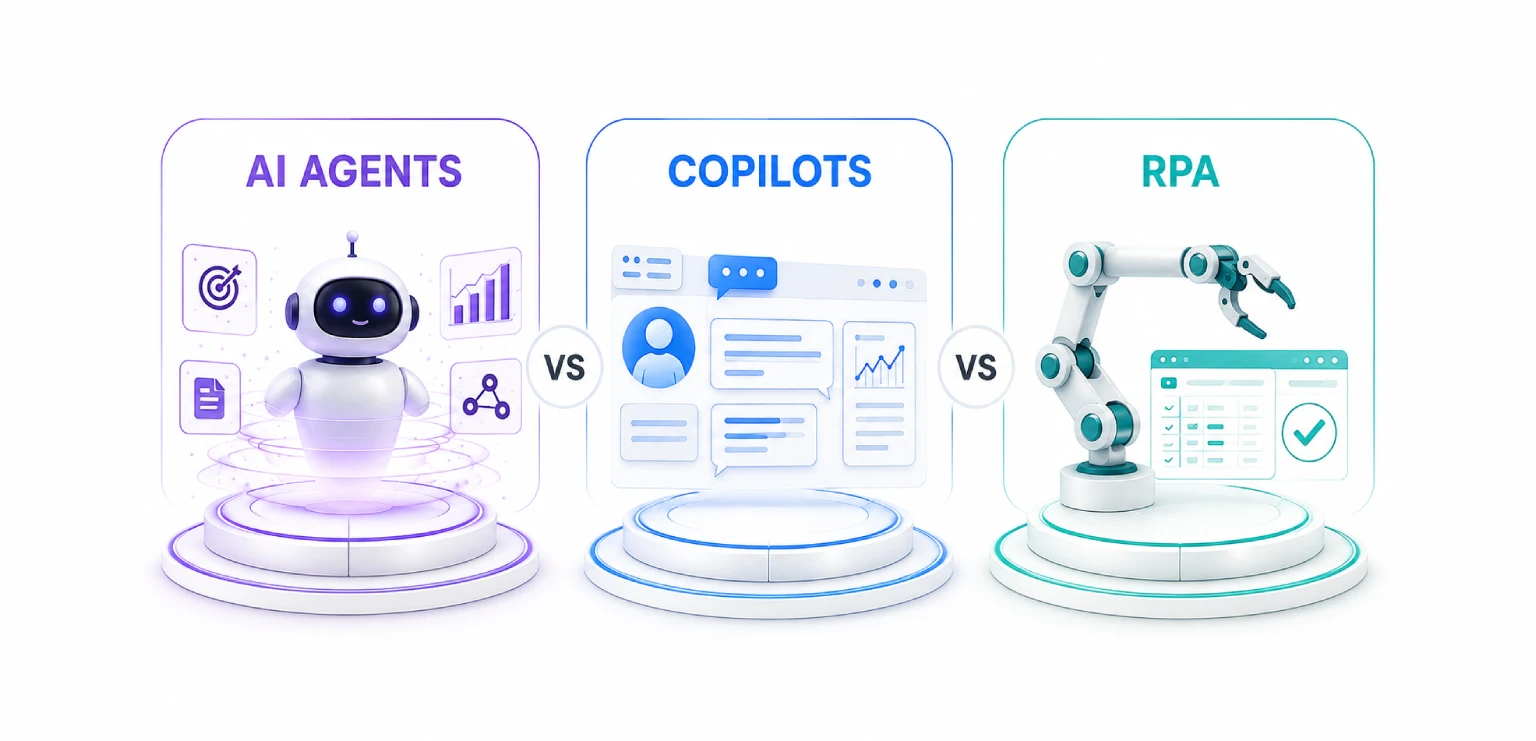
At a glance: RPA repeats, copilots assist, and agents act.
Three Tools, Three Different Operating Models
RPA
Robotic Process Automation
Repeats
Does exactly what it is told. Same steps, same order, every single time.
Deterministic & rule-based
No thinking. No adapting.
Co
AI Copilots
Assists
Works alongside a human to make them faster and sharper. The human decides.
A really good assistant
Not a replacement.
Ag
AI Agents
Acts
Given a goal, figures out how to reach it — planning, calling tools, adapting.
Real autonomy
Handles complexity end to end.
Robotic Process Automation (RPA) is, at its core, a disciplined robot that does exactly what it is told. Log into a system, click through screens, pull data, fill fields, move on. Same steps, same order, every single time. It does not think. It does not adapt. And for the right tasks, that is completely fine. Deterministic automation is not a weakness. It is the whole point.
AI Copilots are assistive tools built to work alongside a human. They do not take over. They make the person using them faster and sharper. A copilot drafts an email, summarizes a document, flags a contract clause, or surfaces an answer buried somewhere in the knowledge base. But the human still decides. The human still acts. A copilot is a really good assistant. It is not a replacement.
AI Agents are a genuinely different category. Not just assisting. Not just repeating. Given a goal, an agent figures out how to reach it. Planning steps, calling tools, accessing systems, handling surprises, adapting when something goes sideways. The autonomy is real, and so is the complexity required to make agents work well.
Three tools. Three fundamentally different operating models. Getting this wrong costs time and money.
Where AI Agents Are the Right Fit
Complexity plus variability is where agents earn their cost
Agents are not magic. But for the right use cases, they are genuinely transformative. The question is knowing what those use cases actually look like.
Take a procurement workflow. A vendor quote comes in and someone needs to check it against existing contracts, verify it fits within spending policy, compare it against current market rates, and either approve it or send it back with specific reasons. That process branches in a dozen different directions depending on the data. RPA works best when the steps are fixed and the data is predictable. A copilot is a strong choice when a human needs to stay in the loop at each decision point. When the workflow needs to navigate all those branches autonomously, end to end, that is where an AI agent fits.
The procurement workflow, handled end to end by an agent.
How an AI Agent Handles a Procurement Workflow
End to end — escalating only when a genuine human judgment call is needed
Vendor quote comes in
↓
1 Pull the contract
3 Compare pricing
2 Check the policy
4 Make a recommendation
↓
Human call needed?
NO
Approve
automatically
YES
Escalate
to a human
Why not RPA or a copilot here?
RPA hits a wall the moment something falls outside its script. A copilot helps a human move faster, but someone still has to handle every single invoice. The agent absorbs the branching and variability end to end.
Other places agents deliver real value: IT incident management, where common issues get diagnosed and resolved before a ticket even reaches a human queue. Customer onboarding that spans five departments and a dozen handoffs. Financial close processes that pull from multiple systems and flag what actually needs review. Supply chain disruption response where the agent monitors signals in real time and triggers corrective actions automatically.
The common thread across these use cases is complexity plus variability: multiple systems, conditional logic, and outcomes that shift based on the data. That is the profile where agentic AI fits best. For processes that are structured and predictable, RPA remains the more efficient and cost-effective option. For workflows that keep a human in control at key decision points, a copilot is often the better match.
Wondering whether your workflow is a real fit for agentic AI?
Complexity plus variability is where agents earn their cost, but not every process clears that bar. We will help you tell the difference.
Often the fastest ROI in the enterprise — results in weeks, not quarters
Here is something that does not get said enough: for a lot of enterprises, copilots will deliver better ROI faster than agents ever will. Easier to deploy, easier to measure, and they slot into how people already work without requiring a process redesign.
A sales rep using a copilot to draft outreach, summarize call notes, and prep for meetings gets back real hours every week. A legal team using a copilot for a first pass on contracts cuts review time without cutting accountability, because a lawyer still reads the output. An HR team with a copilot fielding policy questions handles four times the volume without adding headcount.
The insight worth holding onto: copilots are the right call when a human judgment layer is needed before anything actually happens. Writing, research, knowledge work, content, interpretation. These are areas where human context and final approval genuinely matter, not just as a compliance step. Copilots make that human faster. They do not make that human unnecessary.
When the goal is workforce productivity rather than full workflow replacement, a copilot is almost always the right starting point. Results show up in weeks, not quarters.
INDUSTRY INSIGHT
Copilots win on speed-to-value precisely because they don’t require redesigning a process. When the goal is workforce productivity — not full workflow replacement — they’re usually the right place to start.
And Yes, RPA Still Has a Place at the Table
For high-volume, structured, rule-based work, RPA is still hard to beat
Some people write off RPA as outdated. That view is wrong and it costs companies money.
For high-volume, structured, rule-based work, RPA is still one of the most cost-effective tools available. Month-end reconciliation pulling the same data from the same systems every time? RPA. New employee onboarding that creates accounts across six platforms in a fixed order? RPA. Regulatory reports that follow the same template every quarter? Absolutely RPA.
These processes do not need judgment. They need consistency and speed. RPA delivers both without the overhead of building and managing an AI system that was never needed in the first place.
There is also a practical case for starting with RPA even when the long-term vision includes agents. It builds internal automation capability, forces teams to document their processes properly, and tends to surface the data quality problems that would have broken an AI deployment anyway. Think of it as clearing the ground before building something more sophisticated.
A Framework for Actually Deciding
A decision matrix — a starting point for an honest conversation
Here is a decision matrix worth keeping. Not as a rigid rule, but as a starting point for an honest conversation about what the workflow actually needs.
Workflow Characteristic
Best Fit
Same steps, same data, every time
RPA
Structured inputs, zero exceptions
RPA
Employee stays in control, needs assistance
AI Copilot
Drafting, summarizing, researching
AI Copilot
Knowledge retrieval and answering questions
AI Copilot
Multi-step process with branching logic
AI Agent
Needs to adapt based on new or unexpected input
AI Agent
Spans multiple systems end to end
AI Agent
Unstructured data, variable outcomes
AI Agent
The same logic as a flow: map the process first, then let complexity route the choice.
Start With the Process, Not the Technology
Let the complexity of the workflow drive the choice
Map the workflow first
Where do decisions, exceptions & variability live?
↓
Predictable & structured?
Same steps, same data, zero exceptions, every time.
Human in the loop?
Drafting, research, knowledge work needing final approval.
A mature automation strategy uses all three tools in the right places — that is good engineering.
Three principles that make this framework actually useful:
Start with the process, not the technology. Map the workflow first. Find where decisions happen, where exceptions live, how much variability exists day to day. The answers almost always point clearly to one category.
Let complexity drive the choice. Predictable and structured means RPA. Human in the loop means copilot. Dynamic and end-to-end means agent. When teams skip this step and choose based on what sounds exciting, they waste months finding out the hard way.
Ignore the hype cycle. AI agents are impressive. They are also genuinely overkill for a lot of what enterprises need to automate. A mature automation strategy uses all three tools in the right places. That is not a compromise. That is good engineering.
Mistakes That Keep Showing Up
Patterns that repeat across dozens of enterprise automation projects
After working across dozens of enterprise automation projects, certain mistakes repeat with frustrating regularity.
Deploying AI agents for simple repetitive tasks. Using an agent to check whether an invoice number exists in a database is like flying a private jet to a grocery store. The tool works. The application is absurd. RPA or a basic script does this faster, cheaper, and with fewer points of failure.
Using RPA for processes that require judgment. RPA is unforgiving. The moment real-world data does not match what the script expects, it either fails or produces wrong results quietly. Processes with exceptions, variable formats, or context-dependent decisions need AI. Piling on more RPA rules to cover edge cases is a treadmill that never actually ends.
Expecting copilots to fully automate workflows. This one comes from marketing more than reality. A copilot that drafts a contract clause still needs a lawyer to read it. A copilot that summarizes a customer complaint still needs a human to decide how to respond. That is not a flaw in the copilot. That is what it was built to do. Misunderstanding this leads to real disappointment aimed at the wrong target.
Going live without defining success upfront. Probably the most expensive mistake of all. Projects get approved, built, deployed, and then nobody can measure whether they worked because nobody defined the target before starting. Time per transaction, error rate, cost per process, cycle time: pick the metrics before building, not after.
Avoid the mistakes that quietly drain automation budgets.
Wrong tool, wrong workflow, no success metrics: these are the patterns we see most. We help teams scope it right the first time and measure what matters.
It was never agents vs copilots vs RPA — that framing is the problem
This is not AI agents vs copilots vs RPA. That framing is part of the problem.
The enterprises getting genuine, measurable value from automation are not the ones that picked one technology and went all in because it was trending. They are the ones that looked at their actual workflows, matched the right tool to the right problem, and measured what happened.
RPA for high-volume rule-based work. Copilots for knowledge workers who need to move faster. Agents for complex, multi-step workflows that used to require a dedicated human because nothing else could handle the variability.
The question worth asking is not “which technology is best.” It is “which technology is best for this specific workflow.”
At Impressico Business Solutions, that is where every conversation starts. Not with a preferred vendor or a favorite tool, but with the actual process, the actual problem, and the actual outcome that needs to happen. Getting that part right is what separates a real automation ROI from another expensive experiment.
Key Takeaways
🤖
They don’t compete. RPA repeats, copilots assist, and agents act — three different jobs, not three rivals.
📐
Map the process first. Find the decisions, exceptions, and variability — then let complexity route the choice.
⚡
Copilots often win on speed. For many enterprises they deliver ROI in weeks, not quarters — without a process redesign.
🎯
Define success before you build. Pick the metrics — time, error rate, cost, cycle time — up front, not after.
Frequently Asked Questions
What is the difference between AI agents, copilots, and RPA?
RPA follows fixed, rule-based steps and does exactly what it is told, every time. An AI copilot works alongside a human — drafting, summarizing, or surfacing answers — while the person stays in control and decides. An AI agent is given a goal and works autonomously to reach it, planning steps, calling tools, and adapting across a multi-step workflow.
When should an enterprise use an AI agent instead of RPA or a copilot?
Agents fit best where there is complexity plus variability — multiple systems, conditional logic, and outcomes that shift based on the data. For structured, predictable processes, RPA is more efficient and cost-effective. For workflows that keep a human in control at key decision points, a copilot is usually the better match.
Is RPA still worth using in 2026?
Yes. For high-volume, structured, rule-based work — month-end reconciliation, fixed-order onboarding, recurring regulatory reports — RPA remains one of the most cost-effective tools available. It can also be a smart first step that builds automation capability and surfaces data-quality issues before a more sophisticated AI deployment.
Why do copilots often deliver faster ROI than agents?
Copilots are easier to deploy and measure, and they slot into how people already work without requiring a process redesign. When the goal is workforce productivity rather than full workflow replacement, results tend to show up in weeks rather than quarters.
How do I choose the right automation tool for a specific workflow?
Start with the process, not the technology. Map the workflow and find where decisions, exceptions, and variability live. Predictable and structured points to RPA; human-in-the-loop points to a copilot; dynamic and end-to-end points to an agent. And define success metrics — time per transaction, error rate, cost per process, cycle time — before you build.
Ready to match the right tool to the right workflow?
Impressico starts every automation conversation with your actual process, problem, and target outcome, not a favorite vendor or tool. Let us help you turn automation into measurable ROI instead of another expensive experiment.