


May 22, 2026
From Chatbots to Copilots to Agents: The 2026 Enterprise AI Evolution Map
Enjoying this article?
Share it with the world!


Why Enterprise AI Is Entering a New Phase
| ⚡ Quick Answer Enterprise AI has moved through three phases. Chatbots respond — they wait to be asked and cannot act. Copilots assist — they sit inside your tools with context, but a human still executes. Agents act — given a goal, they plan the steps, use the tools, and complete the work. Most enterprises are somewhere in phase two. The useful question is not which phase is best, but which one your workflows and foundations can actually support next. |
A few years back, getting a chatbot live on your company website felt like a big win. It could handle a handful of FAQs, maybe book a meeting, and deflect some support tickets. People were genuinely impressed.
That era is over.
In 2026, enterprise AI is doing things that would have seemed exaggerated in a product pitch just two or three years ago. It is running multi-step processes without anyone constant supervision. It is connecting across tools, making judgment calls, and completing work that used to need an actual team. We are not talking about a smarter search bar. This is a different animal.
The reason this shift matters so much is not just the technology. It is the pace at which businesses have begun to depend on it. AI went from “let us try this out in one department” to “this is core infrastructure” faster than most leaders expected. And now, the companies that treated it as optional are starting to feel the gap.
So how did we get here? And where exactly are things headed? Let us walk through it.
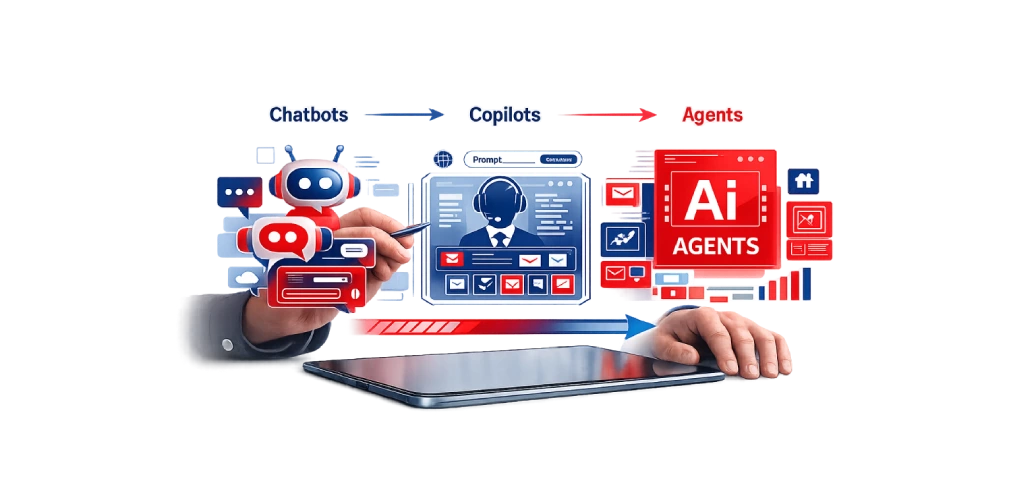
The Chatbot, Copilot, Agent Story
Three workers, three very different ways of getting things done
If you want a simple way to understand the enterprise AI evolution, picture three different workers.
|
|
|
The first one sits at a help desk. You walk up, ask a question, they look it up and give you an answer. That is a chatbot. Useful, but totally dependent on you walking up first. It does nothing on its own.
The second one sits right next to you while you work. They watch what you are doing and say things like “want me to draft that email?” or “I found a similar document from last quarter.” That is a copilot. Much more helpful, still waiting for you to lead.
The third one? You give them a goal in the morning and check back at the end of the day. They figured out what steps to take, used the right tools, and got it done. That is an AI agent.
This is the progression most enterprises are moving through right now, whether they realize it or not. The chatbot vs copilot vs AI agent question is not just a technical one. It has real implications for how companies hire, how they build workflows, and what they spend money on.
| The Enterprise AI Evolution — Rising Autonomy
Each phase hands more of the work — and more of the decision-making — to the AI |
The big reason enterprises are pushing past simple prompt-response systems is that they hit the ceiling. Typing a question and reading an answer does not move the needle on costs or output. Action does. That realization is what is driving the enterprise AI evolution we are seeing play out in 2026.
Phase 1: Chatbots Were a Good Start, But Not Enough
When generative AI tools first became available to businesses, chatbots were the obvious first move. The setup was not too complicated, the use cases were clear, and leadership could point to something visible. “See, we are doing AI now.”
And to be fair, chatbots did help. Customer support teams saw ticket volumes drop. HR departments stopped answering the same twelve questions over and over. New employees could find policy documents without emailing anyone. These were genuine wins.
But pretty quickly, the cracks showed up.
Every conversation with a chatbot started from zero. It had no idea what happened last time you talked. It did not know your company had a complex approval process, or that a certain client needed a different tone. Ask it something slightly outside the script and it either gave you something generic or fell apart completely.
| “Process This Return” — What a Chatbot Actually Does
It describes the work. It does not do the work. A chatbot can explain a process — running it still falls entirely on a person |
| The Biggest Problem: Chatbots could not actually do anything. They could describe a process. They could not run it. You could ask one to help process a return, and it would explain the five steps involved. A human still had to go do those five steps. |
Businesses learned fast that talking to AI and working with AI are very different things.
Phase 2: Copilots Changed the Game, A Little
The arrival of AI copilots was a genuine step forward. Instead of living in some separate chat window, the AI was now embedded inside the tools people already used. Inside your email. Inside your code editor. Inside your CRM.
What changed most was that copilots had context. They could see what you were working on and actually respond to it. A coding copilot did not need you to explain your project from scratch. It could read your file and suggest what came next. A sales copilot could look at the deal you had open and pull up relevant notes before your call.
A copilot lives inside the tools you already use — suggesting, but waiting for your “go” |
Some real-world examples that caught on quickly: writing assistants that could match a company’s tone, meeting tools that could turn a messy hour-long call into clean action items, code review tools that caught bugs before anyone even ran the tests.
The productivity gains were real. Especially for people who were newer to a role. Copilots kind of compressed the experience gap.
| Still a Wall: Copilots assisted. They could not act independently. Your sales copilot could prepare notes for every call on your calendar, but someone still had to make the calls and update the CRM afterward. The human was still responsible for execution. |
For some workflows, that is fine. But for others, especially high-volume, repetitive ones, it felt like the AI was still just helping you carry more boxes instead of driving the truck.
Phase 3: AI Agents Are What 2026 Is Actually About
Here is what makes an AI agent different: you give it a goal, and it works out how to get there.
Not just one step. The whole path. It can call an API, read a database, write a message, check if the result was right, and try again if it was not. It does not need you holding its hand through every decision.
A simple example. Say your company processes dozens of vendor invoices every week. With an agent, you could hand that over. It pulls the invoices, checks them against purchase orders, flags anything that looks off for a human to review, processes the clean ones, updates your accounting system, and sends confirmation emails. The whole thing. Without someone managing each step.
| How an Agent Handles Vendor Invoices
An AI agent runs the full vendor-invoice workflow without step-by-step management |
That is the shift. And that is why the conversation about the evolution of enterprise AI in 2026 keeps coming back to agents specifically.
The core things that enterprise agents can do include:
| ▪ | Handling tasks that span multiple tools and systems |
| ▪ | Remembering context across sessions (not just within one conversation) |
| ▪ | Catching their own mistakes and adjusting |
| ▪ | Knowing when to escalate something to a human rather than guessing |
Agents are not a smarter chatbot. They are a different kind of system entirely. We unpack what that means operationally in Agentic AI for Enterprises.
| Wondering Where Your Organization Stands? The move from chatbots to copilots to agents looks different for every business. We’re happy to talk through where you are today and what a sensible next step might look like. |
The AI Maturity Model for Enterprises
An honest way to assess where you stand and what comes next
Not every company is in the same place. And that is okay. The AI maturity model for enterprises is useful precisely because it gives organizations an honest way to assess where they stand and what comes next. If you would rather work through this as a checklist, see 7 Signs Your Organization Is Ready for AI Agents.
| The AI Maturity Staircase
Build to the next step — without skipping the foundations beneath it Most enterprises in 2026 sit at Stage 2, with the most interesting work happening at Stage 3 |
| Stage 1 The AI Assistant This is the chatbot phase. AI can answer questions and look things up. It is reactive and limited, but it is a real start. A lot of mid-sized companies are still building through this stage. |
| Stage 2 The Workflow Copilot AI is inside the tools your team uses every day. It helps people move faster. It handles first drafts, flags things that look wrong, and reduces the mental load on repetitive tasks. Many enterprises in 2026 are somewhere in this stage. |
| Stage 3 The Semi-Autonomous Agent AI can now handle defined workflows with occasional human checkpoints. It takes real actions. It uses tools. It reports back. This is where the most interesting enterprise experiments are happening right now. |
| Stage 4 Multi-Agent Systems Picture a team of specialized AI agents working together. One does the research. One handles execution. One reviews for compliance. Humans set direction and handle exceptions. The agents handle the rest. A small number of large enterprises are getting into this territory. |
The goal is not to jump from Stage 1 to Stage 4 overnight. The goal is to understand where you actually are and build toward the next step without skipping the foundations.
So Why Is 2026 the Year This Really Changes
Honestly, a few things came together at the same time.
The models got good enough. Not just impressive-in-a-demo good. Actually reliable enough to be trusted with real business processes. The consistency and accuracy that enterprise use requires is finally there in the leading models.
The supporting tools caught up too. A year or two ago, building an agent system meant stitching together a lot of custom work. Now there are proper frameworks, orchestration tools, and deployment options that do not require a team of AI researchers to maintain.
And companies finally have the data and integration groundwork they need. Years of cloud migration and API-first development mean there are real systems that agents can connect into. That plumbing matters.
On top of all that, the business case has gotten too strong to ignore. Operational costs are up. Talent is expensive. The companies using agents for real work are starting to show measurable advantages in output and speed. That creates pressure across whole industries to move faster.
| Four Forces Converged in 2026
2026: AI agents become a realistic enterprise baseline No single breakthrough — four trends maturing at once made agents viable |
The Challenges Are Real Too
It would be dishonest to talk about this shift without talking about what can go wrong. We go deeper on this in our guide to governance and safety for autonomous AI agents.
|
| ||
|
|
Reliability is the first thing. An agent that takes the wrong action inside a live business system is not a minor inconvenience. It can create real problems. Enterprises need proper testing environments, clear guardrails, and the ability to roll things back when something goes sideways.
Security is not far behind. Agents that can move across multiple systems and tools also open up more ways for things to go wrong if access is not managed carefully. This is not a reason to avoid agents. It is a reason to architect them properly.
There is also the accountability question. When an automated system makes a decision that causes a problem, who owns that? You need audit trails. You need to know what the agent did and why. That kind of transparency has to be built in, not bolted on later.
And then there is the people side, which often gets underestimated. Teams that are used to working with copilots will need to adjust to a world where agents are handling full workflows. That adjustment takes communication and time.
| Architecting It Properly Thinking through reliability, security, and accountability? These challenges are manageable when agents are designed with the right guardrails from the start. We’re glad to share how we approach this with enterprise teams. |
How to Actually Move Forward in 2026
The worst move is to wait until everything is perfect. The second worst move is to go all in without a clear plan.
| Start small and specific Pick one workflow that is repetitive, well-documented, and not mission-critical. Invoice processing, employee onboarding steps, IT ticket routing. These are good candidates. Get one working properly before you try to do ten. |
| Put checkpoints in by design Build your agent so it pauses and asks a human before taking any high-stakes action. Trust is earned gradually. You will build more confidence in the system by seeing it work in controlled conditions first. |
| Fix your data foundations if they are messy Agents are only as useful as the systems they can access. If your internal data is disorganized or your APIs are unreliable, that problem will show up immediately when you try to deploy agents against real work. |
| Find partners who have done this before Not just in research environments. The difference between a smooth rollout and a frustrating one often comes down to whether someone in the room has already seen what goes wrong and how to handle it. |
Start small and specific. Pick one workflow that is repetitive, well-documented, and not mission-critical. Invoice processing, employee onboarding steps, IT ticket routing. These are good candidates. Get one working properly before you try to do ten.
Put checkpoints in by design. Build your agent so it pauses and asks a human before taking any high-stakes action. Trust is earned gradually. You will build more confidence in the system by seeing it work in controlled conditions first.
Fix your data foundations if they are messy. Agents are only as useful as the systems they can access. If your internal data is disorganized or your APIs are unreliable, that problem will show up immediately when you try to deploy agents against real work.
And find partners who have done this before in real settings. Not just in research environments. The difference between a smooth rollout and a frustrating one often comes down to whether someone in the room has already seen what goes wrong and how to handle it.
Where This All Goes
The shift from chatbots to copilots to agents is not a small upgrade in the technology. It is a change in what role AI plays inside a business. Chatbots answered questions. Copilots helped people work. Agents get things done.
For enterprises, this means the conversation about AI value has to change too. It is no longer about time saved on a single task. It is about how many workflows can be handed over, how much overhead can be removed, and what your teams can actually focus on when the repetitive execution layer is handled.
The companies that figure this out in the next couple of years will have a real structural advantage. Not because they have better people, but because their people are spending time on the things that actually need human judgment.
The evolution of enterprise AI in 2026 is not waiting for anyone to be ready. The question is how you want to be positioned when it becomes the new baseline.
At Impressico Business Solutions, we have been helping businesses work through exactly this kind of shift, from figuring out where they stand to building and scaling the things that actually move the needle. If you are thinking about what agentic AI looks like for your organization, we are happy to have that conversation.
| Key Takeaways
|
| Let’s Talk Thinking about what agentic AI looks like for your organization? At Impressico Business Solutions, we have been helping businesses work through exactly this kind of shift — from figuring out where they stand to building and scaling the things that actually move the needle. |
Impressico Business Solutions — Helping enterprises navigate the chatbot-to-copilot-to-agent evolution.

IBS
Similar articles

Chunking Strategies for RAG: What Actually Works in Production
September 16, 2026
Vector Databases Compared: Pinecone vs Weaviate vs Qdrant vs pgvector for Enterprise RAG
September 14, 2026
RAG at Scale: Enterprise Retrieval-Augmented Generation Architecture
September 11, 2026
7 Signs Your Organization Is Ready for AI Agents
August 14, 2026
Governance and Safety for Autonomous AI Agents: A Practical Guide for Enterprises
August 3, 2026
Designing Multi-Agent Systems: Orchestration, Tools & Guardrails
July 24, 2026
