

July 24, 2026
Designing Multi-Agent Systems: Orchestration, Tools & Guardrails
Enjoying this article?
Share it with the world!


What's a Multi-Agent System? Here's the Real Deal.
A couple of years ago, most enterprise AI deployments were single-agent: one model, one prompt, one job — answer a question, draft an email, summarize a document. That works fine when a task fits inside one context window and one skill set. It breaks down once a workflow spans multiple systems of record, requires sequential decisions with intermediate validation, or needs different domain expertise at different steps. Push all of that through a single agent and you get context dilution, tool-call ambiguity, and accuracy that degrades as the task graph grows.
Multi-agent systems address this by decomposing a workflow into narrower, more deterministic units of work. Instead of one model handling retrieval, validation, synthesis, and review inside a single context, each of those becomes a distinct agent with its own scoped context, tool access, and prompt. The result behaves less like a single generalist and more like a pipeline of specialists, each optimized for a narrower slice of the problem.
We’ve watched this shift play out with clients at Impressico Business Solutions — most start with a single chatbot and, within a year or two, are asking for orchestrated agent systems that can research, plan, act, and report, with accuracy and compliance built into the design rather than bolted on. This post walks through how these systems actually get built: the architecture, orchestration patterns, memory design, tool integration, and the guardrails that keep the system predictable in production.
| BACKGROUND READING — New to this shift? Our post on moving from chatbots to AI agents covers the groundwork, and AI agents vs. copilots vs. RPA clears up where each one actually fits. |
What is a Multi-Agent System?
01 · Fundamentals
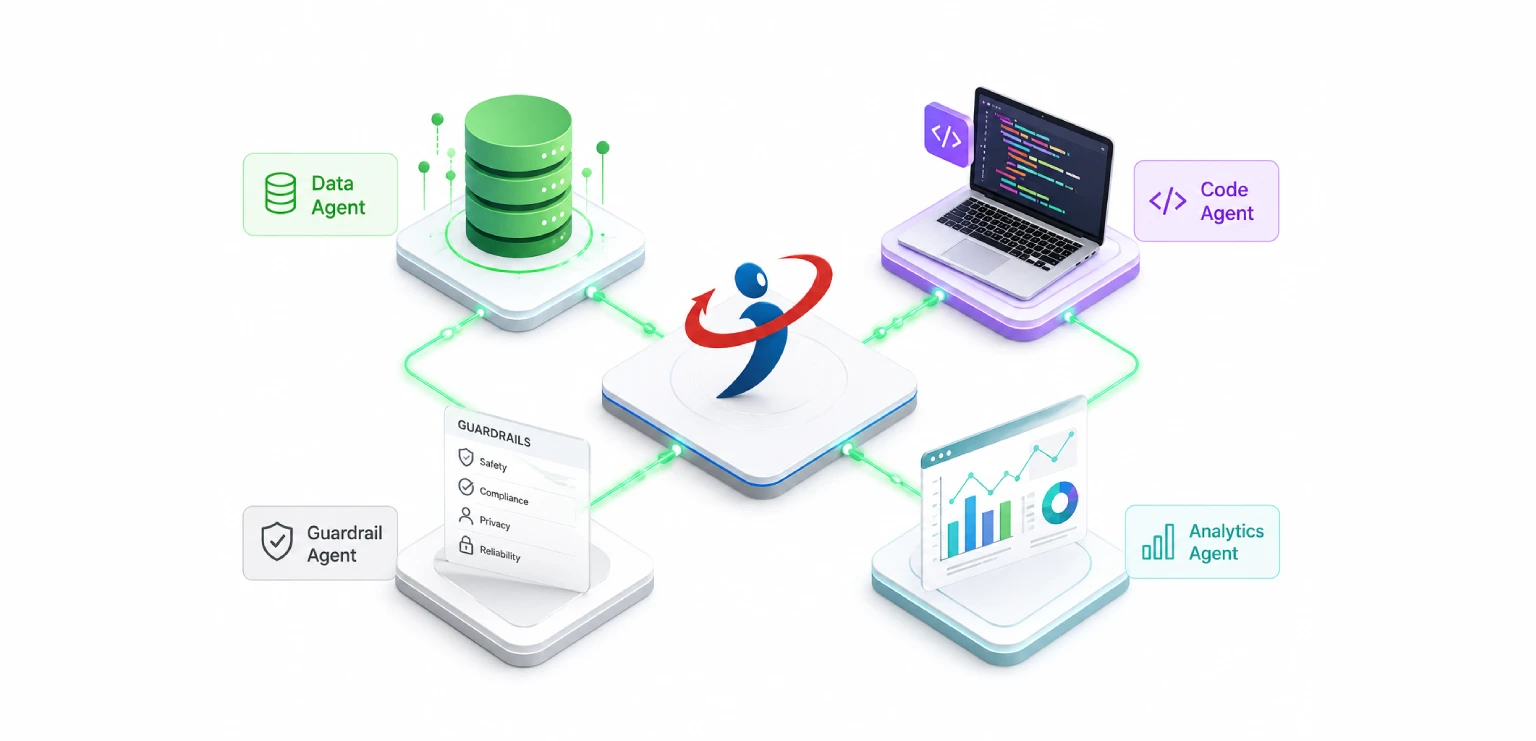
A multi-agent system (MAS) is an architecture in which multiple LLM-backed agents — each with a scoped role, its own prompt and context, and often its own tool access — coordinate toward a shared objective, rather than a single model handling the entire task end to end.
Each agent operates over a narrower state space: one agent’s context might be limited to a customer record and a set of support tools, another’s to structured financial data and a calculation engine. Coordination is typically handled by an orchestrator — a control-flow layer that decides which agent runs, in what order, and with what inputs. The most common implementation of that control layer is the supervisor pattern, covered in the orchestration section below, but it isn’t the only one.
Agents in a MAS aren’t isolated function calls. They exchange intermediate state, pass structured outputs to each other, and in some designs, validate or critique each other’s outputs before anything reaches the end user or a downstream system.
Why Multi-Agent Systems?
02 · The Case For It
Fair question — why not just scale up a single model instead of adding architectural complexity? In practice, single-agent designs hit a ceiling once a task requires heterogeneous reasoning, long tool-call chains, or domain-specific context that doesn’t fit cleanly into one prompt. A few reasons this pattern holds up in production:
|
| |||||
|
| |||||
| ||||||
For enterprise workflows like supply chain planning, financial reporting, or multi-system customer support, this decomposition tends to outperform a single model trying to hold the entire task in context.
| IN PRACTICE — For real-world examples with measurable returns, see agentic AI use cases that deliver measurable ROI and our guide to agentic AI for enterprises. |
Core Architecture
03 · Architecture
Strip away the terminology, and every multi-agent system reduces to the same five architectural components.
| Orchestrator Agents Memory Tools Communication Get these five talking to each other properly, and the system handles work no single agent could. |
| Agents — the execution units. Some are simple, rule-based functions; most in production systems are LLM-backed, with their own system prompt, tool bindings, and context window. |
| The orchestrator — the control-flow layer. It determines agent invocation order, routes inputs and outputs between agents, and enforces the overall execution graph (sequential, parallel, or conditional). |
| Memory — state persistence, both within a single execution and across sessions. Covered in more detail below. |
| Tools — the interface layer between agents and external systems: APIs, databases, search, internal business systems. |
| Communication — the protocol and message format agents use to exchange state, typically structured payloads rather than free text. |
Wire these five layers together correctly, and the system can execute workloads that would exceed the context and reasoning capacity of any single agent.
| ARCHITECTURE DEEP DIVE — For how LLMs, RAG, and agents fit together at the architecture level, see LLM, RAG & AI agents architecture explained. |
Agent Orchestration
04 · Control Flow
Orchestration is the control-flow layer that determines which agent executes, in what sequence, and with what inputs. It’s the single highest-leverage architectural decision in a multi-agent build — get it wrong, and agents duplicate work, race on shared state, or stall waiting on results they don’t actually depend on.
Supervisor Pattern
The most common implementation is the supervisor pattern: one orchestrator agent owns the execution plan and delegates to a set of task-specific subagents. A request comes in, the orchestrator decomposes it into subtasks, routes each to the appropriate agent, evaluates the result, and decides the next step. This request → decompose → delegate → evaluate cycle is often called a planning loop — the system keeps planning, acting, and re-checking until the actual goal is satisfied, not just a partial version of it.
|
1 · Break Down 2 · Assign 3 · Act 4 · Re-check 5 · Goal Met
|
The orchestrator also owns scheduling: it decides which subtasks are dependent and must run sequentially, and which are independent and can run in parallel. Poor scheduling leaves agents idle waiting on results they don’t need; good scheduling keeps the critical path tight.
Other Orchestration Patterns
Supervisor is the default starting point for most enterprise builds, but it isn’t the only topology in use. A few others worth knowing:
| |||
| |||
| |||
| |||
|
The right topology depends on how predictable the workflow is: fixed, well-understood processes lean pipeline or router; open-ended, multi-step reasoning tasks lean supervisor or hierarchical; adversarial or verification-heavy tasks lean debate.
| KEY POINT — Orchestration is the single highest-leverage design decision in the build. Getting it right is a core part of our agentic AI development services. |
Agent Communication
05 · Coordination
For agents to function as a coordinated system rather than a set of disconnected API calls, they need a consistent protocol for exchanging state. This is the communication layer — how task context, intermediate results, and confidence signals move between agents during execution.
Most production systems pass structured messages (typed JSON payloads) rather than free-form text, since structured output is what makes downstream parsing and validation reliable. Implementation varies: some systems route all inter-agent messages through the orchestrator (hub-and-spoke); others use a shared memory or state store that every agent reads from and writes to, avoiding the overhead of point-to-point message passing.
Communication design also has to account for uncertainty. An agent that isn’t confident in a result should surface that explicitly — via a confidence score or flagged field — rather than passing a low-confidence output downstream as if it were verified. That signal is what lets an orchestrator or guardrail layer catch a shaky result before it reaches a user or a business system.
Tool Integration
06 · Execution
Agents create value the moment they can act on a system, not just describe an action. Tool calling (function calling) is the mechanism: an agent emits a structured call — tool name plus typed arguments — that the runtime executes against an API, database, search index, or internal system, then returns the result to the agent’s context.
A support agent might call an order-status tool bound to the order-management API. A research agent might call a web-search tool for current information. A finance agent should call directly into the accounting system’s API rather than reasoning from memory about figures — memory-based numeric recall is one of the more common failure modes to design around in financial workflows.
What matters architecturally is precision in the tool schema: a well-specified tool defines its input parameters, expected types, and output shape unambiguously. Loosely specified tools are where agents pick the wrong tool for a task or malform a call — tool schema design is as much a part of the system’s reliability surface as the orchestration logic itself.
Tool integration is what separates an agent from a chatbot with a system prompt: without tools, an agent can only describe what it would do; with them, it executes.
| CONNECTING THE SYSTEMS — Wiring agents into APIs, databases, and internal business systems is exactly the work our integration services handle day to day. |
Memory Management
07 · State & Recall
Memory determines whether an agent behaves consistently across a task and across sessions, or resets its understanding every time it’s invoked. In a production multi-agent system, memory isn’t a single concept — it’s typically implemented as four distinct layers, each with different storage characteristics and lifetimes.
|
| |||||
|
| |||||
Getting this four-way split right matters for more than tidiness: it determines what needs to be durable versus ephemeral, what needs concurrency control, and what belongs in a database versus a retrieval index — decisions that get expensive to unwind once the system’s in production.
| DATA FOUNDATION — Memory and retrieval are only as good as the data infrastructure behind them — which makes it largely a Data Engineering, Analytics & BI problem before it’s an AI one. |
Guardrails
08 · Safety
Guardrails are the rules, validators, and access controls placed around agent behavior to catch mistakes, prevent misuse, and keep outcomes within an acceptable range. In enterprise deployments, it’s useful to think about guardrails as sitting at four distinct points in the execution path, since each catches a different failure mode.
|
| |||||
|
| |||||
Guardrails matter more, not less, as the domain gets higher-stakes — finance, healthcare, legal — where a wrong output has real consequences rather than just an annoyed user. The goal isn’t to make the system maximally cautious; it’s to make it predictable under the specific failure modes each of these four layers is designed to catch.
Human-in-the-Loop
09 · Oversight
Even a well-guarded multi-agent system shouldn’t be left fully autonomous on every decision. Human-in-the-loop (HITL) design means inserting an explicit checkpoint — approval, review, or correction — before high-risk or high-value actions execute, rather than relying on guardrails alone to catch every failure mode.
In practice: agents might draft a financial report, but a human signs off before it reaches a client. A system might recommend a refund, but a manager confirms before funds move. This keeps a human in control of the decisions where the cost of an error is high, while agents handle the lower-risk, higher-volume work — research, drafting, first-pass analysis.
HITL isn’t a sign of an immature system — if anything, deciding where to place a human checkpoint is itself part of the architecture. It’s usually the difference between a system a business will trust with consequential decisions and one that stays a proof of concept.
Observability & Monitoring
10 · Visibility
You can’t debug what you can’t see. Observability is what lets a team trace exactly what agents did, step by step, rather than treating the system as a black box when something goes wrong.
That typically covers four things: tracing (the full execution path — which agents ran, in what order, on what inputs), logging (inputs, outputs, and errors captured per agent action), monitoring (real-time tracking of latency, error rate, and failure patterns), and evaluation (regularly scoring agent outputs against a reference set to catch accuracy drift before it compounds).
Skip this layer and a multi-agent system becomes genuinely hard to debug in production — when a failure happens, and eventually one will, the team needs to know which agent, on which input, produced it, without reconstructing the execution trace by hand.
| RELATED — The same observability thinking applies to operations more broadly — see AIOps in Practice: using AI to cut incidents and MTTR. |
Best Practices
11 · Checklist
Building a dependable multi-agent system takes more than wiring a few models together and hoping it works. A few things worth keeping in mind:
| ✓ | Start narrow. Get two or three agents handling one well-scoped task reliably before scaling to a larger agent graph. |
| ✓ | Keep agent scope tight. Broad, underspecified roles are harder to route to correctly and harder to debug when something fails. |
| ✓ | Invest in the orchestrator. A weak orchestrator caps the reliability of even a system full of capable agents. |
| ✓ | Design memory and communication early. Retrofitting shared state after agents are built is significantly more expensive than designing it up front. |
| ✓ | Add guardrails and fallback handling before production, not after an incident. Assume each of the four layers will eventually be tested by a real failure. |
| ✓ | Keep a human checkpoint on consequential decisions until the system has a track record that justifies removing it. |
| ✓ | Treat observability as part of the initial build. Teams that can see into their agent execution traces improve the system fastest. |
Conclusion
12 · Wrap-Up
Multi-agent systems represent a real architectural shift in how enterprises deploy AI — from a single model handling a task end to end, to a coordinated set of specialized agents that plan, act, and check each other’s work. Get orchestration, communication, tools, memory, and guardrails right, and the resulting system can take on enterprise workloads with a level of reliability and auditability that a single-agent architecture doesn’t match.
At Impressico Business Solutions, we help businesses design and build multi-agent systems that are not just capable in a demo, but safe, observable, and maintainable in production. If you’re evaluating how agent orchestration could fit into your own workflows, now’s a reasonable point to start that conversation.
| Build multi-agent systems that hold up in production Impressico Business Solutions designs and builds multi-agent systems with the orchestration, memory, tools, and guardrails they need to run safely at enterprise scale. Whether you’re moving beyond a single chatbot or scaling an existing setup, our agentic AI development and AI-first product engineering teams can help you design it right the first time.
Impressico Business Solutions — Helping enterprises build agent systems that are safe, transparent, and maintainable long after launch. |

IBS
Similar articles

AI Agents vs Copilots vs RPA: What Enterprises Should Actually Deploy
June 29, 2026
From Chatbots to Copilots to Agents: The 2026 Enterprise AI Evolution Map
June 19, 2026
From Chatbots to Copilots to Agents: The 2026 Enterprise AI Evolution Map
May 22, 2026
Agentic AI for Enterprises: From GenAI Copilots to Autonomous AI Workforces
May 20, 2026
How Enterprises Should Start with Generative AI
April 24, 2026
Generative AI Checklist for Enterprise Adoption
March 30, 2026
