


May 28, 2021
How Does The Internet Of Behaviour Change Our Perspective Of Data Collection?
Enjoying this article?
Share it with the world!


What Is the Internet of Behaviour? IoB Explained
| ⚡ Quick Answer The Internet of Behaviour extends IoT by reading intent from the data connected devices generate — location, purchases, device usage, facial recognition. Gartner forecast that by 2025 over half the world’s population would be covered by at least one IoB programme. The upside is an unprecedented understanding of how customers behave; the risk is that the same behavioural data, in the wrong hands, makes fraud far more convincing. |
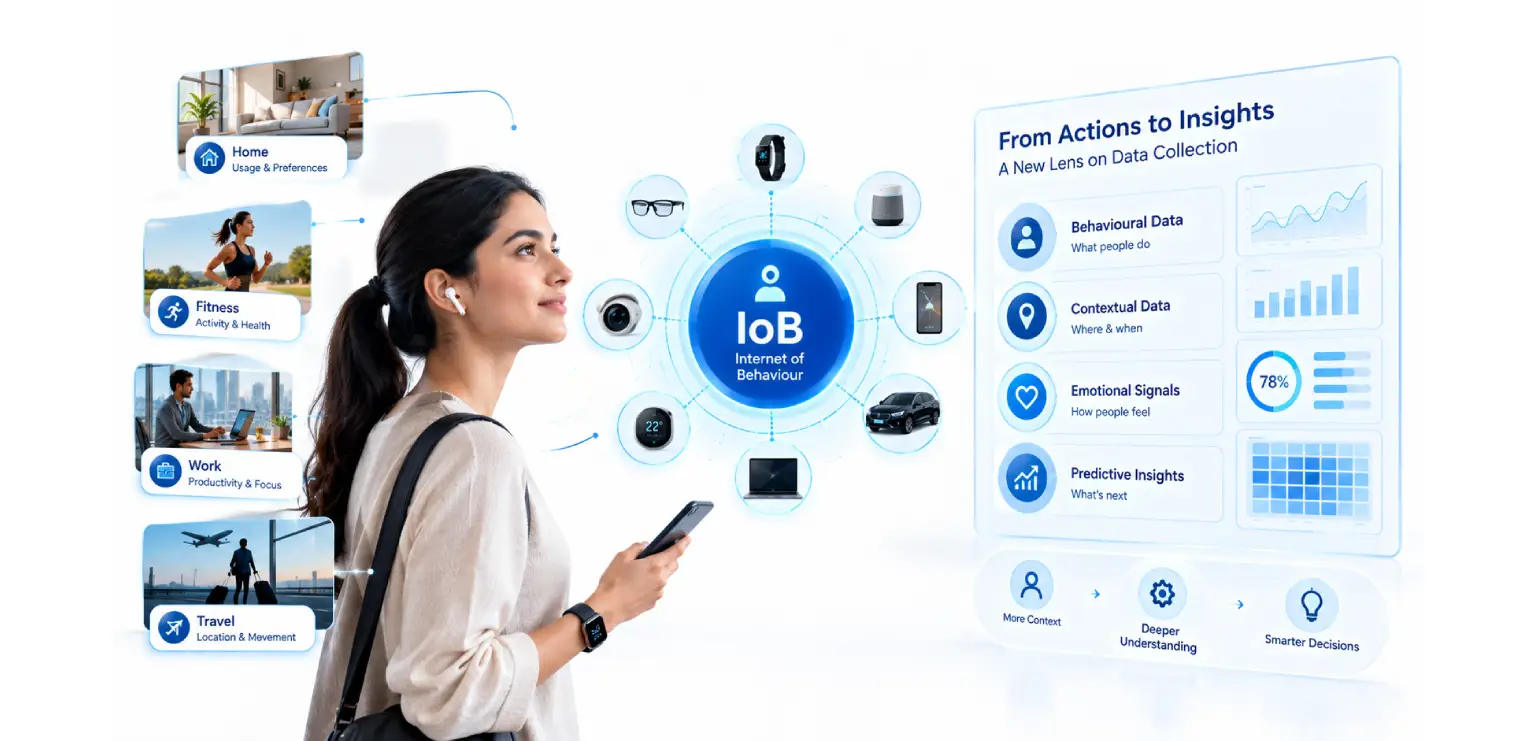
The Internet of Things (IoT) is no longer a science fiction movie. The technology to connect any electronic device to the Internet is under development and has become a reality in many fields. Data collection and use of IoT devices provide valuable information about users’ interests, preferences, and behaviours called the Internet of Behavior (IoB). IoB extends from the Internet of Things, that is, the interconnection of devices, which results in a variety of new data sources.
This is still in its elementary stage, but analysts predict that there are many possibilities to use IoB in business, workplace, finance, personal and other fields. Gartner predicts that by the end of 2025, more than half of the world’s population will be subject to at least one IoB plan, whether private, commercial or government. “While IoB is technically possible, there will be extensive ethical and societal debates about the different approaches employed to influence behavior.”
| 📅 Since publication Two notes on that paragraph. The quoted sentence now gives Gartner’s actual wording; the version published in 2021 paraphrased it inside quotation marks. And the forecast window has since closed — Gartner made this prediction in October 2020 looking ahead to 2025, so a reader today is looking at a forecast about a year that has finished rather than one still to come. |
In 2012, Gote Nyman, a retired professor of psychology at the University of Helsinki, proposed the concept of the Internet of Behaviour, extracted from data. According to Gote, he believes that it is feasible to be able to see the intentions of the human background to understand what is about to happen in the connected world. But Nyman also believes that IoB itself is a complicated process, because statistical data may not fully reveal the meaning and context of personal life. Therefore, Gartner researchers believe that the concept should be supported by data analytics and an understanding of behavioural science.
In the most recent strategic forecast for 2021, Gartner announced that IoB is something we will become more aware of in our work and daily life. It combines existing technologies that directly target individuals: location tracking, big data, and facial recognition. For example, by correlating resulting data with related behavioural events (such as device usage or cash purchases) or monitoring compliance with health protocols during an ongoing pandemic, organizations can use IoB through computer vision to see if employees are wearing masks or use thermal imaging to identify people with fever.
Similarly, a single device such as a smartphone can track your online movement and also your real-life geographic location. Nowadays, brands know a lot about you: your interests, things you don’t like, voting methods and shopping methods. For example, Uber uses IoT data about the location and preferences of drivers, travellers, to reshape the end-user experience. But the idea of analyzing data received from consumers for commercial purposes is not new. When analyzing consumer behaviour and habits in the past, we now have an automated ecosystem of analytic processes that can collect, track, and try to interpret the massive amounts of data we generate through online and Internet activities. The concept of IoB aims to address how to correctly understand data from the perspective of human psychology and apply this knowledge to create and promote new products. Therefore, the Internet of Behavior collects digital dust in people’s lives from various sources, and public or private organizations can use this information to influence behaviour, Gartner said.
The benefits of IoT for businesses covers the device layer this extends from, and five ways IoT big data could help covers the data it generates.
The value and benefits of the Internet of Behaviour
Marketing and psychology go hand in hand from the beginning of advertising. In this way, behavioural analysis and psychology give people new insights into IoT data. The Internet of Behaviour can become a powerful new sales and marketing tool for global companies and organizations. Using this tool, you will gain an in-depth understanding of your customers, which is essential for every business. IoB is destined to generate considerable momentum in the development of the sales industry.
Where UX meets CX covers what that understanding is supposed to produce for the customer, and machine learning operationalization covers the models that read the data.
The major benefits of IoB
| Analyze consumer’s buying habits across different platforms | |
| Study formerly unobtainable data about how consumers interact with devices and products | |
| Gain deeper insights into where a consumer is in the buying journey | |
| Give real-time point-of-sale notifications and target ads |
Ten sectors making big in data analytics and how big data analytics impacts decision-making cover the analytics practice underneath all four.
| Collecting behavioural data, or just collecting data? The gap between the two is governance, consent and a model that can actually read intent. We help teams work out which part they are missing. |
Risk factors of the Internet of Behaviour
However, the Internet of Things has a dark side, and the integration of behavioural data can allow cybercriminals to access sensitive data, thereby revealing consumer behaviour patterns. Cybercriminals can collect and sell hacked property access codes, delivery routes, and even bank access codes to other criminals; the potential is unlimited. However, more likely, they can take phishing to a whole new level by better imitating individuals for the sake of fraud or other wicked purposes. It has been verified by one of the largest ever cybersecurity attacks called the ‘Solarwinds hack,’ at a global level targeting the US Government, its related agencies, and several other private companies.
For businesses, it is not difficult to link smartphones with laptops, home voice assistants, home or car cameras, and perhaps cell phone records (text messages and phone calls). In addition, it is not only the device itself. Behind the scenes, many companies share (sell) data between business lines or with other subsidiaries. Google, Facebook, and Amazon continue to purchase software that may attract individual application users into their entire online ecosystem, usually without our permission, which poses significant legal and security risks. These issues have almost no legal protection. The rapidly expanding network of IoT devices means that new network security protocols are being developed, and companies must be increasingly vigilant and proactive.
Cloud security threats, blockchain and cyber security and AI trust, risk and security management cover the defensive side.
Ethical Use, or None at All
| Key Takeaway In short, organizations must ensure “ethical use of the Internet of behaviour.” Consumer privacy must be paramount, especially as we enter an era where consumer data will explode. |
On the devices and the sectors: the role of IoT in healthcare, how IoT is transforming the healthcare sector, trends governing future manufacturing, why Java suits IoT systems development and digital transformation across industries.
| Key Takeaways
|
| Building on behavioural data? Start with the governance. Impressico helps organizations collect, store and use behavioural data responsibly — the architecture, the security and the consent model that has to come first. 🚀 Start a Data and Privacy ConversationCloud Security Threats → |
Impressico Business Solutions — IoT systems, data engineering and the security and governance that behavioural data demands.

IBS
Similar articles

How IoT Is Transforming the Healthcare Sector
August 18, 2025
What are the Benefits of the Internet of Things for Businesses?
October 23, 2022
5 Ways IoT Big Data Could Help Your Business
September 15, 2022
Automation in the IT Industry: Everything you Need to Know
March 31, 2022
A Look into Trends Governing The Future Manufacturing In Industry
February 27, 2022
