May 18, 2026
Platform Engineering vs DevOps vs SRE: What Modern CTOs Need to Know in 2026
Enjoying this article?
Share it with the world!


Confused by platform engineering vs DevOps vs SRE?
There was a time when most engineering leaders only had one big question to answer: Do we have DevOps in place?
In 2026, that question looks very different.
Today, CTOs are no longer deciding whether automation matters. That decision was made years ago. The real question now is much bigger:
| Are our engineering systems actually designed to scale as fast as our business? |
That is why conversations around platform engineering vs DevOps are becoming far more strategic. And once reliability, uptime, customer trust, and developer productivity enter the picture, another model joins the conversation—SRE.
For many SaaS companies, these three models now exist at the same time.
|
|
|
The challenge is not understanding each term individually.
The challenge is knowing when each one becomes necessary.
At Impressico, we work with organizations that are scaling products, teams, cloud infrastructure, and compliance requirements at the same time. One thing we consistently see is this: the companies that scale smoothly are not necessarily the ones with the most engineers. They are the ones with the clearest engineering operating model.
So if you are evaluating platform engineering vs DevOps in 2026—or trying to understand platform engineering vs SRE—this guide is built for you.
| ⓘ Industry Insight According to the 2024 DORA research from Google Cloud, organizations using internal platforms reported higher team performance and better developer productivity, showing that platform-led engineering is becoming a measurable business advantage. |
Why the Platform Engineering vs DevOps Debate Matters More in 2026
When scale turns a technical question into a leadership one
DevOps changed software delivery forever.
It broke down silos between development and operations. It introduced automation. It made CI/CD, infrastructure as code, monitoring, and continuous deployment part of modern engineering.
And for a long time, that was enough.
But scale changes everything.
A company with 12 engineers and one product can move very differently than a company with 150 engineers, multiple microservices, enterprise customers, and global deployments.
As businesses grow, engineering complexity grows with them.
Cloud accounts multiply. Security policies become stricter. Compliance reviews increase. Production environments expand. Release dependencies become harder to manage.
At that point, DevOps does not fail.
| The Key Shift: It simply starts carrying responsibilities it was never designed to carry alone. That is why platform engineering vs DevOps is no longer a technical discussion. It is a leadership discussion. |
| ⓘ Industry Insight According to Gartner, by 2026, 80% of software engineering organizations are expected to establish platform teams as internal providers of reusable developer services. That is not a tooling trend. It is an operating model shift. |
Understanding the Three Models Without the Buzzwords
What each model actually does, in plain terms
Before comparing them, let us simplify what each model actually does.
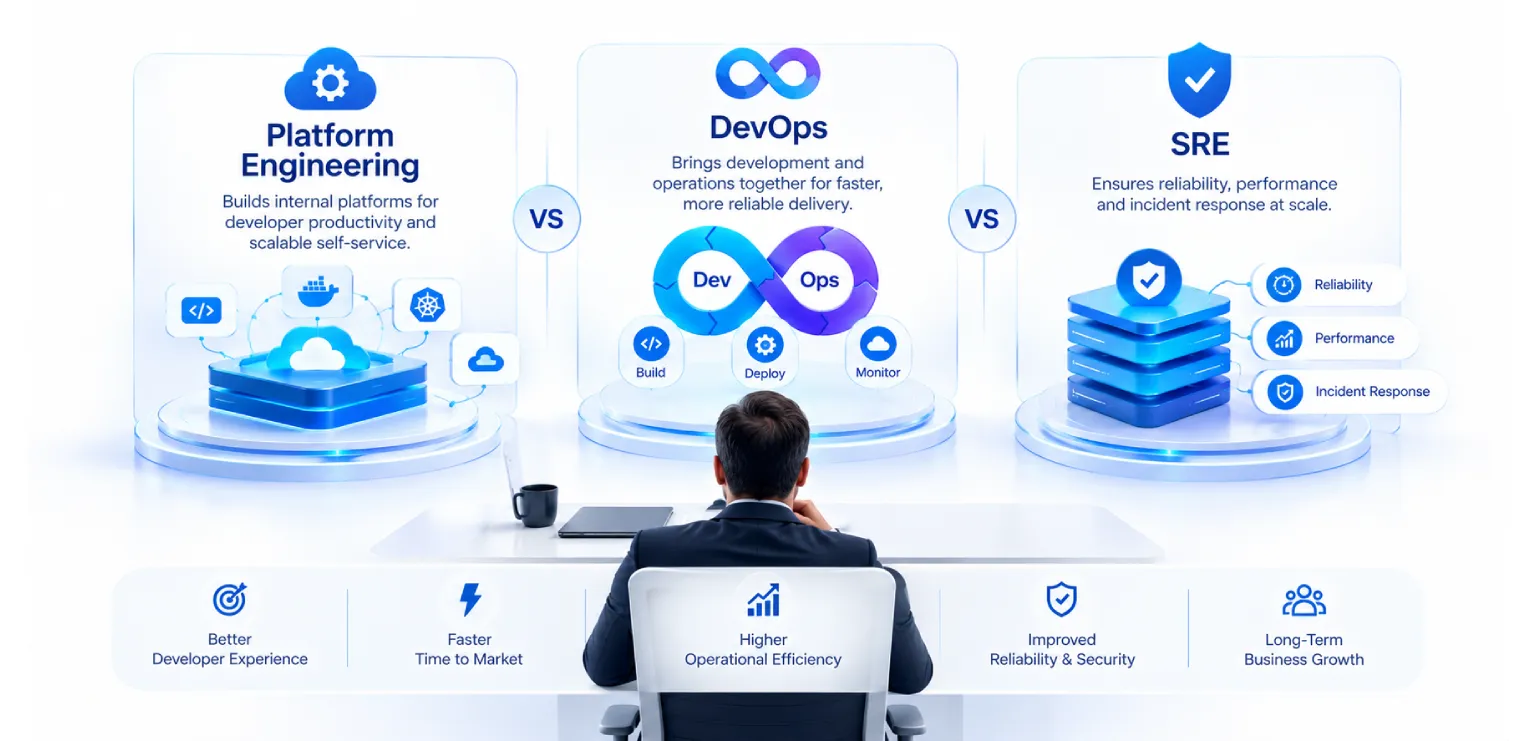
DevOps Is a Culture Model
DevOps focuses on collaboration.
Its purpose is to bring development and operations together so software can move from code to production faster and more safely.
DevOps helps teams:
| ▪ Automate builds and deployments ▪ Manage infrastructure through code ▪ Monitor systems ▪ Improve release speed ▪ Reduce manual operational work |
DevOps is essential.
But DevOps often assumes that each engineering team owns its own pipelines, infrastructure decisions, and operational workflows.
That works well—until scale creates duplication.
Platform Engineering Is a Product Model
Platform engineering takes the best parts of DevOps and makes them reusable.
Instead of every team creating its own deployment pipelines, infrastructure templates, observability standards, and security workflows, a platform team creates shared internal products that everyone can use.
That usually includes:
| ▪ Golden path deployments ▪ Self-service infrastructure ▪ Standardized security controls ▪ Shared observability ▪ Cost governance ▪ Developer documentation |
In simple terms:
|
|
That is the core of platform engineering vs DevOps in 2026.
SRE Is a Reliability Model
Site Reliability Engineering (SRE) focuses on production stability.
Originally developed by Google, SRE applies software engineering practices to operations with one goal: keeping services reliable at scale.
SRE teams focus on:
| ▪ Service Level Objectives ▪ Error budgets ▪ Capacity planning ▪ Monitoring and alerting ▪ Reliability automation |
So when people ask about platform engineering vs SRE, the answer is simple:
|
|
Platform Engineering vs DevOps vs SRE: A CTO Comparison
Here is how these models differ in practice.
This comparison is where many CTOs begin to see that these models are not competitors.
They are layers of engineering maturity.
| Not Sure Which Model Fits Your Stage? The right operating model depends on your scale, team structure, and reliability needs. Our DevOps & Cloud Services team helps engineering leaders assess where they are and what comes next. |
Platform Engineering vs SRE: Where Responsibilities Overlap
When leaders compare platform engineering vs SRE, confusion usually comes from overlap.
Both teams care about:
| ▪ Monitoring ▪ Automation ▪ Incident reduction ▪ Observability ▪ Operational consistency |
But they solve different problems.
|
|
That difference matters.
A platform team might create standardized deployment workflows.
An SRE team might create reliability policies that those workflows must follow.
A platform team may provide observability by default.
An SRE team ensures alerts are meaningful.
A platform team reduces developer cognitive load.
An SRE team reduces production risk.
That is why platform engineering vs SRE is not about choosing one over the other.
It is about understanding where each creates value.
The Role of SRE in Platform Teams
One of the biggest changes we are seeing in 2026 is the growing role of SRE in platform teams.
Instead of operating separately, mature engineering organizations are embedding reliability directly into platform design.
That means:
| ▪ Deployment templates include SLO enforcement ▪ Monitoring is built into service creation ▪ Error budgets become part of release workflows ▪ Incident response playbooks are automated ▪ Reliability checks happen before production |
This creates what many CTOs now call reliability by default.
| ⓘ Industry Insight According to the 2024 State of DevOps report from Google Cloud, platform teams are directly linked with stronger team performance and lower burnout, especially when developer workflows are standardized. |
That is where the role of SRE in platform teams becomes extremely valuable.
When to Move from DevOps to Platform Engineering
Five friction signals that point to the right moment
One of the most common leadership questions we hear is:
When to move from DevOps to platform engineering?
The answer is rarely based on tools.
It is based on friction.
You may be ready when:
|
Signal 1 Teams Are Building the Same Automation Repeatedly If multiple teams are creating similar pipelines, Terraform modules, Kubernetes configurations, or observability dashboards, duplication is already costing you time. |
|
Signal 2 Developer Onboarding Is Slowing Down If new engineers need weeks to become productive because operational knowledge lives inside individuals instead of systems, your operating model is becoming fragile. |
|
Signal 3 Security Reviews Are Delaying Releases If compliance checks happen after development instead of inside workflows, scale will become painful. |
|
Signal 4 Cloud Costs Are Rising Without Ownership If engineering teams cannot easily see the cost impact of infrastructure decisions, platform governance becomes necessary. |
|
Signal 5 Adding Engineers Does Not Increase Output This is usually the strongest signal. When hiring more engineers stops improving velocity, your bottleneck is no longer talent. It is platform maturity. |
If you are experiencing these signals, that is usually the right moment to ask when to move from DevOps to platform engineering.
For teams assessing engineering maturity before making that move, our internal guide, “DevOps Maturity Model: How to Assess and Scale Your Engineering Operations,” offers a practical framework for identifying delivery friction before platform adoption.
| Friction Audit Seeing these friction signals in your org? Duplication, slow onboarding, rising cloud costs, and flat velocity are signs your operating model needs to evolve. Talk to our engineers about where platform engineering fits. |
What Mature SaaS Companies Are Doing Differently in 2026
The most mature SaaS organizations are not choosing between DevOps, platform engineering, and SRE.
They are combining them.
A typical model looks like this:
|
|
|
This creates:
| ▪ Faster releases ▪ Lower operational toil ▪ Better developer experience ▪ Lower incident frequency ▪ Stronger governance ▪ More predictable scaling |
That is why platform engineering adoption continues to rise across high-growth organizations.
A CTO Decision Framework
Questions to ask your organization before you decide
If you are still deciding between these models, ask your organization these questions.
| Stay Focused on DevOps If: ▪ You have fewer than 25 engineers ▪ One or two product teams ▪ Limited infrastructure complexity ▪ Simple release workflows |
| Invest in Platform Engineering If: ▪ Multiple engineering squads exist ▪ Teams duplicate operational work ▪ Developer cognitive load is increasing ▪ Self-service infrastructure is needed |
| Expand into SRE If: ▪ Customer uptime is mission critical ▪ Incident frequency is increasing ▪ SLAs are becoming contractual ▪ Multi-region reliability matters |
This is usually how platform engineering vs DevOps evolves in real organizations.
Not as a replacement.
As a progression.
Final Thoughts
The real question in 2026 is not whether DevOps still matters.
It absolutely does.
The real question is whether your DevOps foundation can continue supporting your next stage of growth.
For some organizations, the answer is yes.
For others, platform engineering becomes the next logical step.
And for customer-facing systems where reliability defines reputation, SRE becomes essential.
The smartest CTOs are not asking which model is best.
They are asking which operating model fits their current stage of scale.
At Impressico Business Solutions, we believe the organizations that win in 2026 will not simply deploy faster. They will build engineering systems that scale faster than the business itself.
| Key Takeaways
|
FAQs
| What is the difference between platform engineering vs DevOps? DevOps focuses on collaboration and delivery automation, while platform engineering creates reusable internal platforms that make those workflows scalable across multiple teams. |
| How does platform engineering vs SRE differ? Platform engineering focuses on developer productivity and self-service infrastructure, while SRE focuses on production reliability, uptime, and incident reduction. |
| When should a company move from DevOps to platform engineering? Companies usually move when engineering teams scale, operational duplication increases, onboarding slows down, or infrastructure complexity starts affecting delivery. |
| What is the role of SRE in platform teams? The role of SRE in platform teams is to embed reliability into platform workflows through SLOs, monitoring, automation, and incident guardrails. |
| Can platform engineering replace DevOps in 2026? No. Platform engineering does not replace DevOps. It scales DevOps by turning team-level automation into organization-wide developer platforms. |
| Build for Your Stage of Scale Build engineering systems that scale faster than the business. Whether you are strengthening DevOps, building internal developer platforms, or embedding SRE reliability, our specialists help engineering leaders choose and implement the right operating model. |

IBS
Similar articles
Shift-Left Security in CI/CD Pipelines: A Practical Playbook
September 4, 2026
DevSecOps: Shifting Security Left Without Slowing Delivery
September 2, 2026
Is Your Engineering Team Ready for Platform Engineering? A Readiness Checklist
August 12, 2026
Measuring Platform Engineering ROI: DORA and SPACE Explained
July 31, 2026
Internal Developer Platforms: Building a Golden Path for Engineering Teams
July 22, 2026
AIOps in Practice: Using AI to Cut Incidents and MTTR
July 6, 2026