
November 24, 2020
The Role of DevOps in Digital Transformation: A Guide
Enjoying this article?
Share it with the world!


DevOps Digital Transformation: Culture, Teams and Training
| ⚡ Quick Answer DevOps combines development and operations to shorten the software development life cycle — and in digital transformation its contribution is as much cultural as technical. It drives zero-touch automation through CI/CD pipelines and builds security in from the left rather than bolting it on. But adoption succeeds or fails on three non-technical things: anchoring the change in corporate culture, building a focused team, and connecting DevOps, Agile and the business outcome into one model. |
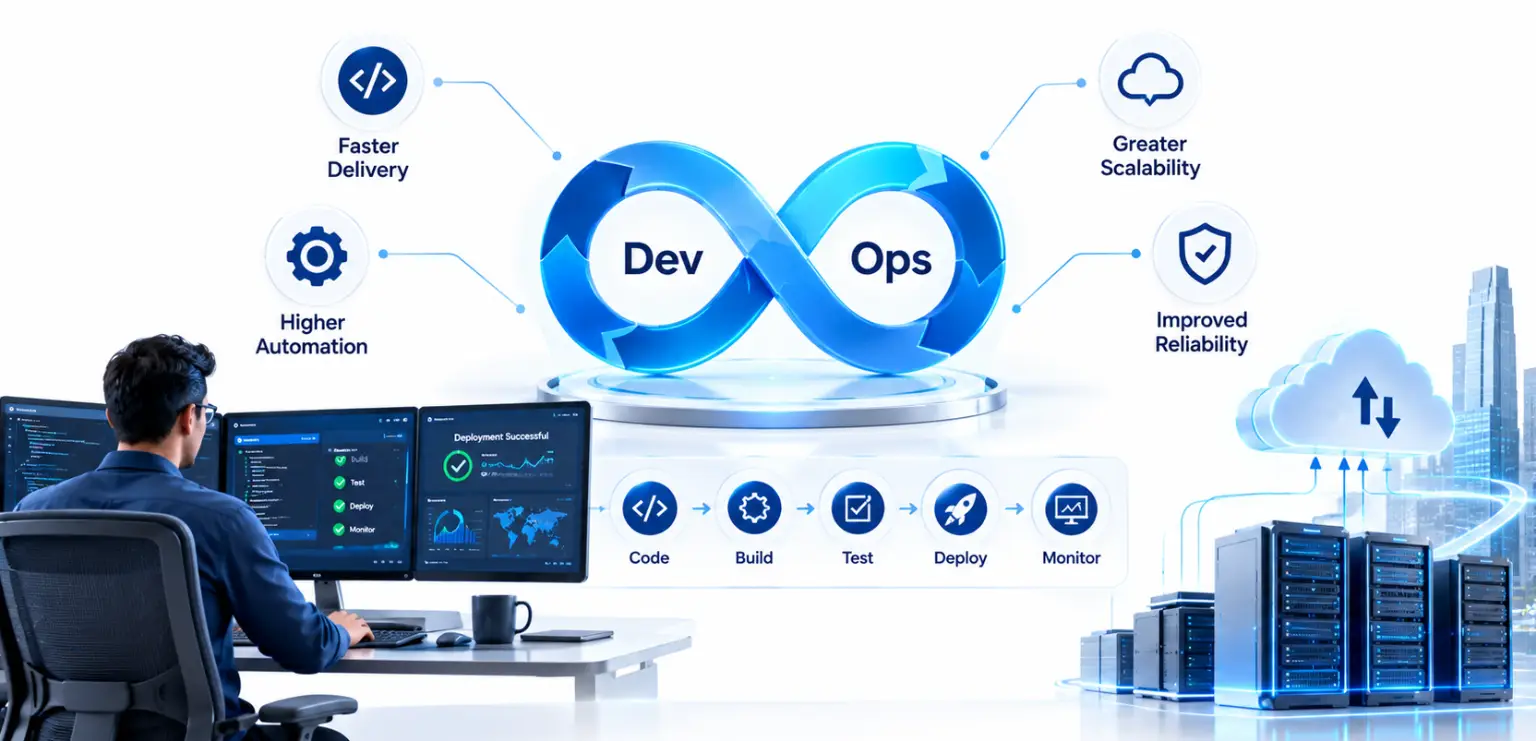
DevOps is the combination of ‘Development’ and ‘Operations.’ It is an assortment of software development practices that cut downs systems development life cycle by combining software development (Dev) and IT operations (Ops).
DevOps is reinventing the path of digital transformation and almost all international and big organizations are leveraging its benefits to meet the highest standards in customer service.
DevOps helps organizations succeed with digital transformation by eliciting a paradigm shift in the cultural approach of the business, breaking down silos and driving constant change and rapid experimentation. That wider programme is covered in digital transformation across industries and the leadership challenges it creates.
DevOps has been gradually gaining force since the “DevOps Days” of 2009. Going ahead, one can definitely imagine DevOps pushing the CIOs to create more related roles in the software industry like Chief Digital Officer. That being said, the shift is never going to be an easy one.
Role of DevOps in Digital Transformation
|
DevOps promotes automation: At the time when the IT industry was struggling to implement Agile, DevOps came as a help. Its approach towards zero-touch automation urged the industry to work with completely automated CI/CD (Continuous Integration and Continuous Delivery) pipelines right from development to deployment. |
|
DevOps ensures security: Along with value and flexibility, DevOps guarantees safety and security. For organizations intending faster and value-added delivery, security remains a major concern. DevOps tackles that issue by integrating security into DevOps processes and following the shift left approach. |
Both have matured considerably since. On automation, see CI/CD pipeline automation, GitHub Actions versus Jenkins and a complete automation framework. On the shift-left point, shift-left security in CI/CD and compliance as code are the practical playbooks.
As most of the organizations hurry to adopt DevOps to match speed with the aggressively growing marketplace, their leaders need to recognize that the pattern of digital transformation is quite exhaustive.
Here are certain things the organizations must consider to facilitate smooth transition of methods:
Anchoring the Change in Corporate Culture
For any successful transition, be it at the business front or at the technical level, instilling a change in the corporate culture is essential. The enterprise should be encouraging enough to let its employees understand and get familiar with the DevOps environment. It’s a two-way process. On one hand, the organization has to recognize its leaders who will master the ongoing processes and relate them with new skills.
On the other hand, it has to connect with the certain set of stakeholders who will make important contributions to this transformation.
Building a Focused Team
For digital transformation to be successful in any modern organization, first of all, a focused team is necessary that will realize the need of the hour and team up consequently. Most of the companies face stress at this point. They often fail to recognize the changing demands of the customers, user expectations and market opportunities.
A 360-degree change management is necessary to beat this pressure. The management should also understand the fact that the transformation will not only be executed at its ground but across the whole organization. Structuring that at scale is what internal developer platforms and platform engineering later formalised.
Connecting the Dots
The enterprise must find out the issue in a process and aim to connect the dots. It can employ the three-dimensional business model by connecting the three points: DevOps, Agile, and the business outcome.
| The Three-Dimensional Business Model DevOpsAgileBusiness outcome Connect the three points rather than treating them as separate programmes. |
Though easier said than done, a continuous development and testing process should be incorporated in the whole delivery and operation cycle for smoother transition of methods. On the Agile side, see our guide to agile software development and how agile and DevOps turbocharge legacy modernization.
Lastly, proper training is vital at every level for the digital transformation to be fruitful. The company must take up one technology tool at one time and guide its people systematically in it. Only then, it will be able to understand the real value of transformation in the long run.
| Is your DevOps programme stalling on culture rather than tooling? Most transformations slow down at team structure and change management, not at the pipeline. We help diagnose which one is actually blocking you. |
DevOps Aids Digital Transformation
| Maximize collaboration | |
| Simplification of major processes and minimization of hardware provisioning | |
| Introduction of services with a ‘one-click’ deployment | |
| Modernization and generalization of IT infrastructure and applications | |
| API- enabling of legacy systems | |
| A shift from colossal technology to a micro-services architecture | |
| Execution of constant integration/delivery pipeline | |
| Empowerment of software teams with DevOps tools, e.g. GitHub for development, JIRA for project management, and Jenkins for Automation, etc. |
Two of those have become substantial topics in their own right — migrating from a monolith to microservices and turbocharging legacy systems through digital transformation.
Upcoming Opportunities
With quickly changing business dynamics and customer expectations along with stellar technology innovations, digital transformation is the only way forward. DevOps is going to play a key role in this process. Presently, published surveys put DevOps adoption at roughly 74–80% of organizations — Puppet reported 80% practicing DevOps, while RedGate’s State of DevOps found 74% had adopted it in some form. The ones who are left behind are also planning to incorporate DevOps as a solution to their daily workarounds.
While it’s true that DevOps will not address all software development problems, they will be useful in helping organizations improve their engagement with clients and other key business stakeholders. These practices and the tools used therein will help companies to keep up with the continually changing and volatile business environment. The effect on customer satisfaction is measurable, and the metrics every CTO should track are how you prove it.
To judge where your own organization sits on that curve, the DevOps maturity model gives you a structured assessment, and why DevOps is essential for digital transformation looks at the same question from the cloud side.
| Key Takeaways
|
| Ready to make DevOps a transformation lever rather than a tooling project? Impressico helps organizations align culture, team structure and delivery practice — so DevOps changes outcomes, not just pipelines. |
Impressico Business Solutions — DevOps consulting, delivery practice and digital transformation for organizations changing how they ship software.

IBS
Similar articles
Shift-Left Security in CI/CD Pipelines: A Practical Playbook
September 4, 2026
DevSecOps: Shifting Security Left Without Slowing Delivery
September 2, 2026
Is Your Engineering Team Ready for Platform Engineering? A Readiness Checklist
August 12, 2026
Measuring Platform Engineering ROI: DORA and SPACE Explained
July 31, 2026
Internal Developer Platforms: Building a Golden Path for Engineering Teams
July 22, 2026
AIOps in Practice: Using AI to Cut Incidents and MTTR
July 6, 2026