


May 29, 2026
Application Modernization on AWS: From Legacy Monoliths to Cloud-Native Systems
Enjoying this article?
Share it with the world!


Why Enterprises Are Prioritizing Application Modernization on AWS
| ⓘ QUICK ANSWER Application modernization on AWS means redesigning legacy systems so they can support modern business demands — not just migrating them. It can include moving workloads to AWS, breaking monoliths into microservices, containerization, database modernization, DevOps automation, and rebuilding components selectively. In this guide: why legacy systems become a business problem, what modernization on AWS really involves, the shift to cloud-native, the real challenges, and a practical roadmap for 2026. |
There was a time when building one large application for everything made complete sense. Most enterprises relied on monolithic systems because they were easier to manage in the early stages of digital growth. Over the years, those systems became deeply connected with daily business operations, customer data, internal workflows, and reporting systems.
Now the same applications are becoming one of the biggest obstacles to growth.
Many businesses today are dealing with slow deployments, expensive maintenance cycles, security concerns, and systems that simply cannot adapt fast enough. Even small updates can take weeks because one change affects the entire application. Teams spend more time managing old infrastructure than building new capabilities.
That is why application modernization on AWS has become a major priority for enterprises heading into 2026.
Organizations are no longer modernizing applications just to “move to the cloud.” They are doing it because customers expect faster digital experiences, leadership teams want more agility, and businesses need technology that can support AI, automation, analytics, and continuous innovation.
| ⓘ Industry Insight According to AWS, modernized applications help businesses improve operational efficiency, scalability, reliability, and development speed while reducing technical debt over time. |
At Impressico Business Solutions, we work with organizations that are trying to solve a common problem: how to modernize without disrupting the business that still depends on those legacy systems every single day.
Why Legacy Systems Become a Business Problem
When stability-first architecture meets speed-first business demands
Most legacy applications were not designed for today’s business environment.
They were built for stability, not speed. They worked well when release cycles happened once every few months and customer expectations were lower. But modern businesses operate differently now.
|
|
The gap between what business demands and what legacy delivers keeps widening
What enterprises require today:
| ▪ Fast feature releases, ▪ Real-time scalability, ▪ Seamless integrations, ▪ Cloud-friendly approach, ▪ Top cybersecurity measures, ▪ Capabilities for consistent innovations. |
And legacy applications cannot cope with all that.
Probably, the key problem with monoliths is that everything is interconnected. And even minor changes in one module affect the whole system negatively. Developers become too cautious to make any updates and slow down their releases and innovations.
Eventually, organizations start noticing all consequences beyond IT scope:
| ▪ Slow user experience, ▪ Late product releases, ▪ High costs for maintenance, ▪ Inability to scale up fast, ▪ The accumulation of technical debt. |
That is precisely the reason why modernizing legacy applications has stopped being just another IT initiative. Now it has turned into a full business transformation.
| ⓘ Industry Insight A recent IDC study sponsored by AWS found that organizations migrating and modernizing workloads on AWS reported significant operational improvements, including lower infrastructure costs and faster innovation cycles. |
What Application Modernization on AWS Really Means
More than cloud migration — redesign for modern business demands
A lot of people assume modernization simply means migrating applications to the cloud. In reality, that is only one part of the process.
Application modernization on AWS is about redesigning systems so they can support modern business demands more efficiently.
|
|
| |||
|
|
|
For some organizations, modernization may involve:
| ▪ moving workloads from on-premise infrastructure to AWS, ▪ breaking large monolithic applications into microservices, ▪ containerizing workloads, ▪ modernizing databases, ▪ introducing DevOps automation, ▪ rebuilding certain components completely. |
For others, modernization may happen gradually over time.
The important thing is that businesses no longer need to rebuild everything from scratch immediately. AWS provides multiple modernization approaches depending on business goals, timelines, and technical complexity.
| Why This Matters: That flexibility is one reason AWS continues to lead enterprise modernization initiatives globally. |
The Shift from Monoliths to Cloud-Native Systems
From one giant block to independently scaling services
One of the most radical changes occurring within enterprises currently is the move towards cloud-native architecture.
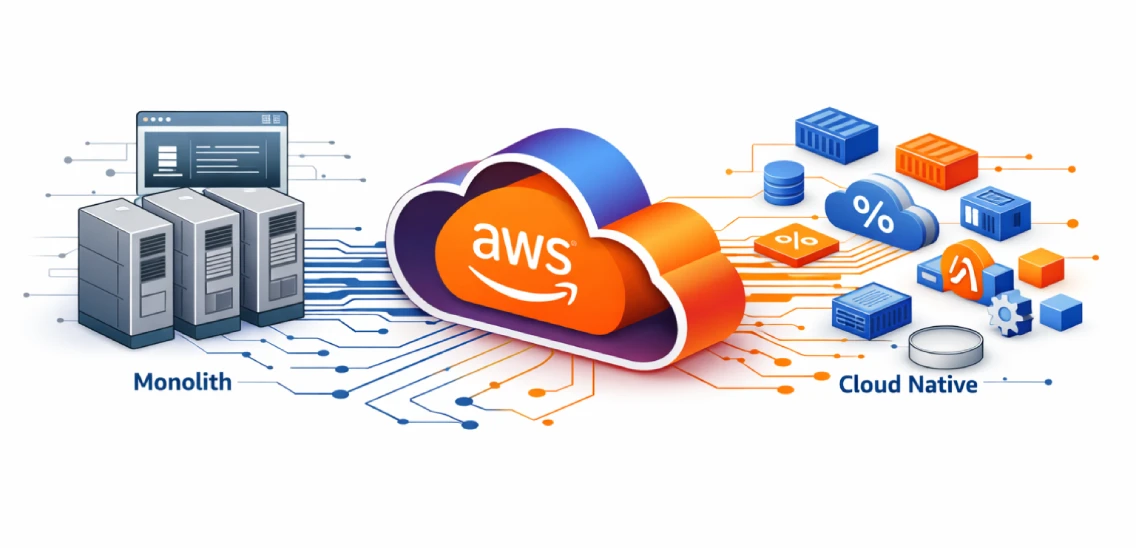
Monoliths, as a traditional architecture approach, consisted of an entity with all of its functions operating at once. Cloud native architecture differs drastically from the former approach. Here, applications are split into multiple services capable of scaling independently.
| MONOLITH VS CLOUD-NATIVE ARCHITECTURE
|
Decoupled services means one team can ship without coordinating across the whole stack
It affects the way businesses develop and maintain their technology.
In particular, while in case of monoliths the whole application was deployed at every change, with cloud-native architecture, it is possible to deploy only specific services without interfering with the remaining parts of the application.
This is one of the main reasons organizations want to modernize legacy apps to cloud-native environments.
Cloud-native systems also make it easier to:
| ▪ integrate AI tools, ▪ improve customer experiences, ▪ support hybrid work environments, ▪ scale globally, ▪ reduce downtime. |
AWS services powering the transition
AWS supports this transition with services like:
|
|
| |||
|
|
|
AWS services powering this transition include:
| ▪ Amazon ECS, ▪ Amazon EKS, ▪ AWS Lambda, ▪ Amazon API Gateway, ▪ AWS Fargate, ▪ AWS CloudFormation. |
These services allow businesses to modernize gradually instead of forcing large-scale disruption all at once.
| Trying to Map This to Your Stack? If you’re weighing which AWS services fit your workloads — ECS vs EKS, when Lambda makes sense, where Fargate beats EC2 — we’re happy to walk through what’s worked for teams modernizing similar systems. |
Why Businesses Are Choosing AWS for Modernization
Modernization projects fail when organizations focus only on migration and ignore long-term scalability.
AWS stands out because it supports both migration and continuous modernization.
Businesses can start with simple infrastructure migration and gradually move toward:
| ▪ microservices, ▪ serverless architecture, ▪ containerization, ▪ automation, ▪ advanced cloud-native operations. |
AWS also provides strong governance, monitoring, compliance, and security capabilities that enterprises need during modernization.
For heavily regulated industries, that matters a lot.
Another reason organizations prefer AWS is ecosystem maturity. AWS has built modernization frameworks, migration programs, automation tools, and operational best practices specifically for enterprise transformation.
| ⓘ AWS Guidance AWS explains that modernization should happen in phases rather than through risky all-at-once migration strategies. |
That phased approach is usually far more realistic for large organizations managing complex systems.
The Real Challenges Behind Legacy Application Modernization
Modernization sounds exciting in strategy meetings. In reality, it is often complicated.
Many enterprises underestimate how deeply connected their legacy applications actually are.
Older systems usually depend on:
| ▪ custom integrations, ▪ outdated databases, ▪ hardcoded workflows, ▪ legacy authentication methods, ▪ undocumented infrastructure dependencies. |
Sometimes even internal teams do not fully understand how certain systems still operate because the original developers are long gone.
This creates hesitation around modernization projects.
Leaders worry about:
|
|
|
|
|
Those concerns are valid.
That is why successful modernization projects focus heavily on assessment and prioritization before any migration work begins.
Instead of rebuilding everything immediately, smart organizations modernize in stages.
They identify:
| ▪ business-critical systems, ▪ low-risk workloads, ▪ modernization dependencies, ▪ performance bottlenecks, ▪ opportunities for quick operational improvements. |
This phased approach reduces disruption while creating measurable business value earlier in the journey.
Building an Application Modernization Roadmap for 2026
Business priorities first, technology second
A strong application modernization roadmap 2026 should focus on business priorities first, technology second.
That sounds simple, but many organizations reverse the process. They chase new technologies without defining what modernization should actually improve inside the business.
A better modernization roadmap usually starts with questions like:
| ? Which systems are slowing operations down? ? Where is technical debt creating business risk? ? Which applications cost the most to maintain? ? What systems limit scalability? ? Which workloads need cloud-native flexibility? |
Once those answers are clear, modernization planning becomes much more practical.
| THE 8-STAGE MODERNIZATION ROADMAP
Not every application requires every stage — the roadmap should balance innovation with operational stability |
Phased modernization — the discipline to follow these stages separates successful programs from stalled ones
Most enterprises then move through stages like:
| ▪ Assessment and discovery ▪ Cloud readiness evaluation ▪ Infrastructure migration ▪ Application refactoring ▪ Containerization ▪ DevOps automation ▪ Security modernization ▪ Continuous optimization |
Not every application requires the same modernization strategy.
Some systems only need rehosting. Others require deeper architectural redesign.
The key is building a roadmap that balances innovation with operational stability.
Modernization Is Also About Team Agility
One thing businesses often overlook is how modernization impacts internal teams.
Legacy environments slow developers down.
Engineering teams spend too much time:
| ▪ troubleshooting old infrastructure, ▪ managing dependencies, ▪ handling manual deployments, ▪ maintaining outdated workflows. |
Modern cloud-native environments improve operational speed not only for systems, but also for people.
Teams can collaborate faster. Releases become more predictable. Automation reduces repetitive operational work.
This is where DevOps becomes extremely important during modernization.
At Impressico’s DevOps & Cloud Services, we help organizations build scalable cloud operations that support long-term modernization goals rather than short-term migrations alone.
That includes:
| ▪ CI/CD automation, ▪ infrastructure optimization, ▪ monitoring, ▪ container orchestration, ▪ operational scalability planning. |
| DevOps for Modernization Modernizing infrastructure but not the operations around it? A new AWS architecture doesn’t deliver speed if CI/CD, monitoring, and deployment workflows stay manual. We help teams build the operational side that makes modernization actually stick. |
Cost Savings Are Only Part of the Story
A lot of modernization discussions focus heavily on infrastructure cost reduction.
Yes, AWS modernization can reduce operational costs significantly. But the bigger value often comes from business agility.
When businesses can release products faster, scale quickly, and respond to customer needs more efficiently, the long-term business impact becomes much larger than infrastructure savings alone.
Modernization also improves resilience.
Cloud-native systems recover faster, scale better during traffic spikes, and support continuous operational improvement.
In competitive industries, that flexibility matters.
Companies that continue relying on rigid legacy systems often struggle to keep pace with changing customer expectations and digital-first competitors.
Why Modernization Decisions Matter More in 2026
There is increasing pressure to modernize due to fast-changing technology requirements.
These include AI implementations, automation capabilities, advanced predictive analytics, as well as real-time digital experiences.
Such initiatives become increasingly difficult with legacy systems in place.
Organizations in 2026 require technology frameworks that can respond dynamically to change without introducing risks every time there is a change.
It explains why many organizations are increasingly focusing on application modernization on AWS.
Application modernization now means more than replacement of outdated systems.
Start with an Application Modernization Readiness Assessment
Modernization projects become far more successful when businesses understand their current environment clearly before making large architectural decisions.
A readiness assessment helps organizations identify:
| ▪ legacy risks, ▪ modernization priorities, ▪ migration complexity, ▪ security gaps, ▪ scalability limitations, ▪ cloud-native opportunities. |
At Impressico Business Solutions, we help enterprises evaluate modernization readiness with a practical and business-focused approach designed to reduce risk while improving long-term scalability.
You can also explore:
| Key Takeaways
|
FAQs - Application Modernization on AWS
| |
| |
| |
| |
|
| Practical & Business-Focused Modernize without disrupting the business that depends on those systems. Whether you’re still scoping the journey or already in the middle of a phased rollout, we help enterprise teams cut through the noise and focus on the modernization moves that actually deliver business impact.
|

IBS
Similar articles

Oracle to Amazon Aurora PostgreSQL Migration: Approaches, Pitfalls, and Cost Savings
September 30, 2026
Database Modernization: From On-Prem Oracle & SQL Server to Cloud-Native
September 28, 2026
Is Your Legacy Application Holding Your Business Back? A Modernization Reality Check
August 10, 2026
Modernize, Rebuild or Retire? A Decision Framework for Enterprise Leaders
August 5, 2026
The Hidden Cost of Technical Debt in Legacy Applications
July 27, 2026
Breaking the Monolith: Migrating Legacy Apps to Microservices on the Cloud
July 10, 2026
