


June 22, 2026
Legacy Application Modernization: A CIO’s Guide to Replatforming & Cloud-Native Transformation
Enjoying this article?
Share it with the world!


Legacy App Modernization: Replatforming & Cloud-Native
|
| Technology is meant to accelerate business growth, but numerous organizations still use apps created several years ago. These applications have problems with scaling, are costly to maintain, and are hard to integrate into other technologies. As organizations increasingly adopt AI, automation, and cloud computing, legacy application modernization has become a key business strategy rather than just an IT project. In lieu of complete system replacement, companies are opting for an approach that uses AI to facilitate modernization by leveraging discovery, dependency analysis, and validation in a highly visible, continuous and controlled manner. According to AWS Prescriptive Guidance, application modernization enables companies to enhance their scalability, reliability, efficiency, and agility and innovate using cloud-native technologies. Application modernization is also considered an important area for organizations by industry experts like Gartner to help them deal with technical debt and accelerate their digital transformation process. In this guide, you’ll learn what legacy application modernization is, which are the most effective modernization strategies, and how to create an application modernization strategy to drive business growth. |
What Is Legacy Application Modernization?
| Modernizing — not replacing — the applications that still carry real business value |
| Application Modernization refers to making necessary modifications to existing software applications such that they satisfy current day requirements. Modernization does not necessarily imply replacement of an application. Companies could simply move their applications to cloud computing, enhance the application design, modernize their databases, or implement APIs and automation without losing the business logic. The primary goals are to: |
| • Improve business agility • Reduce maintenance costs • Strengthen security • Support future innovation |
| Instead of asking whether an application should be replaced, organizations should ask how they can modernize existing systems to deliver greater business value. |
Why Legacy Systems Become a Business Challenge
| Reliable today, but a brake on innovation as requirements evolve |
| Many legacy applications continue to support mission-critical operations reliably. However, as business requirements evolve, these systems can limit an organization’s ability to innovate quickly. Modernization is not about replacing “broken” applications—it’s about giving valuable enterprise applications the scalability, visibility, and engineering agility needed to support future growth. Common challenges include: |
| • Growing technical debt • Higher infrastructure and maintenance costs • Slow software releases • Security and compliance risks • Difficulty integrating with cloud platforms, APIs, and AI solutions |
| Over time, these issues reduce business agility and increase operational costs. Legacy system modernization addresses these challenges while creating a stronger foundation for future innovation. |
|
Signs It’s Time to Modernize
| Five warning signs that should put modernization on the roadmap |
| Your organization may need legacy system modernization if: |
| • Software releases take weeks instead of days. • Most IT spending goes toward maintenance. • Integrating with modern platforms is difficult. • Scaling applications increases infrastructure costs. • Security vulnerabilities continue to grow. |
| If several of these issues exist, developing an application modernization strategy should become a business priority. |
|
How AI Is Accelerating Legacy Modernization
| AI augments engineering judgment — it doesn’t replace it |
| Modernization projects are often slowed by limited visibility into legacy systems, undocumented dependencies, and extensive manual engineering effort. Today, AI-augmented engineering helps organizations understand, transform, validate, and modernize complex application environments more efficiently while maintaining operational control. AI does not replace engineering expertise. Instead, it helps teams assess, understand, validate, and modernize enterprise systems with greater confidence. |
|
Understand Complex Systems FasterAI-assisted discovery helps uncover application dependencies, business logic, integration patterns, and architectural relationships hidden across complex environments. This enables organizations to: |
| • Accelerate application discovery and assessment. • Improve visibility into system dependencies. • Reduce uncertainty during modernization planning. • Build more informed modernization roadmaps. |
Re-Architect with Greater ConfidenceAI helps architects identify application re-architecting opportunities, analyze technical debt, and evaluate modernization priorities. Benefits include: |
| • Faster architectural assessments. • Better modernization planning. • Support for API-first and cloud-native architectures. • Improved scalability and maintainability. |
AI-Assisted Code Understanding and ModernizationAI helps engineering teams analyze complex codebases, generate technical documentation, identify dependencies, recommend modernization opportunities, and create test cases more efficiently. While AI can support modernization efforts, engineering teams continue to review architectural decisions and business logic to ensure changes align with organizational requirements. Organizations can: |
| • Accelerate code analysis and documentation. • Generate and improve automated test coverage. • Identify modernization opportunities across applications. • Reduce manual engineering effort during assessment and validation. • Improve engineering productivity while maintaining human oversight. |
Migrate and Modernize More EfficientlyAI also improves cloud readiness assessments, dependency analysis, migration planning, and validation activities. This helps organizations: |
| • Improve migration planning. • Validate modernization outcomes. • Increase operational readiness. • Enhance cloud performance. |
Building an Effective Application Modernization Strategy
| Five common steps every successful modernization shares |
| Every organization is unique, but the process of modernization, when successful, always goes through certain common steps. 1. Evaluate Current Applications 2. Focus on Business Value 3. Choose the Proper Modernization Strategy 4. Design a Transition to Cloud-Native Architectures 5. Modernize Step by Step |
Understanding the 6 Rs of Modernization
| A strategic framework for choosing the right path per application |
| The widely used 6 Rs framework helps organizations choose the right modernization path for each application. |
| Many organizations combine multiple approaches within a single modernization roadmap. Even though the 6 Rs offer a good strategic approach, application modernization services go further than the categories mentioned above. In most cases, modern enterprise modernization initiatives include re-platforming, refactoring, application re-architecting, monolith to microservices migration, containerization, API modernization, cloud migration, and selective application rebuilds within a single transformation roadmap. Instead of using a generic approach to modernization, application modernization companies assess individual applications and choose the best path that suits each case based on business impact, technical complexity, risk, and scalability. More often, AI-powered application modernization is becoming an effective tool for making such decisions due to dependency analysis, candidate identification, and support during planning and implementation of changes. Coupled with cloud migration services, these modernization methods will allow enterprises to modernize their systems without affecting operations and risking transformation. |
Rehosting vs. Replatforming vs. Refactoring
| Similar-sounding terms that solve very different business problems |
| While these terms may seem similar, they address different problems in the business environment. |
| • Rehosting is the quickest way to “migrate to the cloud” with minimal code modification. • Replatforming increases cloud efficiency while making minor modifications to the application. • Refactoring involves rewriting the application code for better scalability and adaptability. |
| The decision as to which solution to select is dependent upon business objectives, timelines, budget, and ROI. |
Why Cloud-Native Transformation Matters
| Moving to the cloud is the start — building for the cloud is the goal |
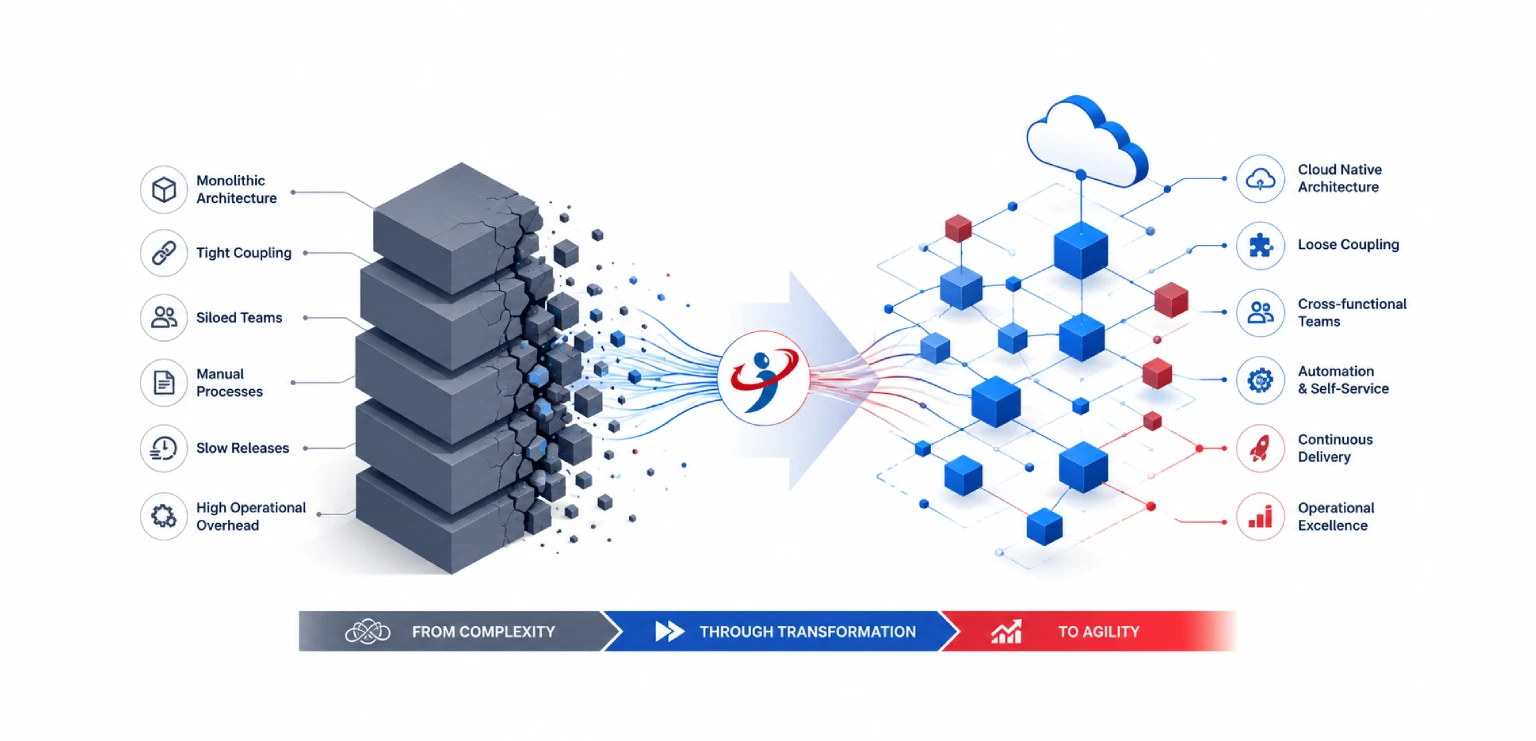
| Moving applications to the cloud is just one aspect of the process. Cloud native transformation entails developing applications which effectively utilize cloud technologies like containers, Kubernetes, APIs, and CI/CD pipelines. If your modernization roadmap includes AWS, you may also find our guide on Application Modernization on AWS: From Legacy Monoliths to Cloud-Native Systems helpful. It explains how organizations can modernize workloads using AWS services while minimizing disruption. Modern application modernization often includes adopting event-driven architectures to improve scalability, resilience, and flexibility. Instead of relying only on synchronous REST APIs, modern applications increasingly use asynchronous messaging platforms such as Apache Kafka and RabbitMQ to enable communication between services. These event-driven patterns reduce tight coupling, improve fault tolerance, and allow applications to process workloads more efficiently. Since many legacy systems were built without these capabilities, introducing event-driven communication is often a key step in cloud-native transformation. Cloud-native applications provide: |
| • Better scalability • Faster software releases • Improved reliability • Lower infrastructure costs • Greater flexibility for future innovation |
| Rather than scaling an entire application under peak loads, cloud-native approaches can help scale up services individually, leading to better performance and efficiency. |
|
When Should You Move from Monolith to Microservices?
| Microservices are powerful — but not every application needs them |
| Legacy systems are mostly monoliths, where all functionality exists within a single code base. Though dependable, such architecture gets increasingly difficult to maintain as a business expands. It is time to move from a monolith to microservices architecture when: |
|
| • Multiple development teams work on the application. • Features require frequent updates. • Traffic varies across different services. • Faster software releases are a priority. • Scalability has become a challenge. |
| However, not every application needs microservices. If a monolithic application continues to meet business needs efficiently, maintaining it may still be the right decision. It may not be the right time to move when: |
| • A small team manages the application. • The product is relatively simple and stable. • Current performance and scalability meet business needs. • A single shared database is still central to the application design. • The added complexity of microservices outweighs the expected business value. |
|
A Practical Modernization Roadmap
| Impressico’s five-stage lifecycle for modernizing without disruption |
| Successful modernization is not a one-time migration project. It requires a structured, phased approach that balances innovation with operational continuity. A well-defined application modernization process helps organizations reduce risk while improving long-term business outcomes. Impressico structures this as a five-stage lifecycle: |
|
| Assess Start the journey by evaluating existing applications, infrastructure, integrations, data flows, and operational dependencies. AI-assisted discovery helps shed light on complex environments and identify modernization priorities.Understand Study business logic, workflows, architectural constraints, technical debt, and modernization risks before deciding on transformation. This guarantees that your modernization initiatives will be in line with business and technology goals. Transform Validate Operate By following this structured lifecycle, organizations can modernize complex technology environments while maintaining operational continuity, reducing transformation risks, and improving long-term engineering agility. |
Modernize or Rebuild?
| One of the biggest decisions a CIO faces — and it’s often a hybrid |
| One of the biggest decisions CIOs face is whether to modernize, rebuild, or combine both approaches. In many enterprise applications, modernization follows a hybrid approach, where some components are modernized while others are rebuilt or replaced based on business value and technical requirements. Modernization is usually the better choice when: |
| • Core business functionality remains valuable. • Existing systems continue to support critical business operations. • Infrastructure or architecture requires improvement rather than complete replacement. • Organizations want faster innovation without disrupting existing processes. |
| Rebuilding becomes the better option when: |
| • The underlying technology stack has become obsolete. • Maintenance costs continue to increase. • Security and compliance risks cannot be effectively addressed. • Business requirements have changed significantly. |
| The right decision depends on balancing business value, modernization costs, business priorities, and long-term flexibility. |
Best Practices for Successful Modernization
| Turning modernization into business value, not an expensive tech exercise |
| Companies can get better results from application modernization if they: |
| • Align modernization with organizational objectives. • Focus on high-impact apps. • Manage technical debt consistently. • Automate testing and deployments. • Design security into all phases. • Track business impact, not technical progress. • Regularly review and refresh their application modernization strategy. |
| This approach ensures that application modernization drives tangible business value, rather than turning into an expensive technology exercise. |
CIO Modernization Checklist
| Five questions to answer before the initiative begins |
| Before beginning a modernization initiative, organizations should ensure they have addressed the following questions: |
| ✓ Have the highest-value applications been identified? ✓ Does each application have a clearly defined modernization strategy? ✓ Are business objectives aligned with technology investments? ✓ Have security, compliance, and operational risks been evaluated? ✓ Are success metrics established before implementation begins? |
| Answering these questions early helps reduce project risks and improves the likelihood of successful modernization outcomes. |
Conclusion
| Legacy app modernization is no longer an advantage but rather a must-have for businesses today. Delaying the process results in high technical and business risks along with rising costs and makes it impossible to adapt to changing customer expectations and requirements. Whatever approach an organization takes to modernize its applications—whether through rehosting, replatforming, refactoring, rebuilding, or cloud application modernization—it should be selected based on business value, ROI, and the needs of each application, then executed through a phased modernization plan. There are numerous examples in various industries where modernization already showed real value through tangible results. Financial companies have sped up their release cycles by switching from monolithic apps to microservices, insurers have increased scalability through phased cloud replatforming, and retailers have been able to modernize huge application portfolios using AI-assisted code analysis and modernization with ongoing operations. These outcomes are made possible by means of modern engineering methods and enterprise technologies such as AWS, Azure, and GCP migration services, Docker, Kubernetes, CI/CD pipelines, automated validations, and observability solutions. Impressico Business Solutions brings together the know-how of modernization along with AI-enabled engineering to enable companies to modernize their complicated systems in a manner which has greater visibility, operational continuity, and engineering control while having proper engineering controls in place. In most cases, the first step involved in the process includes a discovery and modernization assessment to define the priorities, risk assessment, roadmap sequencing, and phased delivery timelines. |
|
Frequently Asked Questions
|
|

IBS
Similar articles

Is Your Legacy Application Holding Your Business Back? A Modernization Reality Check
August 10, 2026
Modernize, Rebuild or Retire? A Decision Framework for Enterprise Leaders
August 5, 2026
The Hidden Cost of Technical Debt in Legacy Applications
July 27, 2026
Breaking the Monolith: Migrating Legacy Apps to Microservices on the Cloud
July 10, 2026
Rehost, Replatform, Refactor, Rebuild: Choosing the Right Modernization Path (the 6 R’s)
July 1, 2026
Application Modernization on AWS: From Legacy Monoliths to Cloud-Native Systems
May 29, 2026
