


September 18, 2022
How Does Mobile App Development Benefit A Small Business?
Enjoying this article?
Share it with the world!


Mobile Apps for Small Businesses: 8 Advantages and App Ideas
| ⚡ Quick Answer The main benefits of mobile apps for small businesses are closer customer relationships, more repeat visits, easier bookings and payments, and less admin for a small team. The best approach is to start with one high-value use case, such as loyalty or appointment booking, and grow the app as customers use it. |
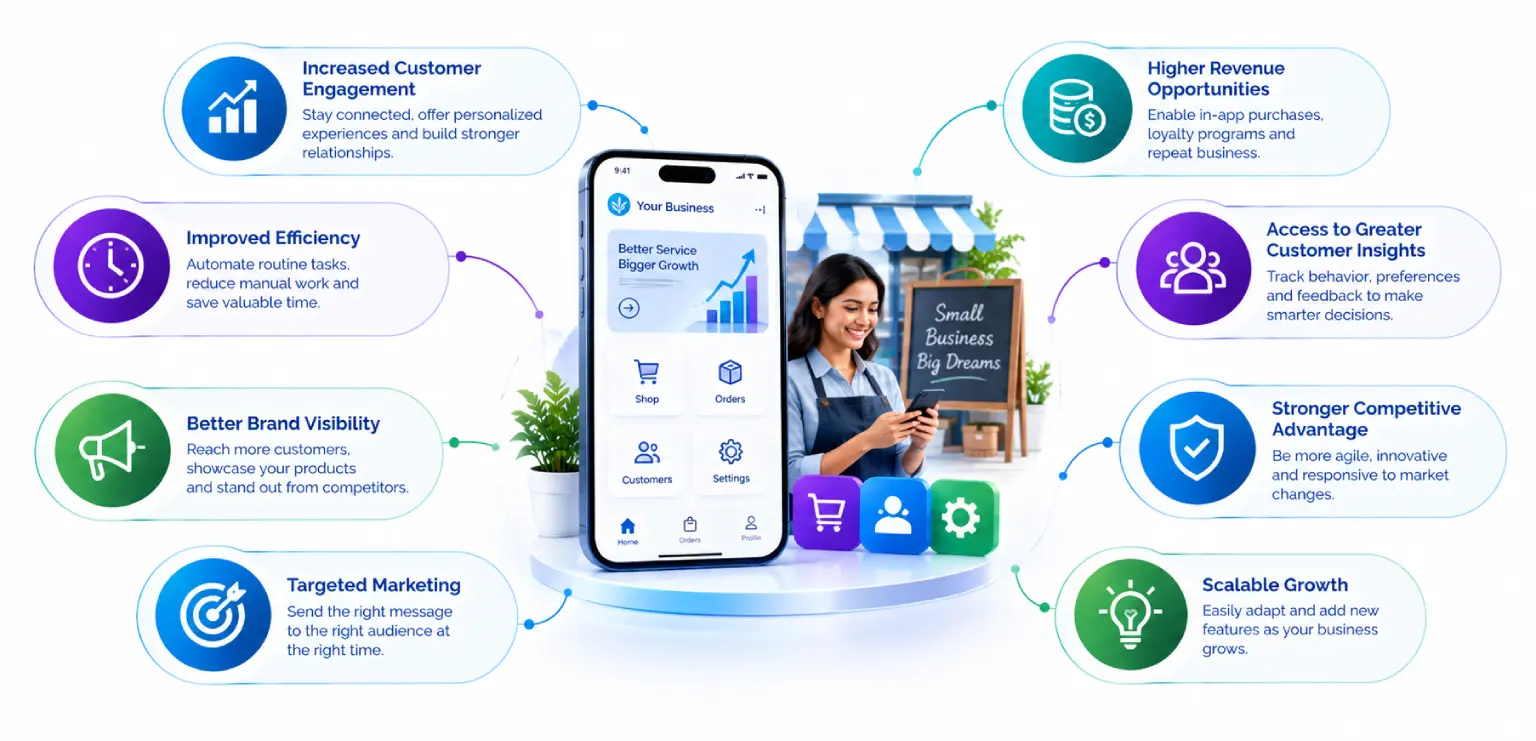
For an owner-operated shop, studio, clinic or trade business, an app can feel like something only big brands build. In practice, the benefits of mobile apps for small businesses come from doing a few everyday things well. Customers book, reorder, pay and get answers in a few taps. Your team spends less time on the phone and more time serving people.
Phones are already where customers spend their attention. Sensor Tower reports that in 2025 people spent 5.3 trillion hours in apps, roughly 3.6 hours per day per mobile user. A focused app puts your business inside that daily routine.
This guide covers eight practical advantages, app ideas you can adapt, and a lean way to launch without a large budget. If you run a larger or fast-scaling company, our companion guide on how mobile apps help businesses grow covers growth levers and metrics in more depth.
8 Benefits of Mobile Apps for Small Businesses
Each benefit below stands on its own. Pick the two or three that match how your customers already buy from you.
1. A direct line to your regular customers
An app icon on a customer’s home screen is a standing invitation to come back. You can share new services, opening hours and offers without paying for every message. Regulars feel recognized, and your best customers stay close.
2. More repeat business through loyalty
Digital stamp cards, points and member-only offers turn occasional visits into habits. A loyalty app also removes lost paper cards and makes rewards easy to redeem. For cafes, salons and retailers, repeat visits are often the most reliable source of revenue.
3. Easier bookings and fewer missed appointments
Customers can book at midnight, reschedule in seconds and receive automatic reminders. Owners get a clear calendar without phone tag. Fewer gaps in the schedule mean more billable hours from the same team.
4. Faster, simpler payments
Saved cards, digital wallets and in-app ordering shorten checkout. Customers can pay ahead, tip, or settle an invoice from the job site. Faster payment also improves cash flow for small teams.
5. Responsive customer service
An in-app help center, chat and order tracking answer common questions before they become calls. Customers get updates when they want them. Your staff handles the requests that truly need a person.
6. A stronger local brand
A well-designed app signals that a small business is organized and easy to work with. Consistent branding, useful content and smooth flows build trust. That trust carries into word-of-mouth and reviews.
7. Useful customer insight
App activity shows which services are popular, when people book and which offers they redeem. Owners can plan staffing, stock and promotions from real behavior. Even simple reports help you make better weekly decisions.
8. Smoother teamwork for a small staff
Internal app features such as shared schedules, job checklists and photo notes keep a small team aligned. Field staff can update jobs on site. Less double entry means more time for customers.
Small Business App Ideas You Can Adapt
These ideas build on the strongest use cases for local and service businesses. Start with one, then add others as customers respond.
Customer loyalty app
Loyalty apps suit cafes, restaurants, boutiques and personal services.
| Digital stamp cards or points that reward each visit | |
| Birthday and member-only offers | |
| Referral rewards that turn regulars into promoters | |
| Simple redemption at the counter by QR code |
Appointment booking app
An appointment booking app fits salons, fitness studios, clinics, tutors and repair services.
| Real-time availability by staff member and service | |
| Automatic reminders by push notification or SMS | |
| Easy rescheduling and waitlists to fill open slots | |
| Deposits or prepayment to secure busy time slots |
Mobile ordering and payments
Ideal for food service, retail and trades that invoice on site.
| Order ahead and pick up, or reorder favorites in one tap | |
| Secure card and digital wallet payments | |
| Digital receipts and invoices sent instantly |
Customer service and updates
Useful for any business with frequent questions or multi-step jobs.
| Searchable FAQs and service guides | |
| In-app chat or callback requests | |
| Job and order status updates with photos |
Team collaboration tools
A private staff app helps owner-led teams stay coordinated.
| Shared rosters and shift swaps | |
| Job checklists and site notes | |
| Announcements and document sharing in one place |
How to Start Lean With a Mobile App for Small Business
A mobile app for small business does not need to launch with every feature. A lean, staged plan keeps cost predictable and lets customer feedback guide the next step.
Start with one use case
Choose the single job that matters most to your customers, such as booking or loyalty. Define what success looks like, for example more online bookings or more repeat visits. Launch that well before adding more.
Control cost with PWA or cross-platform builds
A progressive web app (PWA) runs in the browser, installs to the home screen and needs no app store approval. It is a quick, budget-friendly first step. Cross-platform frameworks such as Flutter or React Native let one codebase serve both iOS and Android. A hybrid app development company can help you choose the right option for your audience and budget.
Weigh no-code and custom options
Both paths have a clear place:
| No-code and template apps are fast to launch and well suited to testing an idea or running a standard loyalty or booking flow. | |
| Custom apps fit businesses with unique workflows, integrations with existing systems, or plans to scale. They give full control over design, data and features. |
Many owners start with a template or PWA, then move to a custom build once demand is proven. For a deeper comparison, see our guide to the benefits of custom mobile apps.
Plan for adoption from day one
| Promote the app at the counter, on receipts and on your website | |
| Offer a welcome reward for the first booking or order | |
| Ask for feedback early and release small improvements often |
Key Takeaways
| The benefits of mobile apps for small businesses come from everyday convenience: booking, paying, reordering and getting help. | |
| Loyalty and appointment booking are two of the strongest first use cases for local and service firms. | |
| Start lean with one use case, then expand based on customer behavior. | |
| PWAs and cross-platform builds keep the first release affordable across iOS and Android. | |
| No-code tools suit early testing, while custom apps suit unique workflows and long-term growth. |
Frequently Asked Questions
| What are the main benefits of mobile apps for small businesses? The main benefits of mobile apps for small businesses are stronger customer relationships, more repeat visits, easier bookings and payments, faster customer service and less admin work for staff. An app also gives owners useful data on what customers buy and when. Together, these help a small team serve more people with the same resources. |
| Is a mobile app for small business worth the cost? It is usually worthwhile when the app solves a frequent customer task, such as booking, reordering or loyalty rewards. Starting with one use case through a PWA, template or cross-platform build keeps early cost modest. You can then measure results, such as repeat visits or online bookings, before investing in more features. |
| What are good small business app ideas? Strong small business app ideas include a customer loyalty app, an appointment booking app, order-ahead and mobile payments, in-app customer service, and a private staff app for scheduling and job notes. The best idea is the one that matches how your customers already interact with you, so start with your most common request. |
| How does a customer loyalty app increase repeat business? It makes rewards visible and easy to redeem, which encourages customers to return. Digital points, stamp cards and member-only offers replace paper cards that get lost. Owners can also send timely offers to regulars, such as a reward on a birthday or after a period without a visit. |
| Should a small business choose no-code or a custom app? No-code and template apps are a fast, affordable way to test an idea or run a standard booking or loyalty flow. A custom app is a better fit when you need unique workflows, integrations with existing systems, or room to scale. Many businesses start with no-code and move to custom once demand is clear. |
| How long does it take to launch a first app? A simple PWA or template-based app can often go live in a few weeks. A custom app with integrations takes longer, depending on scope, design and testing. Launching one focused use case first shortens the timeline and gives you real customer feedback to plan the next release. |
Your First Small Business App
The benefits of mobile apps for small businesses build over time as customers make the app part of their routine. Impressico helps owners scope a lean first release, choose the right platform approach and build an app that grows with the business.
| Ready to scope your first app? We start with the one job your customers do most, and build outward from there. |
Impressico Business Solutions — mobile app development for small businesses, from a lean first release to a product that scales.

IBS
Similar articles

AI in Mobile App Development: What the Research Actually Shows
July 9, 2025
Mobile App Testing Process: Types, Devices and Automation Explained
November 4, 2022
How Does Custom Mobile App Development Help Boost Your Business?
October 24, 2022
Importance of Mobile App Testing: 7 Benefits for Quality and Growth
October 12, 2022
How Mobile Apps Help Businesses Grow: 7 Growth Levers That Compound
September 16, 2022
Android App Development Trends that You Should Know
July 15, 2022
