


September 16, 2022
How Mobile Apps Help Businesses Grow: 7 Growth Levers That Compound
Enjoying this article?
Share it with the world!


Learn How Mobile Apps Help Businesses Grow
| ⚡ Quick Answer Mobile apps help businesses grow by creating an owned channel to customers, lifting retention and lifetime value, enabling personalization from first-party data, opening new revenue models and making operations more efficient. Growth compounds when each lever is measured and improved release by release. |
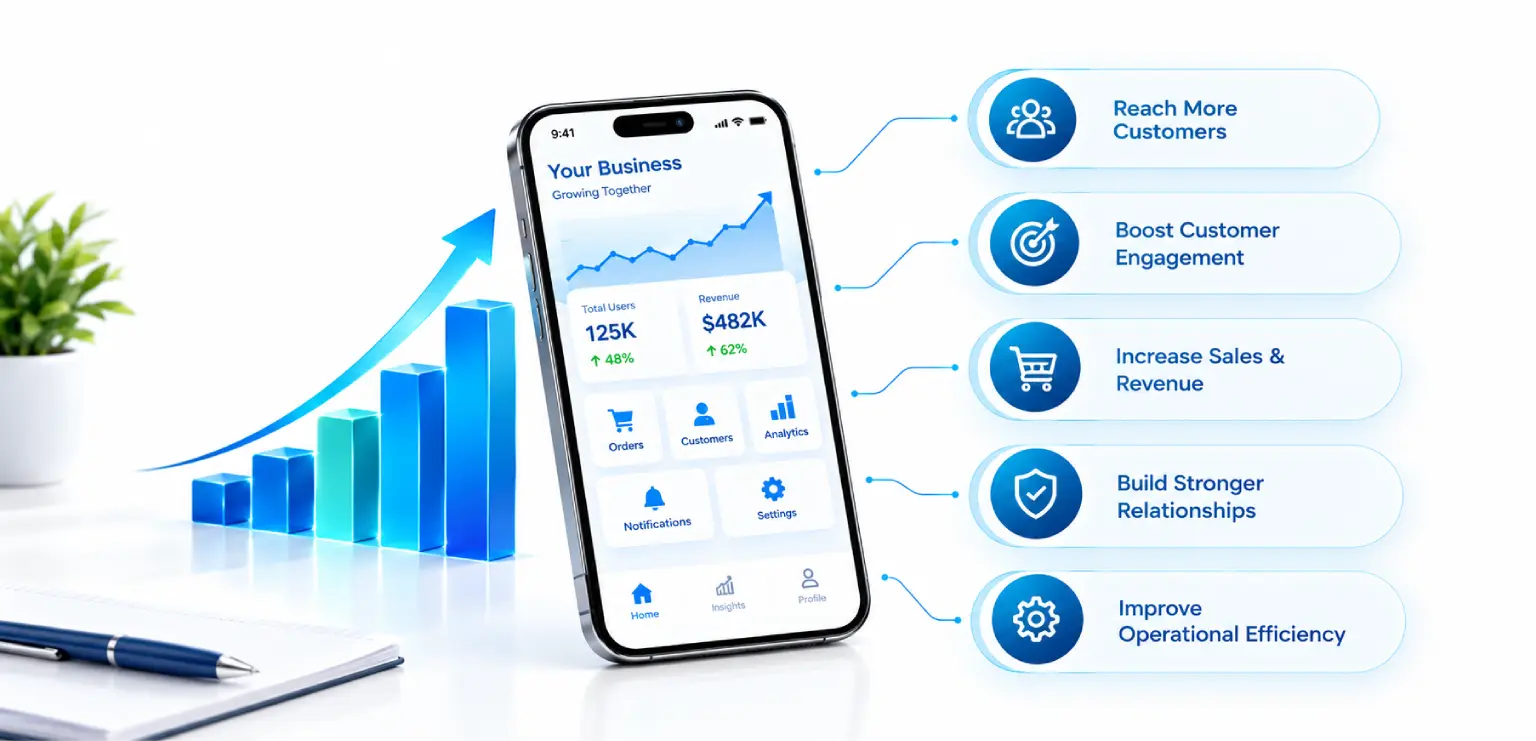
For an established or scaling business, the real question is how mobile apps help businesses grow beyond a first launch. The answer is a set of levers that reinforce each other. An app gives you a direct channel, richer data and new ways to deliver value. Used together, these levers compound.
Customer attention supports the case. Sensor Tower’s State of Mobile 2026 report shows consumers spent 5.3 trillion hours in apps in 2025, roughly 3.6 hours per day per mobile user. In-app purchase and paid app revenue reached $167 billion, and non-game app revenue surpassed games for the first time.
This guide breaks down seven growth levers and the metrics that show whether they are working. If you run a small, owner-led business, start with our guide to the benefits of mobile apps for small businesses.
How Mobile Apps Help Businesses Grow: 7 Levers
Each lever below can stand alone, but the strongest mobile app growth strategies combine several. Retention improves monetization. Data improves personalization. Operations improve the customer experience.
1. A direct channel and an owned audience
An installed app is a channel you own. You reach signed-in customers directly, without bidding for every impression on third-party platforms. Over time, this audience becomes a durable asset.
| Account-based experiences tied to a customer profile | |
| Direct offers, content and service updates | |
| Lower dependence on paid media for repeat sales |
Acquisition still matters. App store presence, referrals and campaigns bring new users in. Our guide to mobile app marketing trends covers that side in detail.
2. Customer retention with apps
Retention is the lever that compounds most. A retained customer buys more often, costs less to serve and refers others. Apps support retention through convenience, rewards and habit.
| Saved preferences, one-tap reorders and stored payment methods | |
| Tiered loyalty programs and member benefits | |
| Onboarding flows that show value in the first session |
3. Personalization from first-party data
App usage generates first-party data with clear consent. That data powers relevant recommendations, content and offers. Personalization raises engagement because each session feels more useful.
| Recommendations based on browsing and purchase history | |
| Location- or context-aware content, with explicit permission | |
| Segments for offers by lifecycle stage |
Collect only what you need and explain why. Privacy rules such as GDPR in the EU and equivalent local laws set the baseline. Clear consent builds trust that supports growth.
4. A value-led push notification strategy
A strong push notification strategy is permission-based and useful. Ask for opt-in at a moment when the value is obvious, such as order tracking. Then send messages customers are glad to receive.
| Transactional updates: orders, bookings, deliveries | |
| Personalized reminders, such as a saved cart or a back-in-stock item | |
| Frequency caps and user-controlled preferences |
Measure opt-in rate, open rate and opt-outs together. That balance keeps notifications a growth channel over the long term.
5. App monetization models
Apps open revenue streams that fit different products. The right app monetization models depend on how customers perceive value.
| Subscriptions for ongoing content, services or premium features | |
| In-app purchases for one-time upgrades, credits or digital goods | |
| Freemium to grow a broad user base and convert engaged users | |
| In-app advertising for high-reach, free-to-use apps | |
| Commerce for physical goods and services ordered in the app |
Many businesses blend models, such as freemium with a subscription tier. Test pricing and packaging the same way you test features.
6. Operational efficiency
Growth also comes from doing more with the same team. Internal and field apps give staff real-time access to jobs, inventory and customer records.
| Field service apps with scheduling, checklists and photo capture | |
| Store and warehouse apps for stock checks and fulfillment | |
| Approvals and workflows that move off paper and email |
Efficiency gains free budget and time to reinvest in customer-facing growth. This internal side is often overlooked when leaders ask how mobile apps help businesses grow, yet it shapes margins as much as new revenue does. Faster service also lifts customer satisfaction and repeat business.
7. Product insight from app analytics
Every tap is a signal. App analytics show where users succeed, where they drop off and which features drive repeat use. Product teams can then prioritize with evidence.
| Funnel analysis for sign-up, checkout and key actions | |
| Feature adoption and cohort trends | |
| In-app feedback and store review themes |
Insight is also where the levers connect. Analytics reveal which retention, personalization and monetization changes made a measurable difference, so the roadmap keeps improving how mobile apps help businesses grow in your specific market.
Platform choice affects reach and insight. For audiences that lean toward Apple devices, an experienced iOS app development company can help you use native capabilities well.
Metrics to Track App-Led Growth
Clear metrics show leadership exactly how mobile apps help businesses grow, and they turn these levers into a repeatable system. Set a baseline at launch, then track trends by cohort and release. Benchmarks vary widely by category, so compare against your own history first.
| Retention rate at day 1, day 7 and day 30, by acquisition cohort | |
| DAU/MAU ratio to gauge how habitual the app has become | |
| Conversion rate for key actions, such as sign-up, purchase or booking | |
| Customer lifetime value (LTV) compared with acquisition cost | |
| Average revenue per user by monetization model | |
| Push opt-in and engagement rates to validate your push notification strategy | |
| App store ratings and review themes as a signal of quality and trust |
Review these together. A rise in conversion with a fall in retention, for example, points to a different next step than steady growth across all metrics.
Turning Levers Into a Growth Roadmap
Strong mobile app growth strategies follow a simple loop. Pick one lever with clear upside. Ship a focused improvement. Measure, learn and repeat.
| Audit current metrics and identify the biggest gap, often customer retention with apps. | |
| Prioritize two or three levers that reinforce each other. | |
| Define a target metric for each release. | |
| Use analytics and feedback to plan the next cycle. |
This loop is how mobile apps help businesses grow steadily rather than in one-time spikes.
Key Takeaways
Five things to carry into planning
| How mobile apps help businesses grow comes down to seven levers: owned channel, retention, personalization, push, monetization, operations and insight. | |
| Customer retention with apps is the lever that compounds most. | |
| First-party data with clear consent powers personalization and trust. | |
| App monetization models can be blended and tested like any product feature. | |
| Track retention, DAU/MAU, conversion, LTV and ratings against your own baseline. |
Frequently Asked Questions
| How do mobile apps help businesses grow? Mobile apps help businesses grow by giving them a direct channel to customers, increasing retention and lifetime value, and enabling personalization from first-party data. Apps also add revenue through subscriptions, in-app purchases or commerce, and improve operations through staff and field tools. Growth compounds when these levers are measured and improved with each release. |
| What are the most effective mobile app growth strategies? The most effective approaches focus on retention first, then personalization and monetization. Strong onboarding, saved preferences and loyalty rewards keep users returning. Relevant, permission-based notifications bring them back at the right moment. Analytics then show which features and offers drive value, so teams can prioritize the next release with evidence. |
| Which app monetization models work best? The best model depends on how customers see value. Subscriptions suit ongoing content or services. In-app purchases fit one-time upgrades or digital goods. Freemium builds a broad base and converts engaged users. In-app advertising suits high-reach free apps. Many businesses combine models and test pricing over time. |
| How often should an app send push notifications? There is no single right number. Send notifications when they carry clear value, such as order updates or personalized reminders. Let users choose topics and frequency, and apply frequency caps. Track opt-in, open and opt-out rates together, and reduce volume if opt-outs rise. |
| Which metrics show that an app is driving growth? Key metrics include retention by cohort, DAU/MAU ratio, conversion rate for core actions, customer lifetime value, average revenue per user and app store ratings. Compare each against your own baseline and track trends by release. Together they show whether the app is building lasting customer value. |
Build Your Next Growth Lever
Impressico helps established and scaling businesses plan, build and improve apps around measurable growth goals, from retention and personalization to monetization and field operations.
| Ready to discuss your roadmap? We start by finding which lever has the biggest gap in your current metrics, then build the release around closing it. |
Impressico Business Solutions — mobile app development built around retention, monetization and the analytics that prove both.

IBS
Similar articles

AI in Mobile App Development: What the Research Actually Shows
July 9, 2025
Mobile App Testing Process: Types, Devices and Automation Explained
November 4, 2022
How Does Custom Mobile App Development Help Boost Your Business?
October 24, 2022
Importance of Mobile App Testing: 7 Benefits for Quality and Growth
October 12, 2022
How Does Mobile App Development Benefit A Small Business?
September 18, 2022
Android App Development Trends that You Should Know
July 15, 2022
