
December 11, 2020
How DevOps Improves Customer Satisfaction and Retention
Enjoying this article?
Share it with the world!


How DevOps Improves Customer Satisfaction: 3 Ways
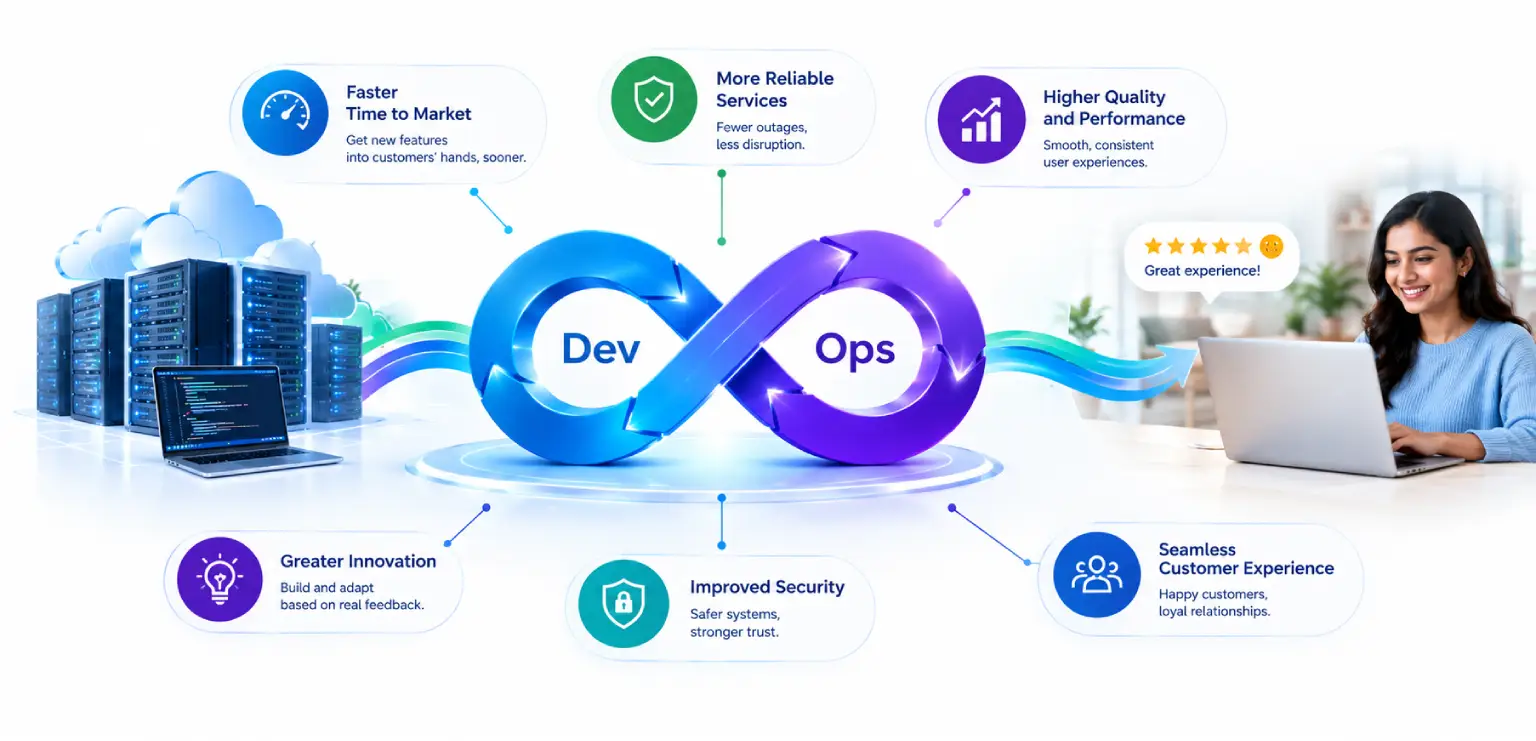
| ⚡ Quick Answer DevOps improves customer satisfaction through three mechanisms. Faster feedback — integrated feedback loops mean bugs and complaints get fixed quickly rather than waiting for the next release. Faster delivery — removing routine work and automating operations cuts the time between a customer need and a shipped product. And lower cost — shorter cycle times reduce what it costs to build, which can pass through to price. All three depend on breaking down departmental silos, which is why adoption needs a roadmap rather than a tooling decision. |
The advent of Digital Transformation has reformed, the way people live their lives, but also the way organizations connect and contact their customers. In fact, major overhauls have happened in terms of giving overall customer satisfaction, mainly in the technological aspect of a 21st-century company.
Entrepreneurs have never been more conscious of the disruptive effect of digital technology. Across every sector of the industry, companies are embarking on digital transformation programs geared towards enhancing internal systems and providing better products and services to clients.
However, no organization can allow to see a ‘digital first’ program as a single fix or even as a sequence of yearly iterations. Software is changing commerce, not in flurries of activity pursued by periods of stability, but in a continuous flow of market-driven innovation.
As customers want more, market leading organizations are finding newer ways to cater to them. However, instead of waiting for competitors to play catch up, the same market leaders continue to innovate, week by week and month by month.
This produces a real challenge for organizations accustomed to rolling out new products or developing digital services possibly once a year. In a fast-moving market, a software-driven service created today for roll-out six months down the line may be outdated by the time it’s launched.
That’s why utilizing DevOps consulting services from a devops solution provider has become extremely important. By utilizing the concept of agility to a methodology that allows constant software innovation, DevOps allows businesses to respond dynamically to the fast-changing market conditions and growing customer expectations. Digital transformation across industries sets the wider context.
Why do organizations need a DevOps roadmap?
The adoption of a DevOps approach will require not just a readiness to grasp cultural change within the organization, but also new structures and better approaches for working. Specifically, the DevOps model includes developers working together day-by-day with different stakeholders within the business; the software team could be working with client assistance or request handling staff, for instance. As such, DevOps includes the breakdown of conventional departmental silos.
For many businesses, this will signify a major change in working practices and it is crucial that any DevOps-led program is reinforced by a roadmap. The cultural side of DevOps adoption covers what that roadmap has to address, and the DevOps maturity model gives you a way to assess where you are starting from.
| Source The three reasons below follow the framework set out in Vikas Agrawal’s How DevOps Can Help in Improving Customer Satisfaction (CustomerThink, April 2018). |
A global study organized by CA Technologies — 1,300 senior IT decision-makers across 21 countries, conducted by Vanson Bourne — found that DevOps adopters reported improvements of 17 to 23 percent across revenue, time to market, competitive positioning and customer experience, along with a 22 percent increase in customer numbers. Here are some reasons why:
1. Faster customer feedback and response
The sheer number of mobile applications and other software-based products in existence have changed the competitive backdrop in terms of consumer loyalty. Customers today expect that an organization will respond promptly and will manage their complaints, questions, and suggestions as quickly as possible.
If a business won’t be able to respond to the demand, then the consumer will merely switch to other alternatives and might prefer to do business with a competitor instead. With the incorporated and frequent feedback loop system of a DevOps business, mobile applications support has the ability to fix bugs and errors in no time. That loop depends on monitoring that actually tells you something and mobile app testing catching problems before customers do.
2. Products are made and delivered rapidly
Gone are the days when a competitor will create a cutting-edge product and a competing company will take several months or even years just to come up with their own concept that matches the quality of the first product.
By removing routine tasks, simplifying the processes, and automating most of its operations, an organization that adopts a DevOps culture can develop a product at fast speed. In other words, it decreased the time required for software delivery. That is what CI/CD pipeline automation and a complete automation framework are built to deliver — and the mistakes that undo it are worth knowing first.
It is the reason why technological innovations are now occurring in a matter of days or weeks. And also, with new and better products that are according to customer inclinations, the customer satisfaction will be taken care of. Agile software development is the practice this builds on, and reducing deployment downtime is how you ship that often without breaking things.
Lower price for products
One of the main advantages of using DevOps is the shorter time that is required for production, operation, delivery, and feedback. With the decreased cycle time that is being spent, the cost to build the product is also reduced. This drop in cost translates to lower prices that customers have to pay. On the infrastructure side, how DevOps reduces cloud costs covers the other half of the saving.
Truly, DevOps did not only remove the conventional barrier between developers and operators, it also offered a way for businesses to adjust to shifting consumer demands and hence, enormously affect the organization’s ability to influence customer satisfaction.
There are numerous ways in which a DevOps model can help businesses achieve 100% customer satisfaction. So, this is a high time to adopt DevOps approach to ensure faster delivery, higher customer satisfaction and let your business achieve newer heights of success.
If you want to measure the effect rather than assume it, the DevOps metrics every CTO should track is the place to start, and QA testing is what keeps quality from slipping as pace increases. On the experience side itself, where UX meets CX and front-end development decide what the customer actually feels. For the cloud half of this argument, see why DevOps and cloud are essential to digital transformation.
| Key Takeaways
|
| Ready to make DevOps something your customers notice? Impressico helps organizations connect delivery practice to customer outcomes — faster feedback, faster releases, and the measurement to prove the difference. 🚀 Talk to Our DevOps TeamDevOps Metrics Every CTO Should Track → |
Impressico Business Solutions — DevOps consulting, delivery automation and customer-facing engineering for organizations that ship continuously.

IBS
Similar articles

Shift-Left Security in CI/CD Pipelines: A Practical Playbook
September 4, 2026
DevSecOps: Shifting Security Left Without Slowing Delivery
September 2, 2026
Is Your Engineering Team Ready for Platform Engineering? A Readiness Checklist
August 12, 2026
Measuring Platform Engineering ROI: DORA and SPACE Explained
July 31, 2026
Internal Developer Platforms: Building a Golden Path for Engineering Teams
July 22, 2026
AIOps in Practice: Using AI to Cut Incidents and MTTR
July 6, 2026