


March 23, 2026
Why Most Generative AI POCs Never Reach Production
Enjoying this article?
Share it with the world!


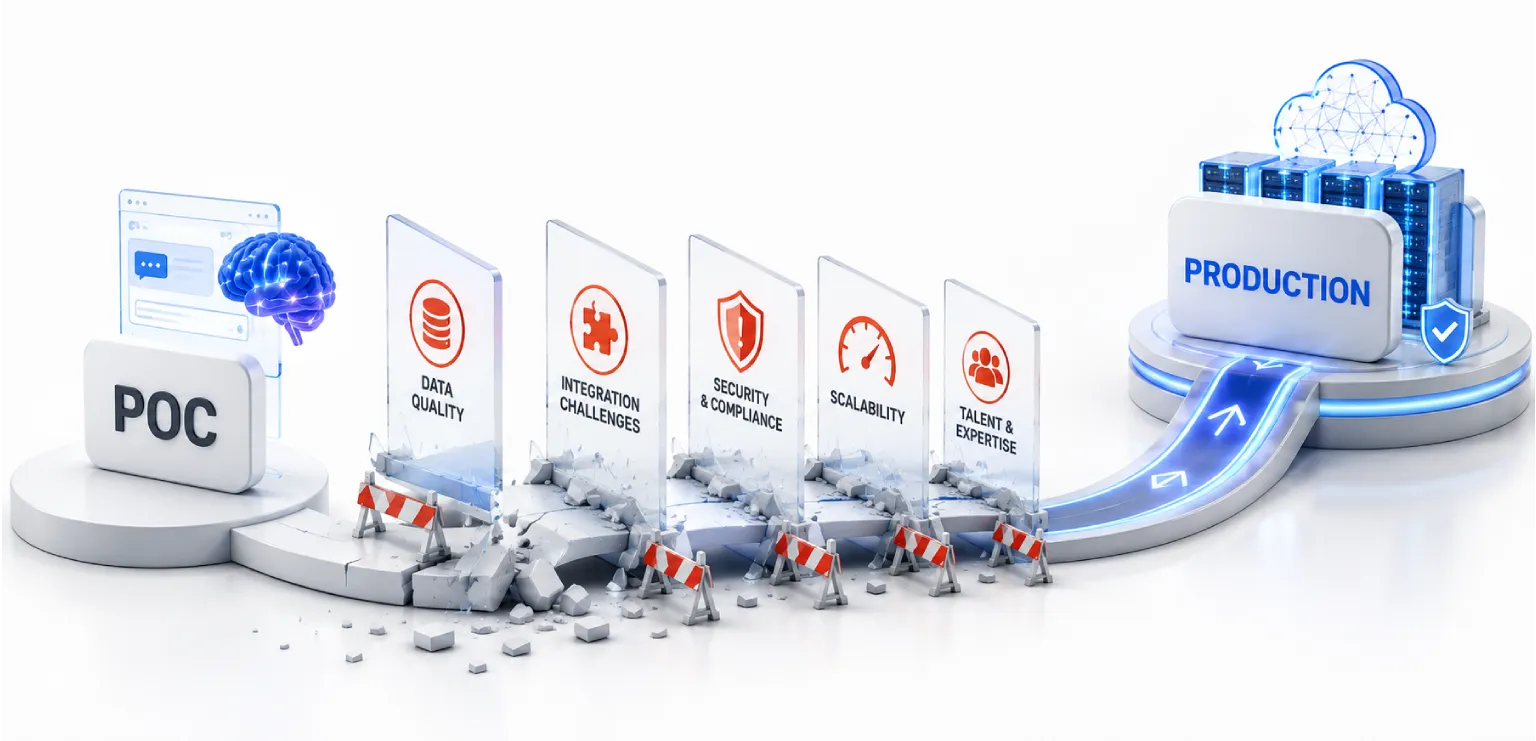
GEN AI Poc to Production Gap
| ⚡ Quick Answer Generative AI prototypes stall before production because building a demo and building a product are different engineering problems. A POC proves an LLM can return a good answer; production requires evaluation pipelines, data quality work, cost controls, latency budgets, fallback architecture, and security review. Teams that treat generative AI as a full software product from day one — with KPIs defined before the build — are the ones that ship. |
There’s a pattern playing out in boardrooms and tech teams across just about every industry. A company gets excited about generative AI, wires up an API, builds something that looks magical in a demo — and then… nothing. The project stalls. Months pass. The prototype never reaches real users.
This isn’t a rare edge case. It’s become the norm.
According to Gartner, at least 30% of generative AI projects will be abandoned after the proof of concept stage — citing poor data quality, unexpected costs, and unclear business value. McKinsey echoes this: while over 55% of organizations have adopted some form of AI, only a fraction successfully scales to production.
— Gartner 2024 & McKinsey State of AI Report
So why does this keep happening? And more importantly, what can teams do differently?
The Scale of the Problem
| |
|
Where the Numbers Stand in 2026
Two years of newer survey data — and the gap has widened, not closed
| |
The figures above come from 2024 research. Two further survey cycles have run since, and they tell a sharper version of the same story: adoption climbed steeply, while the share of organisations converting pilots into scaled systems barely moved.
| Adoption Up, Scaling Flat
The share of companies abandoning most of their AI initiatives rose from 17% to 42% year over year. |
Read together, these figures reframe the problem. In 2024 the question was whether enterprises would adopt generative AI. They have. The open question now is operational: nearly nine in ten organisations run AI somewhere, fewer than one in ten run it at scale, and almost half of everything built as a proof of concept is discarded. The bottleneck moved from ambition to engineering.
POC vs. Production: They're Not the Same Thing
| |
The Core Distinction
Engineers creating proofs of concept have one goal: demonstrate that something is achievable. Production is an entirely different challenge — questions shift from “Can this work?” to “Will this work consistently for every user under all conditions?”
|
The Problem Is Bigger Than People Realize
| |
The Hidden Reality
The failure rate of generative AI POCs is one of the most underreported stories in enterprise technology. Teams celebrate the demo win, leadership approves the next phase, and then the harsh realities of production engineering start piling up.
A 2024 S&P Global Market Intelligence survey found that 91% of organizations experienced significant barriers to AI adoption — data readiness, integration complexity, and cost being the top blockers. These aren’t startup problems. They’re showing up at Fortune 500 companies with dedicated AI teams and real budgets.
— S&P Global Market Intelligence, 2024
Building a generative AI demo has never been easier — you can call an API in a few lines of code and have something that looks like magic within a week. But that simplicity is deceptive. It masks everything that actually makes a system production-ready.
What Nobody Talks About in the Demo
The 9 Challenges
| |
|
| ||
|
| ||
|
| ||
|
| ||
| |||
| Facing these challenges in your AI roadmap? Impressico helps enterprises navigate every stage — from POC to production-grade deployment. |
What's Really Going On Under the Hood
Challenge Deep Dives
| |
The Demo-to-Production Gap
A POC usually runs on a laptop, talks to one API, and gets tested by three people. A production system might handle thousands of concurrent users, route across multiple services, require 99.9% uptime, and log every interaction for compliance. Teams that treat generative AI as just an LLM integration — rather than a full software engineering challenge — consistently underestimate what’s required.
Data Quality Is Almost Always the Real Problem
Most enterprise data is a mess. Documents are in inconsistent formats. PDFs are scanned images with no embedded text. The same concept is described five different ways across five different systems. When you build a RAG system on top of this data, the AI doesn’t make bad data good — it just makes bad data sound confident.
IBM’s research on AI adoption found data quality to be the single largest barrier enterprises face when moving AI from pilot to production. This is not a technical problem you can LLM your way out of. It requires real data engineering work.
— IBM Institute for Business Value
Related reading: Is Your Data Ready for Generative AI?
Retrieval Failures in RAG Systems
Chunking strategy matters enormously. Split documents the wrong way and a question about a contract clause might return formatting text, not actual content. Each of these decisions, made casually during a POC, can silently degrade response quality in ways that are hard to detect until real users start complaining.
How to Measure Success
In traditional software, you run unit tests. In generative AI, outputs are probabilistic and open-ended. Industry frameworks like RAGAS, G-Eval, and observability platforms like Arize exist precisely to bring rigor to this problem — measuring answer faithfulness, context relevance, and retrieval precision systematically.
The Cost of Running This at Scale
Token costs sneak up on teams. In a POC, you’re making a few hundred LLM calls. In production, you might be making millions. Without careful cost optimization — prompt compression, caching, tiered model selection, batching — LLM inference costs can make a product economically unviable before it finds its footing.
A Harvard Business School study noted that many organizations significantly underestimate the total cost of AI deployment, especially as usage grows.
— Harvard Business School / LexDataLabs
Latency and User Expectations
Consumer expectations have been set by Google, which returns results in milliseconds. When an AI assistant takes 8–12 seconds to respond, users disengage. Streaming responses help perceived speed, but they don’t fix underlying infrastructure issues. Optimizing for latency requires architectural choices most POC teams skip entirely.
Infrastructure Reliability Is a House of Cards
Production generative AI systems depend on several external services simultaneously — LLM APIs, vector databases, embedding models, document storage, orchestration frameworks, logging systems. Any one can go down. Building for reliability means designing fallbacks, circuit breakers, retry logic, and graceful degradation from the beginning.
Security and Compliance Are Not Optional
When real user data flows through a generative AI system, regulatory stakes rise immediately. Prompt injection — where malicious input manipulates AI behavior — is an increasingly documented attack vector. Data leakage across user sessions is a real risk in multi-tenant systems requiring security architecture that simply isn’t part of most POC conversations.
ROI Is Hard to Prove
Even when teams overcome the technical challenges, they struggle to demonstrate clear business value. Without clear KPIs defined before the build — reduce support tickets? Cut document review time? — many enterprise AI projects get quietly shelved not because they failed technically, but because nobody could point to the money saved or made.
Related reading: How to Measure ROI from Generative AI Projects
Eight Questions to Ask Before You Build
A diagnostic for teams already holding a working demo
| |
The playbook that follows describes what to do. This is the shorter diagnostic that tells you whether you are about to stall. Each question maps to one of the nine challenges above, and each one has a factual answer — not an opinion. If you cannot answer six of the eight, the prototype is not ready to become a project.
|
| The Reality Question eight is the one that most reliably predicts failure. A prototype with no named operational owner is not a system — it is a demonstration with a URL. Ownership is usually assigned after launch, which is precisely when it is least likely to be accepted. |
Getting to Production: The Proven Playbook
What Actually Works
| |
The teams that successfully cross the finish line treat this like a full software product from day one — not a research experiment.
| 🎯 Step 01 Start With a Real Problem Focus ruthlessly on a use case that solves a measurable business problem — internal document Q&A, contract review, customer support triage. Novelty isn’t a use case. If you can’t define the KPI before you build, don’t build yet. |
| 🏛 Step 02 Treat Data as the Foundation Before writing a single line of LLM code, invest in understanding what your data actually looks like. Document ingestion pipelines must handle PDFs, Word docs, scanned images, and inconsistent formatting gracefully. The unglamorous work that separates working production systems from broken demos. |
| 📐 Step 03 Build Evaluation From Day One Create a benchmark dataset of representative questions and expected answers before deploying to users. Run automated evaluation on every model output during testing. Track hallucination rates, retrieval precision, and user satisfaction as ongoing metrics — not a one-time check. |
| ⚡ Step 04 Optimize for Cost & Speed Early Choose the right model for the task — not just the most powerful one. Implement semantic caching (reusing responses to similar queries) and model routing (directing simple tasks to smaller, faster models). These decisions made early compound into significant savings at scale. |
| 🛡 Step 05 Engineer for Reliability Design the system to fail gracefully. Implement rate limit handling, retry with exponential backoff, and fallback responses. Add logging and alerting from the start so issues surface before users report them. Treat the AI system like any other critical piece of production infrastructure — because it is one. |
|
| ||
|
| ||
|
|
| Already have a demo that works? The gap to production is usually four or five specific pieces of engineering, not a rebuild. Identifying which ones takes days, not months. |
| 💡 From Impressico’s Experience The teams that successfully move from generative AI POC to production are the ones that treat the project like a full software product from the beginning. That means product managers who define success metrics upfront. Engineers who think about reliability and security before features. Data teams who clean and structure information before it ever touches a model. And leaders who understand that a working demo is not the finish line — it’s the starting gun. The technology is genuinely powerful. The failure rate of generative AI POCs isn’t because the AI doesn’t work. It’s because organizations confuse the ease of building a prototype with the difficulty of building a product. Close that gap and the results speak for themselves. |
| Key Takeaways
|
Frequently Asked Questions
| Why do most generative AI POCs fail to reach production? Not because the model underperforms. POCs are built to answer “can this work?” while production has to answer “will this work for every user, every time, at acceptable cost?” The work that closes that gap — data pipelines, evaluation, cost controls, fallbacks, security review — is rarely scoped when the prototype is approved. |
| How long should the move from POC to production take? It depends far more on data readiness than on model work. Teams with clean, well-structured source data and a defined KPI often ship in weeks. Teams that discover mid-project that a third of their documents are scanned images without embedded text are looking at months, most of it spent on ingestion rather than AI. |
| How do you evaluate a generative AI system when outputs aren’t deterministic? With a benchmark set of representative questions and expected answers, scored on dimensions like answer faithfulness, context relevance, and retrieval precision rather than exact match. Frameworks such as RAGAS and G-Eval, and observability platforms like Arize, exist to make this systematic. The important part is running it on every change, not once before launch. |
| How do you keep LLM inference costs under control at scale? Four levers, in rough order of impact: route simple requests to smaller models rather than sending everything to the largest one; cache semantically similar queries; compress prompts and trim retrieved context; and batch where latency allows. Model the cost per query at expected production volume before committing to an architecture, not after. |
| What is the difference between a generative AI POC and an MLOps problem? They converge. Once a generative AI system is live, it needs the same disciplines that classical machine learning systems need — versioning, monitoring, retraining or re-indexing triggers, and governance. Most of the production gap described here is machine learning operationalization arriving under a different name. |
| Should we build in-house or bring in a partner? The model integration is the part most teams can do themselves. The parts that stall projects — ingestion pipelines for messy documents, evaluation harnesses, cost architecture, security review — are where outside experience shortens the timeline most. A reasonable split is to keep domain knowledge and KPI ownership in-house and bring in help for the production engineering layer. |
| Ready to Go Beyond the Demo? Impressico Business Solutions helps enterprises design, build, and scale AI-powered systems that go beyond the demo — from data architecture and evaluation frameworks to production deployment and ongoing optimization. |
Generative AI · Data Engineering · Production Deployment · impressicobusiness.com

IBS
Similar articles

Chunking Strategies for RAG: What Actually Works in Production
September 16, 2026
Vector Databases Compared: Pinecone vs Weaviate vs Qdrant vs pgvector for Enterprise RAG
September 14, 2026
RAG at Scale: Enterprise Retrieval-Augmented Generation Architecture
September 11, 2026
7 Signs Your Organization Is Ready for AI Agents
August 14, 2026
Governance and Safety for Autonomous AI Agents: A Practical Guide for Enterprises
August 3, 2026
Designing Multi-Agent Systems: Orchestration, Tools & Guardrails
July 24, 2026
