


March 30, 2026
Generative AI Checklist for Enterprise Adoption
Enjoying this article?
Share it with the world!


Generative AI Adoption Checklist
Enterprises today are not asking whether to adopt generative AI—they’re asking how fast they can move. But speed, without clarity, often leads to scattered efforts, wasted budgets, and stalled initiatives. That’s exactly why a well-defined generative AI adoption checklist matters. Instead of jumping straight into tools or models, organizations need to pause and ask a more practical question: Are we actually ready to adopt generative AI at an enterprise level?
| “According to a report by McKinsey, nearly 70% of AI initiatives struggle to move beyond the pilot stage due to organizational and operational gaps.” |
Why Enterprises Need a Generative AI Adoption Checklist Before Getting Started
Many enterprises start with excitement—pilot projects, internal demos, quick wins. But as soon as they try to scale, things begin to slow down.
| ▪ | Data isn’t ready |
| ▪ | Teams are not aligned |
| ▪ | Governance is unclear |
| ▪ | Security concerns start surfacing |
| Key Principle: A checklist doesn’t just guide execution—it helps prevent costly missteps before they happen. |
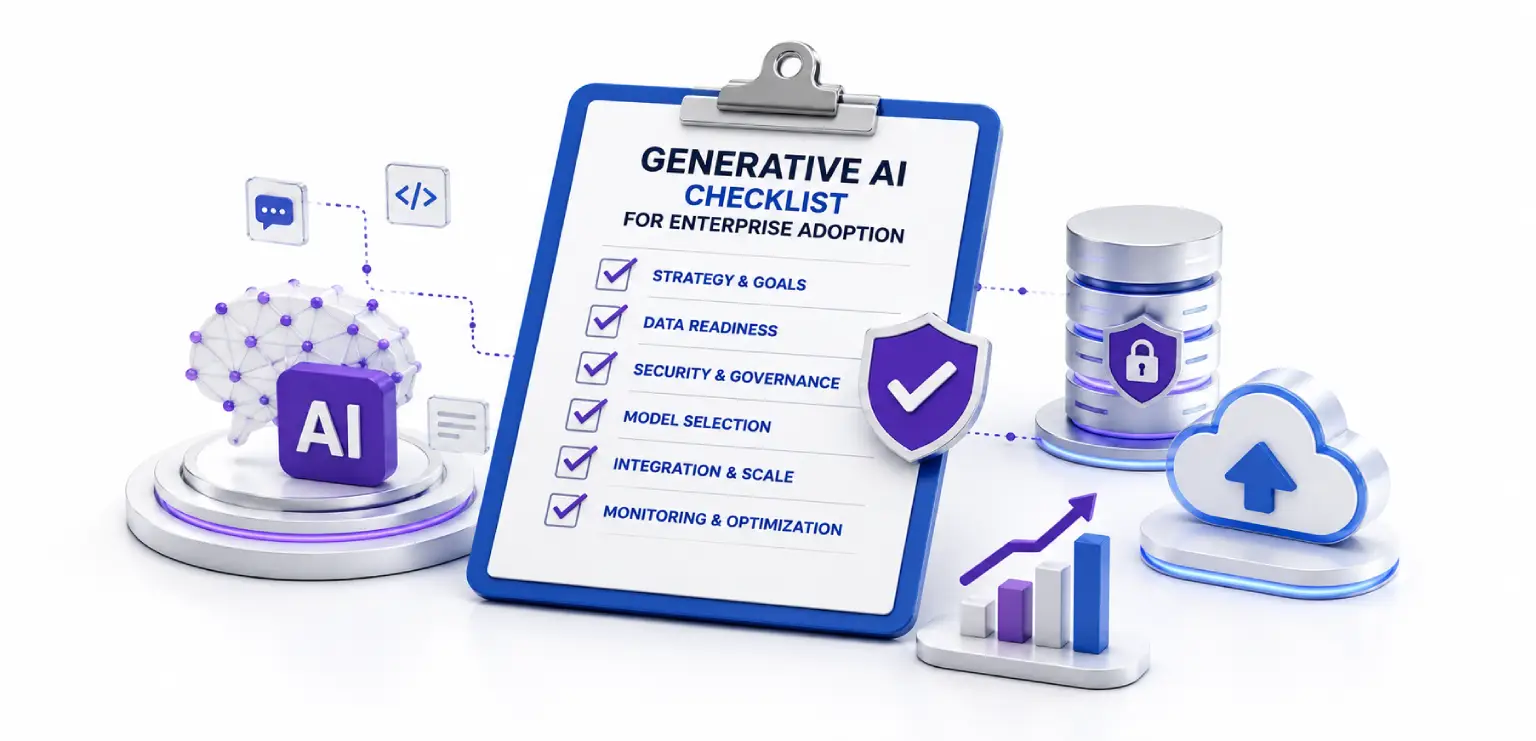
The Complete Generative AI Adoption Checklist for Enterprises
Seven areas to evaluate before you commit budget
Before moving forward, here’s what enterprises need to evaluate carefully.
Business Use Case Clarity (Start With What Matters)
The biggest mistake enterprises make is adopting AI without a clear purpose.
Instead of asking “Where can we use AI?”, the better question is:
| “Where can generative AI create measurable business impact?” |
Focus on:
| ▪ | High-impact, repeatable workflows |
| ▪ | Areas with clear ROI visibility |
| ▪ | Problems that already exist—not hypothetical ones |
This is a core part of any strong generative AI enterprise strategy.
One of the most effective generative AI adoption best practices is simple: start with fewer use cases—but make sure they actually matter. Our guide on how enterprises should start with generative AI covers use-case selection in more depth.
Data Readiness and Accessibility
Generative AI is only as good as the data behind it.
If your data is scattered, inconsistent, or inaccessible, your AI outputs will reflect the same problems.
Ask yourself:
| ▪ | Do we have clean, structured, and usable data? |
| ▪ | Is data ownership clearly defined? |
| ▪ | Can teams access the data they need without friction? |
A study by Gartner highlights that poor data quality costs organizations an average of $12.9 million annually.
| Note: That’s why data readiness is a non-negotiable part of any generative AI readiness checklist for enterprises. See Is Your Data Ready for Generative AI? for a fuller assessment approach, and our data engineering services for the groundwork itself. |
Governance, Risk, and Compliance Structure
As AI adoption grows, so do the risks.
Without a proper generative AI governance framework, enterprises can quickly run into:
| ▪ | Compliance issues |
| ▪ | Ethical concerns |
| ▪ | Lack of accountability |
You need clarity on:
| ▪ | Who owns AI decisions? |
| ▪ | How outputs are monitored and validated |
| ▪ | What policies guide AI usage across teams |
| Rule: Governance is not something you add later—it’s something you build from day one. |
Security and Privacy Safeguards
Generative AI introduces new layers of security challenges.
From sensitive data exposure to unauthorized model access, the risks are real—and growing.
Enterprises must ensure:
| ▪ | Strong access controls |
| ▪ | Data encryption and protection |
| ▪ | Clear policies for handling confidential information |
According to IBM’s Cost of a Data Breach Report, the average cost of a data breach reached $4.45 million globally in 2023.
| Warning: Embedding security early is not just a best practice—it’s essential for sustainable enterprise generative AI adoption. |
Scalable Technology and Infrastructure Readiness
Many organizations underestimate what it takes to run AI at scale.
It’s not just about models—it’s about:
| ▪ | Infrastructure that can handle large workloads |
| ▪ | Systems that integrate with existing enterprise tools |
| ▪ | Performance that remains stable as usage grows |
This is where your generative AI implementation strategy connects directly with real-world execution — the layered view in Generative AI Architecture: LLMs, RAG and AI Agents maps what that infrastructure has to support.
| Warning: Without scalable infrastructure, even the best ideas fail during generative AI enterprise deployment. |
Pilot-First Approach With a Clear Scaling Path
Starting small is smart—but staying small is not.
Enterprises should:
| ▪ | Launch focused pilot projects |
| ▪ | Measure outcomes quickly |
| ▪ | Identify what works (and what doesn’t) |
But more importantly, they should define:
| ▪ | How successful pilots will scale |
| ▪ | What resources are needed for expansion |
| Key Principle: A clear generative AI implementation roadmap ensures that pilots don’t remain isolated experiments. The failure pattern is examined in Why Most Generative AI POCs Never Reach Production. |
Talent, Skills, and AI Literacy
Technology alone does not drive transformation—people do.
One of the most significant hurdles to the adoption of generative AI technology in enterprises is the absence of:
| ▪ | AI-trained personnel |
| ▪ | Inter-functional understanding |
| ▪ | Executive-level buy-in |
To overcome these hurdles, enterprises need to invest in:
| ▪ | Training personnel to work with AI technology |
| ▪ | Creating awareness of AI technology across functions within the company |
| ▪ | Creating a collaborative environment between business and technology teams |
| Note: Without these basic steps, even the most powerful technology will go to waste. |
Common Challenges in Enterprise Generative AI Adoption
While the decision to adopt generative AI technology is right, enterprises face many hurdles that may affect the adoption of this technology. Some of these hurdles are:
| ▪ | Change management across functions within the company |
| ▪ | Lack of alignment between leadership and execution |
| ▪ | Scalability of technology beyond the initial phase of adoption |
| ▪ | Defining ownership of the project |
The above challenges underscore the need for a generative AI checklist for enterprises — it is not optional. These same patterns are dissected in Why Most Generative AI Initiatives Fail.
Best Practices to Scale Generative AI Across the Enterprise
Scaling AI is less about technology and more about consistency.
Some practical steps for enterprise generative AI adoption include:
| ▪ | Standardizing processes across teams |
| ▪ | Aligning governance with business goals |
| ▪ | Continuously monitoring AI performance |
| ▪ | Iterating based on real-world feedback |
Enterprises that succeed treat AI as an evolving capability—not a one-time implementation. This is key to understanding how enterprises scale generative AI adoption effectively.
How to Build a Practical Generative AI Implementation Roadmap
A strong roadmap doesn’t need to be complex—it needs to be clear.
|
Phase 1: Readiness ▪ Assess data, infrastructure, and governance ▪ Identify high-value use cases |
|
Phase 2: Pilot ▪ Launch controlled experiments ▪ Measure outcomes and refine approach |
|
Phase 3: Scale ▪ Expand successful use cases ▪ Standardize processes across the enterprise |
This structured approach answers a critical question:
| Key Question: How to adopt generative AI in enterprises without unnecessary risk? |
When to Consider Enterprise Generative AI Consulting Support
In many instances, internal teams may not always have the expertise to manage large scale AI adoption.
This is why collaborating with a competent partner like Impressico Business Solutions can be a great factor in making things clear and outlining the right targets.
Some enterprises choose to begin by evaluating their present capabilities through AI readiness assessment services, especially when there is confusion about data, infrastructure, or governance.
Sometimes, for businesses, getting structured guidance through generative AI implementation consulting is a must to go from a pilot stage to full deployment and not get stuck.
Along with increasing adoption, assistance with the architecture and long-term planning will become equally important to make sure that AI projects are scalable, secure, and in line with the business objectives.
The aim is not to make AI a dependency but to use this technology as a tool to help speed up work, decrease risk, and have a more certain way towards enterprise-wide adoption.
| Ready to assess your GenAI readiness? Identify gaps, align governance, and build a scalable roadmap. |
Quick Generative AI Adoption Checklist (At a Glance)
If you want a simple way to evaluate readiness, here’s a quick summary:
|
| Signal: If the answer to any of these is unclear, it’s a signal to pause—not rush. |
Conclusion: Enterprise Adoption Starts With the Right Checklist
Generative AI has massive potential—but only for organizations that approach it with clarity and discipline.
A strong generative AI adoption checklist doesn’t slow you down—it helps you move in the right direction.
Because in enterprise environments, success is not about starting fast.
Enterprises that invest in structured readiness today will be the ones that scale Generative AI successfully tomorrow. The question is not whether to adopt—but whether you are ready to scale.
| Final Thought: It’s about building something that actually scales. |
| Ready to scale GenAI? Move from pilot to enterprise-wide adoption with confidence. |

IBS
Similar articles

Chunking Strategies for RAG: What Actually Works in Production
September 16, 2026
Vector Databases Compared: Pinecone vs Weaviate vs Qdrant vs pgvector for Enterprise RAG
September 14, 2026
RAG at Scale: Enterprise Retrieval-Augmented Generation Architecture
September 11, 2026
7 Signs Your Organization Is Ready for AI Agents
August 14, 2026
Governance and Safety for Autonomous AI Agents: A Practical Guide for Enterprises
August 3, 2026
Designing Multi-Agent Systems: Orchestration, Tools & Guardrails
July 24, 2026
