


July 3, 2026
What is Salesforce Agentforce? Autonomous AI Agents for Sales & Service
Enjoying this article?
Share it with the world!


Salesforce Agentforce Explained: AI Agents for CRM
You’ve probably heard the word “Agentforce” a lot lately if you follow anything related to CRM or business software. Salesforce keeps bringing it up in every product update, webinar, and event they run. But what does it actually mean for a business owner or sales leader who just wants to get more done without hiring five more people?
Our clients at Impressico Business Solutions bring up this question all the time. So here’s a look at what Salesforce Agentforce actually means, how it works behind the scenes, and what it can really do for your sales and service teams. It sits squarely within the wider shift toward Agentic AI systems that more and more enterprises are adopting.
What Is Salesforce Agentforce?
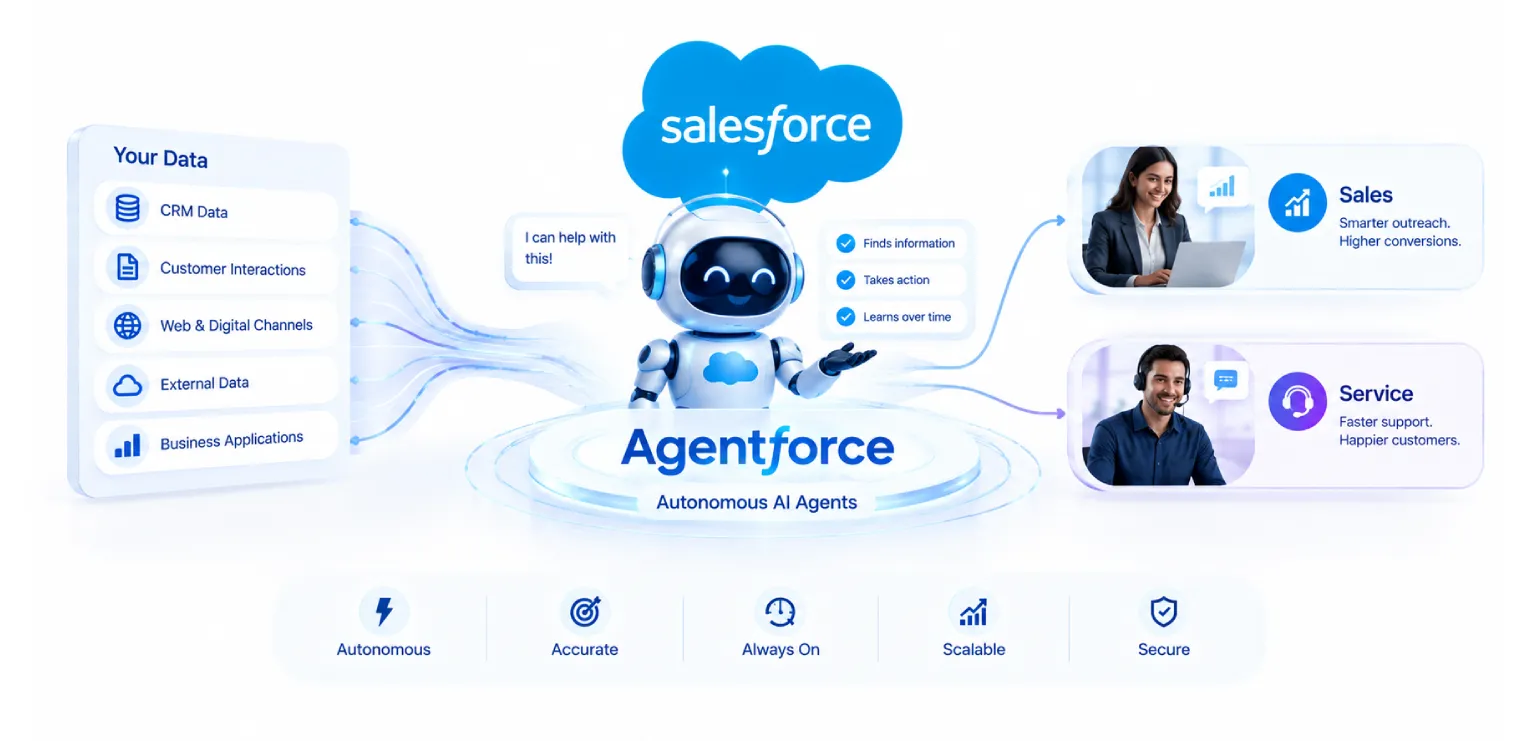
Put simply, Salesforce Agentforce is a platform for building and using AI agents right inside your Salesforce system. And no, these aren’t the same old chatbots that just answer basic FAQs. Salesforce calls them “autonomous agents,” and that word autonomous is doing a lot of work here. It means the agent can think, decide, and take action on its own. No human needs to guide every single step.
Here’s an easy way to picture it. A regular chatbot might answer “What’s my order status?” with a copy-paste reply. An Agentforce agent can actually go check the order, notice it’s running late, apply a discount if your policy allows it, and email the customer an update. All of that happens without a person clicking a single button.
That’s a real shift from the older AI tools most of us are used to — the ones that mostly gave suggestions or wrote text for you to review. Agentforce agents are built to finish actual tasks and handle real work inside your CRM, not just chat about it.
| RELATED: Agentforce is one expression of a broader movement. Explore how Generative AI and LLM solutions and AI-first product engineering are reshaping enterprise software. |
How Does Agentforce Work?
The “brain” behind Agentforce is something Salesforce calls the Atlas Reasoning Engine. This is what lets an agent understand what someone wants, break that request into smaller steps, pick the right action, and actually carry it out. Here’s roughly how it plays out in real life.
| The Atlas Reasoning Engine The “brain” that drives every agent, step by step
The Atlas Reasoning Engine drives every agent: understand → plan → pull data → act → escalate |
First, it understands the request. Whether it’s a customer typing a question on your website or a sales rep asking for a hand, the agent reads the message and figures out what’s really being asked.
Then it plans the steps. A request like “cancel my order and issue a refund” is really two or three separate actions bundled together, and the Atlas engine figures that out on its own instead of treating it as one flat instruction.
It also pulls in the right data, and this is where Data Cloud comes in. Agentforce connects directly to your company’s data — customer history, product details, past support cases, sales records — so the agent isn’t guessing at anything. It’s working off real, current information about your actual business. Getting this foundation right is exactly where strong Data Engineering, Analytics & BI pays off.
Then it takes action, using what Salesforce calls topics and actions. Topics are the general areas an agent is allowed to touch, like billing or order tracking. Actions are the specific tasks it can perform within that area, like issuing a refund or updating a shipping address. This structure is what keeps an agent from wandering off and doing something it shouldn’t.
And when things get complicated, it knows to step back. A well-built agent doesn’t try to be the hero for every situation. If something’s too sensitive or messy, it hands the conversation to a real person, along with all the context, so nobody has to start over from scratch.
| GOOD NEWS: You don’t need a room full of developers to build one of these. Salesforce has a low-code agent builder, so business teams can set up and tweak agents using drag-and-drop tools and plain-language instructions instead of writing code. For deeper customization, our Salesforce services and integration services fill the gaps. |
What Can Agentforce Do for Sales and Service?
This is probably the part you actually care about. Let’s get into some real Agentforce use cases.
|
|
For Service Teams
Customer service is where Agentforce is already proving itself.
▪ Handles routine questions around the clock. Agents answer common questions about orders, billing, returns, and account details any time of day, so customers aren’t stuck waiting until 9am.
▪ Resolves issues instead of just talking about them. Unlike a basic bot, a service agent can process a return, update an account, or book a technician visit — not just tell you how to do it yourself.
▪ Takes pressure off your human agents. When AI handles the repetitive, low-stakes tickets, your support staff can spend their energy on the complicated or emotionally tricky cases that genuinely need a person.
▪ Works across languages too. Agents can respond in different languages, helping you serve a wider customer base without building out separate language-specific teams.
For Sales Teams
Sales teams get a different kind of win here, mostly around time.
▪ Lead qualification gets faster. An agent can look at incoming leads, check them against your criteria, and flag the ones actually worth a rep’s time.
▪ Meeting prep becomes less of a scramble. Before a call, an agent can pull together account history, past interactions, and relevant news so the rep walks in already knowing something.
▪ Follow-ups stop falling through the cracks. Instead of a rep writing every follow-up email by hand, the agent can draft it — and depending on your setup, even send it based on rules you’ve defined.
▪ CRM records actually stay updated. Agents can update records automatically based on call notes or emails, so your CRM data stays clean without anyone chasing it down.
These autonomous CRM agents work inside your existing Salesforce setup, so there’s no need to rip everything out and rebuild your process from zero. Where deeper automation is needed, our Software Engineering Solutions and ML Engineering teams can extend what an agent is capable of.
Is Agentforce Different from Einstein Copilot?
This trips a lot of people up, so let’s sort it out.
|
|
Copilot supports the human; Agentforce finishes tasks on its own and escalates only when needed
Einstein Copilot, which Salesforce has since folded into the broader Agentforce family, was built more like an assistant. It sat alongside a human, answering questions, suggesting next steps, and helping people move through tasks faster. But the human was still doing the actual work and making the final call most of the time.
Agentforce goes a step further. Instead of just assisting a person, it can act on its own within whatever boundaries you set for it. That’s really the core difference. Copilot-style tools support the human. Agentforce agents can independently finish tasks start to finish, and only loop in a human when it’s actually needed.
So think of it this way: Copilot is like a sharp assistant sitting next to you, and Agentforce is more like a trained team member who can handle certain jobs solo — but still knows when to ask for help.
Why This Matters for Your Business
So many companies are paying attention to this right now for a simple reason: customer expectations have shifted. People want fast answers at any hour, and they don’t have much patience for long hold times. At the same time, businesses want to keep costs under control without hiring a massive support or sales team just to keep up.
Agentforce is trying to solve both sides of that at once. Customers get quicker responses, and your teams get more time back for the work that actually needs a human touch.
That said, rolling this out properly takes some planning. You need to think through which topics and actions to hand an agent, how it should handle sensitive data, and where exactly the line sits between “let the AI take this” and “this needs a person, now.” Ongoing managed services and DevOps & Cloud Services keep it running smoothly after launch.
How Impressico Business Solutions Can Help
At Impressico, we work with businesses to design, build, and set up Agentforce solutions that actually match how your teams work day to day. We’re not fans of one-size-fits-all here. Every business has different workflows, different customers, and different risk tolerances — and your agent setup should reflect that, not fight against it.
Whether you’re just curious about what Agentforce could do for your sales pipeline, or you’re ready to build a full service agent for your support team, our team can walk you through it from planning all the way to deployment. Browse our full range of service offerings and technical capabilities to see how the pieces fit together.
| Ready to explore autonomous agents? If you want to explore how autonomous agents could fit into your Salesforce environment, reach out to Impressico Business Solutions. We’re happy to talk through what’s possible and help you figure out where to actually start. |

IBS
Similar articles

Salesforce Health Cloud: Modernizing Patient Engagement and Provider Workflows
September 25, 2026
Salesforce Financial Services Cloud vs Sales Cloud: Which One Fits Wealth, Banking, and Insurance
September 23, 2026
Salesforce Industry Clouds: When Vertical CRM Beats Sales Cloud
September 18, 2026
Agentforce Readiness: What to Fix in Your Salesforce Org First
August 17, 2026
Is Your Salesforce Org Ready for AI? An Enterprise Readiness Checklist
August 7, 2026
Salesforce Data Cloud Explained: Unifying Customer Data for AI
July 29, 2026
