


April 22, 2026
Salesforce Cloud Solutions Explained: Sales Cloud, Marketing Cloud and Service Cloud for Enterprises
Enjoying this article?
Share it with the world!


Salesforce Cloud Solutions for Enterprises
Most enterprise technology decisions start with a problem nobody wants to say out loud. The sales team runs on three different spreadsheets. Marketing has no idea which leads actually closed. Support keeps answering the same questions because there is no shared knowledge base. And the customer, stuck in the middle of all this, is quietly having a terrible experience.
That is usually the point where someone brings up Salesforce.
But there is often real confusion about what Salesforce actually includes, which products do what, and whether the investment makes sense for a company of your size. This blog is an attempt to clear that up. We will cover three of the most important Salesforce cloud solutions for enterprises — Sales Cloud, Marketing Cloud, and Service Cloud — explain what each one does, how enterprise teams actually use them, and how to figure out which one fits your situation right now.
What Are Salesforce Cloud Solutions?
The simple answer: they are software tools that live online and help businesses manage customer relationships at every stage, from first contact to long-term support. No local servers, no heavy IT setup. Your teams can access everything from a browser, whether they’re in the office or on the road.
For a small business, a basic CRM might do the job. But for a large enterprise managing thousands of customers across multiple markets and departments, you need something built to handle real complexity. Salesforce cloud solutions for large enterprises are designed for exactly that. Each cloud product targets a specific part of the customer journey, and they all run on the same underlying Salesforce enterprise cloud platform, which means your data is always connected.
Salesforce Sales Cloud for Enterprises
Talk to any enterprise sales leader about their biggest frustration and you will usually hear something about visibility. They don’t know what’s actually in the pipeline. Reps are working in silos. Forecasting feels like guesswork. Deals slip because someone forgot to follow up.
Sales Cloud is built to fix this. It is a CRM system, yes, but calling it just a CRM undersells what it does for a large sales organization.
How enterprise teams use it day to day
The first thing most teams notice after a proper Salesforce Sales Cloud implementation is how much manual work disappears. Follow-up emails, meeting logs, lead assignments — a lot of it runs automatically. Reps spend less time on admin and more time actually selling.
The bigger shift happens at the leadership level. Instead of waiting for weekly reports that are already outdated by Friday, sales managers get a live dashboard showing every deal, every stage, and every rep’s activity in real time. For a company with large field sales teams spread across regions, that kind of visibility changes how decisions get made.
| ▪ All leads, contacts, and opportunities managed in one central system instead of scattered tools ▪ Automated follow-ups, reminders, and lead routing so nothing falls through the cracks ▪ Accurate revenue forecasts built on real pipeline data rather than gut feeling ▪ Easy collaboration across large sales teams, even when they’re spread across different regions ▪ Connects with tools reps already use — Outlook, Gmail, LinkedIn, calling software |
One thing worth saying about Salesforce Sales Cloud implementation services is that configuration matters. The platform is flexible enough to match almost any sales process, but that flexibility also means you can set it up wrong. A poor implementation leads to low adoption because the system doesn’t reflect how the team actually works. Getting it right from the start makes all the difference.
Salesforce Marketing Cloud Solutions
Sending the right message to the right person at the right time sounds simple. In practice, it means handling large customer databases, multiple channels, unpredictable behavior, and constant pressure to prove ROI. This is where Salesforce Marketing Cloud solutions become genuinely useful for enterprise teams.
What it does for large marketing operations
How Marketing Cloud helps enterprise marketing teams really comes down to replacing guesswork with actual data. Instead of sending one email to your entire list and hoping for the best, you build segments based on what customers have actually done — what they bought, what pages they visited, which emails they opened — and send them something that’s relevant to where they are right now.
The automation side is equally powerful. You can build customer journeys where specific actions trigger the next step automatically. Someone downloads a whitepaper and gets a relevant follow-up a few days later. A long-inactive customer gets a targeted offer. A prospect who visits your pricing page twice gets flagged for a sales call. None of this requires anyone to manually monitor it.
| ▪ Personalized campaigns across email, SMS, push notifications, and social media from one platform ▪ Automated nurture sequences that keep leads engaged between sales touchpoints ▪ Attribution tracking so you know which channels are actually driving results ▪ Customer data pulled from your website, app, and offline channels into one complete profile ▪ AI tools that predict what content a specific customer is most likely to respond to |
Salesforce Marketing Cloud consulting services are often helpful here because the platform has a lot of depth. Many enterprise teams barely scratch the surface of what it can do because it was not set up properly at the start.
Salesforce Service Cloud for Enterprises
A lot of companies invest heavily in acquiring customers and almost nothing in keeping them. Then they wonder why churn is high. Salesforce Service Cloud for enterprises exists to fix the post-sale experience, because what happens when a customer needs help determines whether they stay or leave.
What it actually delivers for support teams
The benefits of Salesforce Service Cloud for customer support are both immediate and strategic. On the immediate side, it brings everything into one place. Cases coming in by phone, email, chat, and social media all land in one queue. Agents stop switching between tools and start actually resolving issues.
Every agent also sees the full customer history before the conversation starts. What they bought, what issues they’ve had before, whether there are any open cases. That context saves time and makes the customer feel like they matter rather than like they have to explain themselves from scratch every call.
| ▪ All support channels unified into one inbox so nothing gets missed ▪ Full customer history visible to every agent before they pick up the case ▪ Automated routing sends cases to the right team or agent immediately ▪ Self-service portals and knowledge bases cut down on repetitive ticket volume ▪ AI-powered chatbots handle common questions without human involvement ▪ Real-time dashboards track resolution times, agent performance, and customer satisfaction |
Salesforce Service Cloud implementation services need to account for how your specific operation works. A software company’s support process looks very different from a healthcare provider’s. The setup should match your actual workflow, not the other way around.
Sales Cloud vs Marketing Cloud vs Service Cloud: Which One Do You Start With?
This is the question we get asked most often. The answer depends on where the biggest pain is right now.
|
|
|
If your sales numbers are inconsistent and leadership cannot get a reliable forecast, start with Sales Cloud. If you are spending on marketing but cannot show what is working, Marketing Cloud deserves the focus. If customers are leaving because support is slow or repetitive, begin with Service Cloud.
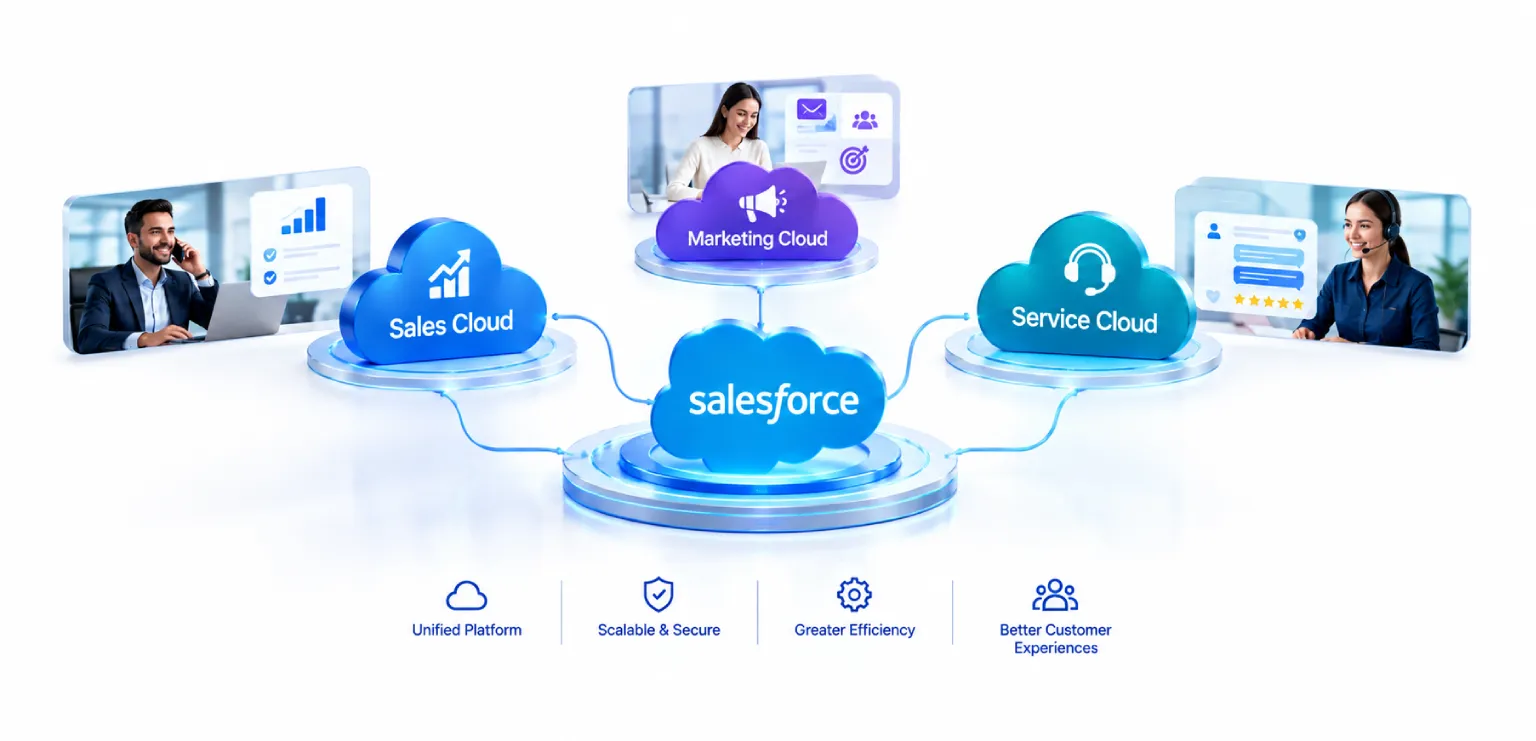
That said, the real value of Salesforce CRM cloud solutions shows up when all three are connected. A lead from a Marketing Cloud campaign flows into Sales Cloud for follow-up. Once that person becomes a customer, their full history is available in Service Cloud. The experience feels seamless even though three different teams are involved. Most enterprises end up using all three. The question is usually about where to start, not which one to choose permanently.
| Not sure which Salesforce cloud fits your enterprise? Get a free, no-obligation consultation with our certified Salesforce experts. We’ll help you map the right cloud to your business goals. |
Connecting Salesforce Clouds Across Your Organization
When we start working with a new enterprise client, we almost always find the same thing. Teams are operating in silos. Marketing does not know which leads converted. Sales does not know about recent support issues. Support does not know a customer is mid-negotiation on a renewal.
Salesforce cloud integration services fix this. When you properly integrate Salesforce clouds across departments, every team shares a complete picture of the customer. And Salesforce integration consulting services help connect Salesforce not just within its own ecosystem but also to your ERP, billing system, data warehouse, and other tools. Getting integration right upfront saves years of problems later.
When Should Your Enterprise Move Forward with Salesforce?
The honest answer is earlier than most companies think. The warning signs are usually obvious. Disconnected tools. Campaigns that aren’t converting. Support tickets piling up. Customers who feel like they always have to start over. These aren’t just operational annoyances. They’re revenue problems.
The other clear signal is organizational change — a major acquisition, expansion into new markets, or a shift in business model. These moments are exactly when having the right platform in place makes everything else smoother. When should enterprises implement Salesforce cloud solutions? When the cost of not doing it is clearly higher than the cost of doing it.
What Good Implementation Support Looks Like
Salesforce is not a plug-and-play tool. The same flexibility that makes it powerful also means that configuration decisions matter a great deal. Set it up wrong and people won’t use it. Set it up right and it becomes something your whole organization relies on.
A certified Salesforce consulting partner USA does more than install the software. They map your real business processes before touching any configuration. They migrate your data cleanly. They build integrations that actually work. They train teams in ways that are relevant to how each group works. And they stay involved after launch to make sure adoption actually happens — not just in the first week, but over time.
Salesforce managed services are particularly valuable for enterprises without a large internal team. Instead of scrambling when something needs to change, you have a partner who knows your setup and can handle ongoing optimization, user support, and new feature rollouts as your business evolves.
How Impressico Business Solutions Can Help
At Impressico Business Solutions, we have worked with enterprise clients across technology, financial services, healthcare, retail, and manufacturing. We have helped companies get their first Salesforce implementation right, helped others fix setups that weren’t working, and helped many more expand from one cloud to all three as they grew.
What we’ve learned from all of that is simple. Every enterprise is different. We don’t come in with a standard template. We take the time to understand how your business actually works before recommending anything. Our team includes certified consultants with hands-on experience across Salesforce Sales Cloud, Marketing Cloud, Service Cloud, and the full range of Salesforce cloud integration services.
We also stay involved after go-live. The most successful projects we’ve been part of are the ones where we stayed engaged, tracked adoption, and kept optimizing as the business changed. That’s what good Salesforce consulting services USA actually look like in practice.
| Explore our full Salesforce services and in‑depth guides: Role of a Consulting Partner → Enterprise Implementation Guide → Agentforce & Einstein AI in Salesforce → Trusted Salesforce consulting partner with end‑to‑end capabilities across Sales, Service, Marketing, CPQ, Health Cloud, Experience Cloud, and more. |
Final Thought
Salesforce cloud solutions for enterprises are not just about software. When Sales Cloud, Marketing Cloud, and Service Cloud work together, your entire organization shares one picture of the customer. That’s when the platform stops feeling like a tool and starts feeling like an actual competitive advantage.
If you’re trying to figure out which Salesforce cloud is right for your business, or you’re ready to move and just need a partner who can make the implementation actually work, reach out to the team at Impressico Business Solutions. No jargon, no pressure. Just a real conversation about what would help.
| Start your Salesforce journey A real conversation about which cloud fits your enterprise, what implementation actually involves, and where the value shows up first. |

IBS
Similar articles

Salesforce Financial Services Cloud vs Sales Cloud: Which One Fits Wealth, Banking, and Insurance
September 23, 2026
Salesforce Industry Clouds: When Vertical CRM Beats Sales Cloud
September 18, 2026
Agentforce Readiness: What to Fix in Your Salesforce Org First
August 17, 2026
Is Your Salesforce Org Ready for AI? An Enterprise Readiness Checklist
August 7, 2026
Salesforce Data Cloud Explained: Unifying Customer Data for AI
July 29, 2026
Einstein AI Use Cases Across Sales, Marketing & Service Cloud
July 13, 2026
