

May 25, 2026
Agentforce & Einstein AI: How Enterprises Are Embedding AI Inside Salesforce in 2026
Enjoying this article?
Share it with the world!


How Enterprises Are Using Agentforce Inside Salesforce
| ⓘ QUICK ANSWER Agentforce is Salesforce’s AI agent platform that lets autonomous agents take real action inside your CRM — reading situations, making decisions, and completing work without human input. Einstein AI reads the patterns in your data and flags what matters. Together, Einstein sees the signal and Agentforce acts on it. In this guide: what Agentforce is, how it works with Einstein, what enterprises are using it for, honest implementation tradeoffs, and a proven rollout pattern. |
There is a moment in every enterprise software rollout where the excitement fades. The licenses are paid. The kickoff call happened. And then three months in, half the team is still working the old way, the CRM is full of stale data, and someone in leadership starts asking whether this was worth the budget.
That cycle is familiar to anyone who has sat through enough technology rollouts. A new tool lands, creates a brief flurry of activity, and then quietly gets absorbed into the background noise of the business.
Agentforce is breaking that pattern in a pretty fundamental way. What Salesforce has built here does not just track work or organize information. It actually does work. On its own. Inside a platform your team already uses every day. If you run sales, lead service operations, or manage a Salesforce environment for a large enterprise, this one is worth paying close attention to.
What Is Agentforce? Salesforce's AI Agent Platform Explained
AI agents that read, decide, and act inside your CRM — not chatbots
Here is the simplest way to explain it. Agentforce lets you put AI agents to work inside Salesforce. Not a chatbot sitting on your website. Not a widget that auto-fills forms. Actual agents that can read situations, make decisions, and take action on their own.
Picture this. A customer writes in at midnight saying their order never arrived. In the old world, that email sits in a queue until morning. Someone picks it up, logs into the system, checks the order, types a reply, and closes the ticket. Maybe that takes 20 minutes of someone’s day.
|
|
A real example of how Agentforce changes the unit economics of customer service
With Agentforce, that same interaction plays out automatically. The agent reads the message, pulls up the order record, sees what happened, and sends a proper response with a resolution. No human needed. And the customer gets help at midnight instead of 9 AM.
| How Agentforce Handles a Midnight Service Ticket
A four-step flow that used to need a person — now runs autonomously inside Salesforce From a 20-minute manual task to a midnight resolution — the kind of unit-economics shift driving 2026 adoption |
That is not a demo scenario. That is what companies are running in production right now in 2026.
Salesforce rolled this out in late 2024, and what started as a promising beta has become one of the fastest-adopted features in Salesforce’s history. The reason is simple: it actually works.
Einstein AI vs Agentforce: How They Work Together
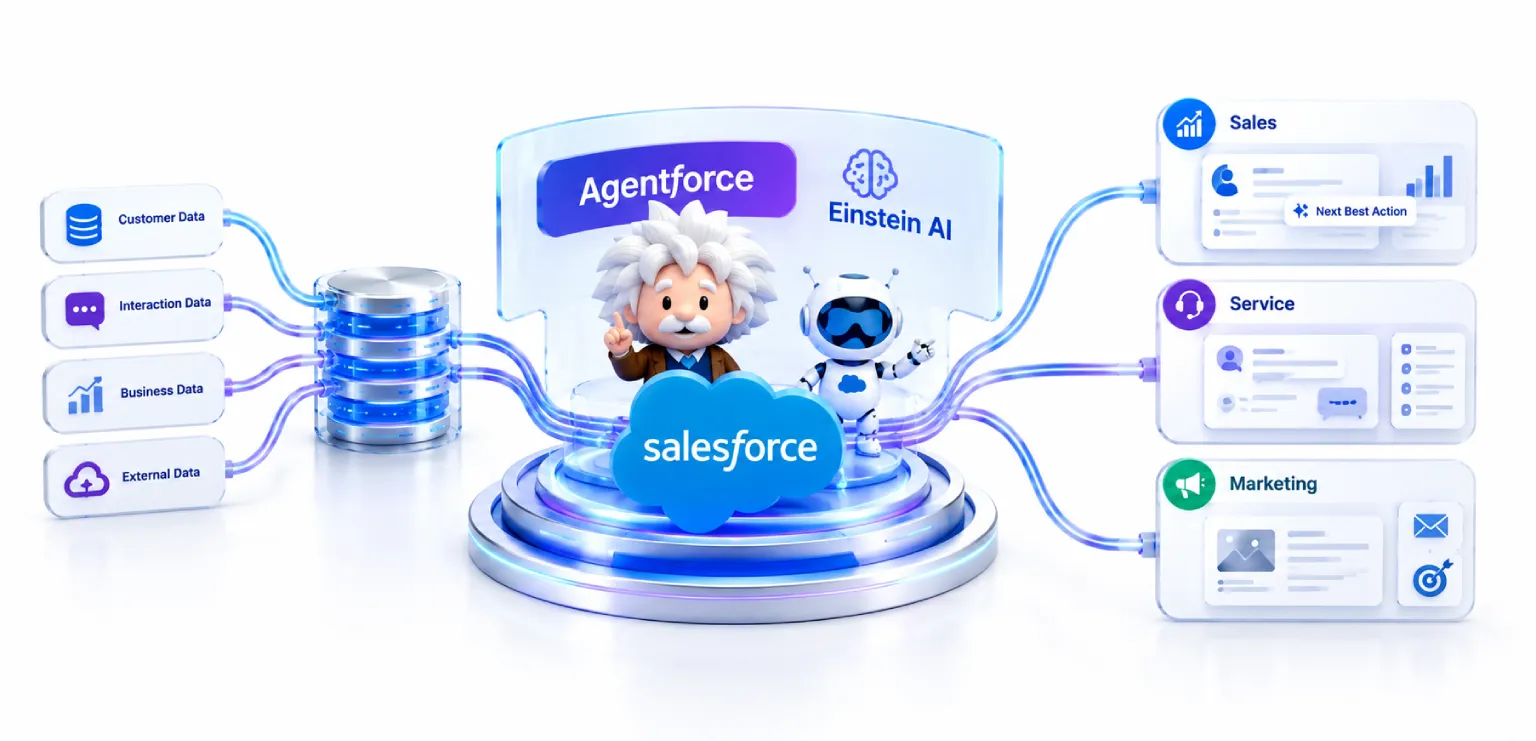
Einstein has been around in Salesforce for a while now. Its job has always been to look at your data and surface useful things. Which leads are warm. Which deals are at risk. Which customers might churn. It is the part of Salesforce that reads patterns and tells you what to pay attention to.
Agentforce is what happens next. Where Einstein flags something, Agentforce does something about it.
Say Einstein notices that one of your top accounts has gone quiet. Fewer email opens, no recent activity logged, engagement down for three weeks. In the past, that signal might sit in a dashboard that no one checks. Now, Agentforce can automatically trigger an outreach. It drafts a personalized note, routes it to the account manager for a quick review, or in some cases sends it directly depending on how you have set things up.
Einstein sees the signal. Agentforce acts on it. The two together create something neither could do alone.
Einstein sees the signal. Agentforce acts on it. The two together create something that neither could do alone.
| Signal to Action — How the Handoff Works
A signal that used to sit in a dashboard now triggers an actual response — automatically |
| Mapping Agentforce to Your Salesforce Org? If you’re thinking through where Einstein and Agentforce fit in your environment — and what a sensible first use case looks like — we’re happy to walk through it together. |
Agentforce Use Cases: What Enterprises Are Running in 2026
Real production deployments across sales, service, ops, and admin
This is the part I find most useful to talk about because the real-world use cases are more varied than most people expect.
| Where Agents Plug Into Your Salesforce Org Salesforce + Agentforce
Four department-level entry points — pick where it matters most for you Most enterprise rollouts start in just one of these four areas, then expand outward |
| Sales Teams Instant Lead Follow-Up An agent picks up the conversation the moment a form is submitted, asks qualifying questions, and hands a qualified lead to the rep — instead of leads waiting hours or overnight. |
| Service Teams Tier-One Support at Scale Billing, password resets, order status, returns — handled by agents. Human reps focus on complex complaints, relationship-sensitive accounts, and escalations. |
| Sales Ops Smarter Pipeline Reviews Einstein surfaces which deals need attention across 200+ open opportunities and explains why a deal is at risk — not just a score, but the reasoning behind it. |
| Admins & IT Replace Legacy Flow Sprawl Replace years of tangled custom flows, process builders, and automations with cleaner, smarter agents that are easier to maintain. |
Sales teams have been the biggest early adopters. The most common starting point is lead follow-up. Someone fills out a form on your website. Before Agentforce, that lead sat until a rep got to it, sometimes hours later, sometimes the next day. Now an agent picks up the conversation immediately, asks a few qualifying questions, and by the time a rep engages, they already know if the lead is worth their time.
Service teams have gone even further. Many enterprises are using Agentforce to handle their entire tier-one support volume. Billing questions, password resets, order status, return requests. These go through an agent. Human reps focus on the things that genuinely need a human, complex complaints, relationship-sensitive accounts, anything escalated.
Sales ops leaders are finding Einstein’s updated pipeline tools genuinely useful. Instead of asking a manager to dig through 200 open opportunities to figure out what needs attention, Einstein does that automatically and explains its reasoning. It is not just a number. It tells you why a deal is at risk.
Salesforce admins and IT folks are also seeing the benefit in a less obvious way. A lot of enterprise Salesforce orgs have been propped up by a tangle of automations, custom flows, and process builders built over years. Agentforce can replace whole chunks of that with cleaner, smarter agents that are easier to maintain.
Why 2026 Is the Year Agentforce Actually Delivers
Two years ago, AI inside Salesforce was mostly about suggestions. Recommended next steps. Predicted scores. Auto-generated call summaries. Genuinely useful things, but nothing that changed how many people you needed or how much work got done.
What shifted is the reliability. Early AI agents made enough mistakes that you could not hand them anything important without a human watching closely. That has changed. The underlying models are better, the guardrails Salesforce built are tighter, and companies have figured out how to deploy agents in ways that are actually trustworthy.
| Key Takeaway: The reliability problem has shifted. Agents are now trustworthy enough to handle real work — and Salesforce has opened the platform so you can build agents around your own data, your own business logic, and your own workflows. |
There is also the customization piece. Salesforce opened up the platform so you can build agents around your own data, your own business logic, and your own workflows. A healthcare company and a manufacturing company are going to use Agentforce very differently, and now that is possible without a massive custom build.
For any company that has invested seriously in Salesforce over the years, this is a big deal. All that historical data, all those custom objects and flows, it all becomes more valuable because now there is an intelligent layer that can actually use it.
| Why 2026 — Three Things Landed at Once
↓ 2026: Trustworthy agents you can deploy in production Three trends finally maturing at the same time made enterprise-grade Agentforce viable |
The Parts Nobody Likes to Talk About
I want to be straight with you here because I have seen too many blog posts that make implementation sound frictionless.
It is not.
|
|
|
The number one problem is data quality. Agentforce is working from your CRM data. If that data is incomplete, outdated, or inconsistently formatted, the agents are going to behave accordingly. Before you get real value from this, most companies need to do a honest cleanup pass on their Salesforce data. That takes time and it is not glamorous work, but skipping it is one of the main reasons AI projects stall.
The second challenge is getting your team to actually change. Sales reps who have worked a certain way for ten years do not automatically trust an AI agent to handle their leads. Service reps worry about their jobs. Managers worry about losing visibility. These are real concerns and they need real attention, not just a training session.
Governance is the third one. When an agent takes an action, who is responsible for that? How do you review what agents did and why? What is the process when something goes wrong? These questions need clear answers before you go live, not after.
| The Honest Truth: None of this is a reason not to do it. But companies that treat it as a pure technology project and skip the change management tend to end up frustrated. |
| Implementation Reality Check Worried about the data, change, or governance side? These are the issues that quietly stall AI projects — and the ones we spend the most time helping enterprise teams navigate. Our enterprise Salesforce implementation guide covers how others have handled it. |
How Enterprises Are Rolling Out Agentforce
The proven pattern: start narrow, prove it, then expand
The pattern that works is almost always the same: start narrow, prove it, then expand.
| The Agentforce Rollout Pattern
Each stage compounds on the last — confidence and complexity grow together Companies that move slowly through these stages tend to land in much better shape than those that try to leap ahead |
| Step 1 Pick One High-Volume, Low-Stakes Use Case Customer service triage is popular for this reason. You get a lot of repetitions quickly, you can measure results clearly, and when it works, it builds confidence across the organization. |
| Step 2 Configure Agents Inside Salesforce Connect agents to your data and existing flows. Write the instructions that tell agents how to behave. Test carefully before anyone goes live. |
| Step 3 Measure, Learn, Then Expand From there, move into more complex territory: pipeline management, renewal campaigns, cross-sell outreach, account health monitoring. Each new use case gets easier. |
| Step 4 Work With a Salesforce Implementation Partner Most companies work with a Salesforce consulting partner because getting it right matters and the edge cases are not always obvious from the documentation. |
Pick one use case that is high-volume and relatively low-stakes. Customer service triage is popular for this reason. You get a lot of repetitions quickly, you can measure the results clearly, and when it works, it builds confidence across the organization.
From there, companies move into more complex territory. Pipeline management. Renewal campaigns. Cross-sell outreach. Account health monitoring. Each new use case gets easier because the team knows how to think about it now.
On the technical side, implementation means configuring agents inside Salesforce, connecting them to your data and your existing flows, writing the instructions that tell agents how to behave, and testing things carefully before anyone goes live. Most companies work with a Salesforce consulting partner on this because getting it right matters and the edge cases are not always obvious from the documentation.
What This Actually Means for Your Business
If you have not looked hard at Agentforce for enterprises yet, you are not behind, but the gap is starting to open. Companies in most industries are somewhere between pilot and full rollout right now.
The ones doing it well are not the ones who handed everything to AI and hoped for the best. They are the ones who thought carefully about where AI makes sense, kept humans in the loop where it matters, and treated it as a change to how their team works rather than just a new software feature.
Einstein AI gives you the picture. Agentforce gives you the action. Used together, inside a Salesforce environment that your team already knows, the combination is genuinely powerful in a way that is hard to fully appreciate until you see it running.
| Key Takeaways
|
Frequently Asked Questions: Enterprise AI in Salesforce
| What is Agentforce in Salesforce? Agentforce is Salesforce’s AI agent platform that lets autonomous agents take real action inside the CRM — reading situations, making decisions, and completing work without human input. Unlike chatbots or auto-fill widgets, Agentforce agents can resolve customer issues, follow up on leads, and update records on their own. |
| How is Agentforce different from Einstein AI? Einstein reads patterns in your data and surfaces insight — which leads are warm, which deals are at risk, which customers might churn. Agentforce takes action on those signals. Einstein sees; Agentforce acts. They are designed to work together. |
| What are the best Agentforce use cases for enterprises? The strongest early adopters are sales teams using Agentforce for instant lead follow-up, service teams handling tier-one support volume (billing, returns, password resets), sales ops for pipeline reviews, and admins replacing legacy flow sprawl with cleaner agents. |
| What does an Agentforce implementation actually involve? Implementation means configuring agents inside Salesforce, connecting them to your data and existing flows, writing instructions that tell agents how to behave, and testing carefully before go-live. Most enterprises work with a Salesforce consulting partner to handle edge cases that aren’t always obvious from the documentation. |
| What are the biggest risks with Agentforce? Three challenges quietly stall most Agentforce projects: (1) poor CRM data quality, which limits what agents can do reliably; (2) underestimated change management for sales and service teams; and (3) unclear governance — who owns the action when an agent does something. None are reasons not to do it, but they need attention upfront. |
Thinking About Making the Move?
At Impressico Business Solutions, we have been helping enterprise teams get real outcomes from Salesforce for years. Agentforce is the most significant shift we have seen in the platform, and we have been deep in implementations across industries since early 2025.
If you are trying to figure out where to start, what the right use cases are for your business, or how to build a plan that your leadership and your team can actually get behind, we would genuinely like to talk.
Reach out to the Impressico team and let us have a real conversation about what Agentforce could look like inside your Salesforce environment. No pitch deck required.
| No Pitch Deck Required Let’s have a real conversation about Agentforce. Where to start, what the right use cases are for your business, and how to build a plan your leadership and team can get behind — we’ve helped enterprises across industries answer exactly these questions since early 2025. |

IBS
Similar articles

Is Your Salesforce Org Ready for AI? An Enterprise Readiness Checklist
August 7, 2026
Salesforce Data Cloud Explained: Unifying Customer Data for AI
July 29, 2026
Einstein AI Use Cases Across Sales, Marketing & Service Cloud
July 13, 2026
What is Salesforce Agentforce? Autonomous AI Agents for Sales & Service
July 3, 2026
AI-Powered Salesforce: Agentforce, Einstein & Data Cloud for Enterprise CRM
June 24, 2026
Einstein Copilot Use Cases Across Sales, Service and Marketing Cloud
May 27, 2026
