
April 16, 2021
What Is The Difference Between Devops And Devsecops?
Enjoying this article?
Share it with the world!


DevOps vs DevSecOps: What Changes When You Add Security
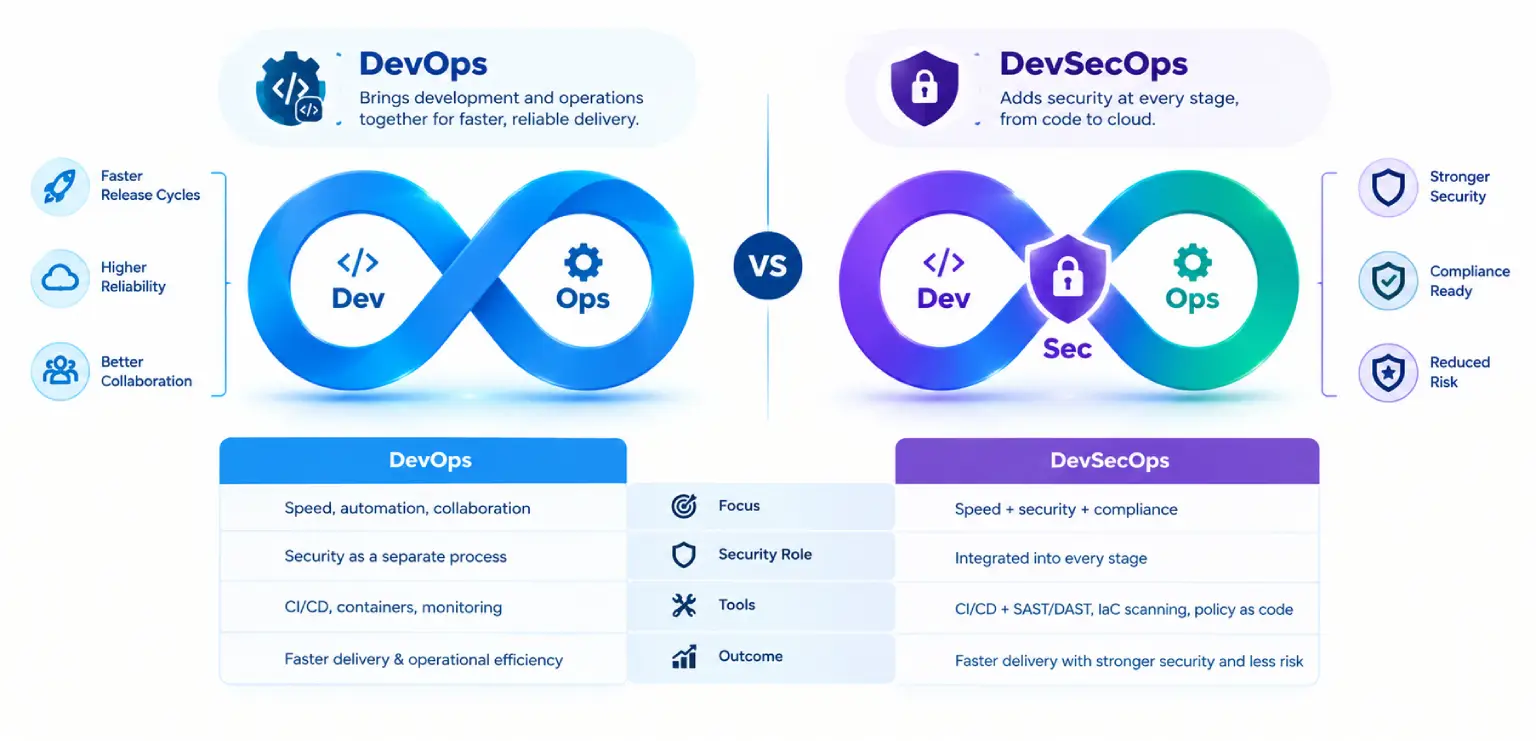
| ⚡ Quick Answer DevOps brings developers and operations together to ship software faster, prioritising delivery speed. DevSecOps extends that by building security into the process from the start of the development lifecycle rather than testing for it at the end. Both rely on automation, continuous processes and collaboration across teams that once worked separately. The trade-off is real: DevSecOps may lengthen development time initially, in exchange for a more secure codebase. |
DevOps is a methodology that is primarily designed to establish closer cooperation, synergy, and coordination between the system administrators and software developers during the development of software. DevOps (Development Operations) is an innovative development method entrusted with the task of enhancing the predictability, efficiency, and security of entire software development to the highest level possible. A DevOps engineer is a specialist working on the intersection of these two fields. DevSecOps takes the DevOps concept a bit further.
What is devsecops vs devops?
Today, a large number of software development professionals have adopted the agile framework. The landscape has changed from transforming the process to laying more emphasis on prioritizing responsibilities. Development methodologies like DevOps, SecOps, and DevSecOps make use of the agile methodology for different purposes. DevOps emphasizes delivery time, SecOps prioritizes security and DevSecOps tries to strike a fine balance between these two objectives.
| The DevSecOps Equation DevelopmentSecurityOperations DevSecOps = Development + Security + Operations |
In simple terms, DevSecOps simply means placing security practices early during the SDLC (Software Development Life Cycle) processes within an Agile framework. It besides automation, addresses the issues of code quality and reliability assurance. Agile software development is the framework all three sit inside.
DevOps Methodology
Let’s talk first about what is DevOps? The DevOps methodology merges two elements of computer science. Its primary aim objective is to unite the activities related to development, quality assurance, deployment, and integration of software. The abbreviation ‘Dev’ stands for software development, while ‘Ops’ characterizes information technology operations.
Let’s take it another way for a better understanding of DevOps. It, in fact, represents a philosophy whose objective is to ensure the development of a culture of collaboration between teams that previously worked in isolation. For example, in the traditional scheme of things, development and deployment operations have generally been by separate teams or departments. The primary objective of DevOps as such is to improve the overall efficiency of software development by eliminating the borders between these two phases of SDLC. For any technical specialist, DevOps plays an important role in maximizing time and resources for enhanced productivity, efficiency and training.
The primary aim, as such of DevOps is to augment the speed at which software is developed and delivered, by enabling enhanced collaboration, communication and automation. The role of DevOps in digital transformation and how DevOps improves customer satisfaction look at what that speed is actually for.
What is a DevOps Engineer?
Since this job title is a recent invention, you would be hard-pressed to assign an exact definition to it. At best, we can suggest a DevOps engineer is a person hired by an organization to help it adopt the DevOps methodology or framework. Platform engineering versus DevOps versus SRE traces how the role has since split apart.
DevSecOps: what’s that and how is it different from DevOps?
In a manner similar to DevOps, DevSecOps can also be termed as a culture of its own. DevSecOps combines three elements of computer science. The abbreviation ‘Dev’ stands for software development, the contraction ‘Sec’ represents cybersecurity, while ‘Ops’ denotes information technology operations. In other words, it is a philosophy of integrating security methods into a DevOps process. It is to be noted that teamwork lies at the centre of both these methodologies as teamwork is as vital to a DevSecOps engineer as it is to a DevOps engineer: their conflicts solving abilities in conjunction with productive negotiations skills play a crucial role in when it comes to the creation of a secure application. From the very inception of a Software Development Life Cycle (SDLC), DevSecOps works hard to make the application safe through the introduction of a variety of security techniques.
The primary goal of DevSecOps as such is to ensure quick development and deployment of a safe codebase. Some developers lay more emphasis on the speed of software development, while others prioritize security at the cost of speed. The DevSecOps methodology is implemented to allow developers and programmers to find a healthy balance between the two. The application of an agile framework makes it possible for the development and security teams to collaborate in real-time.
| So when it comes to DevSecOps vs DevOps: DevOps focuses on collaboration between development and operations, DevSecOps goes further by integrating cybersecurity practices, ensuring both speed and security throughout the software development lifecycle. |
The practice has matured considerably since 2021 — DevSecOps: shifting security left without slowing delivery is the current treatment, with shift-left security in CI/CD pipelines and compliance as code covering the implementation detail. On the infrastructure side, cloud security threats is the companion read.
| Weighing speed against security on your own pipeline? The trade-off is real but it is not fixed. Where you automate the security checks decides how much delivery time it actually costs. |
Conclusion
DevOps and DevSecOps methodologies have a lot of things in common, including the usage of automation and constant processes for creating joint cycles of development. However, when its about devops vs devsecops- DevOps prioritizes delivery speed, DevSecOps lays slightly more emphasis on security. What it means is that DevSecOps practices may initially raise the development time, but on the positive side, it will ensure better security for the codebase.
Whichever you are building towards, the mechanics are shared: CI/CD pipeline automation, the right CI/CD tooling, an automation framework, quality assurance and container orchestration. To judge where you currently stand, the DevOps maturity model and the metrics every CTO should track give you the measurement, and why DevOps and cloud are essential covers the platform underneath.
| Key Takeaways
|
| Ready to build security into delivery rather than after it? Impressico helps engineering teams move from DevOps to DevSecOps without surrendering the delivery speed they built in the first place. |
Impressico Business Solutions — DevOps and DevSecOps consulting, secure delivery pipelines and platform engineering.

IBS
Similar articles

Shift-Left Security in CI/CD Pipelines: A Practical Playbook
September 4, 2026
DevSecOps: Shifting Security Left Without Slowing Delivery
September 2, 2026
Is Your Engineering Team Ready for Platform Engineering? A Readiness Checklist
August 12, 2026
Measuring Platform Engineering ROI: DORA and SPACE Explained
July 31, 2026
Internal Developer Platforms: Building a Golden Path for Engineering Teams
July 22, 2026
AIOps in Practice: Using AI to Cut Incidents and MTTR
July 6, 2026