


July 6, 2026
AIOps in Practice: Using AI to Cut Incidents and MTTR
Enjoying this article?
Share it with the world!


AIOps Explained: Reduce MTTR & Predict Outages
Modern SaaS applications are expected to stay available around the clock. Customers don’t think about the infrastructure behind the software — they simply expect every feature, integration, and transaction to work without interruption. For engineering teams, meeting those expectations has become much harder than it was just a few years ago.
Cloud-native architectures, microservices, containers, and distributed systems make applications incredibly flexible but simultaneously make them much more complicated to run. While a single customer request may pass through dozens of services before it is satisfied, the operations team may have to sift through thousands of alerts, huge volumes of logs, and countless metrics before finding the root cause of an issue.
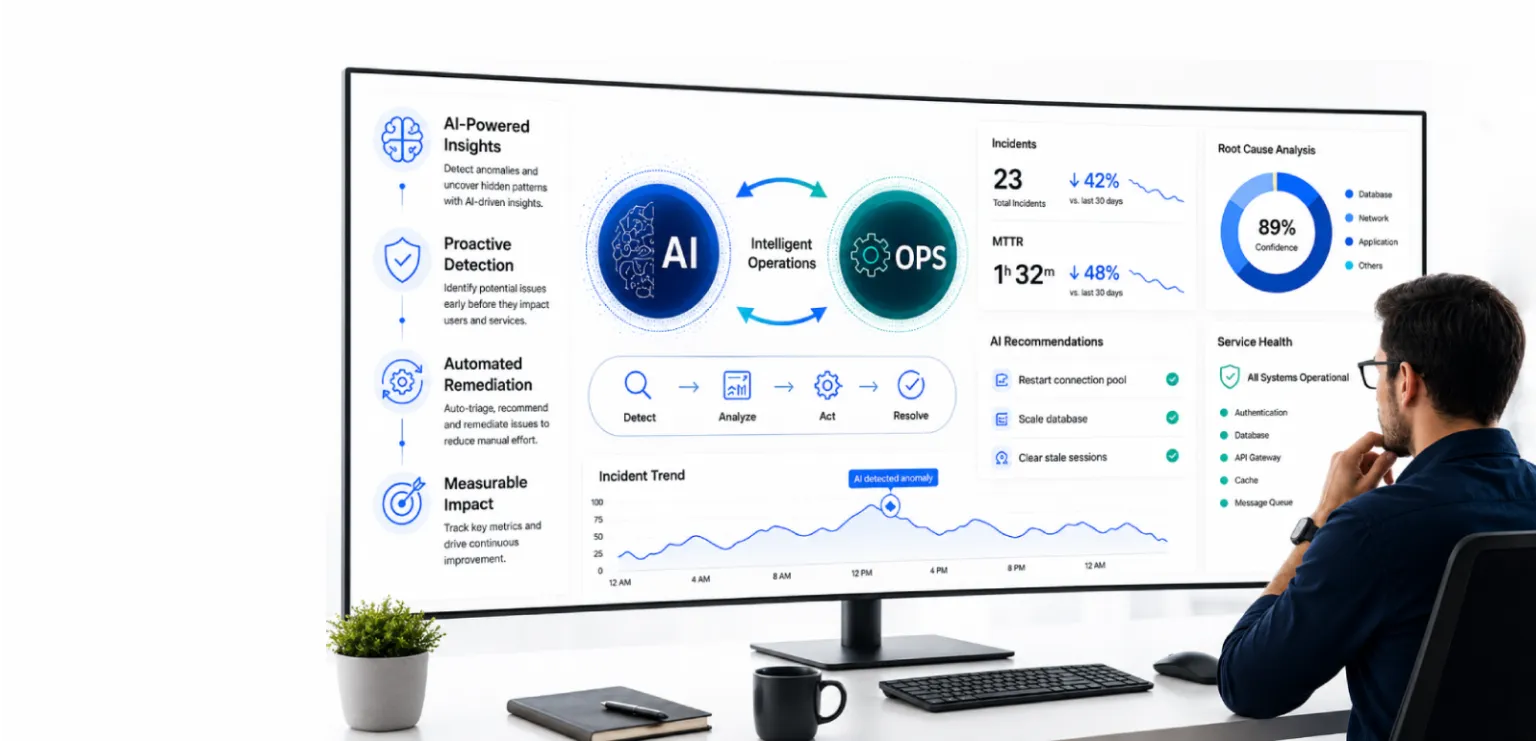
This is where AIOps for SaaS becomes extremely helpful. Instead of having engineers manually analyze information during incidents, the technology uses artificial intelligence and machine learning to process operational data, detect patterns and anomalies, and surface the probable root cause of an issue.
As more organizations invest in AI in DevOps, AIOps is becoming a practical capability rather than an emerging concept. Instead of replacing engineering teams, it helps them focus on solving problems instead of searching for them. It fits naturally alongside modern DevOps & Cloud Services, extending them with a layer of intelligence.
Why Traditional Operations Are No Longer Enough
For many businesses, the number of monitoring tools has increased over the years. Infrastructure monitoring, application performance monitoring, log management, cloud dashboards, and security tools all provide useful insights. The problem is that those tools are independent of each other, and engineers have to make the connections themselves.
To resolve a slow-down or outage, someone usually has to:
| ▪ Analyze alerts from several monitoring tools |
| ▪ Review application and infrastructure logs |
| ▪ Compare metrics across various services |
| ▪ Examine recent deployments |
| ▪ Coordinate across engineering teams to find the root cause |
According to IBM, the average cost of a data breach was about $4.88 million globally in 2024. Longer operational problems lead to greater financial and reputational risk. Every situation is unique, but reducing response time is no longer just an IT task — it’s a business one.
Modern SaaS platforms generate more operational data than teams can analyze manually. Organizations need AI to turn that data into actionable insights instead of overwhelming engineers with alerts.
| 65% of organizations now use generative AI in at least one business function — nearly double the rate recorded just ten months earlier, according to McKinsey’s 2024 State of AI. As AI becomes common across enterprises, it’s increasingly used to make operations more efficient. |
What Is AIOps?
The most common question that comes up in organizations is: What is AIOps?
AIOps stands for Artificial Intelligence for IT Operations. It combines artificial intelligence, machine learning, automation, and advanced analytics to enhance the performance of IT operations.
Unlike traditional monitoring that treats each alert as an isolated incident, AIOps looks at data from many sources — logs, metrics, traces, events, and monitors. It finds connections between disconnected alerts, spots abnormalities using anomaly detection, and helps teams prioritize their incidents. It doesn’t replace traditional monitoring or observability solutions; it adds intelligence to the process.
In practice, organizations typically integrate AIOps with their existing monitoring, observability, IT service management (ITSM), and incident response workflows rather than replacing those systems. This lets engineering teams build on their current processes while adding AI-driven analysis and automation where it delivers the greatest value.
In practical terms, an AIOps platform can:
| ▪ Detect unusual system behavior before users report a problem |
| ▪ Correlate hundreds of related alerts into a single incident |
| ▪ Support faster root cause analysis |
| ▪ Reduce repetitive manual investigation |
| ▪ Recommend next steps during incident response |
| ▪ Continuously improve its recommendations by learning from historical data |
Why AIOps Matters More Than Ever for SaaS Businesses
Traditional enterprise applications usually had predictable workloads and small infrastructure changes. Modern SaaS applications work in an entirely different way.
New features can ship multiple times a day. Infrastructure scales automatically with customer demand. Services span multiple cloud environments, APIs, and third-party platforms. Every change increases operational complexity — and yet customers expect a seamless experience no matter their region.
AIOps lets engineers detect possible problems proactively by analyzing operational telemetry, so they aren’t reacting only after a customer has already hit the issue. In a growing cloud environment, that job can hardly be done manually anymore — which is why AIOps is increasingly treated as part of a broader move toward AI-first solutions across the enterprise.
| 98% of firms are currently researching or using AI, according to Google Cloud’s AI Business Trends 2025 — showing that AI adoption is now an essential part of modern business operations, not an experiment. |
How AI Helps Reduce MTTR
Reducing MTTR (mean time to resolution) is one of the most important goals for operations teams, because every minute spent troubleshooting can affect customers, revenue, and engineering efficiency. Monitoring systems detect a problem quickly, but they often don’t explain its nature or what to investigate first. This is where AI in DevOps becomes valuable.
| Three Ways AI Reduces MTTR
|
Earlier detection + less noise + faster root cause = substantially lower MTTR
Detecting Problems Earlier with Anomaly Detection
Most production issues start with subtle signs that are hard to spot manually — small increases in latency, spikes in CPU utilization, or minor database irregularities that don’t look like a problem at first glance.
Using anomaly detection, AIOps constantly compares current system performance against historical trends. It doesn’t depend only on thresholds; it recognizes unusual activity that might signal a future problem. These models are built and refined through disciplined ML Engineering, so accuracy improves as they learn from your operational history. Early detection gives engineering teams enough time to analyze the situation before users are affected.
Reducing Alert Fatigue Through Intelligent Noise Reduction
In large SaaS ecosystems, thousands of alerts can be generated daily. Many represent the same problem, and some don’t need immediate action at all. Processing that volume becomes a burden for the operations team and raises the chance of missing a genuinely important incident.
The answer is noise reduction, which AIOps performs through event correlation and suppression of duplicate alerts.
Accelerating Root Cause Analysis
Identifying the exact root of an incident is usually the longest step in recovery. In distributed systems, one error can trigger alarms across several services at once, making it hard to pinpoint the true origin.
Instead of forcing engineers to troubleshoot every alarm individually, AIOps finds common threads across infrastructure, applications, and clouds. This drastically reduces the time needed for root cause analysis, since the probable source is identified along with its relevant data. Remediation starts much faster, and MTTR is substantially reduced.
| ADOPTION TIP: Many teams begin by applying AIOps to production environments where incident volumes are highest. Once they trust AI-assisted alert correlation and root cause analysis, they gradually extend it across cloud infrastructure, application services, and hybrid environments. |
A Practical AIOps Workflow
AIOps has the most impact when it’s woven into normal operations rather than bolted on as a separate tool. Implementations differ, but the general approach is common across organizations.
|
Integrated into existing operations — not a separate tool bolted on
First, operational data is gathered from logs, metrics, traces, events, and monitoring systems — an area where solid Data Engineering, Analytics & BI makes all the difference to signal quality. Machine learning then analyzes this data on the fly to detect abnormalities, correlate related alerts, and filter out duplicates. If a problem recurs often, organizations can automate predefined steps such as restarting a service or creating a ticket. The result is a more streamlined incident response process.
In mature environments, this workflow is connected with automated runbooks, ticketing platforms, and collaboration tools, so engineers can investigate, assign, and resolve incidents without switching between multiple systems — creating a faster, more consistent incident response across teams.
AIOps vs. Observability
Although they’re often mentioned together, AIOps and observability serve different purposes.
| Observability | AIOps |
| Collects logs, metrics, and traces. | Analyzes operational data using AI. |
| Shows what is happening across systems. | Explains what matters and why. |
| Helps engineers investigate issues. | Accelerates investigation through automation and intelligence. |
Think of observability as the source of operational data, while AIOps transforms that data into actionable insights. Together, they help engineering teams work more efficiently and improve service reliability.
Can AI Predict Outages?
AI cannot predict every outage with complete certainty, but it can recognize patterns that often lead to failures.
Using predictive monitoring, AIOps continuously analyzes historical and real-time operational data. If it detects behavior similar to previous incidents — such as rising latency or abnormal resource usage — it can alert teams before customers experience a disruption. This proactive approach lets organizations investigate and resolve issues earlier, reducing the likelihood of unexpected downtime.
Business Benefits of AIOps for SaaS
For SaaS providers, faster operations translate directly into better customer experiences. Some of the biggest advantages include:
| ▪ Faster incident response and reduced MTTR |
| ▪ Improved anomaly detection before users report problems |
| ▪ Lower alert fatigue through intelligent noise reduction |
| ▪ More efficient root cause analysis |
| ▪ Better engineering productivity by reducing manual investigations |
| ▪ Increased service reliability and customer satisfaction |
According to the IBM Institute for Business Value, organizations continue to expand AI investments to improve operational resilience and automation across IT environments.
Best Practices for Successful AIOps Adoption
AIOps delivers the best value when it’s built on a robust operational foundation.
First, make sure the data from your monitoring and observability tools is comprehensive and trustworthy. Before implementing automation, establish an incident management process and set specific goals — for instance, reduce MTTR, cut alert fatigue, or increase service availability.
Many companies see quicker success by first focusing on one essential application, measuring outcomes, and only then scaling the AIOps practice across the rest of their operations.
| ALREADY DOING DEVOPS? If you’ve already implemented DevOps automation, AIOps is the natural next step. Automation handles routine tasks; AIOps adds the intelligence to detect and resolve incidents quickly. Learn more in our blog post, DevOps Automation to Reduce Downtime. |
Challenges of AIOps Adoption
Many AIOps projects run into problems caused by inconsistent operational data, disconnected monitoring solutions, or undefined incident management practices. Ultimately, any AI model relies on the data it analyzes, so its success depends on data quality. Organizations typically benefit from stronger observability, unified operational workflows, and a gradual introduction of AIOps into their practice.
How to Evaluate an AIOps Platform
Several factors matter when choosing an AIOps platform. Beyond core AI capabilities, consider integration with your existing monitoring and observability tools, scalability, cloud-native design, automation capabilities, explainable insights, and ease of deployment. Above all, the platform should help engineering teams reduce alert fatigue and improve incident investigation and resolution.
The Future of AIOps
As cloud environments become more distributed and AI capabilities improve, AIOps is expected to evolve from intelligent monitoring toward autonomous operations — the same direction driving interest in Agentic AI systems. These platforms will increasingly recommend, validate, and execute more remediation tasks — while leaving engineers in charge of the decisions. This evolution will help SaaS organizations improve resilience while reducing manual operational effort.
Key Takeaways
| ▪ Turns data into insight: AIOps analyzes operational data using AI. ▪ Less noise: It reduces alert fatigue through correlation and suppression. ▪ Faster diagnosis: It speeds root cause analysis across distributed systems. ▪ Lower MTTR: It shortens mean time to resolution. ▪ Complements observability: It adds intelligence rather than replacing your tools. |
Frequently Asked Questions
1. What is AIOps?
AIOps combines artificial intelligence, machine learning, and automation to analyze operational data, detect anomalies, and improve incident management.
2. How does AIOps reduce downtime?
By identifying issues earlier, correlating alerts, and accelerating troubleshooting, AIOps enables teams to restore services faster and reduce MTTR.
3. Can AI predict outages?
AI cannot predict every outage, but it can identify warning signs based on historical trends and real-time data, allowing teams to take preventive action.
4. How is AIOps different from observability?
Observability provides visibility into system health by collecting telemetry data. AIOps uses that data to automate analysis, prioritize incidents, and recommend actions.
5. What are the biggest challenges when implementing AIOps?
Organizations often face challenges related to data quality, tool integration, and change management. A phased implementation supported by reliable data and well-defined processes typically leads to better long-term results.
Conclusion
Modern cloud environments produce more data than any engineering team can reasonably analyze by hand. AIOps for SaaS helps organizations meet this challenge by combining AI with operational intelligence to improve incident response and observability, reduce alert fatigue, and lower MTTR — the kind of outcome our DevOps & Cloud Services are designed to deliver.
| Build more reliable operations with Impressico Impressico Business Solutions works with organizations to develop modern DevOps capabilities that make operations more reliable, scalable, and efficient. By combining automation with AI-powered operations, companies can respond to issues quickly, limit downtime, and deliver the best possible experience to their customers.
|

IBS
Similar articles
Shift-Left Security in CI/CD Pipelines: A Practical Playbook
September 4, 2026
DevSecOps: Shifting Security Left Without Slowing Delivery
September 2, 2026
Is Your Engineering Team Ready for Platform Engineering? A Readiness Checklist
August 12, 2026
Measuring Platform Engineering ROI: DORA and SPACE Explained
July 31, 2026
Internal Developer Platforms: Building a Golden Path for Engineering Teams
July 22, 2026
Platform Engineering vs DevOps: What’s Actually Changing in 2026
June 26, 2026
