


June 26, 2026
Platform Engineering vs DevOps: What’s Actually Changing in 2026
Enjoying this article?
Share it with the world!


Platform Engineering vs DevOps: The 2026 CIO Guide
| ⚡ Quick Answer Platform engineering isn’t replacing DevOps — it’s the next stage of its evolution. DevOps remains the operating philosophy (collaboration, automation, CI/CD, shared ownership), while platform engineering is the delivery mechanism that makes those practices work at scale through an internal developer platform, self-service infrastructure, and golden paths. As engineering environments grow more complex, the real success metric is shifting from deployment speed to developer experience (DevEx) and reduced cognitive load. The question isn’t “how fast can we deploy?” but “how easily can developers deliver value?” |
Software teams have more automation than ever, yet delivering software hasn’t become much simpler. Cloud-native architectures, Kubernetes, AI-enabled development, and increased security requirements have introduced an entirely new set of challenges for dealing with complexity.
This is why in 2026 many engineering leaders are asking a different question: If DevOps revolutionized software delivery, how come software delivery has become more complex? Software developers are spending their time working with the infrastructure, waiting for necessary resources, and moving between multiple applications to create a product.
It doesn’t mean that DevOps has become ineffective. The problem is that modern engineering environments have simply grown beyond many organizations’ DevOps practices. This change has started a new discussion about platform engineering vs DevOps not as different practices but as the next stage of DevOps evolution.
In this article, we’ll analyze the actual change that has occurred in 2026, why companies have decided to invest in platform engineering, and how this trend influences the software delivery process of engineering teams.
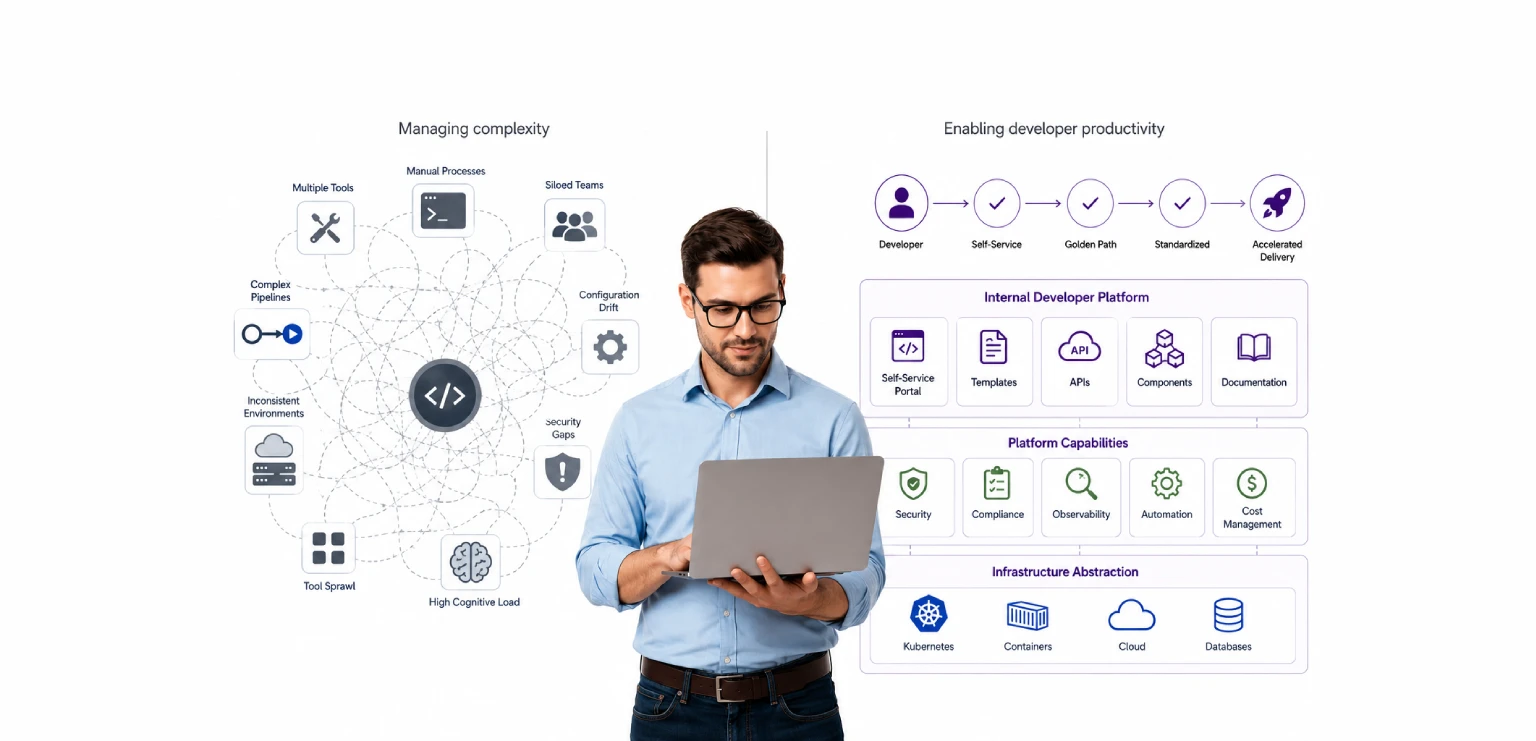
| The Modern Developer’s Growing Burden Building features now means owning all of this too — each layer adds operational responsibility
…all on top of building features for customers. That’s where the real problem begins. |
DevOps Isn’t Dead - It’s Entering a New Phase
Platform engineering extends DevOps; it does not replace it
One of the most common questions circulating across engineering communities is simple:
Is DevOps dead?
The short answer is no.
| DevOps Isn’t Dead — It’s Entering a New Phase
Without DevOps there’s no foundation for platform engineering — the real story is evolution, not replacement. |
DevOps continues to be the backbone of modern-day software delivery processes. The principles like collaboration, automation, continuous integration, continuous delivery, and shared ownership are now more important than ever before.
What has changed is how the concepts are implemented.
In the last ten years, the engineering landscape has evolved drastically. Multi-cloud infrastructure management, hundreds of microservices, container orchestration platform, artificial intelligence computing services, strict compliance needs, and higher security standards are managed by the teams. Each additional technology creates an additional layer of operational responsibility.
While building features for customers, the developer is expected to know the workings of deployment pipelines, configuration management, cloud networking, security policies, observability, and incident management.
That’s where the real problem begins.
| Industry Insight According to Google’s annual DevOps Research and Assessment (DORA) research, high-performing engineering organizations consistently reduce operational friction by investing in better developer workflows rather than simply adding more automation. The focus has shifted from faster deployments alone to creating an environment where engineers can spend more time solving business problems and less time managing infrastructure. |
Perhaps the biggest shift we’re seeing is that developer productivity is no longer viewed as just a tooling challenge—it has become a platform challenge. Organizations are realizing that even the best CI/CD pipelines can’t solve productivity issues if developers still spend hours navigating infrastructure, requesting environments, or managing inconsistent workflows. Instead of chasing faster deployments alone, engineering leaders are focusing on reducing friction across the entire software delivery lifecycle.
This is the heart of the current DevOps evolution.
Rather than asking developers to become infrastructure experts, organizations are looking for ways to simplify the development experience while keeping operational standards consistent across teams.
Why More Engineering Organizations Are Investing in Platform Engineering
From fragmented, duplicated effort to one shared foundation
Platform engineering emerged as organizations scaled beyond what individual DevOps practices could efficiently support.
As organizations grow, every product team starts solving the same operational challenges independently. One team creates deployment scripts. Another builds infrastructure templates. A third develops its own monitoring dashboards. While each solution may work locally, the overall engineering ecosystem becomes fragmented.
The result is inconsistent developer experiences, duplicated effort, and unnecessary operational risk.
| From Fragmented to Shared
From every team rebuilding tooling to one shared internal developer platform. |
Platform engineering addresses this challenge by treating internal engineering capabilities as products instead of one-off solutions.
Instead of asking every development team to build deployment processes from scratch, a platform team creates reusable services, standardized workflows, and an internal developer platform that engineers can use without becoming infrastructure specialists.
This approach emphasizes self-service without sacrificing governance.
| • Need a development environment? It should take minutes instead of days. |
| • Need cloud resources? Teams should request them through approved workflows instead of waiting for manual provisioning. |
| • Need deployment templates? Developers should have access to a trusted golden path—sometimes called a paved road—that reflects engineering best practices while remaining flexible enough for different applications. |
The objective isn’t to remove developer choice. It’s to remove repetitive operational work that slows development.
| Is operational friction quietly slowing your teams down? If developers wait days for environments or every team rebuilds the same tooling, a platform approach may be the next step. We can help you assess where the friction lives. |
What’s Actually Changing in 2026?
Not org charts — the daily experience of software delivery
Many discussions about platform engineering vs DevOps focus on organizational charts or job titles. That’s not where the biggest transformation is happening.
The real change is in how engineering teams experience software delivery every day.
Another important change is how engineering leaders now measure productivity. Deployment frequency still matters, but organizations are increasingly focusing on reducing cognitive load and improving the overall developer experience (DevEx)
Platform engineering supports this by simplifying everyday workflows through standardized platforms and self-service capabilities, allowing developers to focus on delivering software instead of managing infrastructure.
According to the Cloud Native Computing Foundation (CNCF), organizations continue to expand their cloud-native adoption, making consistent developer experiences increasingly important as engineering environments become more distributed and complex.
What's the Difference Between Platform Engineering and DevOps?
Culture and practice vs. the platforms that scale them
After reading this far, you might still wonder: What’s the difference between platform engineering and DevOps?
The simplest way to think about it is this:
DevOps is a software delivery culture focused on collaboration, automation, continuous integration, and shared ownership between development and operations teams. Platform engineering builds internal platforms that make these DevOps practices easier to use at scale.
DevOps introduced the cultural and operational practices that helped development and operations teams collaborate more effectively. Platform engineering builds on those principles by creating shared capabilities that every engineering team can use without reinventing the wheel.
Imagine a company with 30 product teams. If every team builds its own deployment pipeline, infrastructure templates, monitoring dashboards, and security workflows, engineering effort becomes fragmented. Teams spend time solving the same operational problems instead of delivering new features.
Platform engineering changes that equation.
A dedicated platform team develops and maintains common services that product teams can consume through an internal developer platform. Rather than requesting infrastructure from another department or creating custom workflows from scratch, developers access approved resources through standardized interfaces.
Many organizations are also adopting principles from the Team Topologies framework, which recommends treating platform teams like internal product teams. Their customers aren’t external users—they’re developers. Success isn’t measured by the number of support tickets completed but by how much time engineering teams save and how smoothly they can build, test, and deploy software.
This product mindset is one of the most important platform engineering trends 2026 has brought into focus.
Why Are Companies Moving to Platform Engineering?
The inefficiencies that compound as you scale
Engineering leaders rarely decide to invest in platform engineering because it’s trendy. They do it because the numbers start revealing inefficiencies that can’t be ignored.
Developer onboarding takes weeks instead of days.
Infrastructure requests pile up in shared queues.
Different teams follow different deployment standards.
Security reviews become bottlenecks.
Operations teams spend more time answering repetitive questions than solving strategic problems.
As organizations scale, these issues compound quickly.
| The Inefficiencies That Can’t Be Ignored Five signals that compound quickly as organizations scale
|
| Self-Service Without Sacrificing Governance The golden path: what used to take days should take minutes
The objective isn’t to remove developer choice. It’s to remove the repetitive operational work that slows development down. |
A platform engineering approach addresses many of them by creating reusable capabilities that everyone can rely on. Developers spend less time navigating infrastructure and more time building software. Operations teams focus on improving the platform instead of responding to repetitive support requests. Security policies become embedded into workflows instead of being enforced after the fact.
The benefits extend beyond engineering productivity.
Organizations often see:
| • Faster onboarding for new developers. |
| • More consistent deployment practices. |
| • Better governance without excessive manual reviews. |
| • Reduced operational overhead. |
| • Greater confidence when adopting cloud-native technologies. |
| 🚀 Faster onboarding for new developers | ♻ Consistent deployment practices | ✅ Better governance without manual reviews |
| 📉 Reduced operational overhead | ☁ Cloud-native confidence when adopting new tech | 🎯 Consistency the biggest advantage |
Perhaps the biggest advantage is consistency.
Instead of every team solving similar infrastructure problems differently, everyone starts from a trusted foundation. Teams can still innovate where it matters—in their products—without constantly rebuilding operational tooling.
| Turn repeated operational work into reusable platform capabilities. Faster onboarding, consistent deployments, governance built into workflows — these are the outcomes a well-designed internal developer platform delivers. |
The Real Success Metric Isn’t Deployment Speed
From “how fast can we deploy?” to “how easily can developers deliver value?”
For years, engineering performance was often measured by release frequency, deployment success, or incident recovery time.
Those metrics still matter.
But they don’t tell the whole story.
In 2026, more organizations are paying attention to something that directly affects every engineer: DevEx.
Developer Experience isn’t about making tools look nicer. It’s about removing unnecessary friction from daily work.
Consider how much time engineers lose to tasks that don’t create customer value:
| • Searching for documentation. |
| • Waiting for environment provisioning. |
| • Troubleshooting inconsistent configurations. |
| • Requesting permissions. |
| • Managing repetitive infrastructure tasks. |
| How Small Frictions Add Up to Cognitive Load Individually small, together they pull focus away from delivering value
Reducing this friction across the lifecycle is what platform engineering — and better DevEx — is really about. |
Individually, these interruptions seem small. Together, they create significant cognitive load, making it harder for developers to stay focused and productive.
Google’s DORA research has consistently shown that high-performing engineering teams don’t just automate deployments—they improve the overall experience of building software. Teams that reduce friction across the development lifecycle are better positioned to deliver software reliably while maintaining quality.
This is why platform engineering vs DevOps isn’t really a competition.
The conversation is shifting from “How fast can we deploy?” to “How easily can developers deliver value?”
Is Platform Engineering Replacing DevOps?
The real story isn’t replacement — it’s evolution
No. Platform engineering is not replacing DevOps. Instead, it extends DevOps by providing reusable internal platforms, standardized workflows, and self-service infrastructure that help engineering teams apply DevOps practices consistently at scale.
| Key Takeaway Think of DevOps as the operating philosophy. Platform engineering becomes the delivery mechanism that makes that philosophy practical for dozens—or even hundreds—of engineering teams. Without DevOps, there would be no foundation for platform engineering. |
Without DevOps, there would be no foundation for platform engineering.
The culture of collaboration, automation, shared responsibility, and continuous improvement remains essential. Platform engineering simply provides a more scalable way to deliver those capabilities across growing engineering organizations.
Think of DevOps as the operating philosophy.
Platform engineering becomes the delivery mechanism that makes that philosophy practical for dozens—or even hundreds—of engineering teams.
For companies already practicing DevOps successfully, platform engineering often feels like the natural next step rather than a complete transformation.
That’s why discussions around is DevOps dead tend to miss the bigger picture.
The real story isn’t about replacement.
It’s about evolution.
What Engineering Leaders Should Be Asking in 2026
Start with friction, not with another tool
Rather than asking whether they need platform engineering, technology leaders should evaluate where their current engineering processes create unnecessary friction.
Questions worth asking include:
If the answer to several of these questions is yes, the conversation shouldn’t start with buying another tool.
It should start with improving the engineering experience.
Technology alone won’t solve operational complexity. Well-designed engineering platforms, clear standards, and thoughtful workflows will.
| Key Takeaways
|
Final Thoughts
The discussion about platform engineering vs DevOps is not about picking one over the other. It’s about understanding that as software environments get more complicated, companies’ use of DevOps has to change as well.
The most successful engineering teams in 2026 are strengthening DevOps with platform engineering, not replacing it. They are creating a setting where developers can concentrate on producing excellent products instead of handling infrastructure by lowering operational complexity, refining developer processes, and enabling secure self-service.
Our blog, Platform Engineering: The Next Evolution Beyond DevOps for High-Growth SaaS, gives a more thorough explanation of why this strategy is becoming a strategic goal for present software companies as you are researching how platform engineering can enhance your engineering plan.
Impressico Business Solutions helps businesses modernize software delivery with scalable technical solutions that align with their business goals. Whether you are modifying your DevOps methods or creating an internal developer platform, our experts can assist you in building a safe, effective, and scalable development environment.
| Let’s Talk Ready to make DevOps practical at scale? Whether you’re refining DevOps practices or building an internal developer platform, Impressico helps you create a secure, effective, and scalable development environment aligned to your business goals.
|

IBS
Similar articles

Shift-Left Security in CI/CD Pipelines: A Practical Playbook
September 4, 2026
DevSecOps: Shifting Security Left Without Slowing Delivery
September 2, 2026
Is Your Engineering Team Ready for Platform Engineering? A Readiness Checklist
August 12, 2026
Measuring Platform Engineering ROI: DORA and SPACE Explained
July 31, 2026
Internal Developer Platforms: Building a Golden Path for Engineering Teams
July 22, 2026
AIOps in Practice: Using AI to Cut Incidents and MTTR
July 6, 2026
