

July 13, 2026
Einstein AI Use Cases Across Sales, Marketing & Service Cloud
Enjoying this article?
Share it with the world!


Einstein AI Use Cases Across Sales, Marketing & Service
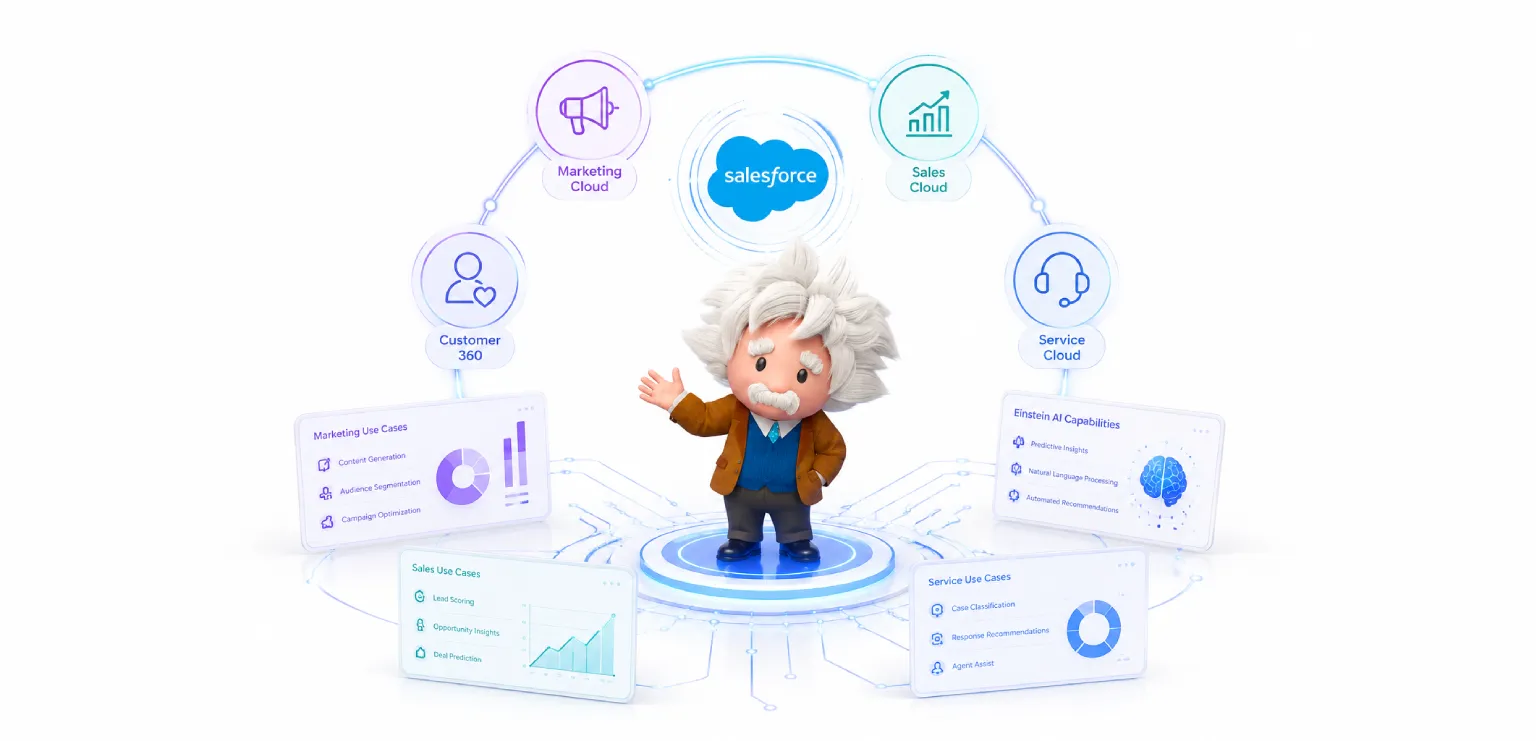
Anyone who’s touched Salesforce in the last couple of years has run into the name Einstein at some point. It’s not a person, obviously, though the name confuses a few clients when we bring it up for the first time. It’s the AI built into Salesforce, and its whole job is to help sales, marketing, and service teams get through their day with a bit less guesswork.
We get asked about this a lot at Impressico Business Solutions. Usually it’s some version of “okay, but what does Einstein actually do for us, in plain terms?” That’s a fair thing to ask, because Salesforce’s own documentation can get pretty dense pretty fast.
By the end of this post, you should have a clear picture of the main Salesforce Einstein AI use cases across sales, marketing, and service, plus a decent understanding of how predictive AI and generative AI actually divide the work between them.
What Einstein Actually Is
Think of it like a quiet observer sitting inside your CRM. It watches your sales history, old support tickets, email opens, website clicks, basically everything that gets logged. Then it does one of two things with what it sees: it either predicts what’s likely to happen next, or it helps write something for you right there on the spot, like a reply to a customer or a draft for your next campaign.
It’s not one big feature you switch on. It’s really a bundle of smaller AI tools spread across Sales Cloud, Service Cloud, and Marketing Cloud, and each one solves a slightly different problem. Let’s walk through them.
| How Einstein Works Inside Your CRM
At a high level, Einstein observes your CRM data, learns the patterns, then either predicts or generates — so your team can act faster. |
Predictive AI vs Generative AI (Because People Mix These Up Constantly)
This distinction comes up in almost every client call, so let’s get it out of the way early.
Predictive AI looks at what already happened and uses that to guess what’s coming. Show it a pile of old deals, and it’ll tell you the odds that a new one closes. It doesn’t write anything. It just hands you a number, a score, a probability, something to act on.
Generative AI works the other way around. It creates something new, usually a piece of text. Ask it to draft a follow-up email, write three subject line options, or condense a messy support ticket into a couple of sentences, and it does that.
|
|
Predictive AI points you to what matters; generative AI produces the content to act on it.
Salesforce doesn’t make you choose between the two. Einstein runs both side by side. Predictive AI tells you where to focus your attention. Generative AI helps you act on that attention faster than you could on your own. Honestly, that pairing is the whole reason Einstein feels useful across three very different departments at once.
| Quick Take Predictive = a score that tells you where to look. Generative = a draft that helps you respond. Einstein runs both together, which is why it works across sales, marketing, and service at the same time. Deciding which of these to switch on first is exactly what our Salesforce services team helps with. |
Einstein for Sales
Sales reps almost never have enough hours for the number of leads sitting in front of them. Einstein for sales exists mostly to fix that imbalance.
Lead scoring is usually the first thing people mention. Rather than treating every lead the same, Einstein studies what your past conversions had in common and scores new leads against that pattern. A higher score usually means a better shot at closing. Reps stop guessing who to call first and just follow the score, which sounds small but saves a surprising amount of time over a month.
Opportunity insights kick in once a lead becomes a real opportunity. Einstein reads through emails, call notes, and activity history tied to that deal and flags things worth a second look, maybe a deal’s gone quiet for two weeks, or a key contact stopped responding. These little nudges give reps a chance to jump in before a deal dies quietly in the background, which happens more often than most sales teams like to admit.
Sales forecasting answers the question every manager loses sleep over: are we going to hit the number this quarter? Einstein pulls in historical performance, current pipeline, and patterns in rep activity to build a forecast that’s usually more trustworthy than a spreadsheet built on gut instinct. It also calls out deals that look risky early, so managers aren’t finding out in the last week that half the pipeline was never really there.
Next best action is pretty self-explanatory once you see it in action. For a given customer or deal, Einstein suggests what to try next, send a specific offer, book a call, share a piece of content that’s worked before. It’s not magic, it’s just data doing the thinking that a rep would otherwise do by instinct, only a bit more consistently.
| How We Help Getting lead scoring and forecasting tuned to your real pipeline (not the defaults) is a big part of our Salesforce services. |
Einstein for Marketing Cloud
Marketing teams sit on an enormous pile of data too, email opens, site visits, ad clicks, and Einstein’s role here is mostly to translate that pile into something usable without anyone needing a background in data science.
Content gets more personal first. Einstein looks at what someone’s browsed or bought before and suggests what they’d probably want next, so people get something closer to a one-to-one experience instead of the exact same blast everyone else on the list gets.
Timing matters too, more than people assume. Not everyone checks email first thing in the morning. Einstein studies engagement history and predicts the best moment to reach each person individually, and that alone tends to push open and click rates up a bit, no extra effort required.
Then there’s the writing itself, which is where generative AI earns its keep. Drafting a dozen subject line variations or a handful of social captions by hand used to burn hours. Now generative AI can draft subject lines, campaign copy, and message variations in seconds. Someone still reviews and adjusts before anything goes out, but at least nobody’s staring at a blank page anymore.
Segmentation quietly improves too, almost as a side effect. Instead of grouping people by basic demographics, Einstein builds segments around actual behavior and predicted interest, and campaigns tend to land closer to home because of it.
Einstein for Service
Support teams work under constant pressure to solve things quickly while still keeping people happy, and Einstein for service is mostly aimed at trimming time off that whole process.
Case classification is a good starting point. A new ticket comes in, and someone has to figure out what it’s about and send it to the right team. Einstein reads the case and sorts it on its own, routing it to the right agent or department without anyone doing that first pass by hand. Doesn’t sound like a big deal on its own, but multiply it by a few hundred tickets a week and it adds up fast.
Sentiment analysis catches the tone underneath the words. Customers rarely type “I’m frustrated” outright, but it usually leaks through somewhere in how they write. Einstein scans messages, chats, and emails and flags whether the tone reads positive, neutral, or negative, so agents know who needs extra care before a minor complaint turns into a much bigger one.
Generative replies are probably the feature agents notice the most day to day. When someone opens a case, Einstein can draft a full response right there, based on the case details and similar tickets handled before. The agent still checks it and tweaks the wording before sending, but nobody’s starting from a blank screen anymore. For repetitive, common questions, this alone can cut response time noticeably.
Knowledge article suggestions round it out, where Einstein scans the knowledge base while an agent is working a case and surfaces whatever article is most likely to help, instead of leaving someone to dig through search results while a customer sits and waits.
| How We Help Wiring case classification, sentiment routing, and generative replies into your existing support flow is the kind of setup work our Salesforce services team handles day to day. |
Bringing It All Together
If someone asked “what can Salesforce Einstein actually do” and wanted the short version, here it is.
|
|
|
The three clouds at a glance — same predictive-plus-generative pattern in each.
In sales, it covers lead scoring, opportunity insights, forecasting, and next best action suggestions. In marketing, it personalizes content, predicts the right time to reach someone, and speeds up campaign writing through generative AI. In service, it handles case classification, sentiment analysis, and drafts generative replies so agents aren’t starting from zero every single time.
The pattern repeats across all three areas. Predictive AI tells you what’s likely to happen. Generative AI helps you respond to it, quickly, with actual usable content ready to go, not just a suggestion sitting in a report somewhere.
Einstein isn’t trying to replace sales, marketing, or service teams, whatever the hype cycles might suggest. It’s there to strip away the repetitive parts of the job so people have more time for the part that actually needs a human touch, talking to customers, building relationships, closing deals that matter.
At Impressico Business Solutions, we spend most of our time helping companies set these features up in a way that fits how their teams actually work, not something that looks impressive in a demo and then quietly gets ignored a month later. If you’re curious how Salesforce Einstein AI use cases could fit into your own sales, marketing, or service workflow, we’re happy to walk through it with you based on your specific setup, no generic pitch, just an honest look at what would actually help.
| Impressico · Salesforce Services See what Einstein would actually do for your team Every Salesforce org is set up a little differently, so the features worth turning on first vary from team to team. If you’d like an honest, setup-specific look at where Einstein could save your sales, marketing, or service teams the most time, explore our Salesforce services or reach out to the team at Impressico Business Solutions to walk through it together. |

IBS
Similar articles

Is Your Salesforce Org Ready for AI? An Enterprise Readiness Checklist
August 7, 2026
Salesforce Data Cloud Explained: Unifying Customer Data for AI
July 29, 2026
What is Salesforce Agentforce? Autonomous AI Agents for Sales & Service
July 3, 2026
AI-Powered Salesforce: Agentforce, Einstein & Data Cloud for Enterprise CRM
June 24, 2026
Einstein Copilot Use Cases Across Sales, Service and Marketing Cloud
May 27, 2026
Agentforce & Einstein AI: How Enterprises Are Embedding AI Inside Salesforce in 2026
May 25, 2026
