

July 27, 2026
The Hidden Cost of Technical Debt in Legacy Applications
Enjoying this article?
Share it with the world!


Hidden Cost of Technical Debt in Legacy Applications
Technical debt in legacy applications refers to the costs associated with poor software decisions made in the past that have complicated application maintenance, slowed improvements, and increased security problems. These costs include increased maintenance costs, slower innovation, increased security threats, and decreased agility of business operations.
Most legacy applications don’t fail overnight. They simply become less flexible, costly, and eventually untrustworthy. The feature, which used to be implemented in a few days, now takes several weeks to develop due to the legacy system’s poor design, documentation, and obsolete technologies.
This is not just a consequence of operating with the older technology but is referred to as technical debt in legacy applications.
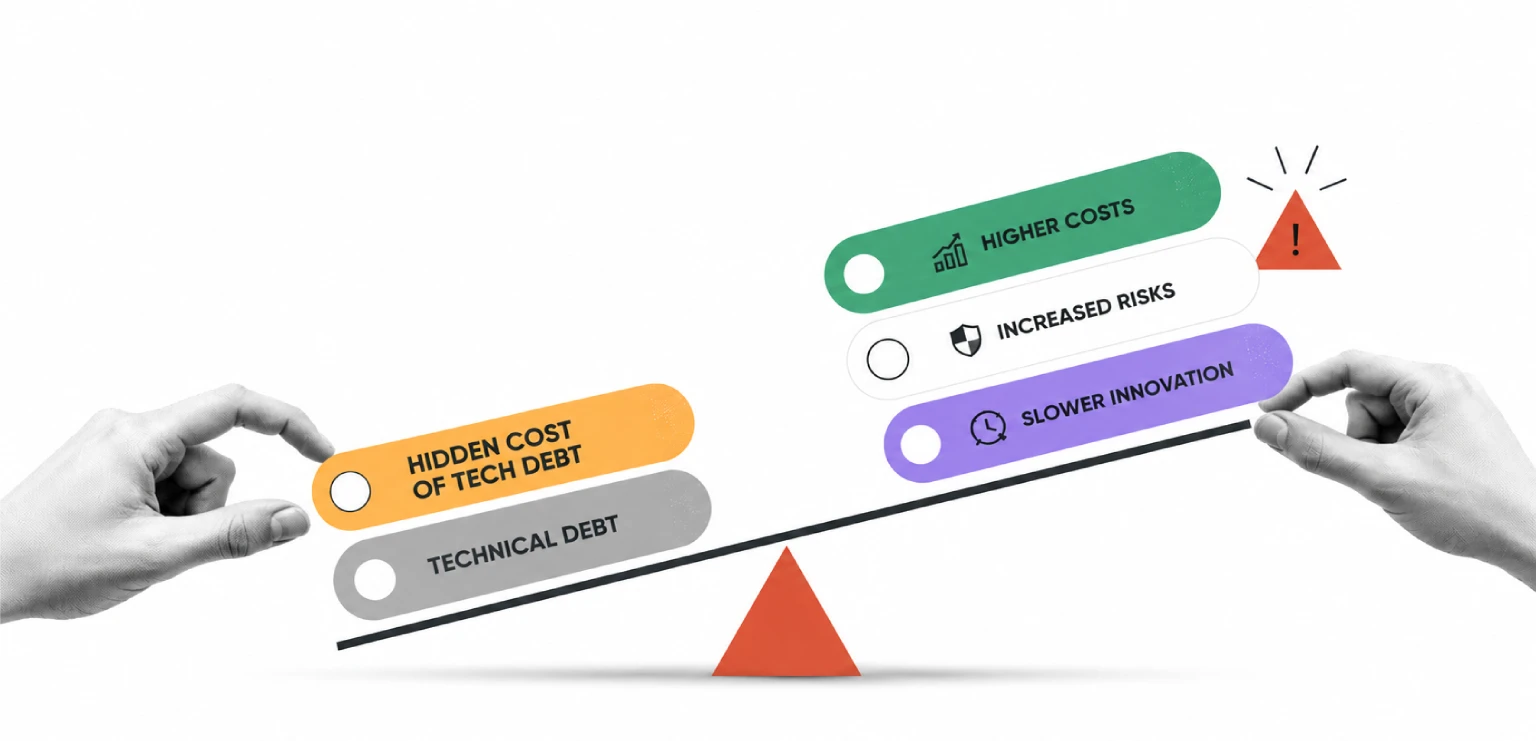
While many companies think that technical debt is an issue associated with their IT department only, in fact, its effects go far beyond engineering teams. Technical debt leads to increased expenses on maintenance, reduced innovativeness, higher security risks, and limited ability to react promptly to market changes. The longer a company delays its management, the more budget and time it wastes unknowingly.
Nevertheless, there is some good news. This problem is preventable and can be handled successfully when an organization understands the root causes of technical debt and its impact on the company.
This article will introduce the phenomenon of technical debt, its hidden costs, and the reason why its management pays off.
What Is Technical Debt?
Technical debt refers to the extra work created when software teams choose a quick or temporary solution instead of building a long-term, maintainable one. Sometimes these decisions are intentional to meet tight deadlines or launch products faster. Other times, technical debt builds gradually as applications evolve without regular updates or architectural improvements.
In technical debt in legacy applications, the challenge is even greater. Older systems often rely on outdated architectures, custom code, and unsupported frameworks that were never designed to support today’s business needs. As applications grow, so do hidden dependencies, making every change more complicated than the last.
Common signs of technical debt include:
| ▪ Increasing maintenance burden on development teams |
| ▪ Aging code that is difficult to understand or modify |
| ▪ Growing refactoring backlog |
| ▪ Dependence on obsolete technologies and unsupported libraries |
| ▪ Limited automated testing and documentation |
| ▪ Frequent production issues after software updates |
Technical debt is not always a sign of poor engineering. In many cases, it reflects business decisions made years ago when speed was more important than long-term maintainability. The problem begins when those temporary solutions become permanent and organizations continue adding new features without addressing the underlying issues.
Eventually, development slows, maintenance costs rise, and innovation takes a back seat to keeping existing systems running.
The Hidden Costs Most Organizations Don't Calculate
Technical debt is not just an issue related to software maintenance but has a lot of influence on development speed, system security, and overall business scalability. These expenses are hard to notice since they come from many different departments such as engineering, operations, security, and customer support.
|
|
|
|
| The Refactoring Backlog Keeps Growing Technical debt almost never stays static — each deferred fix compounds into code rot. |
The costs surface across engineering, operations, security, and support — which is exactly why they’re easy to miss.
Rising Legacy System Maintenance Cost
An increase in legacy system maintenance cost is one of the first indicators of technical debt accumulation. As software gets increasingly complicated, developers invest more time into solving existing problems than in developing new features. Testing and debugging become much more complicated, and even minor changes require collaboration of different departments.
According to the Developer Coefficient Report by Stripe, about 52% of developers state that working on legacy systems and dealing with technical debt prevents them from being productive. Moreover, the average number of hours per week developers spend on technical debt is 13.5.
| MEASURE IT — Track this against delivery performance using the DevOps metrics every CTO should track — deployment frequency and change failure rate expose debt fastest. |
Slower Innovation Creates Opportunity Cost
Every minute dedicated to keeping old software running is one less minute dedicated to enhancing customer experience, bringing new products to market, and even developing cutting-edge technology such as AI and automation.
These are examples of the so-called opportunity cost of technical debt.
Companies with modern and maintainable applications are better able to react to market changes since their development teams are busy innovating instead of putting out fires. Companies using old, heavily indebted systems, on the other hand, have trouble keeping up with customer needs and market pressures.
Eventually, the cost of delayed innovation may exceed that of maintenance itself.
Security Exposure Continues to Increase
Legacy software often runs on outdated operating systems and unsupported libraries, along with outdated third-party software. With the discontinuation of software updates, such technologies become more prone to cyber attacks, thus generating huge security exposure.
It is also quite difficult to maintain the security of such systems, as it is quite challenging to apply up-to-date security approaches and tools in outdated systems.
The average cost of a data breach worldwide is USD 4.4 million, as noted by the IBM Cost of a Data Breach Report 2025. Although faster detection and containment have resulted in lower costs in comparison to the previous year, legacy applications are still facing difficulties with maintaining security updates and responding to emerging threats.
Higher Change Failure Rate
Legacy applications tend to be intricately linked due to undocumented modifications made over the years. Therefore, even a simple change can cause problems within the other parts of the system.
It leads to an increase in the change failure rate, and therefore more deployments have to be rolled back or supported after being deployed.
In order to minimize risks, companies have to conduct more reviews and tests before releasing software. While this makes the process more reliable, it increases the cost and slows down the delivery process.
The Refactoring Backlog Keeps Growing
Technical debt almost never remains static—it increases with time.
Each delay in the upgrade process, each makeshift solution or improvement put off, creates another item on the refactoring list. The accumulation of these short-term solutions leads to code rot, which makes an application less comprehensible, maintainable, and extensible.
In the end, so much effort is spent solving yesterday’s problems that there is no energy left to plan for tomorrow.
Dealing with technical debt before it comes to this enables companies to make strategic decisions and build a solid base for the future.
How Technical Debt Slows AI Adoption
Companies are now spending money on AI technology as they strive to increase efficiency and improve their clients’ experience, but technical debt can make this task significantly harder. The problem is that legacy software solutions use old architectures, disconnected data sources, and technologies that cannot be used for AI integration with cloud services.
It means that before implementing an automated process with AI, using predictive analysis, or developing an intelligent application, companies will have to reduce their technical debt first, which is good both from the perspective of reducing costs and preparation for the future.
| BEFORE YOU SCALE AI — Disconnected data is the usual blocker. Our guide to generative AI data readiness covers what to fix first so AI initiatives aren’t built on guesswork. |
How Much Does Technical Debt Cost a Business?
The real cost of technical debt is not limited only to the growth of IT investments. It influences the efficiency of your operations, innovation capacity of your teams, and your ability to adapt to the evolving needs of your customers.
There are visible costs, like extra maintenance costs or hardware renewals, and hidden ones, which, despite being not very visible, can have a much bigger influence in the long run. For example, delayed product releases, recurring manufacturing problems, burnt-out developers, and missed business opportunities are all the results of the growing software complexity.
The more companies delay the process of modernization, the more severe these costs become.
How Do You Measure Technical Debt?
Technical debt isn’t just a feeling that software has become difficult to manage. It can be measured using engineering and business metrics that reveal where applications are slowing teams down.
Some useful indicators include:
| Metric | What It Indicates |
| Technical Debt Ratio | Estimated effort required to fix code quality issues. |
| Code Complexity | How difficult the application is to maintain and modify. |
| Change Failure Rate | How often deployments result in incidents or rollbacks. |
| Deployment Frequency | How quickly software reaches production. |
| Mean Time to Recovery (MTTR) | How fast systems recover after failures. |
| Maintenance vs. Innovation Ratio | Time spent maintaining existing systems versus developing new features. |
The above metrics assist engineering leaders in determining areas of highest business value for the modernization effort. Tools like SonarQube or CAST Highlight could be used for the detection of duplicate code, obsolete dependencies, and other related maintainability issues.
Besides the technical metrics, there are other metrics that could be used to assess business value, such as the growing number of support tickets, late release schedules, outages, and higher costs of infrastructure. Together, these provide a clearer picture of the potential technical debt ROI from modernization.
How to Reduce Technical Debt in Legacy Systems
Reducing technical debt doesn’t mean replacing every legacy application. In many cases, a phased modernization strategy delivers better results with far less risk.
|
|
|
|
|
A phased path: prioritize, refactor incrementally, modernize the architecture, automate, then keep a roadmap.
Prioritize High-Impact Issues
Start by identifying the areas that have the greatest effect on business operations. Applications that frequently cause outages, require constant maintenance, or slow customer-facing initiatives should be addressed first.
Refactor Incrementally
Rather than rebuilding an entire system, improve it in manageable stages. Incremental refactoring allows development teams to enhance code quality while continuing to support daily business operations.
Modernize the Architecture
Introducing APIs, cloud-native services, containers, or microservices where appropriate can improve scalability without disrupting the entire application. The right modernization approach depends on business objectives, system complexity, and long-term technology goals.
If you’re planning a broader transformation, understanding different modernization strategies can help determine whether rehosting, replatforming, refactoring, or rearchitecting is the best fit. (Our breakdown of the 6 R’s of application modernization walks through each option, and breaking the monolith into microservices covers the rearchitecting path in depth.)
Strengthen Automation
Automated testing, continuous integration, and deployment pipelines reduce manual effort and improve release confidence. They also help teams identify issues earlier, preventing technical debt from accumulating again.
| AUTOMATION FIRST — If pipelines are the bottleneck, start with automating your CI/CD pipeline — it’s usually the fastest way to stop debt from re-accumulating. |
Build a Long-Term Modernization Roadmap
Continuous management of technical debt is necessary rather than addressing the problem only when the system fails. A roadmap that matches the business needs will help in cutting down on maintenance costs and in enabling future innovation.
A phased Legacy Application Modernization strategy will go a long way in helping organizations that are in the process of modernizing their systems.
Modernization is often viewed as a cost, but it’s more accurate to see enterprise applications reducing risks while continuing to operate.
Why Technical Debt ROI Matters
The value of reducing technical debt extends well beyond lower maintenance expenses. Organizations also gain faster release cycles, stronger application security, improved developer productivity, and greater flexibility to adopt emerging technologies.
A positive technical debt ROI often includes:
| ▪ Lower legacy system maintenance cost |
| ▪ Faster software delivery |
| ▪ Reduced production incidents |
| ▪ Improved system reliability |
| ▪ Better customer experiences |
| ▪ Easier cloud and AI adoption |
| ▪ More engineering time focused on innovation instead of maintenance |
When modernization is aligned with business goals, the return is measured not only in reduced costs but also in increased agility and long-term competitiveness.
| CLOUD PATH — Planning a cloud move as part of this? See application modernization on AWS for how the phased approach maps onto a cloud target. |
Frequently Asked Questions
What is technical debt?
Technical debt is the additional work created when short-term software decisions make future development and maintenance more difficult. Over time, these compromises increase complexity, cost, and operational risk.
How much does technical debt cost a business?
It varies by organization, but the impact often includes higher maintenance expenses, slower product delivery, increased security risks, and missed opportunities for innovation. Industry research estimates that poor software quality costs U.S. businesses trillions of dollars each year.
How do you measure technical debt?
Technical debt can be measured using metrics such as technical debt ratio, code complexity, deployment frequency, change failure rate, Mean Time to Recovery (MTTR), and the amount of engineering effort spent on maintenance versus innovation.
How do you reduce technical debt in legacy systems?
Organizations can reduce technical debt by prioritizing high-impact improvements, adopting incremental refactoring, modernizing architecture, expanding test automation, and following a structured modernization roadmap.
Conclusion
Technical debt doesn’t occur overnight due to one single mistake. It accumulates over time because of deferred upgrades, hacks, and numerous iterations until running a legacy application becomes too costly than its development.
The concept of technical debt in legacy applications involves not only enhancing the code. It includes minimizing the risk of failure, cutting down costs of maintenance, speeding up software delivery, and allowing engineering teams to work on innovation rather than maintenance.
If a proper modernization strategy is adopted, the organization will be able to resolve the problem of technical debt in increments, increase performance, and lay a foundation for future development, cloud and AI integration.
At Impressico Business Solutions, we assist businesses in implementing modernization of their legacy applications with a proper and phased approach.
| IMPRESSICO · LEGACY MODERNIZATION Turn technical debt into a modernization roadmap Impressico Business Solutions helps organizations assess where technical debt is costing the most, then modernize in phases that keep the business running. Whether you need incremental refactoring, an architecture upgrade, or stronger delivery automation, our Software Engineering Solutions and DevOps & Cloud Services teams can help you build a roadmap with measurable ROI.
|

IBS
Similar articles

Modernize, Rebuild or Retire? A Decision Framework for Enterprise Leaders
August 5, 2026
Breaking the Monolith: Migrating Legacy Apps to Microservices on the Cloud
July 10, 2026
Rehost, Replatform, Refactor, Rebuild: Choosing the Right Modernization Path (the 6 R’s)
July 1, 2026
Legacy Application Modernization: A CIO’s Guide to Replatforming & Cloud-Native Transformation
June 22, 2026
Application Modernization on AWS: From Legacy Monoliths to Cloud-Native Systems
May 29, 2026
Legacy Data Warehouse Modernization: A CIO’s Guide to Moving to Snowflake & Databricks on AWS
April 29, 2026
