

August 5, 2026
Modernize, Rebuild or Retire? A Decision Framework for Enterprise Leaders
Enjoying this article?
Share it with the world!


Modernize, Rebuild or Retire? Legacy App Decision Guide
Legacy systems don’t suddenly become a problem; they gradually become more expensive to manage, secure, evolve, and integrate with new technologies. However, the complete replacement of all legacy systems is neither realistic nor necessary.
In that case, enterprise decision-makers find themselves with another important question: Should we modernize, redevelop, or decommission the application?
It doesn’t mean that the choice should be made based on technical factors alone. The decision to modernize or develop a new application must take into account a variety of factors: business value, cost, risk, potential for innovation and growth.
According to the IBM Institute for Business Value, 83% of executives say modernizing applications and data is central to their organization’s business strategy, yet only 27% say they have modernized many of the necessary workflows, applications, data, and systems. This gap highlights why every modernization decision is ultimately a business decision—not just an IT initiative.
In this guide, you will learn how to assess your legacy systems, develop a better modernization decision framework, and make an informed decision between modernize vs. redevelop or choose application retirement instead.
Why Enterprise Leaders Are Re-Evaluating Legacy Applications
Not long ago, keeping legacy applications running was considered enough. If the system supported business operations, there was little reason to replace it.
Today, the situation is different.
Expectations of customers move faster than ever before, cyber risks keep rising, and there are investments in artificial intelligence, cloud computing, automation, and data-based decision-making. Outdated applications do not help address these issues since they have stopped being suitable for today’s world because they simply were not made for that.
This leads to reevaluation of applications to decide whether they still contribute to the business or just hold it back.
The most widespread reasons are as follows:
Rising Maintenance Costs
Legacy systems often depend on outdated infrastructure, specialized expertise, and manual support. While maintenance may seem less expensive than replacement in the short term, evaluating the total cost of ownership often reveals a different picture.
Limited Scalability
Business growth demands flexible technology. Older applications frequently struggle to support increasing workloads, digital channels, or expanding customer bases without significant effort.
Security and Compliance Challenges
Unsupported technologies, aging frameworks, and outdated operating systems create growing security risks while making regulatory compliance more difficult.
AI and Cloud Readiness
Organizations adopting AI, automation, and cloud-native services need applications that integrate through APIs and support modern architectures. Many legacy platforms simply weren’t built for that level of flexibility.
Slower Innovation
When engineering teams spend most of their time maintaining aging applications, they have less capacity to deliver new features, improve customer experiences, or support strategic business initiatives.
| Impressico’s Perspective One of the biggest mistakes organizations make is evaluating applications based only on their age. We’ve seen decades-old systems continue to deliver exceptional business value, while much newer applications become costly barriers to innovation. Before making any investment, conduct an application portfolio assessment that evaluates both technical health and business impact. |
The Real Question Isn't "Old or New"—It's Modernize vs Rebuild
One of the biggest misconceptions in enterprise IT is that every legacy application should eventually be replaced.
In reality, there are three possible outcomes.
Some applications only need targeted improvements to continue supporting the business for years to come. Others have reached a point where rebuilding is the only practical option. And some applications no longer justify additional investment at all.
That’s why the discussion should focus on modernize vs rebuild, rather than simply deciding whether a system is old.
Before making a decision, enterprise leaders should ask:
| ▪ Does this application still support critical business processes? |
| ▪ Can its current architecture support future business goals? |
| ▪ How much technical debt exists? |
| ▪ What is the long-term total cost of ownership? |
| ▪ How difficult will modernization or migration be? |
| ▪ Does rebuilding create measurable business value? |
Answering these questions creates a far stronger foundation for decision-making than relying on technology alone.
Ask Yourself These Questions Before Investing
If your organization answers “Yes” to three or more of these questions, it’s probably time to evaluate your modernization strategy.
| ▪ Maintenance costs continue to increase each year. |
| ▪ Development cycles are getting longer. |
| ▪ Security updates have become more difficult. |
| ▪ Integrating with cloud or AI initiatives requires significant effort. |
| ▪ Your engineering team spends more time maintaining applications than building new capabilities. |
Understanding Your Three Strategic Options
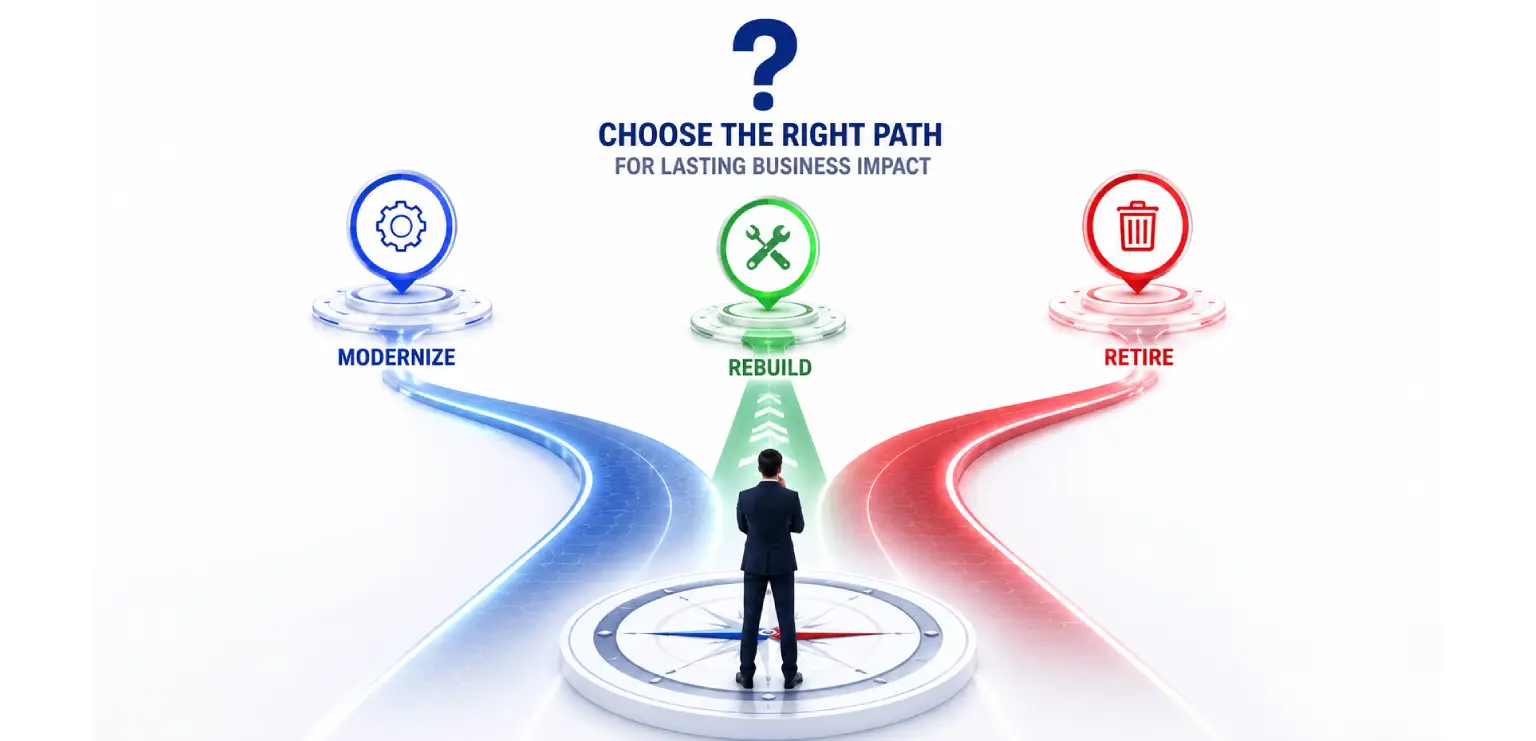
Every enterprise application typically falls into one of three paths: modernize, rebuild, or retire. The right choice depends on business priorities, technical complexity, and expected return on investment—not simply the application’s age.
Modernize, rebuild, or retire — the right path depends on business value, technical debt, and ROI, not age.
Option 1: Modernize Existing Applications
A well-planned legacy application modernization strategy enhances the application without disrupting its core business logic.
Based on the current state of the application, this can involve code refactoring, framework upgrade, integration enhancement, workload migration to the cloud, or security/performance improvement.
Such a method is suitable for situations where the application still delivers good business value, but needs technical upgrades to stay relevant. The phased migration approach further mitigates operational risks as it enables companies to modernize incrementally while keeping their operations going.
| CHOOSE THE RIGHT APPROACH — Not sure which modernization route fits? Our breakdown of the 6 R’s of application modernization walks through rehost, replatform, refactor, rearchitect, rebuild, and replace. For cloud targets specifically, see application modernization on AWS. |
Option 2: Rebuild the Application
There are some applications that have acquired so much technical debt that improving them incrementally no longer makes business sense.
Re-engineering becomes an opportunity for developing an application based on modern architecture, incorporating cloud-native features, facilitating integrations and avoiding future maintenance issues.
Whereas re-engineering usually costs more initially, it is more flexible and scalable for those who are going to undergo a digital transformation.
| THE REARCHITECTING PATH — Rebuilding often means moving to a modern, modular architecture. Our guide to breaking the monolith into microservices covers how to do that without a risky big-bang rewrite. |
Option 3: Retirement of the Application
Not all applications need to be modernized.
In case the application is not used by many users, repeats existing functionality or fails to support business goals, application retirement might become the most economical choice.
A carefully prepared sunset plan would help preserve the data and smoothly transfer users.
| Quick Summary ▪ Modernize when business value is high and technical debt is manageable. ▪ Rebuild when architecture limits future growth. ▪ Retire when maintenance costs exceed business value. |
| Impressico’s Perspective Projects of modernization almost never fail due to technologies, but due to the fact that organizations modernize inappropriate applications at first. Application prioritization based on its business value, modernization complexity, and ROI will help decrease risks and get some results earlier during the transformation journey. |
A Practical Decision Framework for Legacy Applications
After it is defined what application requires attention, there comes a moment when it is required to determine how it should be done. The problem is that without a systematic approach to application evaluation, modernization processes tend to become reactive, increasing costs and unpredictability.
Modernization decision framework is a practical instrument that allows evaluating applications from the point of business priority, feasibility, and value.
|
|
| |||
|
|
|
A six-step framework for evaluating every application on business priority, feasibility, and value.
1. Measure Business Criticality
Start by understanding the application’s role in your business.
Ask questions like:
| ▪ Does it support revenue-generating operations? |
| ▪ How many users depend on it? |
| ▪ Would downtime significantly impact the business? |
| ▪ Does it provide a competitive advantage? |
Applications with high business criticality usually deserve greater investment because they directly influence business performance.
2. Assess Technical Health
A technical assessment reveals whether the application can continue supporting future business needs.
Review factors such as:
| ▪ Technical debt |
| ▪ Code quality |
| ▪ Security vulnerabilities |
| ▪ Performance |
| ▪ Scalability |
| ▪ Integration capabilities |
This evaluation often determines whether refactoring is enough or rebuilding becomes the better long-term investment.
3. Calculate the Total Cost of Ownership
Many organizations compare only implementation costs when evaluating modernize vs rebuild.
A better approach is to calculate the complete total cost of ownership, including infrastructure, licensing, maintenance, support, compliance, downtime, and operational overhead.
Sometimes an application that appears inexpensive to maintain is actually limiting business growth and consuming valuable engineering resources.
4. Evaluate Your Risk Appetite
Every modernization initiative carries risk.
Consider:
| ▪ Acceptable downtime |
| ▪ Budget flexibility |
| ▪ Compliance requirements |
| ▪ Internal capabilities |
| ▪ Tolerance for business disruption |
Organizations with a lower risk appetite often achieve better results through phased migration, delivering value incrementally while minimizing operational disruption.
5. Align Technology with Business Goals
Technology decisions should support long-term business strategy.
If your organization plans to expand into new markets, improve customer experiences, adopt AI, or accelerate cloud adoption, your applications must be capable of supporting those initiatives.
6. Build a Realistic Transformation Roadmap
Modernization doesn’t have to happen all at once.
Many successful organizations modernize in phases, validating progress at every stage instead of attempting a high-risk “big bang” migration. A phased lifecycle that assesses, transforms, validates, and operates aligns with enterprise modernization practices focused on continuity and controlled execution.
| DATA LAYER TOO — Application modernization often stalls on the data behind it. If your analytics or warehouse is part of the legacy estate, see legacy data warehouse modernization on AWS. |
| Impressico’s Perspective Organizations that achieve the highest modernization ROI rarely start with the largest applications. They begin with systems that deliver measurable business impact while presenting manageable implementation complexity. Early wins build momentum, reduce organizational resistance, and strengthen the business case for larger modernization initiatives. |
Modernize vs Rebuild: A Quick Comparison
| Factor | Modernize | Rebuild |
| Initial investment | Lower | Higher |
| Implementation timeline | Faster | Longer |
| Business disruption | Minimal | Moderate to High |
| Existing business logic | Preserved | Recreated |
| Technical debt | Reduced | Eliminated |
| Cloud readiness | Improved | Excellent |
| Long-term flexibility | High | Very High |
| Best suited for | Applications with solid business value and manageable technical debt | Applications with outdated architecture and major technical limitations |
Decision Tip: If the application’s business logic remains valuable but the technology needs improvement, modernization usually delivers faster ROI. If the architecture limits future growth, rebuilding often becomes the better long-term investment.
Refactoring or Rewriting: Which Makes More Sense?
One question frequently comes up during modernization planning:
How do you decide between refactoring and rewriting?
The answer depends on whether the application’s existing architecture can continue supporting future business needs.
Choose Refactoring When:
| ▪ Business logic remains valuable. |
| ▪ The architecture is fundamentally stable. |
| ▪ Performance issues are limited. |
| ▪ You need faster results with lower investment. |
Choose Rewriting When:
| ▪ Technical debt has become overwhelming. |
| ▪ The architecture limits scalability. |
| ▪ Security and compliance issues cannot be addressed efficiently. |
| ▪ Modern integrations are difficult or impossible. |
| ▪ The application slows business innovation. |
In many cases, organizations adopt a hybrid strategy—refactoring business-critical components while rebuilding areas that create the greatest technical constraints.
When Should You Retire a Legacy System?
Sometimes the smartest modernization decision is knowing when to stop investing.
Application retirement becomes the right choice when an application no longer delivers enough business value to justify ongoing maintenance. However, it’s important to distinguish retirement from rebuilding. Many legacy applications have outdated technology, rising maintenance costs, or security challenges, yet they continue to support critical business processes or regulatory requirements. In these cases, rebuilding or modernizing the application may be the better option. Retirement should only be considered when the application’s business purpose has diminished and there is no compelling need to replace it with a new system.
Common indicators include:
| ▪ Declining user adoption |
| ▪ Duplicate functionality |
| ▪ Increasing maintenance costs |
| ▪ Unsupported technologies |
| ▪ Growing security risks |
| ▪ No alignment with future business objectives |
Before retiring an application, organizations should also evaluate whether it still supports critical users, regulatory obligations, historical data access, or business processes that cannot yet be migrated elsewhere. If those dependencies exist, a rebuild or phased replacement may be more appropriate than complete retirement.
Retirement, however, requires careful planning.
A structured sunset plan should include:
| ▪ Data archiving |
| ▪ User transition planning |
| ▪ Dependency analysis |
| ▪ Compliance validation |
| ▪ Controlled decommissioning |
Retiring an application responsibly reduces long-term costs while minimizing operational risk.
Building a Modernization Business Case That Gets Approved
Technology projects receive executive support when they clearly demonstrate business value.
A compelling modernization business case should answer one question:
How will this investment improve business outcomes?
Executives typically evaluate modernization initiatives based on:
| ▪ Reduced total cost of ownership |
| ▪ Faster product delivery |
| ▪ Lower operational risk |
| ▪ Improved customer experience |
| ▪ Higher engineering productivity |
| ▪ Better readiness for AI, automation, and cloud adoption |
When modernization is linked to measurable business outcomes instead of technical improvements alone, securing stakeholder buy-in becomes much easier.
| Impressico’s Perspective The strongest modernization business cases focus on outcomes rather than technology. Enterprise leaders are more likely to invest when modernization is positioned as a way to reduce operational risk, accelerate innovation, and improve long-term business agility—not simply replace aging software. |
Common Mistakes That Delay Modernization Success
Even well-funded modernization initiatives can fall short when organizations make avoidable decisions.
Some of the most common mistakes include:
| ✗ Treating every legacy application the same. |
| ✗ Skipping an application portfolio assessment. |
| ✗ Focusing only on upfront costs instead of long-term value. |
| ✗ Underestimating organizational change management. |
| ✗ Rebuilding applications that could have been modernized successfully. |
| ✗ Starting projects without a clear roadmap or phased migration strategy. |
Avoiding these pitfalls helps organizations reduce risk and realize value sooner.
Make the Right Modernization Decision with Confidence
The debate isn’t simply modernize vs rebuild—it’s about choosing the strategy that delivers the greatest business value.
Some applications deserve modernization because they continue to support critical operations with manageable technical debt. Others require a complete rebuild to create a scalable, future-ready foundation. And in some cases, application retirement is the most strategic decision, allowing organizations to redirect resources toward higher-value initiatives.
A structured modernization decision framework helps enterprise leaders evaluate every application based on business criticality, technical health, total cost of ownership, and future objectives, leading to smarter investment decisions and lower transformation risk.
At Impressico Business Solutions, we help enterprises move beyond assumptions with comprehensive application assessments, AI-assisted engineering insights, and practical modernization roadmaps. Whether you’re evaluating a single mission-critical application or planning an enterprise-wide modernization initiative, our experts help you choose the right path—modernize, rebuild, or retire—with confidence and measurable business outcomes.
| IMPRESSICO · APPLICATION MODERNIZATION Choose the right path with confidence Impressico Business Solutions helps enterprises move beyond guesswork with application portfolio assessments, AI-assisted engineering insights, and phased modernization roadmaps. Whether you’re evaluating one mission-critical system or planning enterprise-wide transformation, our Software Engineering Solutions and DevOps & Cloud Services teams help you decide—and deliver—modernize, rebuild, or retire with measurable business outcomes.
|
Impressico Business Solutions — Helping enterprises choose the right path for every application: modernize, rebuild, or retire.

IBS
Similar articles

The Hidden Cost of Technical Debt in Legacy Applications
July 27, 2026
Breaking the Monolith: Migrating Legacy Apps to Microservices on the Cloud
July 10, 2026
Rehost, Replatform, Refactor, Rebuild: Choosing the Right Modernization Path (the 6 R’s)
July 1, 2026
Legacy Application Modernization: A CIO’s Guide to Replatforming & Cloud-Native Transformation
June 22, 2026
Application Modernization on AWS: From Legacy Monoliths to Cloud-Native Systems
May 29, 2026
Legacy Data Warehouse Modernization: A CIO’s Guide to Moving to Snowflake & Databricks on AWS
April 29, 2026
