

September 18, 2026
Salesforce Industry Clouds: When Vertical CRM Beats Sales Cloud
Enjoying this article?
Share it with the world!


Salesforce Industry Cloud vs Sales Cloud: Which to Pick
| ⚡ Quick Answer The difference between Salesforce Industry Cloud vs Sales Cloud comes down to where you start. Sales Cloud is a general-purpose CRM that assumes nothing about your sector, so you build the data model yourself. A Salesforce Industry Cloud — Financial Services Cloud, Health Cloud, Manufacturing Cloud and the rest — ships with the objects, workflows and compliance structures your industry already uses. Industry Cloud costs more per user but usually less to own, because you spend far less on custom development. Choose vertical CRM when your data is genuinely industry-specific, when compliance is daily work, or when your Sales Cloud org is drowning in custom fields. Stay on Sales Cloud when your sales motion is standard and flexibility matters more than pre-built structure. |
When considering Salesforce as a solution for your organization, you have most likely seen the two solutions known as Sales Cloud and Salesforce Industry Cloud. On the surface, they look like the exact same product, just rebranded. They are far from that. And choosing the wrong solution might mean months of additional work for your team along with unnecessary custom development costs.
At Impressico Business Solutions, we often face the following questions: “We have Sales Cloud now, why do we need Industry Cloud?” Well, it is a reasonable question. Let us clarify this in our blog post.
What Are Salesforce Industry Clouds?
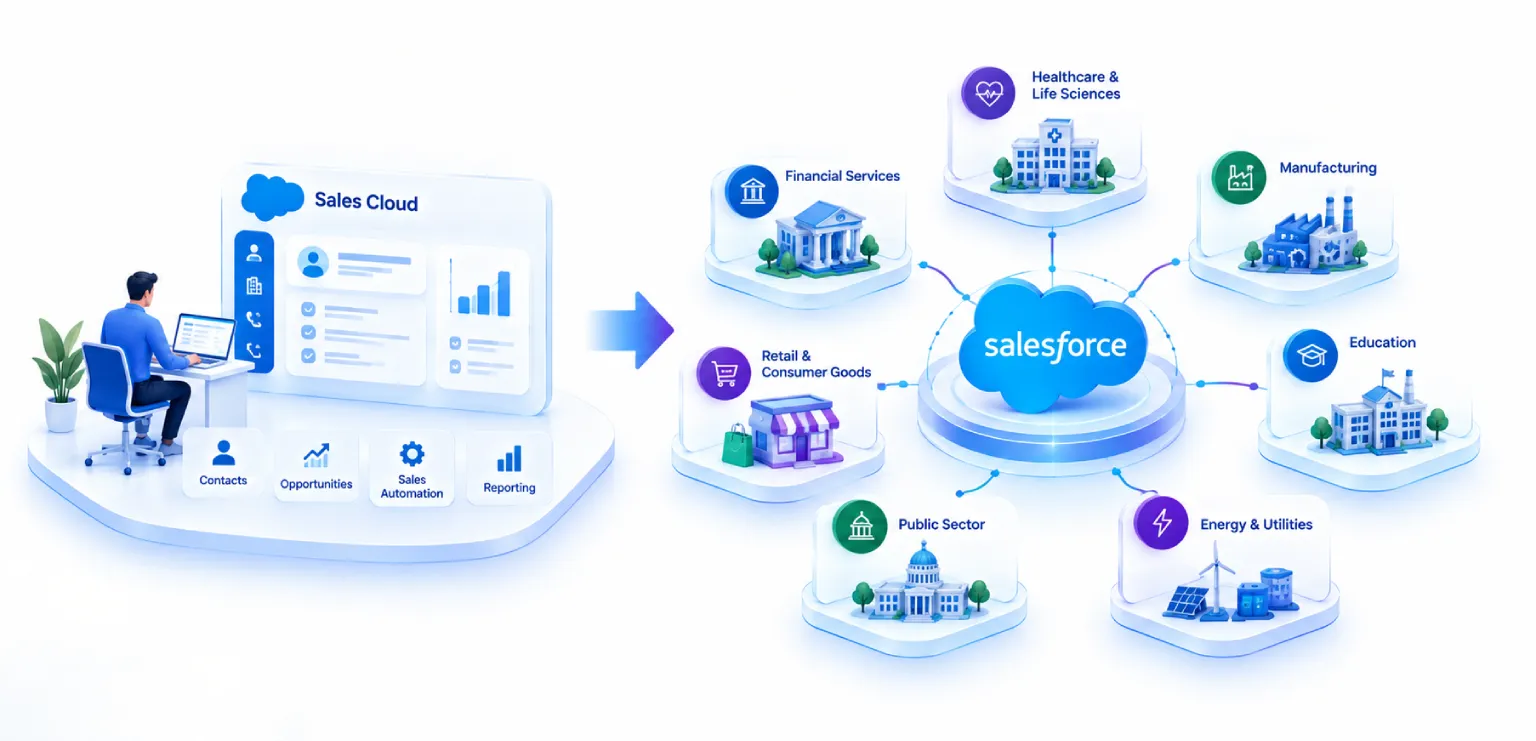
Salesforce Industry Cloud (also called Industries or vertical CRM) is a set of Salesforce products built for specific sectors. Instead of giving every business the same generic tool, Salesforce built separate versions for industries like:
|
|
| |||
|
|
| |||
| |||||
Each of these comes with data models, workflows, and features already built for that industry. So a bank using Financial Services Cloud gets things like household views and financial account tracking right out of the box. A hospital using Health Cloud gets care plans and patient timelines already set up.
What Is the Difference Between Industry Cloud and Sales Cloud?
| The two products solve the same problem from opposite ends. Sales Cloud gives you a general foundation and expects you to shape it. Industry Cloud gives you a shaped foundation and expects you to refine it. Everything below follows from that one difference. |
Salesforce Industry Cloud vs Sales Cloud, side by side
This is the core question, so let’s keep it simple.
Sales Cloud is Salesforce’s general-purpose sales tool. It handles leads, contacts, opportunities, and deals. It works for almost any business because it doesn’t assume anything about your industry. You build on top of it to make it fit your needs.
Industry Cloud starts one step ahead. It already understands your business terms. Instead of “Accounts” and “Opportunities” only, Financial Services Cloud understands things like financial accounts, life events, and referrals. Health Cloud understands patients, care plans, and providers. You are not starting from a blank page.
|
|
Think of Sales Cloud as a plain notebook. You can write anything in it, but you have to design the format yourself. Industry Cloud is more like a notebook that already has the right sections printed in it for your type of work.
Figure 1 — Salesforce Industry Cloud vs Sales Cloud, dimension by dimension.
The tradeoff is cost and flexibility. Sales Cloud is usually cheaper and more flexible since it is not locked into one way of doing things. Industry Cloud costs more but saves you time because a lot of the setup work is already done.
When to Use Salesforce Industry Cloud
Not every business needs a vertical CRM. Here is when it usually makes sense.
|
Your industry has very specific data needs If your business deals with things that a normal CRM doesn’t have fields for, like insurance policies, patient records, or manufacturing contracts, an Industry Cloud saves you from building all of that from scratch. |
|
Compliance and regulation are part of daily work Healthcare and financial services deal with strict rules. Health Cloud and Financial Services Cloud are built with these rules in mind, which reduces the compliance work your team has to handle manually. |
|
You want faster implementation Because the data model and many processes already exist, projects can go live faster compared to building everything custom on Sales Cloud. |
|
Your business has complex relationships to manage Things like households in banking, or care teams in healthcare, are hard to model in a standard CRM. Industry Cloud tools already handle this kind of complexity. |
|
You are scaling and outgrowing your current custom setup If your team has spent years bolting on custom fields and workarounds to Sales Cloud to make it act like an industry tool, it may be time to move to the real thing. |
| Not sure which side of that list you fall on? Most CRM leaders can argue it both ways, which is exactly the problem. An Industry Cloud Fit Assessment gives you a clear answer based on your actual data model and processes, not a sales pitch. |
When Sales Cloud Is Still the Better Choice
Industry Cloud is not always the answer. Sales Cloud still wins when:
| ▪ Your business is not tied to one of the specific industries Salesforce covers ▪ Your sales process is fairly standard (leads to deals to closed sales) ▪ You want lower cost and simpler licensing ▪ You need maximum flexibility to build your own custom process ▪ You are a smaller company that doesn’t need heavy industry-specific structure yet |
If your business runs a normal B2B or B2C sales motion without deep industry complexity, Sales Cloud is usually enough, and it will cost less.
| The Signals on Each Side
|
Figure 2 — The signals on each side of the decision, drawn from the two lists above.
Which Salesforce Industry Cloud Should I Choose?
This depends entirely on what your business does. A quick way to think about it:
Figure 3 — Sector-to-cloud mapping at a glance.
If your business spans more than one of these, or doesn’t fit neatly into any, that’s a sign you need an expert to review your process before choosing. This is exactly where a Salesforce partner like Impressico can help, since picking the wrong cloud is expensive to undo later.
| Sitting between two clouds, or outside all of them? That is the most common position of all, and the most expensive one to get wrong. We map your processes against every Salesforce vertical CRM before a single licence is bought. |
How Much Do Salesforce Industry Clouds Cost?
Salesforce pricing changes all the time, and Industry Cloud products are typically priced at a higher price point per user compared to typical Sales Cloud products because of the additional functionality offered. The precise pricing will depend on which cloud it is, which edition it is, and how many users there are, so it is better to get an accurate answer from Salesforce or an official partner directly.
| The comparison that matters Higher licence fee, potentially lower total cost of ownership — because you spend less on custom development and less time forcing Sales Cloud to behave like an industry tool. |
From our own experience, what we can tell you is that even though the license fee is higher, the cost of ownership may be lower. That’s because you spend less on custom development, and your team spends less time forcing Sales Cloud to behave like an industry tool. So the real comparison is not just license price versus license price. It’s total cost, including implementation and long-term maintenance.
When Should You Migrate to a Salesforce Industry Cloud?
If you’re currently on Sales Cloud, here are the signs that tell you it might be time to move:
| Your custom fields are piling up If your Sales Cloud org has dozens of custom objects trying to recreate what an Industry Cloud already offers, you’re paying for custom work that already exists elsewhere. |
| Your team keeps hitting walls If your business processes don’t fit naturally into standard leads and opportunities, that friction is a sign. |
| Compliance reporting is getting harder Manually tracking regulatory requirements is a strong signal that a purpose-built cloud would help. |
| You’re planning a major CRM overhaul anyway If you’re already budgeting for a big Salesforce project, that’s the natural time to evaluate a switch, rather than rebuilding the same limitations again. |
| Competitors in your industry have moved faster with dedicated tools If rivals are running smoother operations because of the tools they use, it’s worth a serious look. |
| Migration is not something to rush into. It needs proper planning around data migration, user training, and testing, so nothing breaks mid-way. This is where working with an experienced partner really pays off, since a rushed migration can cause more damage than staying put. |
Final Thoughts
There is no universal right answer between Salesforce Industry Cloud and Sales Cloud. It comes down to how specific your industry’s needs are, how much custom work you’re already doing, and how much that custom work is costing you in time and money.
If your business is fairly general and your sales process is simple, Sales Cloud will likely serve you well for a long time. But if you are in a regulated or complex industry like healthcare, banking, manufacturing, or the public sector, and you keep running into the limits of a general CRM, it’s worth seriously evaluating a vertical CRM built for your world.
At Impressico Business Solutions, we help businesses figure out exactly which path fits, whether that means optimizing your current Sales Cloud setup or planning a full move to an Industry Cloud. If you’re unsure where you stand, talk to our Salesforce team before you make the call. Getting this decision right the first time saves a lot of pain later.
| Find out which Salesforce cloud actually fits Impressico has taken CRM leaders in banking, healthcare and manufacturing through this exact decision. The Industry Cloud Fit Assessment reviews your data model, processes and compliance load, then tells you plainly whether to move or stay. Request your Industry Cloud Fit Assessment → |

IBS
Similar articles

Is Your Salesforce Org Ready for AI? An Enterprise Readiness Checklist
August 7, 2026
Salesforce Data Cloud Explained: Unifying Customer Data for AI
July 29, 2026
Einstein AI Use Cases Across Sales, Marketing & Service Cloud
July 13, 2026
What is Salesforce Agentforce? Autonomous AI Agents for Sales & Service
July 3, 2026
AI-Powered Salesforce: Agentforce, Einstein & Data Cloud for Enterprise CRM
June 24, 2026
Einstein Copilot Use Cases Across Sales, Service and Marketing Cloud
May 27, 2026
