

September 23, 2026
Salesforce Financial Services Cloud vs Sales Cloud: Which One Fits Wealth, Banking, and Insurance
Enjoying this article?
Share it with the world!


Salesforce FSC vs Sales Cloud for Banking & Insurance
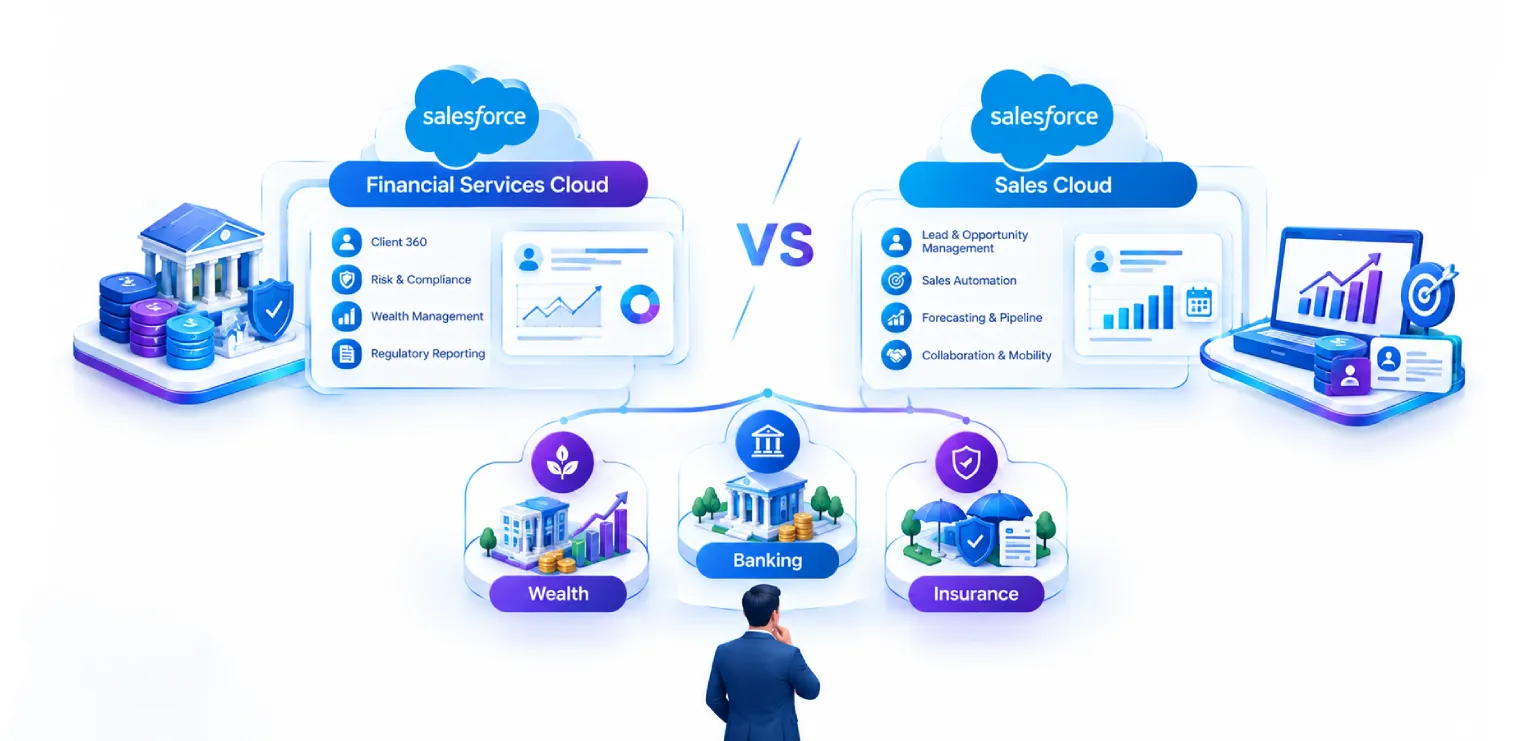
If you run a wealth management firm, a bank, or an insurance business, you have probably asked yourself this question at some point: do we really need Financial Services Cloud, or can our regular Sales Cloud just do the job?
It’s a fair question. Salesforce doesn’t make this an easy choice on paper, and a lot of vendors just push whatever is easier for them to sell. We work with financial services clients at Impressico Business Solutions almost every week, and this comparison comes up in nearly every discovery call. So let’s break it down.
First, What Are We Even Comparing?
Sales Cloud is Salesforce’s general purpose CRM. It was built to help any business track leads, manage deals, and close sales. Retailers use it. Manufacturers use it. Tech companies use it. It’s flexible, but that flexibility comes from being generic.
Financial Services Cloud, or FSC as most people call it, is built on top of the same Salesforce engine, but it’s shaped specifically for banking, wealth management, and insurance.
|
|
Think of it like buying a suit off the rack versus getting one tailored. Both cover your body. Only one actually fits.
A quick side-by-side — the fuller reasoning follows below.
| NEW TO THE CLOUDS? For how Salesforce’s different clouds fit together, see Salesforce cloud solutions explained. |
Where Sales Cloud Starts to Struggle for Wealth and Banking
Sales Cloud thinks in terms of “leads” and “opportunities.” That works fine if you’re selling software or machinery. But a wealth advisor isn’t just closing a one-time deal. They’re managing a household, tracking multiple accounts under one family, keeping an eye on life events like a child going to college or a client nearing retirement, and staying on top of compliance requirements the whole time.
|
|
|
|
Sales Cloud simply wasn’t designed to hold that kind of relationship data out of the box. You can customize it, sure, but you’ll end up building workarounds for things that FSC already gives you for free, like household views, financial account rollups, life event tracking, and relationship mapping between clients, their family members, and their advisors.
| For banks specifically, the story is similar. A retail bank needs to see a customer’s full relationship, checking account, savings, mortgage, credit card, and business loan, all in one place. Sales Cloud doesn’t naturally think in those terms. FSC does. |
What Insurance Companies Get From FSC That Sales Cloud Can’t Offer
Insurance is its own beast. You’ve got policies, claims, underwriting, agents, and renewal cycles all moving at once. FSC has data models built specifically for policies and coverage, so agents and service reps can see a client’s full insurance picture without stitching together five different custom objects.
| If you’re an insurance company still running plain Sales Cloud, chances are your IT team has spent months, maybe years, recreating features that already exist inside FSC. That’s time and budget that could’ve gone somewhere else. |
So Is Financial Services Cloud Always the Better Choice?
Not always, and this is where we’re honest with our clients even when it costs us the bigger deal. If you’re a small advisory firm with a handful of clients and a simple sales process, Sales Cloud might genuinely be enough. Why pay for industry specific features you’ll never touch?
But if you’re a bank, a wealth management firm managing multiple households, or an insurance company juggling policies and claims at scale, Sales Cloud is going to feel like you’re constantly fighting the tool instead of working with it.
| The Gut Check
|
A simple gut-check on which platform matches your business.
| Sitting on the line between the two? The honest answer depends on your household structures, policy volumes and compliance load — not a feature list. We map those before recommending either platform. |
Let’s Talk About Financial Services Cloud Cost
This is probably the question we get asked the most, and honestly, there’s no single number that fits everyone. Salesforce prices FSC per user per month, and it sits higher than standard Sales Cloud because you’re paying for the industry specific data model and features baked in.
The real cost conversation isn’t just the license fee though. It’s implementation. FSC has a lot more moving parts than Sales Cloud, household models, financial accounts, compliance features, integrations with your core banking or policy admin systems. A rushed or DIY implementation almost always costs more in the long run than a properly scoped one.
| Ask the better question Our advice? Don’t just ask “what does FSC cost.” Ask “what does it cost to implement FSC properly for my specific business, and what will I save by not building custom workarounds in Sales Cloud instead.” That’s usually where the real savings show up. |
Migrating From Sales Cloud to Financial Services Cloud
If you’re already on Sales Cloud and thinking about moving to FSC, the good news is you’re not starting from zero. Your data, your users, your existing workflows, all of that carries forward in some form.
| What the migration involves ▪ Mapping existing leads and opportunities into FSC’s relationship model ▪ Converting accounts into household structures ▪ Bringing in financial account data ▪ Reconfiguring automation to use FSC’s industry objects instead of generic ones |
The migration itself usually involves mapping your existing leads and opportunities into FSC’s relationship model, converting accounts into household structures, bringing in financial account data, and reconfiguring your automation so it uses FSC’s industry specific objects instead of generic ones.
It’s not a flip a switch kind of project. Done right, it takes planning, testing, and a partner who has actually done this before, not someone learning on your dime.
| PLAN THE ROLLOUT A structured rollout is what keeps this low-risk. See our Salesforce implementation guide and, for larger orgs, the enterprise Salesforce implementation guide. |
Why the Right Implementation Partner Matters More Than the Platform Itself
Here’s something people don’t talk about enough. Two companies can buy the exact same Financial Services Cloud license and end up with completely different results, one struggling to adopt it, the other running smoothly within a few months. The difference almost always comes down to implementation.
This is exactly where Impressico Business Solutions has built its reputation among wealth, banking, and insurance CRM leaders. We don’t just install FSC and hand you the keys. We understand the regulatory pressure banks operate under, the relationship complexity wealth advisors deal with daily, and the claims and policy workflows that make or break an insurance CRM rollout.
| WHY A PARTNER HELPS On what a strong partner actually changes, see the role of a Salesforce consulting partner. And if AI is on your roadmap, is your Salesforce org ready for AI? is worth a read before you scale. |
Bottom Line
If your business lives and breathes financial relationships, households, policies, claims, or multi account banking customers, Financial Services Cloud is built for you in a way Sales Cloud simply isn’t. If you’re smaller and your needs are simple, Sales Cloud might still get the job done.
Either way, the platform is only half the equation. The other half is getting it implemented by people who actually understand financial services, not just Salesforce configuration. That’s the difference between a CRM that sits there and a CRM that actually helps your advisors, bankers, and agents do their jobs better.
If you’re weighing this decision for your own organization, it’s worth having a real conversation about your specific setup rather than guessing based on a feature list. That’s a conversation Impressico Business Solutions is always happy to have.
| Not sure which Salesforce cloud fits your firm? Whether you’re weighing FSC against Sales Cloud or planning a migration, Impressico Business Solutions helps wealth, banking, and insurance teams choose and implement the right platform — with the regulatory, relationship, and claims/policy know-how that makes a rollout succeed. Our Salesforce services team is happy to talk through your specific setup, not a generic feature list. → Explore our Salesforce Services |
Impressico Business Solutions — Helping wealth, banking, and insurance firms pick the right Salesforce cloud, and implement it right.

IBS
Similar articles

Agentforce Readiness: What to Fix in Your Salesforce Org First
August 17, 2026
Is Your Salesforce Org Ready for AI? An Enterprise Readiness Checklist
August 7, 2026
Salesforce Data Cloud Explained: Unifying Customer Data for AI
July 29, 2026
Einstein AI Use Cases Across Sales, Marketing & Service Cloud
July 13, 2026
What is Salesforce Agentforce? Autonomous AI Agents for Sales & Service
July 3, 2026
AI-Powered Salesforce: Agentforce, Einstein & Data Cloud for Enterprise CRM
June 24, 2026
