

July 31, 2026
Measuring Platform Engineering ROI: DORA and SPACE Explained
Enjoying this article?
Share it with the world!


How to Measure Platform Engineering ROI (DORA + SPACE)
Platform engineering has become a strategic investment for organizations looking to improve software delivery, simplify development, and create a better experience for engineering teams. However, after developing the platform, one more question arises almost immediately — Is it generating any business value?
It goes without saying that fast deployment cannot be considered an ultimate goal. Companies require low operational costs, improved software quality, increased productivity of developers, and speed of delivery. This is the reason why assessing platform engineering ROI is equally important to building the platform.
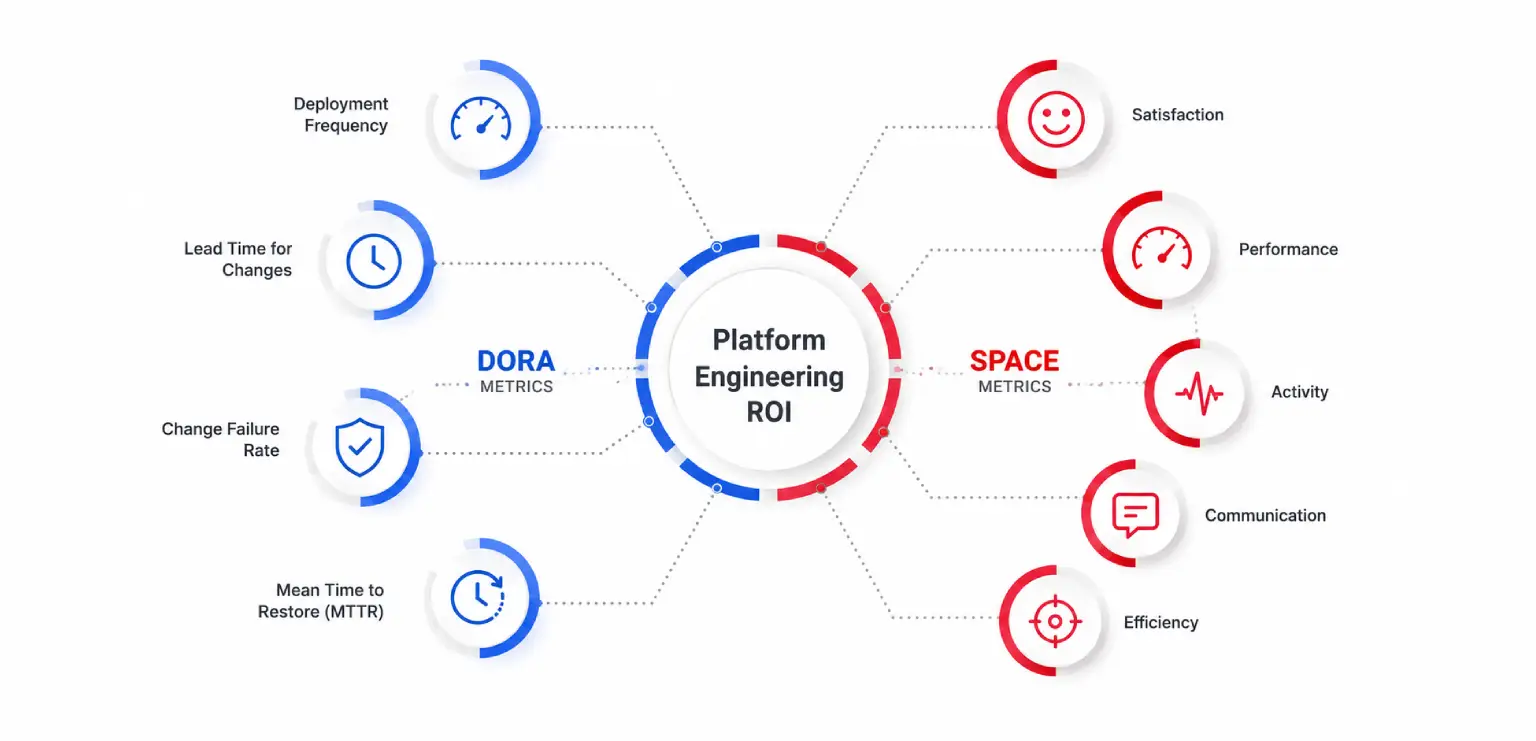
Instead of guessing whether the investment paid off, the company can apply specific tools of analysis, such as DORA metrics or the SPACE framework. The former tool evaluates the performance of the process of software delivery, whereas the latter focuses on developer experience and productivity.
Simply put:
| ▪ Platform engineering = the investment. |
| ▪ DORA metrics = how well software is delivered. |
| ▪ SPACE framework = how effectively developers work. |
| ▪ Together = the proof of platform engineering ROI. |
| The ROI Equation
|
The ROI equation: the platform is the investment; DORA and SPACE together prove the return.
Why Measuring Platform Engineering ROI Is More Important Than Ever
Platform engineering aims to reduce friction, automate repetitive tasks, and help developers deliver software more efficiently. While these improvements are valuable, organizations still need evidence that they are generating real business impact.
Measuring platform engineering ROI helps answer critical questions such as:
| ▪ Are teams releasing software faster? |
| ▪ Has software quality improved? |
| ▪ Are production incidents decreasing? |
| ▪ Is developer time being spent on innovation instead of infrastructure? |
| ▪ Is the organization becoming more operationally efficient? |
More importantly, ROI measurement creates a common language between engineering and business leaders. Rather than focusing only on technical improvements, conversations shift toward customer value, delivery speed, cost optimization, and long-term growth.
| WHERE IT STARTS — If you’re still defining what “good” looks like, our guide to measuring DevOps maturity and the DevOps maturity model help you baseline before you optimize. |
What Does Platform Engineering ROI Actually Mean?
Platform engineering ROI isn’t limited to financial returns. It reflects how effectively a platform helps engineering teams deliver better software while reducing unnecessary effort.
Here are four key indicators of success.
Faster Software Delivery
Automation, standardized workflows, and self-service tools eliminate common bottlenecks, allowing teams to release features more quickly and respond to customer needs faster.
Higher Developer Productivity
Strong developer productivity metrics focus on removing friction rather than increasing coding activity. When developers spend less time managing infrastructure and more time building products, productivity naturally improves while strengthening the overall business case for platform engineering.
Better Reliability
A standardized platform improves testing, deployment consistency, and monitoring, helping reduce production failures while improving recovery times and release confidence.
Faster Onboarding
Standardized environments and reusable templates reduce onboarding time, allowing new engineers to become productive much sooner without depending heavily on senior team members.
Together, these improvements provide a much more meaningful measure of platform engineering ROI than cost savings alone.
The Four DORA Metrics Every Engineering Leader Should Track
If you want to measure platform engineering ROI, start with the DORA metrics. These four industry-recognized metrics help engineering leaders evaluate both the speed and reliability of software delivery.
|
|
|
|
The four DORA metrics measure both the speed and the reliability of software delivery.
Deployment Frequency
Deployment frequency measures how often code reaches production. Frequent, reliable deployments usually indicate mature delivery processes and lower release risk.
Lead Time for Changes
Lead time for changes measures how long it takes for code to move from commit to production. Shorter lead times reflect fewer delivery bottlenecks and faster customer value.
Change Failure Rate
Change failure rate tracks the percentage of deployments that introduce production issues requiring rollbacks or fixes. Lower rates indicate higher software quality.
Mean Time to Recovery (MTTR)
MTTR measures how quickly teams restore services after an incident. Faster recovery reduces downtime and demonstrates stronger operational resilience.
While the DORA metrics effectively measure delivery performance, they don’t explain how developers experience the engineering environment. That’s where the SPACE framework becomes equally valuable.
| IMPROVE THESE — These four move fastest when your pipeline is solid. See how to automate your CI/CD pipeline for SaaS and our DevOps automation framework for SaaS. |
Beyond Speed: Understanding the SPACE Framework
The SPACE framework, developed through research by GitHub, Microsoft, and the University of Victoria, recognizes that developer productivity goes beyond deployment speed.
|
|
|
|
|
SPACE looks at five dimensions of engineering effectiveness — not just delivery speed.
It evaluates five dimensions of engineering effectiveness:
| ▪ Satisfaction and Well-being: Measures developer satisfaction and overall engagement. |
| ▪ Performance: Evaluates meaningful outcomes rather than activity alone. |
| ▪ Activity: Tracks work such as commits and pull requests without treating them as productivity metrics. |
| ▪ Communication and Collaboration: Measures how effectively teams share knowledge and resolve blockers. |
| ▪ Efficiency and Flow: Assesses flow efficiency, identifying how much time developers spend creating value instead of waiting on approvals or manual processes. |
Together, these dimensions provide context that operational metrics alone cannot capture.
DORA vs. SPACE: Which Framework Should You Use?
Although they’re often compared, DORA and SPACE serve different purposes.
| DORA Metrics | SPACE Framework |
| Measures software delivery performance | Measures overall developer productivity |
| Focuses on operational outcomes | Includes human and organizational factors |
| Uses objective engineering data | Combines quantitative and qualitative insights |
| Tracks delivery speed and reliability | Evaluates productivity, collaboration, and satisfaction |
Rather than choosing one over the other, mature engineering organizations use both. DORA explains how efficiently software is delivered, while SPACE explains how effectively developers work. Together, they provide a balanced view of engineering performance and form the foundation for measuring platform engineering ROI.
| RELATED READING — For where platform engineering sits next to DevOps and SRE, see Platform Engineering vs. DevOps, Platform Engineering vs. DevOps vs. SRE, and Platform Engineering Beyond DevOps for SaaS. |
How to Measure Platform Engineering ROI Using DORA and SPACE Together
The most effective way to measure platform engineering ROI is to combine delivery metrics with developer experience. Looking at only one side can create an incomplete picture.
A practical approach includes:
| 1. | Create a benchmark for deployment frequency, lead time for changes, change failure rate, MTTR, time taken for onboarding, and developer satisfaction. |
| 2. | Identify bottlenecks that slow software delivery. |
| 3. | Enable platform capabilities like self-service environments, pre-defined templates, and CI/CD pipelines. |
| 4. | Evaluate success by measuring through both DORA metrics and the SPACE framework. |
| 5. | Convert engineering benefits to business benefits, including speed of releases, reduced costs, and improved product quality. |
For instance, decreasing lead time along with increasing developer satisfaction indicates that the platform has helped speed up software delivery in a sustainable way.
Companies that wish to evolve their engineering culture should also look at Platform Engineering for SaaS.
Proving Developer Productivity Gains to Business Leaders
A common challenge for engineering leaders is proving that platform investments are improving productivity.
The answer isn’t to measure lines of code or commit counts. Instead, focus on business outcomes supported by developer productivity metrics.
Demonstrate how the platform helps teams:
| ▪ Release software more frequently. |
| ▪ Reduce production failures. |
| ▪ Improve flow efficiency. |
| ▪ Shorten onboarding time for new engineers. |
| ▪ Increase developer satisfaction. |
| ▪ Spend more time delivering customer value instead of managing infrastructure. |
When these improvements are linked to faster product releases, reduced operational costs, and improved customer experience, the value of platform engineering becomes much easier for business leaders to understand.
Common Mistakes to Avoid When Measuring Platform Engineering ROI
Even mature engineering organizations can misinterpret ROI if they focus on the wrong indicators. Common mistakes include:
| ✗ Measuring delivery speed while ignoring software quality. |
| ✗ Treating developer activity as a measure of productivity. |
| ✗ Ignoring developer satisfaction and collaboration. |
| ✗ Focusing only on short-term improvements. |
| ✗ Reporting technical metrics without connecting them to business outcomes. |
A balanced approach helps organizations measure sustainable value rather than isolated improvements.
Turning Engineering Metrics Into Business Decisions
The purpose of measurement isn’t simply to build dashboards—it’s to make better decisions.
DORA metrics reveal how efficiently software moves through the delivery pipeline, while the SPACE framework explains how developers experience the engineering environment. Together, they help organizations evaluate delivery performance, engineering efficiency, and long-term business impact.
For organizations looking to strengthen their engineering strategy, our guides on Key DevOps Metrics Every CTO Should Track provide additional insights into measuring software delivery performance and business value.
| TOOLING — Picking the pipeline stack that feeds these metrics? Compare options in choosing CI/CD tools for SaaS companies and GitHub Actions vs. Jenkins. |
FAQs
How do you measure platform engineering ROI?
Measure platform engineering ROI by combining DORA metrics with the SPACE framework. Together, they evaluate software delivery performance, developer productivity, operational efficiency, and business outcomes.
What are the four DORA metrics?
The four DORA metrics are deployment frequency, lead time for changes, change failure rate, and mean time to recovery (MTTR).
What is the SPACE framework?
The SPACE framework measures developer productivity across five dimensions: Satisfaction, Performance, Activity, Communication and Collaboration, and Efficiency and Flow.
How do you prove developer productivity gains?
Use developer productivity metrics that demonstrate business impact, including faster software delivery, improved flow efficiency, shorter onboarding time, fewer production incidents, and higher developer satisfaction.
Conclusion
Platform engineering provides the most benefit when its impact can be quantified and explained. Whereas DORA metrics offer a reliable means to measure the performance of software delivery, the SPACE framework provides the human angle by measuring developer efficiency and experience.
Together, all these approaches allow for a better approach to measuring the return on investment for platform engineering. It allows engineering managers to prove the impact that their platform-related investments have had on delivering products faster, improving the quality of software and the developer experience, and positively impacting business outcomes. At Impressico Business Solutions, we help organizations build scalable platform engineering solutions that not only streamline software delivery but also deliver measurable business value.
| IMPRESSICO · DEVOPS & PLATFORM ENGINEERING Prove the ROI of your platform investment Impressico Business Solutions helps organizations build scalable platform engineering solutions and instrument them with the DORA and SPACE metrics that prove business value. Whether you’re standardizing delivery, automating pipelines, or benchmarking developer experience, our DevOps & Cloud Services team can help you turn engineering metrics into business outcomes.
|
Impressico Business Solutions — Helping engineering teams build platforms that deliver measurable business value.

IBS
Similar articles

Shift-Left Security in CI/CD Pipelines: A Practical Playbook
September 4, 2026
DevSecOps: Shifting Security Left Without Slowing Delivery
September 2, 2026
Is Your Engineering Team Ready for Platform Engineering? A Readiness Checklist
August 12, 2026
Internal Developer Platforms: Building a Golden Path for Engineering Teams
July 22, 2026
AIOps in Practice: Using AI to Cut Incidents and MTTR
July 6, 2026
Platform Engineering vs DevOps: What’s Actually Changing in 2026
June 26, 2026
