
July 22, 2026
Internal Developer Platforms: Building a Golden Path for Engineering Teams
Enjoying this article?
Share it with the world!


Internal Developer Platforms & Platform Engineering
Modern software teams are no longer slowed down by writing code alone. Much of the delay comes from provisioning infrastructure, configuring CI/CD pipelines, setting up environments, and navigating inconsistent deployment processes. As engineering organizations grow, these repetitive tasks increase complexity and reduce developer productivity.
An internal developer platform addresses this issue by providing a standardized process for creating, deploying, and managing applications. Rather than having teams constantly recreate their own processes, developers use an established golden path that utilizes automation and templating. The outcome is enhanced developer productivity, improved software deployment, and a greater emphasis on product creation rather than operations management.
What Is an Internal Developer Platform?
An internal developer platform (IDP) refers to a set of tools and automation, documentation, and standardized workflows that make software development simpler. The internal developer platform makes it easy for developers to provision infrastructure, deploy applications, and use engineering services without the need for manual requests.
The typical IDP has a developer portal, templates, automated deployments, monitoring systems, security guardrails, and developer self-service. The internal developer platform does not eliminate the need for cloud and DevOps but combines both into a more streamlined experience for developers.
It does not mean simplifying everything but eliminating unnecessary complexity so that developers can spend their time building software.
Why Engineering Teams Need an Internal Developer Platform
As engineering organizations grow, so does operational complexity. Different teams often follow different deployment processes, maintain separate documentation, or build services using inconsistent standards. Over time, these differences create inefficiencies that slow delivery.
Common challenges include:
| ▪ Long wait times for infrastructure requests |
| ▪ Inconsistent deployment workflows |
| ▪ Scattered documentation |
| ▪ Manual environment setup |
| ▪ Repeated configuration work |
| ▪ Growing cognitive load across engineering teams |
These issues affect more than developer satisfaction. They increase onboarding time, delay releases, and make systems harder to maintain.
Google Cloud’s DORA research has repeatedly demonstrated that companies with developed engineering processes release software more quickly with higher reliability. The role of standardized processes and automation is critical to achieve such results. (If you track delivery performance, our rundown of the DevOps metrics every CTO should track pairs well with this.)
An Internal developer platform solves these problems by minimizing operational overhead and allowing developers to develop and deploy applications consistently.
Understanding the Golden Path in Platform Engineering
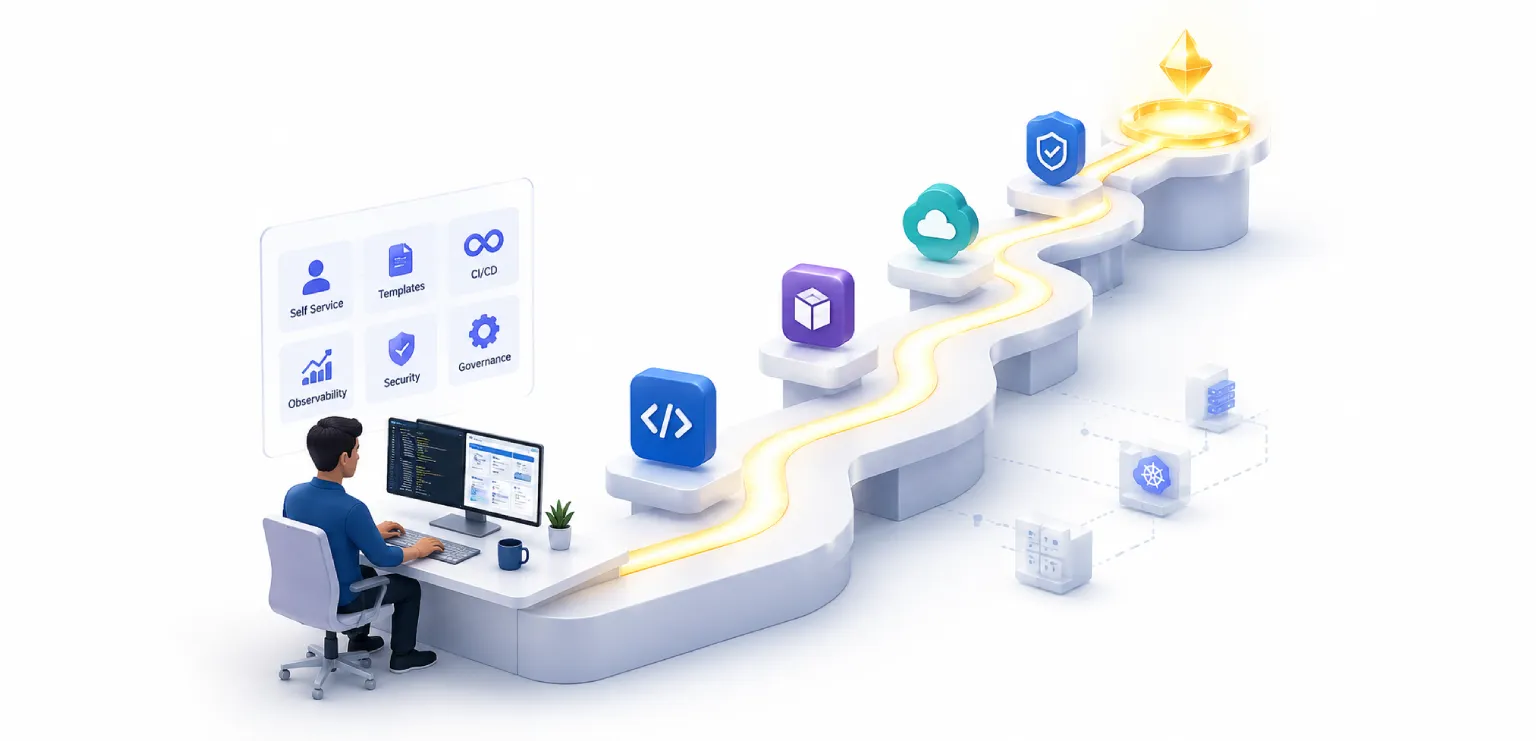
Golden path refers to an approach which is standard enough to be used by all developers in creating, deploying, and running apps using the best available tools, templates, and other good practices. In order to avoid re-inventing the wheel each time developers create a new application and deploy it, they need to follow a golden path.
For example, a developer working on a new microservice will have to spend hours configuring infrastructure, creating CI/CD pipeline, adding security controls and adding monitoring.
However, following a golden path, much of this work will have been done and made accessible through standard templates and automation.
Most often, platform teams refer to it as a paved road. Following a paved road is quicker, easier, and safer, although not necessarily impossible.
It is one of the main ideas of golden path engineering.
The Core Building Blocks of an Internal Developer Platform
Every organization builds its platform differently, but most successful IDPs include a few essential components.
|
|
|
| The Golden Path (a.k.a. the paved road) The standard, quickest, safest way to build and ship — so no one re-invents the wheel each time. |
A developer portal, self-service infrastructure, and lifecycle automation — all paved into one golden path.
Developer Portal and Service Catalogue
The developer portal serves as a central location for engineers. There is no need to switch between different tools to view documentation, deployments, APIs, and other internal tools from a single location.
Most platforms have a service catalogue, which makes it simple to find owners of applications, dependencies, documents, and other details about services. This tool is even more useful when adopting microservices architecture.
Self-Service Infrastructure and Templates
Self-service infrastructure is one of the most significant benefits of an IDP. Engineers are able to automatically set up approved environments, databases, and services without having to fill out requests manually.
Templates help developers get familiar with reusable project configurations, which already have a deployment pipeline and best security practices configured. There is no need to start from scratch.
Automation Across the Software Lifecycle
Automation is a defining characteristic of modern IDP platform engineering. Rather than automating isolated tasks, an internal developer platform connects development, testing, deployment, monitoring, and governance into a consistent workflow.
This reduces repetitive manual work, improves consistency across teams, and allows developers to spend more time building features that deliver value to customers. (For a deeper build-out, see our DevOps automation framework for SaaS.)
How Developer Self-Service Improves Productivity
One of the advantages of the internal developer platform is developer self-service. Rather than having to wait for the platform teams to get done with the process, developers can provision resources, build services, and release apps using automated processes.
For instance, deploying a microservice may require setting up the infrastructure, pipeline, and monitoring. With the internal developer platform, developers can get started with a pre-approved template, which provides all the necessary configuration in place to focus on developing features.
This speeds up the process and makes development more efficient.
Backstage vs. an Internal Developer Platform
A common misconception is that Backstage and an internal developer platform are the same thing. While they work well together, they serve different purposes.
| Backstage | Internal Developer Platform |
| Open-source developer portal created by Spotify | End-to-end platform that supports software delivery |
| Centralizes documentation, services, and developer tools | Combines automation, infrastructure, governance, templates, and developer experience |
| Serves as the user interface for developers | Includes the portal plus the underlying workflows and automation |
| One technology option | A broader platform engineering strategy |
Do You Need Backstage to Build an IDP?
No. Backstage is a popular framework for building a developer portal, but it isn’t required. Organizations can build an effective internal developer platform using other tools or custom solutions that align with their technology stack and engineering goals.
How to Start Building an Internal Developer Platform
Successful IDP platform engineering starts with understanding developer pain points—not selecting tools.
A practical approach includes:
| ▪ Identify repetitive engineering tasks that slow development. |
| ▪ Standardize common workflows such as service creation and deployments. |
| ▪ Build reusable templates with security and monitoring built in. |
| ▪ Enable developer self-service through a centralized portal. |
| ▪ Treat the platform as a product by gathering developer feedback and continuously improving the experience. |
Starting small allows organizations to demonstrate value early while building a platform that developers genuinely want to use.
Common Internal Developer Platform Mistakes to Avoid
Many platform initiatives fail because they prioritize technology over developer experience.
Common mistakes include:
| ▪ Automating everything before understanding developer needs. |
| ▪ Ignoring feedback from engineering teams. |
| ▪ Making the golden path engineering model too restrictive instead of making it the easiest option. |
A successful IDP should simplify development, not introduce another layer of complexity.
Why Internal Developer Platforms Are Becoming a Competitive Advantage
As software systems become more distributed, developer productivity has become a business priority. An internal developer platform helps standardize development workflows, reduce operational overhead, and improve collaboration without limiting flexibility.
This shift is reflected across the industry. Gartner predicts that by 2026, 80% of large software engineering organizations will establish platform teams that provide reusable services, components, and tools for application delivery. Organizations that invest in platform engineering today are also building a stronger foundation for AI-assisted development, cloud-native applications, and long-term engineering scalability.
If you’re evaluating platform engineering, it’s also worth exploring how it compares with traditional DevOps practices and how it supports SaaS environments. Learn more in our guides on Platform Engineering vs. DevOps and Platform Engineering for SaaS.
| RELATED READING — Going deeper on where platform engineering fits: Platform Engineering vs. DevOps vs. SRE and Platform Engineering Beyond DevOps for SaaS. |
FAQs
What is an internal developer platform?
An internal developer platform is a collection of tools, automation, and standardized workflows that enables developers to build, deploy, and manage software through a consistent self-service experience.
What is a golden path in platform engineering?
A golden path is a recommended workflow built around proven tools, templates, and best practices that helps engineering teams deliver software faster and more consistently.
Do you need Backstage to build an IDP?
No. Backstage is a popular developer portal, but organizations can build an IDP using different tools or custom solutions based on their needs.
How do you start building an internal developer platform?
Start by identifying repetitive developer tasks, standardizing common workflows, creating reusable templates, and continuously improving the platform based on developer feedback.
Conclusion
In complex engineering ecosystems, reducing friction becomes as critical as writing good code. Internal developer platforms assist in achieving uniformity in processes, providing self-service to developers and speeding up software delivery in a secure and consistent way.
| IMPRESSICO · PLATFORM ENGINEERING Build your golden path with Impressico Impressico Business Solutions helps organizations create scalable platform engineering practices that streamline software delivery and build a sustainable golden path for engineering teams. Whether you’re standardizing CI/CD, adding self-service infrastructure, or maturing your wider DevOps & Cloud Services, our team can help you get there. Contact us to see how an internal developer platform can accelerate software delivery for your engineering teams.
|
Impressico Business Solutions — Helping engineering teams build a golden path that speeds up software delivery, securely and consistently.

IBS
Similar articles

Compliance-as-Code: Automating SOC 2, HIPAA, and PCI-DSS in CI/CD Pipelines
September 9, 2026
Shift-Left Security in CI/CD Pipelines: A Practical Playbook
September 4, 2026
DevSecOps: Shifting Security Left Without Slowing Delivery
September 2, 2026
Is Your Engineering Team Ready for Platform Engineering? A Readiness Checklist
August 12, 2026
Measuring Platform Engineering ROI: DORA and SPACE Explained
July 31, 2026
AIOps in Practice: Using AI to Cut Incidents and MTTR
July 6, 2026