


September 30, 2026
Oracle to Amazon Aurora PostgreSQL Migration: Approaches, Pitfalls, and Cost Savings
Enjoying this article?
Share it with the world!


Oracle to Aurora PostgreSQL Migration: A Practical Guide
| ⚡ Quick Answer Migrating Oracle to Amazon Aurora PostgreSQL starts with an assessment of the workload, then follows one of three patterns: replatform, refactor, or a phased migration in waves. AWS SCT converts schema and PL/SQL where it can; AWS DMS moves the data and keeps source and target in sync – but DMS does not migrate stored procedures, triggers, views, synonyms or sequences, so those need separate handling. The expensive problems are Oracle-specific features, query performance differences, data type mapping and sequences. Savings come from reduced Oracle licensing and operational overhead, but there is no responsible universal percentage: model it against your own workload. |
Moving away from Oracle is seldom just a matter of the database itself.
There is often existing application code in enterprises that have used Oracle for years and which may involve thousands of tables, crucial PL/SQL, integration, reporting workloads, and other custom code written around Oracle specifics.
This is why companies considering how to migrate Oracle to PostgreSQL must begin by figuring out the specifics of their current environment first.
While Amazon Aurora PostgreSQL could be used as a target for your migration, it cannot be done without doing much more than simply copying your data. Schema migration, application compatibility, testing, performance, cutover strategy, and cost analysis must all come into play.
Here is a practical way to approach the migration.
How to Migrate Oracle to PostgreSQL: Start With an Assessment
The first step in how to migrate Oracle to PostgreSQL is understanding the Oracle workload before selecting the migration method.
A useful assessment should identify:
| Oracle version and edition | |
| Database size and growth rate | |
| Tables, indexes, views, sequences, and materialized views | |
| PL/SQL procedures, functions, and triggers | |
| Oracle-specific data types and functions | |
| Application connections and drivers | |
| ETL, reporting, and integration dependencies | |
| Transaction volumes and peak workloads | |
| Recovery and availability requirements |
This assessment tells you whether the workload is a relatively straightforward conversion or whether application and database refactoring will be required.
| Industry Insight AWS provides an Oracle-to-Aurora PostgreSQL migration playbook that specifically addresses schema conversion, data migration, and feature-level compatibility. |
If you are still deciding whether the estate warrants moving at all, our modernization readiness assessment and the CIO’s guide to replatforming cover that earlier question.
Oracle to Aurora PostgreSQL Migration Approaches
There is no single migration pattern that works for every Oracle environment.
|
Replatform to Aurora PostgreSQL This approach moves the workload to Amazon Aurora PostgreSQL while making the changes necessary for compatibility. It can work well when the application architecture is reasonably portable and the main objective is reducing Oracle dependency without completely redesigning the application. |
|
Refactor During Oracle to PostgreSQL Migration Refactoring makes sense when the application contains substantial Oracle-specific logic. Instead of reproducing every Oracle behavior, teams can convert database logic, modify application queries, replace vendor-specific functions, and redesign selected components around PostgreSQL. |
|
Phased Migration For large enterprise environments, a phased Oracle to Aurora PostgreSQL migration can reduce operational risk. Instead of moving every workload simultaneously, databases or application groups are migrated in waves. Each wave provides an opportunity to validate the migration process before moving to the next workload. From our perspective, this is particularly useful when Oracle supports several applications with different business criticality and dependency patterns. |
| Choosing the Pattern Replatform and refactor map directly onto the wider modernization decision – our guide to rehost, replatform, refactor and rebuild covers how to choose between them across an application estate. |
| Not sure which pattern fits your Oracle estate? The assessment decides it – not the tooling. Impressico runs a structured Oracle discovery covering PL/SQL volume, application dependencies and availability requirements, then recommends replatform, refactor or phased waves with the reasoning attached. |
AWS DMS Oracle to Aurora: Where the Tools Fit
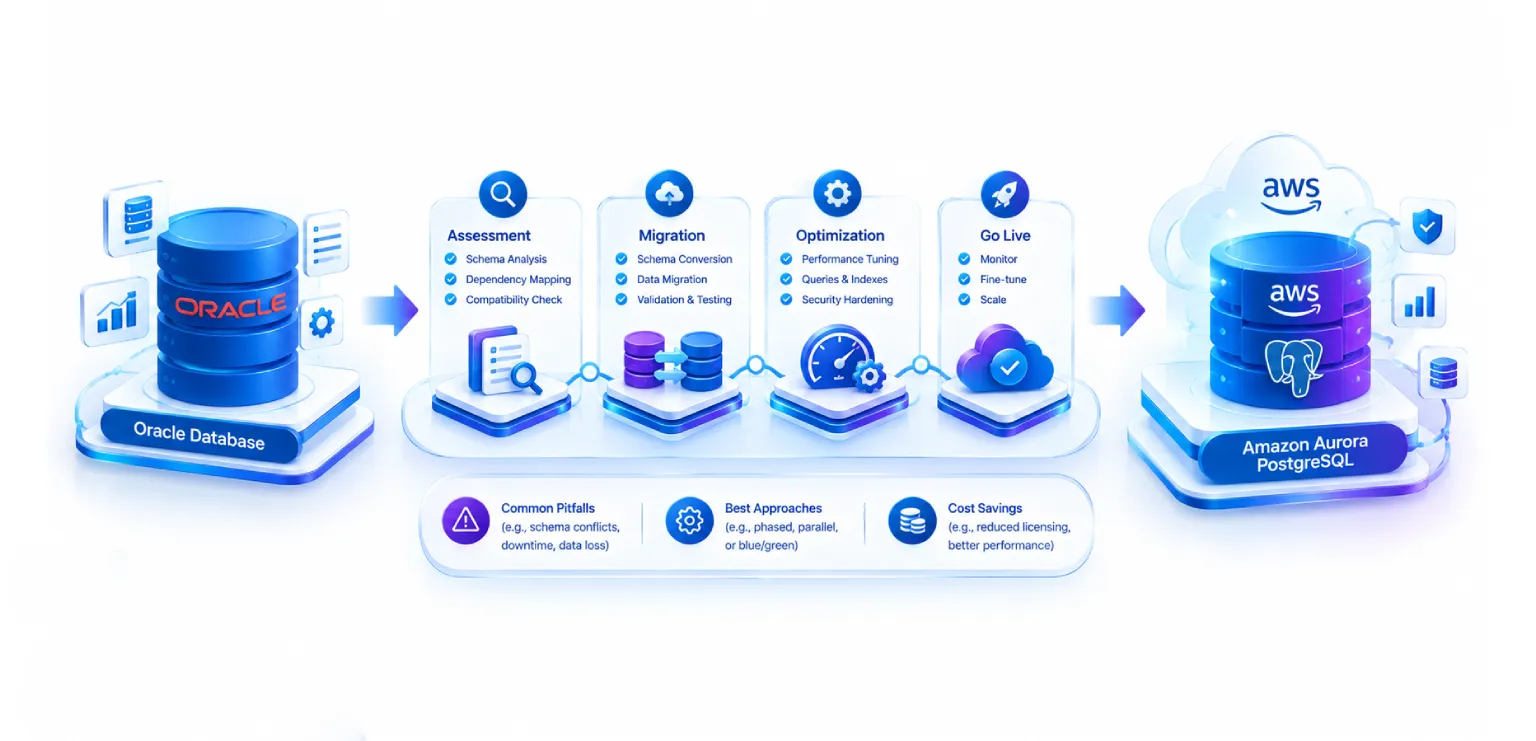
Two AWS tools commonly play an important role in the process: AWS Schema Conversion Tool (AWS SCT) and AWS Database Migration Service (AWS DMS).
AWS SCT analyzes Oracle database objects and converts supported schema elements and code for PostgreSQL. AWS DMS handles data movement and can support ongoing replication from the source during migration.
A simplified workflow looks like this:
| Simplified Migration Workflow
SCT converts the schema and code; DMS moves the data and keeps it in sync until cutover |
The important distinction is that DMS is not a complete Oracle-to-PostgreSQL conversion engine.
| What DMS Leaves Behind AWS documentation notes that DMS does not migrate several schema objects-including stored procedures, triggers, views, synonyms, and sequences-as part of its normal data migration function. Those areas require additional conversion or handling. |
That is why treating AWS DMS Oracle to Aurora as a “push-button migration” can create problems later. Teams new to the platform often pair this with an AWS consulting partner; the broader benefits of the AWS cloud set the context.
Oracle PL/SQL to PostgreSQL: The Conversion Challenge
One of the biggest technical differences is the database programming language.
| 🗃 ORACLE PL/SQL | 🐘 POSTGRESQL PL/pgSQL |
Oracle uses PL/SQL, while PostgreSQL uses PL/pgSQL. Similar business logic may need changes in syntax, functions, exception handling, data types, and database-specific behavior.
AWS SCT can automate significant portions of this conversion, but its output still needs technical review. AWS documentation specifically highlights differences in PL/SQL and PL/pgSQL and recommends resolving conversion warnings and errors before proceeding.
Application code can also require modification.
For example, applications may contain:
| Oracle-specific SQL | |
| OCI dependencies | |
| Vendor-specific drivers | |
| Oracle data-access behavior | |
| Hard-coded connection settings | |
| ORM configurations tied to Oracle |
AWS guidance notes that applications using Oracle-specific interfaces may require code changes as part of the migration.
Oracle to PostgreSQL Migration Pitfalls to Watch
| The Reality The most expensive migration problems are often discovered after the data has already moved. |
|
Oracle-Specific Features Oracle features do not always have direct PostgreSQL equivalents. Functions, packages, sequences, partitioning approaches, and other database capabilities may require redesign or replacement. |
|
Query Performance A query that performs well in Oracle may behave differently in PostgreSQL because the database engines use different optimizers and execution strategies. AWS’s migration playbook specifically notes differences in Oracle and PostgreSQL query planning. Performance testing should therefore happen before production cutover-not after users report slow applications. |
|
Data Type Differences Oracle and PostgreSQL do not have identical data types or conversion behavior. Mapping should be reviewed rather than accepted automatically, particularly for high-volume or performance-sensitive tables. |
|
Sequences and Other Objects Some database objects require additional migration steps. AWS DMS documentation, for example, notes that sequences are not migrated through ongoing replication in the same way as table data and require target-side handling. |
These details are exactly why a technical migration assessment matters. Structured QA is what turns that assessment into evidence before cutover.
| Find the pitfalls before the data moves, not after Performance regressions, unmapped data types and orphaned sequences are all detectable in a pre-migration review. We test your highest-risk queries and objects against Aurora PostgreSQL before any cutover is scheduled. |
Oracle to PostgreSQL Migration Cost: Where Savings Come From
Oracle to PostgreSQL migration cost is not simply the price of running the new database.
A realistic business case should compare:
| The Realistic Business Case
|
Potential savings can come from reducing Oracle licensing expenses, infrastructure administration, and some operational overhead. However, migration itself introduces costs for assessment, conversion, application remediation, testing, engineering, and temporary parallel environments.
Aurora pricing is based on factors including database instances, storage, and selected configuration options. AWS also provides different pricing models and optimization options depending on workload characteristics. On the operational side, how DevOps reduces cloud infrastructure costs covers the running-cost half of the equation.
So, how much can an organization save?
| No Universal Percentage There is no responsible universal percentage. The answer depends on Oracle licensing, workload utilization, Aurora sizing, availability requirements, data volume, migration effort, and the application’s architecture. |
A proper Oracle to PostgreSQL migration cost model should therefore use the organization’s actual workload rather than a generic “X% cheaper” claim.
Is PostgreSQL a Viable Alternative to Oracle?
For many workloads, PostgreSQL can be a viable alternative to Oracle. But that does not mean every Oracle workload should automatically move to PostgreSQL.
The right comparison depends on application requirements, database features, performance expectations, operational needs, compliance requirements, and the amount of Oracle-specific functionality embedded in the environment.
The question should be:
| Can PostgreSQL support this particular workload without creating unacceptable applications or operational trade-offs? |
That is a much more useful question than comparing database brands in isolation. For the broader version of this call across an estate, see our modernize, rebuild or retire decision framework.
How Long Does an Oracle to Aurora Migration Take?
There is no reliable timeline based only on database size.
A relatively simple database with limited application dependencies may move in a shorter project window. A large enterprise environment with extensive PL/SQL, multiple applications, strict uptime requirements, and complex integrations can require several migration waves.
The major timeline drivers are:
| Database complexity | |
| Number of dependent applications | |
| Amount of Oracle-specific code | |
| Data volume | |
| Testing requirements | |
| Cutover strategy | |
| Required downtime | |
| Number of migration waves |
At Impressico Business Solutions, we recommend establishing the timeline after assessment rather than promising a fixed duration before the workload is understood.
That is the same discipline agile and DevOps bring to legacy modernization.
Oracle to Aurora PostgreSQL Migration: A Safer Execution Model
A practical enterprise migration can follow this sequence:
| A Safer Execution Model
Cutover is an operational event – monitoring and rollback defined before it starts |
During validation, teams should compare data, application behavior, queries, transactions, integrations, and performance.
AWS DMS can support ongoing replication so that source and target databases can remain synchronized during the migration process.
The final cutover should be treated as an operational event, with monitoring and rollback procedures already defined.
What Tools Are Used for Oracle to PostgreSQL Migration?
Common tools include:
Third-party migration and assessment tools may also be useful depending on the environment, but the toolset should follow the migration requirements rather than determine them.
How Impressico Approaches Oracle to Aurora PostgreSQL Migration
At Impressico Business Solutions, we treat an Oracle to Aurora PostgreSQL migration as an application-and-database transformation process and not just moving the data.
This kind of process may involve database discovery, compatibility analysis, schema conversion, data migration, application adaptation, performance testing, cutover planning, and even optimization after migration. It sits within our wider application modernization on AWS practice, alongside legacy data warehouse modernization for the reporting and ETL workloads that usually travel with an Oracle estate.
Those reporting workloads have their own decisions attached — data lakes versus data warehouses and Kafka in modern data pipelines are where they usually land.
All in all, the main goal is very simple – to cut dependence on Oracle and to provide the company with a database that will help it proceed with growth.
When companies consider migrating Oracle to PostgreSQL, the first thing to do is not selecting a tool but understanding the requirements.
| Key Takeaways
|
| Get a cost model built on your workload, not a generic percentage. Impressico assesses your Oracle estate, maps the PL/SQL and application dependencies, and gives you a migration plan with a realistic timeline and a TCO comparison you can take to finance – before any commitment to move. Start your Oracle migration assessment →Application Modernization on AWS → Oracle → Aurora PostgreSQL |
Impressico Business Solutions — legacy modernization, database migration and application modernization on AWS for enterprises reducing Oracle dependency.

IBS
Similar articles

Is Your Legacy Application Holding Your Business Back? A Modernization Reality Check
August 10, 2026
Modernize, Rebuild or Retire? A Decision Framework for Enterprise Leaders
August 5, 2026
The Hidden Cost of Technical Debt in Legacy Applications
July 27, 2026
Breaking the Monolith: Migrating Legacy Apps to Microservices on the Cloud
July 10, 2026
Rehost, Replatform, Refactor, Rebuild: Choosing the Right Modernization Path (the 6 R’s)
July 1, 2026
Legacy Application Modernization: A CIO’s Guide to Replatforming & Cloud-Native Transformation
June 22, 2026
