
August 22, 2025
Why Kubernetes Is Now Key to AI and ML Success
Enjoying this article?
Share it with the world!


Kubernetes for AI and ML: Why It's Now Essential
| ⚡ Quick Answer Kubernetes has become the default platform for AI and ML workloads because it solves three problems at once: it schedules scarce GPU capacity across competing jobs, it makes training pipelines repeatable and versioned, and it runs the same way in cloud, on-premise, and edge environments. The tooling layer built on top — Kubeflow, KServe, Volcano, Kueue — turns those primitives into an ML platform. |
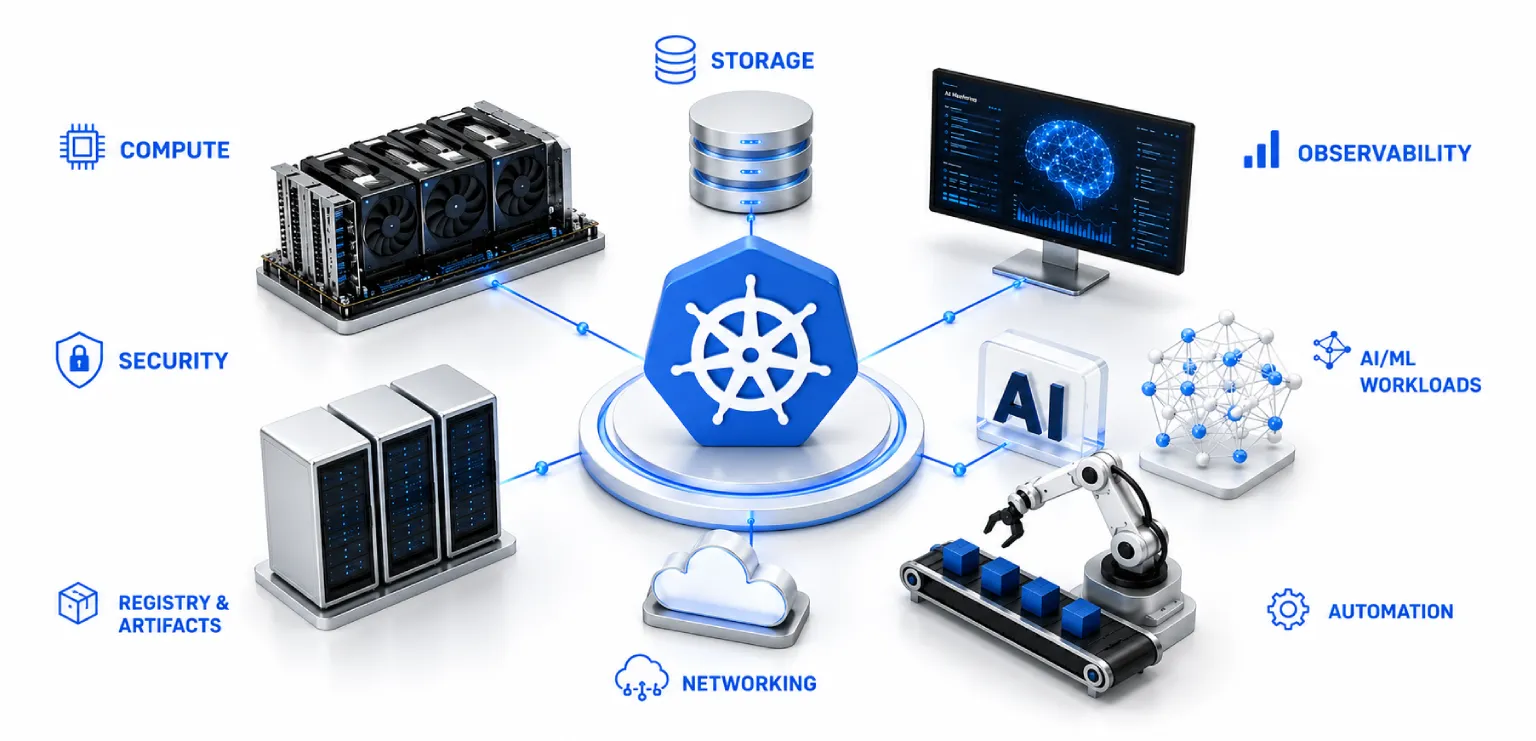
Kubernetes is no longer just about containers. It’s fast becoming the backbone for running AI and ML workloads at scale. Why? It’s flexible, supports GPU hardware, and connects smoothly with tools like Kubeflow and KServe that are built for machine learning. This makes it perfect for companies looking to run real AI in production.
What Makes Kubernetes So Good for AI?
Three properties that matter more for ML than for ordinary applications
| |
Auto GPU Scaling:
Tools like NVIDIA’s GPU Operator let Kubernetes manage GPUs automatically, so your AI workloads can grow without effort. Source: Portworx
Repeatable ML Pipelines:
Kubeflow helps teams create, test, and run machine learning steps over and over again, with full version tracking.
Runs Anywhere:
Kubernetes works on the cloud, at the edge, and in hybrid setups. Tools like Palette and CubeEdge help manage this.
How Kubernetes Actually Schedules a GPU Workload
What sits between your training job and the silicon
| |
“Kubernetes manages GPUs automatically” is true, but it hides a stack of components that each need to be right. A GPU is not a native Kubernetes resource the way CPU and memory are. It has to be advertised to the scheduler by a device plugin, backed by a driver that matches the container’s CUDA version, and then requested explicitly by the pod spec.
The NVIDIA GPU Operator exists to automate exactly this chain — driver installation, container runtime configuration, device plugin deployment, and node labelling — so that adding a GPU node to a cluster does not become a manual afternoon. Understanding the chain matters because almost every “my pod is stuck in Pending” incident on a GPU cluster is a break in one of these links.
| The GPU Scheduling Chain
A pod stuck in Pending on a GPU cluster is almost always a broken link in this chain, not a capacity problem. |
Market Growth: AI and Kubernetes Powering Cloud Innovation
Where the spending is going, and why managed services are winning
| |
The need for AI and ML on Kubernetes is exploding. More businesses are turning to managed Kubernetes services, especially those on cloud platforms like AWS, to run their AI apps efficiently and at low cost.
| • | Experts expect the Kubernetes services market to grow 3X by 2030. Source: Markets n Research |
| • | AI-as-a-Service is now a major reason companies are spending more on cloud. |
| • | Kubernetes makes it cheaper and faster for data teams to get results. |
| • | Containerizing ML helps companies launch models faster and improve ROI. |
| Industry Insight Forecasts in this space vary widely by methodology and by how “Kubernetes market” is scoped. Treat any single projection as directional rather than precise, and note that the managed-service share is the more decisive trend: the shift is less about total spend and more about who operates the control plane. |
| Paying for GPUs that sit idle? Most GPU overspend traces back to node pool design and scheduling policy rather than workload volume. A short review usually finds it. |
What's Next? HPC, Edge AI, and WASM
The directions Kubernetes is expanding into next
| |
Kubernetes is entering new spaces like high-performance computing (HPC), edge AI, and WebAssembly (WASM). These trends are reshaping how AI gets built and deployed.
| • | Projects like Volcano and Kueue now help schedule complex AI tasks in batches. Source: InfraCloud |
| • | AI at the edge is now super fast—some workloads respond in under a millisecond. |
| • | WASM lets AI run light and fast outside containers, perfect for edge devices. |
| • | Hybrid pipelines now span cloud, on-prem, and edge, all coordinated with Kubernetes. |
Training and Inference Are Two Different Problems
The distinction that determines almost every cluster design decision
| |
Teams often talk about “running AI on Kubernetes” as one workload type. It is two, and they pull the cluster in opposite directions. Training is a batch problem: long-running, bursty, tolerant of a few seconds’ delay in starting, and catastrophic to restart from scratch. Inference is a serving problem: short-lived, latency-sensitive, and continuously available.
Batch schedulers like Volcano and Kueue exist because the default Kubernetes scheduler places pods one at a time. A distributed training job needing eight GPUs simultaneously can deadlock — four pods scheduled, four pending, all holding capacity and none progressing. Gang scheduling admits the whole job or none of it. Inference has the mirror-image problem: scale-to-zero saves money but introduces a cold start, and loading a multi-gigabyte model into GPU memory is not a sub-second operation.
| Two Workloads, Two Cluster Strategies
Running both on one undifferentiated node pool is the most common cause of unpredictable inference latency. |
Best Practices in 2025 for AI on Kubernetes
Cost, performance, and compliance controls that hold up in production
| |
Companies using Kubernetes for AI and ML are focusing on smart strategies to save money, improve performance, and stay compliant.
| • | Use autoscalers, node affinity, and GPU quotas to manage costs. |
| • | Run CI/CD pipelines using Kubeflow, Katib, and model version control. |
| • | Combine zero-trust security with OpenTelemetry to monitor everything. |
| • | Use tools like Azure AKS Fleet Manager for hybrid cloud and multi-cluster setups. |
| • | Run stateful ML tools (like model and feature stores) directly on Kubernetes. Source: Red Hat |
What Usually Goes Wrong
The failure modes that appear once AI workloads reach real scale
| |
The practices above are sound, but they describe the destination rather than the road. Four problems account for most of the pain teams report after their first year of running AI on Kubernetes, and none of them is a Kubernetes defect — each is a design decision made early and discovered late.
| Idle GPU spend A GPU node reserved for a team that trains twice a week bills continuously. Without quotas, sharing, or a scale-down policy, utilisation of twenty percent is common and rarely visible on any dashboard anyone reads. |
| Version drift between driver and image A cluster upgrade changes the host driver; container images pinned to an older CUDA release stop working. Pinning both, and testing upgrades against a representative workload, prevents an outage that presents as a mysterious crash loop. |
| Storage as the real bottleneck Expensive accelerators sit waiting on data. When the training loop is I/O-bound, adding GPUs changes nothing; the fix is in the data path — throughput, locality, and caching — not in the compute tier. |
| Cold starts on scale-to-zero inference Scaling to zero is attractive until the first request after idle has to pull an image, provision a node, and load model weights into GPU memory. Warm pools or a minimum replica count trade some cost for predictable latency. |
Infrastructure alone does not resolve these. They sit at the boundary between platform engineering and model development, which is why they respond better to machine learning operationalization practices than to cluster tuning, and why production machine learning systems are best designed with both concerns in the room.
| Key Takeaway Kubernetes gives you the primitives, not the platform. The difference between a cluster that runs AI and a cluster that runs AI economically is scheduling policy, node pool separation, and someone owning utilisation as a number. |
| Already running Kubernetes, but not confident it’s ready for AI? Most clusters need node pool separation, GPU quotas, and a batch scheduler before they can carry serious ML — not a rebuild. |
How Impressico Boosts Your AI Projects with Kubernetes
| |
At Impressico, we make Kubernetes-as-a-Service easy and powerful for AI and ML. Our experts help you plan, build, and manage full-stack solutions using the best of managed Kubernetes, AI tools, and cloud infrastructure.
Here’s what we offer:
| • | Tailored AI and Kubernetes plans that align with your business goals. |
| • | Full cluster setup with GPU support and model serving tools. |
| • | End-to-end ML pipelines with auto deployment, monitoring, and rollback. |
| • | Secure and cost-effective infrastructure across multiple environments. |
| • | Edge and hybrid deployments for real-time applications. |
| Key Takeaways
|
Kubernetes for AI and ML: Frequently Asked Questions
| |
| How does Kubernetes enhance ROI on AI/ML projects? Kubernetes allows you to get more out of less. It makes better use of your computing power, so you waste less and spend less. It also accelerates the time it takes to test and deploy models. It translates to quicker results and more value from your AI efforts. |
| What are the cost-saving advantages of employing Kubernetes for AI over conventional cloud VMs? The classic cloud VMs tend to remain in operation even when idle. With Kubernetes, you consume what you require, when you need it. It automatically scales up and down. This saves us a significant amount of money, particularly with GPU-intensive AI applications. |
| How does Kubernetes enable us to deploy AI models more quickly so that we can get a competitive advantage? Kubernetes automates a lot of steps. It makes it easy for teams to deploy, test, and release AI models in a hurry. Changes can go live quickly using built-in tools without any manual labor. This provides your business with a huge advantage over others. |
| What are the risks of running AI/ML on Kubernetes, and how can we mitigate them? Some of these risks are poor installation, inadequate monitoring, or security risks. But these can be rectified by employing good tools, frequent updates, and security best practices. Employing managed Kubernetes services also mitigates risks. |
| Can Kubernetes handle small-scale experiments and large-scale AI production deployments? Yes, it can support both. Start small with a couple of machines, and expand later on. Kubernetes scales with your requirements, so you can utilize it in early testing or production without having to switch platforms. |
| How does Kubernetes provide high availability and reliability for mission-critical AI workloads? Kubernetes executes your apps on lots of machines. When one fails, the others continue operating. It also monitors your AI services and relaunches them if something goes wrong. This maintains your AI in continuous operation with minimal downtime. |
| What kind of business use cases see the biggest success with Kubernetes-powered AI? Big wins are achieved in such areas as fraud detection, demand forecasting, targeted advertising, and real-time recommendations. Any company requiring immediate insights from data or real-time AI gains significantly from implementing Kubernetes. |
| Want to Build Smarter AI Systems with Kubernetes? Let Impressico Business Solutions be your guide. We’re here to help you get the most out of AI and ML on Kubernetes—whether it’s on AWS managed Kubernetes, hybrid cloud, or edge. Book your free consultation today and start building the future of AI. |

IBS
Similar articles

Shift-Left Security in CI/CD Pipelines: A Practical Playbook
September 4, 2026
DevSecOps: Shifting Security Left Without Slowing Delivery
September 2, 2026
Is Your Engineering Team Ready for Platform Engineering? A Readiness Checklist
August 12, 2026
Measuring Platform Engineering ROI: DORA and SPACE Explained
July 31, 2026
Internal Developer Platforms: Building a Golden Path for Engineering Teams
July 22, 2026
AIOps in Practice: Using AI to Cut Incidents and MTTR
July 6, 2026