


September 30, 2025
The 2026 Blueprint for Enterprise Integration and AI Transformation
Enjoying this article?
Share it with the world!


Data Fabric vs Data Lake: The 2026 Integration Blueprint
| ⚡ Quick Answer A data fabric is not another place to store data — it is an intelligent layer that connects the stores you already have across cloud, on-premises and hybrid. Its engine is active metadata, which discovers sources automatically, joins them in real time, and enforces governance as it goes. It does not replace your data lake or warehouse; it makes them usable together. That connected foundation is what modern AI — especially Compound AI, where several expert models work as one — needs in order to see the whole picture rather than half of it. |
In 2026, the central challenge for businesses is applying their data intelligently and cohesively. While data warehouses and lakes serve a purpose, they are insufficient when used in isolation. The future is the Data Fabric—a single, smart layer that bridges all sources of data into a single system. We have written before on how data lakes and warehouses drive industry-wide transformation and on why data integration matters for enterprise success.
This blog discusses why the data fabric is the basis for AI transformation, how it works, and why it will benefit your business today.
Why Data Silos Crumble AI
Consider a company with various teams. Marketing has its own data. Sales keep another set. Customer support stores data somewhere else. These pools don’t communicate with one another.
Now imagine trying to build an AI tool that gives one a full picture of a customer. It needs all the details—past purchases, support tickets, website visits, feedback surveys, and more. But when data is stuck in silos, AI sees only half the story. This is the same gap we examine in is your data ready for generative AI?
And what happens then?
| It fails at personalization because it doesn’t know the customer well. | |
| It gives weak predictions because it can’t see all patterns. | |
| You throw business dollars at tools that don’t provide results. |
| The Reality That’s why silos shatter AI. Sophisticated systems such as Compound AI—blending several AI models to get more intelligent results—rely on integrated data. Without it, they are in the dark. |
From Data Lakes to Data Fabric: A Big Shift
For years, businesses applied data warehouses for ordered data and data lakes for non-structured data. Warehouses excelled at order and rules. Lakes excelled at holding enormous amounts of raw information — and many are now being replatformed, as our guide to legacy data warehouse modernization sets out.
But here’s the reality: both are static. They hold data, but they don’t join it together across systems in real time. An isolated data lake is merely an enormous bucket. An isolated warehouse is merely a locked cabinet.
This is where the data fabric enters the picture.
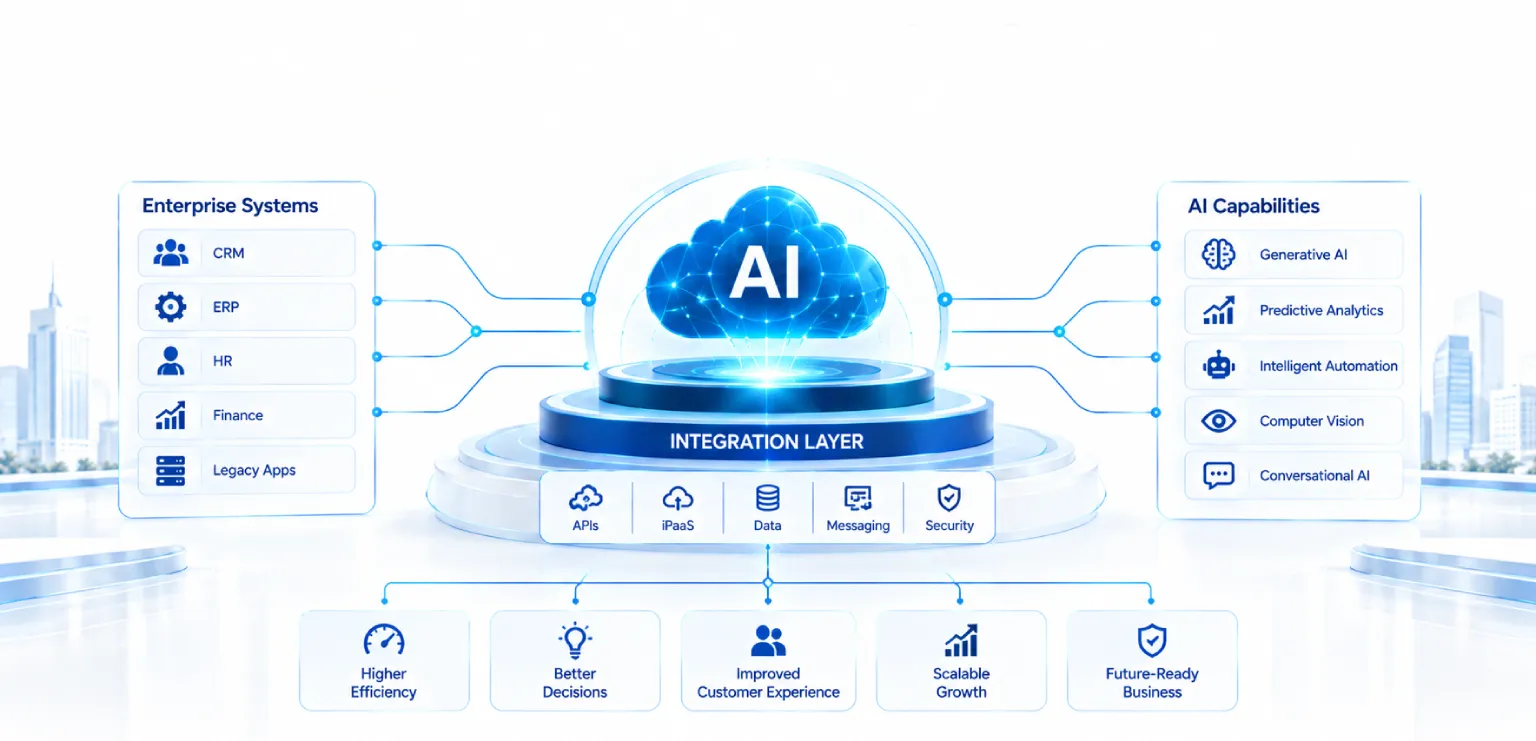
It is not mere storage. This is a smart architecture that bonds all the sources of data, cloud, on-premises, or hybrid. It forms a single layer that makes data accessible everywhere, anywhere, and at any time in real time.
Here’s a straightforward comparison:
So, whereas lakes and warehouses are still relevant, they can no longer work independently. They require the fabric layer to integrate everything.
The Heart of the Fabric: Active Metadata Engine
The reason a data fabric is so strong is its active metadata engine.
Let’s dissect this. Metadata is literally “data about data.” For instance:
| A customer name file may contain information about when it was last created, who changed it, and where it resides. | |
| A sales report may have rules regarding how the numbers were computed. |
In legacy systems, metadata was not dynamic. Individuals needed to label or manage data manually. It was cumbersome and error-prone.
These days, it’s different. In a data fabric, metadata is dynamic. It employs AI to:
| What Active Metadata Does
Four jobs that used to be somebody’s manual, error-prone afternoon |
| Industry Insight Imagine it’s a traffic manager. It doesn’t merely send cars (data) down the road. It foresees traffic jams, changes signals, and keeps traffic moving smoothly. That’s the magic of active metadata. |
Governance is not a bolt-on here — it is enforced by the same engine that does the joining. For the wider control framework, see why AI governance is a top strategic priority.
Business Results of Data Fabric and AI
Everything above may seem techno-jargon-y, but it yields definite business outcomes.
|
Accelerated Time-to-Insight Analysts used to spend the bulk of their time cleaning and reconciling data before they could begin. Now they can jump directly to insights. This saves tremendous amounts of time. |
|
Reduce Data Management Costs Now companies don’t need huge teams piecing data together anymore. The data fabric does it for them. It reduces data management costs drastically. |
|
More Accurate AI Models AI can function only if the data is connected and clean. The Data fabric makes sure AI receives the complete picture, so its predictions and personalization are correct. |
|
Improved Customer Experience With integrated data, companies can finally develop a single customer view. That leads to improved offers, faster support, and better loyalty. |
Where that single customer view has to live inside a CRM, Salesforce Data Cloud solves a narrower version of the same problem. For measuring any of it, our generative AI ROI framework applies directly.
| Not sure where your data is actually trapped? A silo audit is usually the fastest way to find out — and it is the first step of the strategy set out further down this page. |
AI Transformation in 2026: Compound AI + Data Fabric
The second wave of AI is Compound AI. Rather than one single model for everything, it connects several expert models — the orchestration problem we unpack in designing multi-agent systems.
For instance:
| One AI can listen to customer voice calls. | |
| Another can analyze purchasing behavior. | |
| A third can forecast churn. |
They are most powerful when they work together. And for that, they require the same connected data fabric. The retrieval layer that makes this practical is covered in RAG at scale, with a comparison of enterprise vector databases and why embedding is the secret to intelligent data access.
| Key Takeaway So, by 2026, AI disruption isn’t just about smarter models. It’s also about smarter data infrastructure. Without the appropriate foundation, even the most optimal AI will fail. |
For how the whole stack fits together, see our end-to-end generative AI architecture walkthrough.
Cloud Data Integration and Hybrid Needs
Most businesses no longer have all their data in one location. Some is in the cloud. Some is on servers. The rest is divided across multiple platforms.
That is why cloud data integration is important now. A data fabric does not require you to make a choice of one platform. It bridges across clouds, legacy, and everything in between — the same integration discipline described in how application integration can benefit your company, and moved at volume by streaming pipelines such as Apache Kafka.
It allows businesses the best of both worlds. They can modernize at their own pace and still provide connected insights.
Creating an Enterprise Data Strategy
Implementing a data fabric is not merely a tech refresh. It is an enterprise data strategy. Businesses should:
|
Find the silos Identify where data is trapped today. |
|
Set business objectives Determine what insights or results are most important. A structured enterprise AI strategy keeps the data work tied to outcomes. |
|
Use active metadata tools Select platforms that automate integration and governance. |
|
Train individuals for AI-first work Data is the foundation, but people need to trust and utilize the insights. |
This approach flips attention from holding data to deriving value from data — a shift explored further in the role of data engineering and AI collaboration and how Gen AI is redefining data engineering.
| Worried a fabric means ripping out your lake? It does not. The fabric sits above what you already run — your lake, your warehouse, your on-premises systems all stay exactly where they are and finally start talking to each other. |
Data Fabric vs Data Lake: Dispelling the Myths
Some executives still wonder, “Should we swap our data lake for a fabric?” No.
A data fabric is not a substitute. It’s an integration layer.
To illustrate:
| 📚 A data lake is a library with thousands of books. | 🗃 A warehouse is an archive with structured records. | 🤓 The data fabric is the librarian who knows all the books, sees themes, and instantly provides answers. |
| Key Takeaway So, the future is not lake or fabric. It’s lakes + warehouses → fabric, in harmony with one another. |
The Road Ahead: What Businesses Need to Do in 2026
If you are a business leader today, here’s your roadmap:
|
Break silos Don’t allow teams to create stovepipe pools of data. |
|
Invest in Data fabric platforms Consider reputed vendors in this domain. |
|
Prioritize metadata Make active metadata the center of your strategy. |
|
Connect to AI goals Always associate data projects with AI results. The use cases that pay back first are a useful reference point. |
|
Measure success Monitor insights, speed, cost savings, and customer impact. |
This blueprint keeps you ahead in the AI-first era.
Final Thoughts
2026 is a breakpoint for enterprise integration. Data lakes and warehouses are not sufficient if they function independently. The data fabric is the path forward.
It joins it all up with brains, pace, and security. It saves money, powers AI, and enhances customer experiences — the same connected-system logic behind our AI, IoT and DevOps convergence blueprint and the AI + Mobile + Cloud innovation equation.
If you get on board now, you’ll remain competitive.
| The Reality The choice is yours: Integrate with the fabric. Evolve with AI. Or else, remain mired in silos and slow systems. |
| Key Takeaways
|
| Ready to build your data fabric layer? Impressico helps enterprises find the silos, choose active metadata tooling, and connect data work to real AI outcomes — without replacing what already works. 🚀 Schedule Your Strategy SessionIs Your Data Ready for GenAI? → 30-minute strategy session · no commitment |
Frequently Asked Questions: Data Fabric and Enterprise Integration
| Is a data fabric a product we buy, or an architecture we design? Both, in sequence. The architecture comes first — deciding which sources must be connected, what governance rules apply, and which business questions the layer has to answer. Tooling is chosen against that, not before it. Buying a platform before the architecture exists is the common failure. It produces a well-licensed catalogue that nobody has connected to anything, which is a more expensive silo than the ones you started with. |
| How is a data fabric different from a data mesh? They solve the same problem from opposite directions. A fabric is a technology-led answer: one intelligent layer, driven by active metadata, that connects sources centrally. A mesh is an organisation-led answer: domain teams own and publish their own data as products, with federated governance holding it together. Many enterprises end up with elements of both — fabric technology underneath, mesh ownership on top. The choice is less about tooling than about how centralised your data function actually is. |
| Do we need a data fabric before we can start with generative AI? Not before you start, but before you scale. A single AI pilot drawing on one clean source can prove value without any fabric at all. The constraint appears at the second and third use case, when each new project needs data from systems the first one never touched, and integration work starts repeating. That is the point at which data readiness stops being a checklist and starts being architecture. |
| What does active metadata actually require from us? Less manual work than traditional cataloguing, but not none. The engine discovers sources and infers relationships on its own; what it cannot infer is business meaning. Three things still need people:
The governance half of that is covered in governance and safety for autonomous AI agents. |
| How do we measure whether the fabric is working? Measure the questions, not the plumbing. Three signals tell you most of it:
Broader analytics impact is covered in how big data analytics impact business decision-making and seven ways business intelligence can improve your business. |
Impressico Business Solutions — data engineering, integration and AI architecture for enterprises that need their data to work as one.

IBS
Similar articles

Chunking Strategies for RAG: What Actually Works in Production
September 16, 2026
Vector Databases Compared: Pinecone vs Weaviate vs Qdrant vs pgvector for Enterprise RAG
September 14, 2026
RAG at Scale: Enterprise Retrieval-Augmented Generation Architecture
September 11, 2026
7 Signs Your Organization Is Ready for AI Agents
August 14, 2026
Governance and Safety for Autonomous AI Agents: A Practical Guide for Enterprises
August 3, 2026
Designing Multi-Agent Systems: Orchestration, Tools & Guardrails
July 24, 2026
