September 2, 2026
DevSecOps: Shifting Security Left Without Slowing Delivery
Enjoying this article?
Share it with the world!


DevSecOps: Secure Delivery Without the Friction
Software teams are under constant pressure to release faster, support more applications, and respond to changing customer needs. At the same time, security risks are growing more difficult to manage. When security is checked only near the end of development, vulnerabilities can reach testing or production before anyone has time to address them properly.
This is where DevSecOps services can make a practical difference. Instead of treating security as a final approval step, we can build security into planning, coding, testing, deployment, and monitoring. The goal is not to make developers perform more security work. The goal is to make the right security checks part of the delivery process so teams can identify and fix issues earlier without creating unnecessary delays.
The need is clear. Verizon’s 2026 Data Breach Investigations Report analyzed more than 31,000 real-world security incidents, including more than 22,000 confirmed breaches across 145 countries. It also found that vulnerability exploitation had become the most common initial access vector, accounting for 31% of breaches in its reporting dataset.
| 31% of breaches trace to vulnerability exploitation — now the most common initial access vector (Verizon 2026 DBIR, 22,000+ breaches across 145 countries). |
| FOUNDATION FIRST — DevSecOps builds on solid delivery pipelines. If yours need work first, see DevOps pipeline readiness and how to automate your CI/CD pipeline for SaaS. |
What Are DevSecOps Services?
DevSecOps services integrate security principles, automation and control into the software development and delivery process. Security work is not done after development but rather embedded into CI/CD pipelines.
DevSecOps services may include DevSecOps assessment, Secure CI/CD deployment, Application Security Testing, Software Composition Analysis, Secrets Scanning, Security of Infrastructure as Code, Container Security, Vulnerability Management, Threat Modeling, and Compliance Automation.
The DevSecOps guidelines by OWASP (Open Worldwide Application Security Project) particularly mention security of CI/CD and include examples like SAST, DAST, IAST, SCA, infrastructure vulnerabilities scans, and container vulnerabilities scans.
The idea is straightforward – detect security issues as soon as possible, automate where possible and use security expertise where human judgment adds the most value.
DevSecOps vs. DevOps: What Actually Changes?
DevSecOps does not replace DevOps. It extends the DevOps approach by making security a continuous part of software delivery.
| DevOps | DevSecOps |
| Focuses on development and operations | Adds security throughout development and operations |
| Security may be handled separately | Security becomes a shared responsibility |
| Security testing may happen late | Security testing starts earlier |
| Manual reviews can create delays | Repeatable checks can be automated |
| Focuses on speed, reliability, and delivery | Adds security and risk management to those goals |
DevSecOps implementation is about more than adding security gates to an already existing pipeline. It involves looking at how security decisions can be made earlier and where automation can be used to eliminate manual steps.
| GO DEEPER ON THE DIFFERENCE — For how these disciplines relate more broadly, see platform engineering vs. DevOps and platform engineering vs. DevOps vs. SRE. |
| Expert tip: Don’t assess DevSecOps success based on the number of security tools you’ve added to your pipeline. Assess success based on how early risks are being identified and how much remediation time has been saved. |
Where DevSecOps Fits Into the Software Delivery Lifecycle
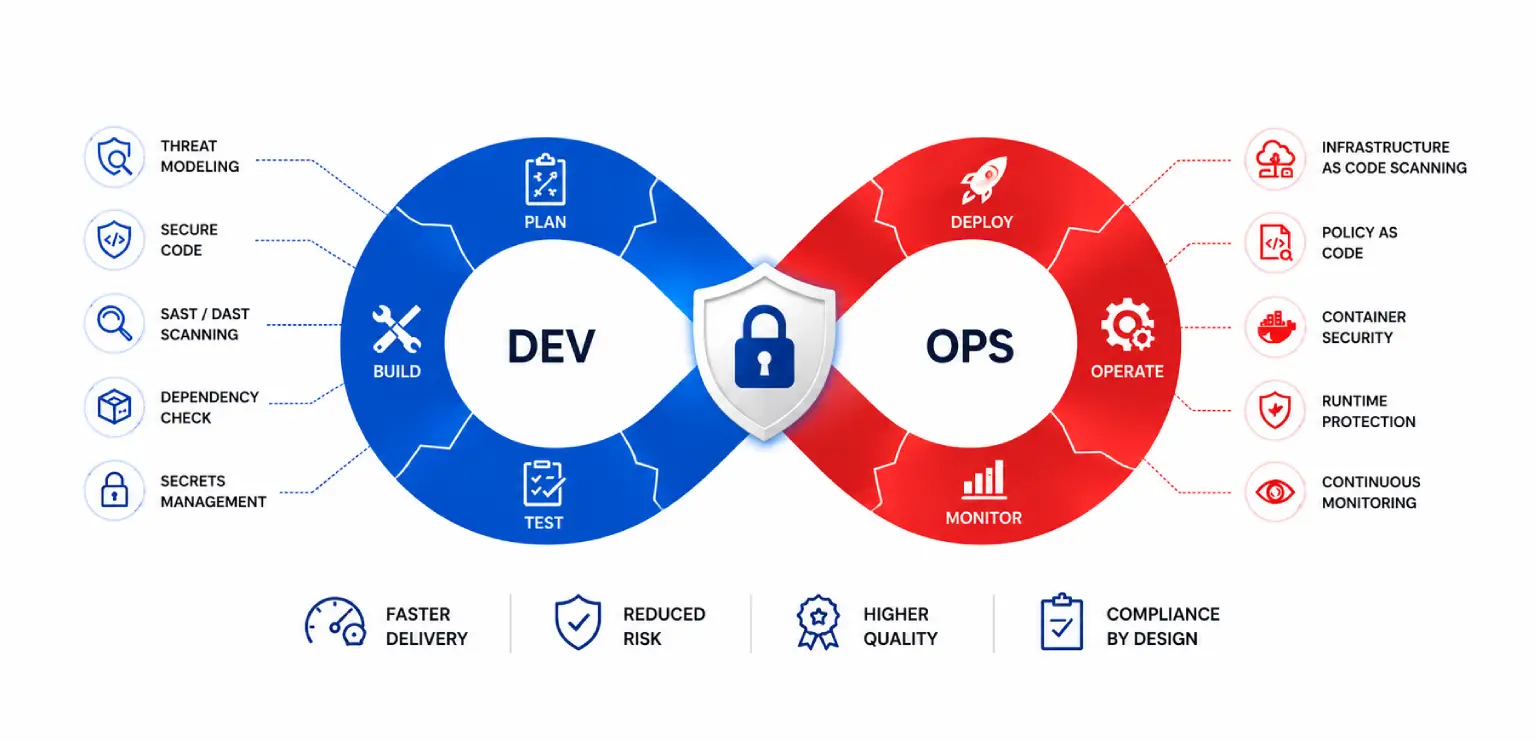
A practical DevSecOps implementation can introduce security controls across the entire software lifecycle:
Security Across the Software Delivery Lifecycle
The right security check at the earliest stage where it can be made efficiently — not every scan everywhere.
Security activities mapped across every stage from Plan to Monitor.
| Delivery Stage | Example Security Activity |
| Plan | Security requirements and threat modeling |
| Code | SAST and secrets detection |
| Build | SCA and dependency checks |
| Test | DAST, IAST, and security testing |
| Release | Risk-based security policies and gates |
| Deploy | IaC and container security |
| Monitor | Vulnerability management and continuous monitoring |
This approach is consistent with OWASP’s secure development guidance, which describes DevSecOps as building security practices into DevOps activities and using automated security testing across the software lifecycle.
The important point is that every stage does not need the same level of security testing. A lightweight check may be appropriate during coding, while deeper testing can happen later in the pipeline.
What Do DevSecOps Services Typically Include?
Effective DevSecOps services (Development, Security and Operations) should be designed around an organization’s applications, infrastructure, development practices, and risk profile rather than around a fixed list of tools.
| ▪ DevSecOps assessment: We first identify gaps across development workflows, CI/CD pipelines, cloud environments, security controls, and governance. |
| ▪ Secure CI/CD: We integrate appropriate security checks into existing pipelines so security becomes part of normal delivery. |
| ▪ Application security: SAST, DAST, IAST, SCA, secrets detection, and secure code practices can help identify weaknesses at different stages. |
| ▪ Cloud and infrastructure security: IaC scanning, container security, Kubernetes security, and configuration checks can help address risks outside application code. |
| ▪ Security automation: We automate repeatable checks, reporting, policy enforcement, and selected remediation workflows. |
| ▪ Governance and compliance: Security requirements can be translated into repeatable controls and policies instead of relying only on manual reviews. |
OWASP’s DevSecOps Verification Standard also includes areas such as threat modeling, hardcoded secrets detection, SAST, SCA, container security, secure dependency management, DAST, IAST, penetration testing, and security test coverage.
| AUTOMATE THE REPEATABLE — Secure CI/CD depends on strong automation underneath. See our DevOps automation framework for SaaS and guidance on choosing CI/CD tools. |
How Does DevSecOps Shift Security Left Without Slowing Delivery?
The phrase “shift left” is often misunderstood. It does not mean running every possible security scan on every piece of code at every stage.
With effective DevSecOps implementation, we make the right security decision at the earliest stage where it can be made efficiently.
For example, secrets can be checked before code moves further through the pipeline. Dependencies can be checked during the build process. Application behavior can be tested later when a running environment is available. Higher-risk findings can receive deeper human review.
This creates an important balance between security and engineering velocity.
The DevSecOps “Friction Budget”
We recommend looking at security through what we call a DevSecOps friction budget.
Every security control can create some level of friction. A scan may increase pipeline time. A false positive may require developer attention. A manual approval may delay a release. A poorly configured security gate can create repeated interruptions.
The DevSecOps “Friction Budget”
How much friction can we introduce while achieving meaningful risk reduction? Measure it across four areas:
Security Signal
Real risk surfaced
Remediation Time
Time to fix findings
Pipeline Impact
Added build time
Developer Adoption
Teams actually use it
The friction budget: measure security’s cost to delivery across four dimensions.
Instead of asking, “How many security controls can we add?”, ask:
| “How much security friction can we introduce while achieving meaningful risk reduction?” |
We can measure this through four areas: security signal, remediation time, pipeline impact, and developer adoption.
This creates a more useful view of DevSecOps services because security becomes an engineering performance issue as well as a security issue.
| MEASURE WHAT MATTERS — Pipeline impact and remediation time are delivery metrics too. See the DevOps metrics every CTO should track. |
What Does a DevSecOps Consultant Do?
A DevSecOps consultant helps connect security goals with the way engineering teams actually build and release software.
A good DevSecOps consulting engagement always starts with an analysis of the existing setup. We have to know the architecture, applications, CI/CD pipelines, cloud setup, compliance needs, security threats, development methodologies, and tools currently used to recommend any changes.
The consultant should be able to offer more than security product suggestions. A DevSecOps consultant can help develop the target architecture, choose proper controls, integrate them into the delivery process, set up security policy, and implement the new workflow inside the organization.
| Expert advice: When working with a consulting company, and if they start suggesting a set of tools before analyzing your development environment, ask them the reasons for doing that. The proper security architecture has to support your development methodology, not vice versa. |
How Much Do DevSecOps Services Cost?
There is no reliable single price for DevSecOps services because the scope can vary significantly between organizations.
Cost may depend on a variety of factors including the number of applications and pipelines, complexity of the current environment, cloud and Kubernetes usage, compliance needs, current security solutions, legacy systems, and whether we are doing a one-time setup or ongoing maintenance.
The business case is also becoming more urgent. Verizon’s 2026 DBIR found that only 26% of critical vulnerabilities listed in CISA’s Known Exploited Vulnerabilities catalog were fully remediated by organizations in 2025. The report also found that the median time for full resolution increased to 43 days, compared with 32 days in the previous year’s reporting dataset.
| 26% / 43 days Only 26% of CISA KEV critical vulnerabilities were fully remediated in 2025, and median time-to-resolution rose to 43 days (from 32). Delay has a cost too. |
This means cost should not be evaluated only as the price of implementation. We should also consider the cost of delayed remediation, manual security work, production incidents, compliance effort, and engineering time.
How to Choose a DevSecOps Consulting Partner?
Choosing a DevSecOps consulting partner should start with capability, not simply certifications or a list of security tools.
We recommend using a simple 4D Partner Test:
| Dimension | Question to Ask |
| Discover | Can the partner identify our actual security and delivery gaps? |
| Design | Can they create a practical target-state architecture? |
| Deliver | Can they implement the solution rather than only provide advice? |
| Demonstrate | Can they show measurable improvements in security and delivery? |
A good partner should understand application development, CI/CD, cloud infrastructure, security operations, compliance, and developer experience.
We should also look for a partner that can work with existing investments where they make sense. Replacing every tool is rarely the same thing as improving security.
| CHOOSING HELP — Our guide on selecting a DevOps consulting partner for SaaS applies the same capability-first lens to DevSecOps engagements. |
Enterprise DevSecOps: What Changes at Scale?
Enterprise DevSecOps is not simply DevSecOps with more applications and more security scans. Scale changes the problem.
Large organizations need consistent security controls across many teams while still allowing those teams to move independently. This requires reusable pipeline patterns, centralized governance, policy as code, software supply chain visibility, identity controls, cloud security, container security, SBOM management, and measurable security standards.
The goal should be centralized guardrails with distributed execution.
Security teams can define the controls and risk standards, while engineering teams can apply those controls within their delivery workflows.
This model helps avoid another common enterprise problem: creating one central security team that becomes the approval bottleneck for hundreds of development teams.
| SCALE WITH A PLATFORM — “Centralized guardrails, distributed execution” is exactly the platform-engineering model. See platform engineering for SaaS. |
DevSecOps Readiness: 7 Questions to Ask Before Implementation
Before starting DevSecOps implementation, we recommend answering seven basic questions:
| 1. Do we have standardized CI/CD pipelines? |
| 2. Do developers receive security findings within their normal workflow? |
| 3. Do we know which applications and assets carry the highest business risk? |
| 4. Are dependencies continuously monitored? |
| 5. Is infrastructure managed through code? |
| 6. Can important security policies be automated? |
| 7. Do we measure remediation time and security-related delivery impact? |
If several answers are “no,” jumping directly into tool deployment may create more work without solving the underlying problems.
A readiness assessment can help establish the baseline first. From there, we can prioritize security improvements based on risk, engineering maturity, and business needs.
| BASELINE FIRST — A structured maturity check turns these questions into a roadmap. See measuring DevOps maturity and the DevOps maturity model. |
FAQs
Are DevSecOps services only for large enterprises?
No. The core principles can work for organizations of different sizes. DevSecOps services become especially valuable as application portfolios, development teams, cloud environments, and compliance requirements become more complex.
Does DevSecOps replace the security team?
No. DevSecOps distributes security responsibility across the software lifecycle. Security specialists can focus more on architecture, threat modeling, high-risk findings, governance, and complex security decisions while automated controls handle repeatable checks.
What tools are used in DevSecOps?
Common categories include SAST, DAST, SCA, secrets scanning, IaC scanning, container security, vulnerability management, SBOM tools, and policy-as-code solutions. The right combination depends on the organization’s technology stack and risk profile.
How long does DevSecOps implementation take?
There is no universal timeline. DevSecOps implementation depends on application count, pipeline maturity, architecture, cloud environment, existing tools, security requirements, and the amount of process change required.
Build Security Into Delivery, Not Around It
Security should not become a final obstacle between engineering and production. With the right DevSecOps services, you can move security closer to the work, automate repeatable controls, prioritize meaningful risks, and give developers useful security feedback without unnecessary friction.
At Impressico Business Solutions, our focus is on building a DevSecOps approach that fits the organization’s engineering reality rather than adding security for the sake of security.
The best approach to enterprise DevSecOps is one where enhanced security does not come at the cost of speed of delivery, developers’ ease, and business considerations. Once security is integrated into the process of software development rather than being an activity conducted after the fact, secure delivery becomes an engineering discipline.
| IMPRESSICO · DEVOPS & CLOUD SERVICES Make secure delivery an engineering discipline Impressico Business Solutions builds a DevSecOps approach that fits your engineering reality — embedding the right security checks into planning, CI/CD, testing, and monitoring so risks surface earlier without slowing delivery. Whether you’re starting with a readiness assessment or scaling enterprise DevSecOps, our DevOps & Cloud Services team can help you design, deliver, and measure it.
|
Impressico Business Solutions — Building security into delivery, not around it.

IBS
Similar articles
Compliance-as-Code: Automating SOC 2, HIPAA, and PCI-DSS in CI/CD Pipelines
September 9, 2026
Shift-Left Security in CI/CD Pipelines: A Practical Playbook
September 4, 2026
Is Your Engineering Team Ready for Platform Engineering? A Readiness Checklist
August 12, 2026
Measuring Platform Engineering ROI: DORA and SPACE Explained
July 31, 2026
Internal Developer Platforms: Building a Golden Path for Engineering Teams
July 22, 2026
AIOps in Practice: Using AI to Cut Incidents and MTTR
July 6, 2026