


August 12, 2026
Is Your Engineering Team Ready for Platform Engineering? A Readiness Checklist
Enjoying this article?
Share it with the world!


Platform Engineering Readiness Checklist & Scorecard
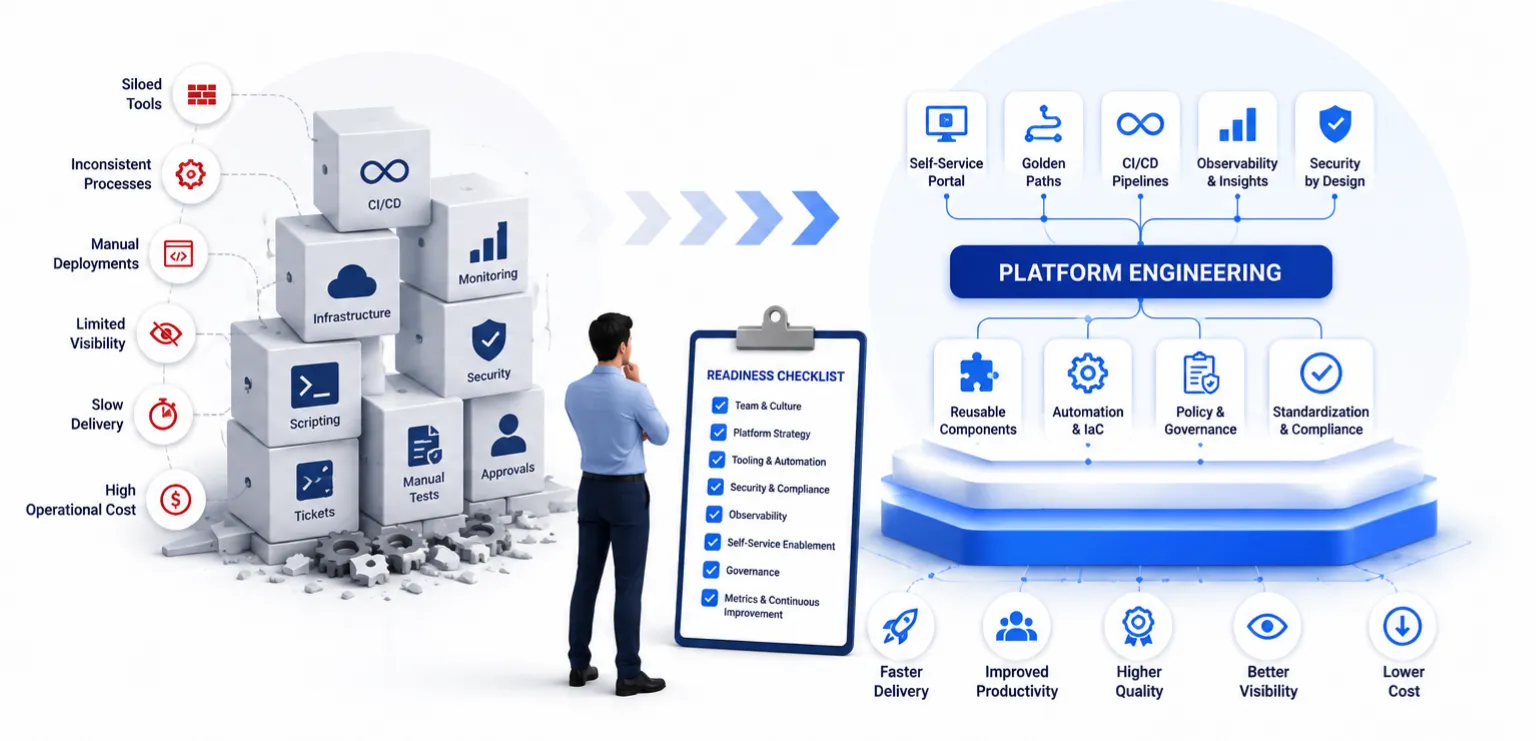
Platform engineering isn’t the right next step for every engineering team. It’s the right step when your developers spend more time dealing with infrastructure, deployment processes, and fragmented tools than building software. If onboarding is becoming slower, DevOps teams are overwhelmed with repetitive requests, and every product team follows a different workflow, these are strong signs of platform engineering readiness.
Instead of asking, “Should we build an Internal Developer Platform?” a more appropriate question would be, “Are we at the stage where building the platform will create less friction than not building it?”
As per the Cloud Native Computing Foundation (CNCF), platform engineering helps companies to offer standardized and self-service experiences that increase developer efficiency and ease of accessing necessary infrastructure and services. As the engineering gets more complex, such standardized experiences are highly valued.
The problem is that it’s hard to determine when to make such a move. Jumping into it too soon might result in creating a platform that is never used. And being too late means facing engineering problems that are costly to resolve.
In this guide, we’ll use a practical platform engineering checklist to help you evaluate your team’s readiness, identify the right time for a DevOps to platform transition, and understand whether an Internal Developer Platform is the right investment for your organization.
| FIRST, THE LANDSCAPE — If you’re still separating these disciplines, our guides on platform engineering vs. DevOps and platform engineering vs. DevOps vs. SRE set the context. |
What Platform Engineering Readiness Really Means
Many people think platform engineering readiness begins when an engineering team reaches a certain size. While team growth matters, it’s rarely the deciding factor. What matters more is whether your engineering organization has reached a point where developers repeatedly face the same operational challenges.
Think about your current workflows. Are developers waiting for Kubernetes namespaces, cloud infrastructure, IAM permissions, managed databases, or CI/CD environments to be provisioned? Does every team maintain its own deployment pipeline? Do new engineers spend days understanding different tools before they can contribute meaningful code? If these situations sound familiar, they are signs that your engineering practices may have outgrown your existing DevOps model.
This shift also supports better developer productivity. Google’s 2025 State of DevOps Report highlights that improving developer experience and reducing cognitive load are closely linked to stronger organizational performance and software delivery outcomes.
The goal isn’t to replace DevOps. Instead, platform engineering builds on mature DevOps practices by making proven workflows easier to consume across the organization.
| Expert Tip: Before discussing new platform tools, spend a few weeks measuring recurring engineering requests. If your DevOps team keeps solving the same problems for different product teams, you may already have enough evidence to evaluate your platform engineering readiness. |
| MEASURE IT — Not sure how to baseline today? Our guides to measuring DevOps maturity and the DevOps maturity model give you a starting point. |
What Does an Internal Developer Platform Include?
Before deciding whether your organization is ready, it’s helpful to understand what an Internal Developer Platform (IDP) actually provides. An IDP is not just a tool but rather a combination of the engineering capabilities within the same platform where developers can provision infrastructure and deploy apps.
Depending on your engineering needs, a mature platform may include:
| ▪ Infrastructure provisioning using Infrastructure as Code (IaC) |
| ▪ Standardized CI/CD pipelines |
| ▪ Kubernetes deployment templates |
| ▪ Secrets and configuration management |
| ▪ Developer portals and service catalogs |
| ▪ Monitoring and observability integrations |
| ▪ Security guardrails and policy enforcement |
| ▪ Reusable software templates |
| ▪ Automated environment creation |
The goal isn’t to implement every capability at once. Most successful organizations start with the areas causing the greatest engineering friction and gradually expand their platform as adoption grows.
| Expert Insight: One of the biggest mistakes we see is treating an Internal Developer Platform as a technology project. In reality, it’s an internal product that should evolve based on developer feedback and business priorities. The best platforms solve everyday engineering challenges instead of trying to include every possible feature from day one. |
| BUILDING FOR SAAS? — For how IDPs play out in SaaS specifically, see platform engineering for SaaS and platform engineering beyond DevOps for SaaS. |
Why Many Teams Start Too Early
Platform engineering has become one of the fastest-growing topics in modern software delivery. As more organizations share success stories about Internal Developer Platforms (IDPs), it’s easy to assume that every engineering team should build one.
That assumption often leads to unnecessary complexity.
Some organizations invest months creating developer portals, automation frameworks, and platform teams before understanding whether these investments solve an actual business problem. Instead of reducing engineering friction, they create another product that requires maintenance, documentation, and ongoing support.
A successful Internal Developer Platform isn’t built because the industry is talking about platform engineering. It’s built because developers are consistently facing challenges that standardized workflows can solve.
For example, imagine a software company with 30 engineers working on a single product. Everyone uses the same deployment process, infrastructure requests are handled quickly, and onboarding takes only a few days. Building a dedicated platform team at this stage would likely create more overhead than value.
Now compare that with an organization that has multiple product teams, separate CI/CD pipelines, different infrastructure templates, and frequent deployment inconsistencies. Here, platform engineering can significantly reduce duplicated effort while improving consistency across teams.
| Leadership Insight: Platform engineering should solve repeated organizational problems—not isolated technical ones. If your engineers aren’t experiencing recurring operational friction, strengthening your current DevOps practices may deliver better results than launching a platform initiative. |
The 10-Point Platform Engineering Readiness Checklist
Every engineering organization is different, but certain patterns consistently indicate when platform engineering begins delivering measurable value. Use this platform engineering checklist to assess where your team stands today.
|
Ten patterns that consistently signal platform engineering readiness.
1. Tooling Sprawl Is Slowing Development
When different teams use different CI/CD tools, infrastructure templates, monitoring platforms, or deployment methods, developers spend valuable time learning processes instead of building products.
Standardizing these workflows is often one of the strongest indicators of platform engineering readiness.
2. Developer Onboarding Takes Too Long
If new engineers need several weeks before they can contribute confidently, your onboarding process may rely too heavily on tribal knowledge.
A mature Internal Developer Platform provides standardized environments, documentation, and self-service resources that help developers become productive much faster.
3. Developers Frequently Wait for Infrastructure
When developers regularly submit tickets for environments, databases, cloud resources, or access permissions, delivery naturally slows down.
One of the biggest advantages of platform engineering is enabling secure self-service without requiring DevOps intervention for every request.
| Common Mistake: Many organizations automate infrastructure provisioning but still require multiple manual approvals. True self-service maturity removes unnecessary waiting while maintaining governance and security. |
4. Engineering Teams Keep Rebuilding the Same Solutions
If multiple teams are creating similar CI/CD workflows, Infrastructure as Code (IaC) modules, deployment scripts, or Kubernetes configurations independently, valuable engineering time is being spent solving problems that have already been solved elsewhere.
Platform engineering encourages teams to reuse proven building blocks instead of reinventing them, improving consistency while reducing maintenance effort across the organization.
| STANDARDIZE CI/CD — This is where a shared pipeline pays off. See our DevOps automation framework for SaaS and how to automate your CI/CD pipeline for SaaS. |
5. DevOps Engineers Spend Most of Their Time on Repetitive Requests
When your DevOps specialists repeatedly answer the same infrastructure questions, troubleshoot similar deployment issues, or manually provision environments, they’re acting more like a support desk than strategic engineers.
Reducing these repetitive tasks allows DevOps teams to focus on improving the platform instead of maintaining day-to-day operations.
| How We Help: Before recommending platform engineering, we work with organizations to identify recurring operational bottlenecks. Sometimes small workflow improvements solve the immediate problem. Other times, the assessment clearly shows that investing in an Internal Developer Platform will create long-term value. Making that distinction early helps avoid unnecessary platform investments. |
6. Security and Compliance Vary Between Teams
When every product team implements security controls differently, maintaining compliance becomes increasingly difficult.
A centralized platform makes it easier to embed approved security standards directly into development workflows, reducing both risk and manual reviews.
7. Self-Service Is Still Limited
If developers depend on another team for routine tasks like creating environments, requesting infrastructure, or accessing deployment pipelines, your self-service maturity may still be low.
Improving self-service is one of the clearest goals of platform engineering because it allows developers to work independently while following organizational standards.
8. Engineering Standards Are Difficult to Maintain
Documentation alone rarely guarantees consistency.
If engineering standards vary from one team to another, your platform can become the place where best practices are built into workflows instead of existing only as written guidelines.
9. Your Engineering Organization Is Growing Faster Than Your Processes
Growth introduces complexity. More products, more developers, and more cloud services naturally create additional operational work.
If your existing processes no longer scale with your engineering organization, platform engineering can help standardize operations without slowing innovation.
10. Leadership Wants Better Developer Experience Metrics
Modern engineering leaders increasingly measure success through developer productivity, deployment consistency, onboarding speed, and operational efficiency—not just deployment frequency.
If your organization is actively tracking these metrics, platform engineering becomes a practical way to improve them through standardized developer experiences instead of relying on individual teams to solve the same challenges repeatedly.
| Ask Your Team: If one engineer spends several hours every week answering the same infrastructure or deployment questions, what would happen if those answers became self-service instead? Sometimes the strongest sign of platform engineering readiness isn’t another new tool—it’s recognizing the repetitive work your teams have quietly accepted as normal. |
| TRACK THE RIGHT METRICS — For what to measure, see the DevOps metrics every CTO should track and how to prove value in measuring platform engineering ROI. |
Platform Engineering Readiness Scorecard
By now, you probably have a sense of whether platform engineering could benefit your organization. To make that decision more objective, use this simple readiness scorecard. The more statements you agree with, the stronger your platform engineering readiness.
| Statement | Yes |
| Our developers regularly wait for infrastructure or environment provisioning. | ☐ |
| Different teams use different deployment or CI/CD processes. | ☐ |
| DevOps engineers spend significant time handling repetitive support requests. | ☐ |
| Onboarding new engineers takes more than one week. | ☐ |
| We have noticeable tooling sprawl across teams. | ☐ |
| Developers still depend on manual approvals for routine tasks. | ☐ |
| Security and compliance practices differ between product teams. | ☐ |
| We want to improve developer experience through self-service. | ☐ |
| Our engineering organization is growing faster than our current processes. | ☐ |
| Leadership wants consistent engineering standards across teams. | ☐ |
There isn’t a universal score that determines readiness. Instead, use this assessment to identify recurring engineering challenges and decide whether an Internal Developer Platform is the right next step.
How to Interpret Your Score
| ▪ 0–3 Yes: Your current DevOps practices may still be sufficient. Focus on improving existing processes before building a platform. |
| ▪ 4–7 Yes: You’re approaching platform engineering readiness. Begin identifying common workflows and opportunities for standardization. |
| ▪ 8–10 Yes: Your organization is likely ready for an Internal Developer Platform, and delaying the transition may continue adding unnecessary operational overhead. |
When NOT to Build an Internal Developer Platform
One of the biggest misconceptions about platform engineering is that every growing company needs an Internal Developer Platform. In reality, building one too early can create unnecessary complexity, additional maintenance, and low adoption.
You may not need platform engineering yet if:
| ▪ Your engineering team is still relatively small and collaborates closely. |
| ▪ Everyone follows the same deployment process. |
| ▪ Infrastructure requests are handled quickly without becoming a bottleneck. |
| ▪ Developers rarely experience onboarding challenges. |
| ▪ Your existing DevOps workflows are consistent and continue to scale with the business. |
In these situations, investing in better documentation, automation, or infrastructure-as-code may provide greater value than creating a dedicated platform team.
| Leadership Insight: Platform engineering should solve existing friction—not anticipate future friction that may never happen. |
The Hidden Cost of Waiting Too Long for Platform Engineering
While adopting platform engineering too early creates unnecessary work, waiting too long carries its own risks.
As engineering organizations grow, operational knowledge often becomes concentrated within a few senior engineers. Teams begin relying on specific individuals for deployment guidance, infrastructure changes, and troubleshooting. This creates knowledge silos, slows delivery when key people are unavailable, and makes scaling engineering operations much more difficult.
Over time, this affects much more than developer productivity. New engineers take longer to become productive. Security policies become harder to enforce. DevOps teams spend more time supporting individual requests instead of improving shared capabilities. Engineering leaders also struggle to measure delivery performance because every team follows different practices.
According to the 2025 State of DevOps Report, organizations that invest in improving developer experience and reducing cognitive load consistently achieve better software delivery and organizational performance. This reinforces the importance of removing operational friction before it slows innovation.
Mini Case Study
| Consider a growing SaaS company with around 100 engineers working across multiple product teams. Each team had developed its own deployment process over time. While every workflow met the team’s immediate needs, supporting multiple approaches increased operational overhead, slowed onboarding, and made it harder to maintain consistent engineering standards. Rather than redesigning each workflow all at once, the organization found common deployment patterns, established infrastructure templates, and enabled self-provisioning incrementally. Within just a few months, onboarding had become easier, fewer operational requests were required, and engineers could focus more on building product functionality rather than infrastructure. The most important change? It wasn’t a technology—it was cutting down the friction. |
DevOps to Platform Transition: Are You Ready?
Many organizations view platform engineering as a replacement for DevOps, but the two disciplines serve different purposes.
DevOps establishes engineering practices such as automation, collaboration, and continuous delivery. Platform engineering builds on those practices by turning them into reusable internal products—such as deployment templates, Infrastructure as Code (IaC), and self-service workflows—that every development team can use consistently.
Before beginning a DevOps to platform transition, ask your team a few practical questions:
| ▪ Are developers solving the same operational problems repeatedly? |
| ▪ Can common workflows be standardized without limiting team flexibility? |
| ▪ Do engineering leaders support long-term platform ownership? |
| ▪ Is there a clear platform team charter defining responsibilities? |
| ▪ Can success be measured through developer experience, onboarding time, deployment consistency, or operational efficiency? |
If the answer to most of these questions is “yes,” your organization may be ready for a structured DevOps to platform transition that improves consistency without disrupting existing engineering practices.
| How We Help: Every engineering organization reaches this point differently. At Impressico Business Solutions, we help teams evaluate their current engineering maturity, identify opportunities for self-service, and create practical platform roadmaps that align with existing DevOps investments instead of disrupting them. |
A 90-Day Platform Engineering Readiness Action Plan
Platform engineering doesn’t need to begin with a large-scale transformation. A phased approach reduces risk while allowing teams to demonstrate measurable progress.
A phased approach reduces risk while showing measurable progress.
Days 1–30: Assess
Start by understanding where engineering friction exists.
| ▪ Map your current developer journey. |
| ▪ Identify repetitive infrastructure requests. |
| ▪ Measure onboarding time. |
| ▪ Review tooling sprawl across teams. |
| ▪ Define clear success metrics. |
Days 31–60: Standardize
Focus on creating consistency before introducing new platforms.
| ▪ Standardize deployment workflows. |
| ▪ Create reusable infrastructure templates. |
| ▪ Improve documentation. |
| ▪ Establish governance and security standards. |
| ▪ Define your platform team charter. |
Days 61–90: Pilot
Launch a small pilot instead of a company-wide rollout.
| ▪ Select one engineering team. |
| ▪ Introduce self-service capabilities. |
| ▪ Gather developer feedback. |
| ▪ Measure adoption and productivity improvements. |
| ▪ Refine the platform before expanding to additional teams. |
| Best Practice: The most successful Internal Developer Platforms evolve alongside engineering teams. Treat your platform like a product, listen to developer feedback regularly, and improve it continuously instead of trying to build everything on day one. |
Conclusion
Platform engineering delivers the greatest value when it solves real engineering challenges—not when it follows industry trends. By evaluating your platform engineering readiness, you can identify the right time to invest in an Internal Developer Platform and build a stronger foundation for developer productivity and long-term growth. At Impressico Business Solutions, we help organizations assess their readiness and create practical platform strategies that scale with their engineering goals.
FAQs
1. Is our team ready for platform engineering?
Your team is likely ready if developers regularly face onboarding delays, infrastructure bottlenecks, tooling sprawl, and repetitive operational tasks that can be standardized through self-service workflows.
2. When should a company build an Internal Developer Platform?
An Internal Developer Platform makes the most sense when engineering complexity begins affecting developer productivity, deployment consistency, and operational efficiency rather than simply when the team reaches a specific size.
3. How many engineers do you need before platform engineering makes sense?
There is no fixed number. Some organizations benefit with fewer than 50 engineers, while others may not need it even with larger teams. Engineering complexity, workflow consistency, and self-service maturity are better indicators than headcount alone.
4. What should be included in a platform engineering checklist?
A strong platform engineering checklist should evaluate tooling sprawl, onboarding friction, infrastructure provisioning, security consistency, developer experience, engineering standards, self-service capabilities, and leadership support.
5. How is platform engineering different from DevOps?
DevOps improves collaboration and delivery practices, while platform engineering builds reusable internal products that make those practices easier and more consistent for developers to use.
6. Can small engineering teams benefit from platform engineering?
Some can, but many smaller teams gain greater value by improving automation and standardizing DevOps workflows first. Platform engineering becomes more beneficial as operational complexity and repeated engineering challenges increase.
| IMPRESSICO · DEVOPS & PLATFORM ENGINEERING Find out if platform engineering is your right next step Impressico Business Solutions helps engineering teams evaluate their maturity, spot self-service opportunities, and build practical platform roadmaps that align with existing DevOps investments instead of disrupting them. Whether you’re weighing your first Internal Developer Platform or planning a structured DevOps-to-platform transition, our DevOps & Cloud Services team can help you decide—and deliver.
|
Impressico Business Solutions — Helping engineering teams build platforms that reduce friction, not add to it.
Similar articles

Shift-Left Security in CI/CD Pipelines: A Practical Playbook
September 4, 2026
DevSecOps: Shifting Security Left Without Slowing Delivery
September 2, 2026
Measuring Platform Engineering ROI: DORA and SPACE Explained
July 31, 2026
Internal Developer Platforms: Building a Golden Path for Engineering Teams
July 22, 2026
AIOps in Practice: Using AI to Cut Incidents and MTTR
July 6, 2026
Platform Engineering vs DevOps: What’s Actually Changing in 2026
June 26, 2026
