November 2, 2026
FinOps Consulting Services: What to Expect From a Cloud Cost Partner in 2026
Enjoying this article?
Share it with the world!


Visibility, Allocation, Forecasting and Governance across Cloud, AI and SaaS
| ⚡ Quick Answer FinOps consulting services help organizations understand, allocate, forecast and optimize technology spending, bringing Finance, Engineering, Product and business teams together. A credible engagement covers visibility, allocation, forecasting, optimization, governance and accountability — not a one-off audit. In 2026 the scope reaches well past public cloud: the State of FinOps 2026 report found 98% of respondents now manage AI costs and 90% manage SaaS. The measure that matters is realized savings against an agreed baseline, not savings somebody identified on a slide. |
FinOps consulting services assist businesses in gaining a greater understanding of where technology funds go and whether these expenses are generating any value. The increase of the cloud environment and investments in artificial intelligence and SaaS creates challenges to manage costs in an efficient way.
A FinOps consulting partner will combine the skills of the Finance and Engineering departments to deal with this problem. Rather than trying to reduce expenses immediately, it aims at better budgeting, responsibility and making better choices in technology investments.
In 2026, these services will not be limited to public cloud cost management. The infrastructure and software costs related to AI, SaaS, and private clouds will become equally important.
What are FinOps Consulting Services?
FinOps consulting services help organizations understand, allocate, forecast and optimize technology spending. They bring Finance, Engineering, Product and business teams together to ensure cloud investments deliver measurable business value.
FinOps is not just cost saving, it is an operating model to help organizations make informed decisions when investing in technology. It provides a framework and culture to help organizations make data driven decisions and have accountability around costs. (FinOps Foundation).
A FinOps consulting company will help you implement this practice through:
| Cloud cost visibility | |
| Cloud cost allocation | |
| Cloud cost forecasting | |
| Cloud resource optimization | |
| Cloud cost governance | |
| Cloud financial accountability |
These activities form the foundation of effective cloud financial operations and long-term cost control.
What Does a FinOps Consultant Do for Your Business?
A consultant will help you link your financial data to your technical decisions. The support you need will depend on your current FinOps maturity, your cloud environment and business goals.
A well-structured engagement may include the following FinOps consulting solutions:
Understand Your Current Spend
The consultant will look at your billing data, resource usage, account structure, tagging and any existing reporting you have. A FinOps maturity assessment will help identify gaps in your cost visibility, accountability, forecasting and optimisation.
This will give you a solid baseline to make recommendations.
Create a Practical FinOps Strategy
A FinOps strategy will help you understand how to manage your costs. It should ensure you have alignment between your financial goals and engineering goals.
It may include having a clear FinOps operating model, decision rights and regular reviews.
Identify and Prioritize Optimization Opportunities
The consultant will look at your idle resources, oversized resources, storage, workload patterns and any pricing commitments you have. They may recommend AWS cost optimization, Azure cost optimization and/or Google Cloud cost optimization.
If you have a container-based platform, they can help you with Kubernetes cost optimization to help you understand your resource requests and limits, cluster utilization and workload efficiency.
Improve Reporting and Financial Planning
Cloud cost reporting should show more than how much your organization spent during a particular month. They should help teams understand where spending is increasing, which workloads are driving costs and whether actual usage matches forecasts. Cost anomaly detection and cloud cost forecasting tools can make these patterns easier to identify.
This makes cost information more useful to decision-makers.
What Should You Expect From FinOps Consulting Services in 2026?
A modern FinOps engagement should not be a one-off audit. It should provide you with processes that help your teams manage their technology spend.
You can expect the following:
Better Visibility Across Cloud and Technology Spending
Often, large organizations will have multiple providers, accounts and business units. This means you need to have consistent insight into your costs across Multi-cloud cost optimization.
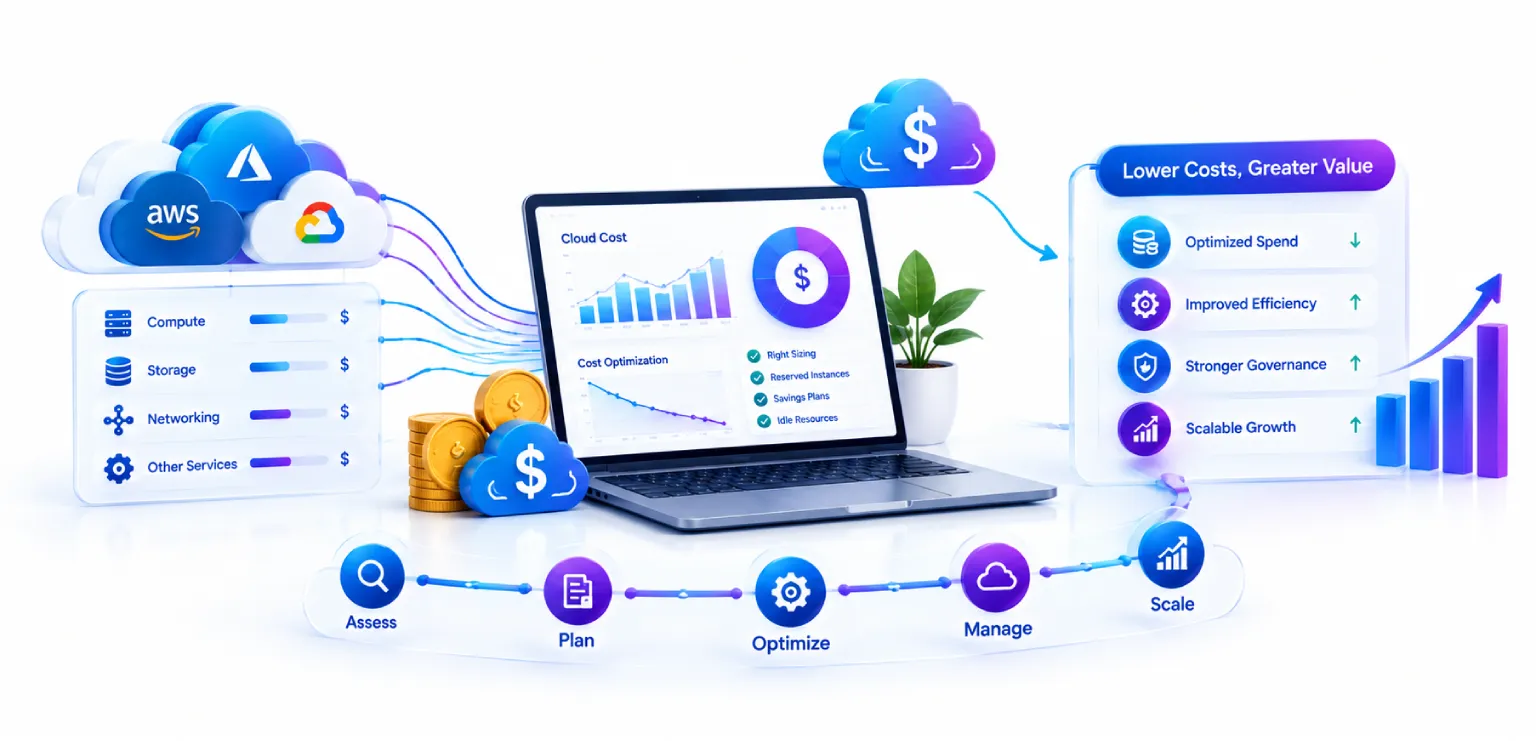
Your partner should help you put in place cloud infrastructure cost management to give you a view of your usage, accountability and billing. They will also help you create a practical cloud cost allocation strategy.
Using the FOCUS specification (FinOps Open Cost and Usage Specification) can help to standardize your billing data.
| What FOCUS does The FinOps Open Cost and Usage Specification (FOCUS) provides a standardized way to represent cloud billing and usage data across providers. This makes it easier for organizations to compare costs, consolidate reporting and build consistent financial visibility. |
A Balance Between Cost and Engineering Performance
You shouldn’t have a negative impact on your application performance due to reducing your infra costs. Effective cloud cost optimization services should balance infrastructure savings with application performance, availability and workload requirements.
They may look at your cloud resource utilization, rightsizing, storage improvements and cloud usage optimization.
For example, if you have a workload running on larger compute resources than needed, they can look at your usage, trial a suitable configuration and recommend changes to improve efficiency.
Stronger Governance & Automation
A good FinOps operating model will give your teams clarity on who is responsible for making decisions. This will cover budgets, approvals, reporting and escalation.
FinOps automation can help you with this by providing alerts for budgets, checking tagging, enforcing policies and cloud cost monitoring. The automation should help reduce repetitive tasks but still keep important decisions under human control.
Better Commitments & Pricing Decision
Cloud providers have various pricing options. However, committing to discounts without knowing your future demand can cause you to lose money.
Your consultant can help you understand your cloud commitment management, reviewing reserved instances and savings plans. They will also help you understand the potential savings and compare them with your forecasting and flexibility needs.
They should recommend something that takes into account your workload stability, contract and potential changes.
Support Beyond Initial Recommendations
Depending on your organization, you may want a defined project or ongoing support. FinOps implementation services can help you set up your initial framework. Or managed FinOps services can provide you with ongoing support to monitor, report, optimize and govern.
You may also have FinOps advisory services to help leadership make decisions on major technology investments, vendors and long-term spending.
Enterprise FinOps Implementation: Key Stages and Process
An effective enterprise FinOps implementation should be carried out in a structured manner. Depending on the complexity of your organization, data and number of cloud environments, this can take varying lengths of time.
| Enterprise FinOps Implementation Discover Review billing, usage, ownership and existing processes — baseline and maturity findings Design Define priorities, KPIs, governance and responsibilities — a FinOps roadmap Implement Apply allocation, optimization, reporting and automation — working FinOps processes Improve Review results, refine forecasts and identify new opportunities — continuous improvement Days 1–30 Discovery, data quality, usage, major cost drivers Days 31–60 Accountability, priorities, reporting and governance Days 61–90 Implement improvements, review, long-term plan An indicative roadmap, not a fixed delivery promise Complex enterprise environments may need additional time. The four stages, and what the first ninety days look like. |
What Happens in the First 90 Days?
A practical roadmap could be:
| Days 1-30: Complete discovery, data quality, resource usage and identify major cost drivers. | |
| Days 31-60: Define accountability, prioritize optimization opportunities, define reporting and govern. | |
| Days 61-90: Implement chosen improvements, review & long-term optimization plan. |
This is an indicative roadmap, not a fixed delivery promise. Complex enterprise environments may need additional time.
For companies working to strengthen their engineering foundation, FinOps processes may also integrate with Platform Engineering. Good platform practices and reuse of infrastructure can help make visibility and ownership of costs simpler to achieve.
| Not sure where your cloud spend is actually going? Most organizations can report what they spent. Far fewer can say which workloads drove it, which team owns it, or whether it bought anything. Impressico starts with a discovery pass that answers those three questions before anyone proposes a saving. Book a FinOps discovery callExplore cloud and DevOps services |
How Much Do FinOps Consulting Services Cost in 2026?
There is no universal price for FinOps consulting services. It will depend on the project scope, cloud spend, number of vendors, and tools needed.
Factors may include:
| The warning sign Avoid any proposals that promise savings without explaining how they’re measuring the baseline, what they’re measuring and any technical trade-offs. A reputable partner should be able to show you how they’ll validate the opportunities and measure success. |
How to Choose the Right FinOps Consulting Partner?
Look for a partner who understands cloud engineering and financial decision- making.
Questions to ask a FinOps consulting partner:
| Do they understand your cloud environment? Ensure they have the relevant experience with AWS, Azure, Google Cloud, Kubernetes & hybrid. | |
| Can they link cost to outcomes? They should be able to explain how costs relate to your products, workloads & goals. | |
| Do they have a clear approach? Ask them how they’ll assess, what milestones they’ll have, who will be accountable and how they’ll report. | |
| Can they support governance & engineering? Cost optimization should work alongside security, reliability & delivery. | |
| How do they measure success? How do they differentiate between identified savings and actual savings? |
A good partner should also understand how FinOps can tie in with DevSecOps.
Why AI FinOps is Changing Things in 2026
AI has added complexity to your technology spend. You now need to understand the cost of using models, GPU’s, data and inference.
The State of FinOps 2026 report found that 98% of respondents manage AI costs. 90% manage or plan to manage SaaS. It also shows how FinOps is increasing with licensing, private cloud & data centers.
| What FinOps Now Covers 98% of respondents manage AI costs 90% manage or plan to manage SaaS AI FinOps Track AI usage, allocate costs and evaluate value AI Infrastructure Compute capacity, workload placement and infrastructure Generative AI Cost How models tie into your business and costs GPU Cost Optimization Utilization, capacity planning and idle GPU AI Inference Cost Understanding your inference costs AI Cost Governance Accountability, budgets and policies for AI spend And beyond AI SaaS cost optimization, licensing, private cloud and data centres are all moving into scope. State of FinOps 2026, 1,192 respondents. Figures verified October 2026. |
This broader spending landscape is changing what organizations need from their FinOps teams. Some of the most important areas now include:
| AI FinOps– helps teams track AI usage, allocate costs and evaluate value. | |
| AI Infrastructure Cost Optimization – Looking at your compute capacity, workload placement & infrastructure. | |
| Generative AI Cost Management – Understanding how models tie into your business and costs. | |
| GPU Cost Optimization – Understanding your utilization, capacity planning & idle GPU. | |
| AI Inference Cost Optimization – Understanding your inference costs. | |
| AI Cost Governance – Ensuring you have accountability, budgets & policies for your AI spend. |
For example,
| You may be using a more expensive model for every request when you could use a smaller model for regular tasks. By looking at your model choice, token usage & inference, you can identify opportunities to improve efficiency. | |
| An organization running AI workloads may have expensive GPU instances sitting idle between training jobs. A FinOps consultant can examine utilization patterns, workload scheduling and infrastructure requirements to identify opportunities to improve GPU efficiency. |
FinOps is also expanding into SaaS cost optimization & technology spend management. Organizations want to understand their software licensing, data platforms & other technology investments. The 2026 framework also puts more emphasis on aligning with executive strategy & value.
| Your AI spend is now a FinOps problem, whether or not anyone owns it GPU hours, token usage, inference and model choice do not appear on a traditional cloud bill in any useful shape. Impressico helps teams get AI costs allocated, forecast and governed alongside the rest of the estate. |
5 Ways to Measure Your FinOps Success
A simple cost saving figure won’t tell you if your program is a success. You should measure financial improvements along with engineering and business improvements.
Unit economics & cloud unit economics can help here. Rather than looking at total costs, you can track cost per workload.
Savings Validation Framework
A great way to avoid misleading savings is to track all opportunities through the 5 stages:
| Identified – Potential savings identified. | |
| Approved – Business approved. | |
| Implemented – Technical change complete. | |
| Realized – Spend has decreased against agreed baseline. | |
| Cost avoidance – Future cost avoided. |
| The Savings Validation Framework 1. Identified Potential savings identified 2. Approved Business approved 3. Implemented Technical change complete 4. Realized Spend has decreased against agreed baseline 5. Cost avoidance Future cost avoided Why the narrowing matters Tracking all five stages is what makes financial reporting credible to stakeholders. Identified savings and realized savings are not the same number, which is exactly the point. |
This simple framework will make your financial reporting more credible and give stakeholders a clear view of what has been achieved.
How Impressico Business Solutions Can Help
Impressico Business Solutions can help you treat FinOps as an ongoing business and engineering practice.
Our approach starts with understanding your existing cloud environment, spending patterns and engineering requirements. From there, we identify optimization opportunities, improve cost visibility and establish processes that your teams can maintain over time. This may include cloud cost optimization services, cost allocation, forecasting, governance and ongoing cost management.
We can also ensure your efforts tie in with your wider engineering improvements by implementing relevant Platform Engineering & DevSecOps.
The engagement should reflect your current maturity, tech stack & business goals.
FAQs
| What are FinOps consulting services? They will help you manage your technology spend by providing cost visibility, cost allocation, forecasting, optimization and accountability between Finance, Engineering & business teams. |
| How much do FinOps consulting services cost? It will depend on how complex your cloud is, how big your organization is, how ready your data is, what the scope is and if you want a one-off assessment, implementation or ongoing support. |
| What Does a FinOps Consultant Do for Your Business? They will help you understand your spend, identify cost saving opportunities, improve reporting, forecasting & help with governance and accountability. |
| How long will it take to implement FinOps in my enterprise? The initial assessment & roadmap may take a few weeks. An initial implementation may take around 90 days. Wider adoption & continuous improvement may take longer. |
| Is FinOps only for large enterprises? No, businesses of all sizes can benefit from FinOps. The scope & operating model should fit with your technology spend, team structure & financial goals. |
| What is the difference between FinOps and cloud cost optimization? Cloud cost optimization focuses on improving your infrastructure & reducing waste. FinOps will include this but also forecasting, cost allocation, governance, collaboration & managing your technology value. |
Make Your Technology Spend More Accountable in 2026
As organizations continue to add AI, grow their cloud environments & use more software platforms, your technology costs will continue to change. You need to look at ways to manage this.
The right FinOps consulting services will help you link your spend to your engineering decisions. With a clear strategy, measurable plan & ongoing governance, you can be confident in your technology investments.
Impressico Business Solutions can help you look at a practical approach to suit your current cloud environment & business goals.
Book a FinOps Discovery Call to see where you can improve visibility, control & gain value from your technology.
| Key Takeaways
An operating model Not a cost-cutting exercise, and not a one-off audit.
Past public cloud 98% now manage AI costs; 90% manage SaaS.
Realized, not identified Track all five stages or the savings number means little.
Cost per workload Unit economics beat a single total-spend figure. |
| Book a FinOps Discovery Call See where you can improve visibility, control & gain value from your technology. Impressico works across AWS, Azure, Google Cloud and Kubernetes, and ties cost work to the engineering decisions that drive it. Book a FinOps discovery callExplore cloud and DevOps services |
Impressico Business Solutions — FinOps, cloud cost optimization and platform engineering for the enterprise.

IBS
Similar articles
Cloud Cost Optimization Services: What a Modern FinOps Engagement Actually Delivers
October 28, 2026
SAST vs DAST vs SCA: Choosing the Right Security Tools for Modern DevOps Pipelines
October 19, 2026
Compliance-as-Code: Automating SOC 2, HIPAA, and PCI-DSS in CI/CD Pipelines
September 9, 2026
Shift-Left Security in CI/CD Pipelines: A Practical Playbook
September 4, 2026
DevSecOps: Shifting Security Left Without Slowing Delivery
September 2, 2026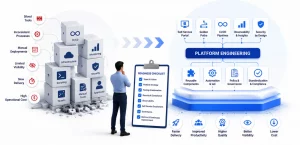
Is Your Engineering Team Ready for Platform Engineering? A Readiness Checklist
August 12, 2026