October 19, 2026
SAST vs DAST vs SCA: Choosing the Right Security Tools for Modern DevOps Pipelines
Enjoying this article?
Share it with the world!


SAST vs DAST vs SCA: Which Should You Use?
| ⚡ Quick Answer SAST analyzes source code without running it. DAST tests a running application from the outside. SCA examines third-party and open-source dependencies. They inspect different parts of software and complement one another rather than replace one another, so the practical question is not which to pick but where each belongs in the pipeline. |
SAST vs DAST is one of the essential considerations for modern DevOps teams that seek to enhance application security while keeping software delivery processes unchanged. Nevertheless, scanning source code cannot guarantee application security on its own. Third-party libraries can include security flaws, and well-written applications might have security issues when being executed in an inadequately configured environment. That is why application security testing tools are essential for modern DevSecOps practices.
At Impressico Business Solutions, we advise using a combination of SAST, DAST, and SCA depending on specific risks, architecture and the development cycle of an application.
The need for more effective protection is obvious nowadays. For example, Verizon’s 2026 Data Breach Investigations Report says that exploitation of vulnerabilities accounted for 31% of initial access vectors in the analyzed non-error, non-misuse breaches, which is much higher than 20% mentioned in the previous report.
If the wider practice is new to your team, our explainer on the difference between DevOps and DevSecOps sets the context for everything below.
SAST DAST SCA Comparison: What Is the Difference?
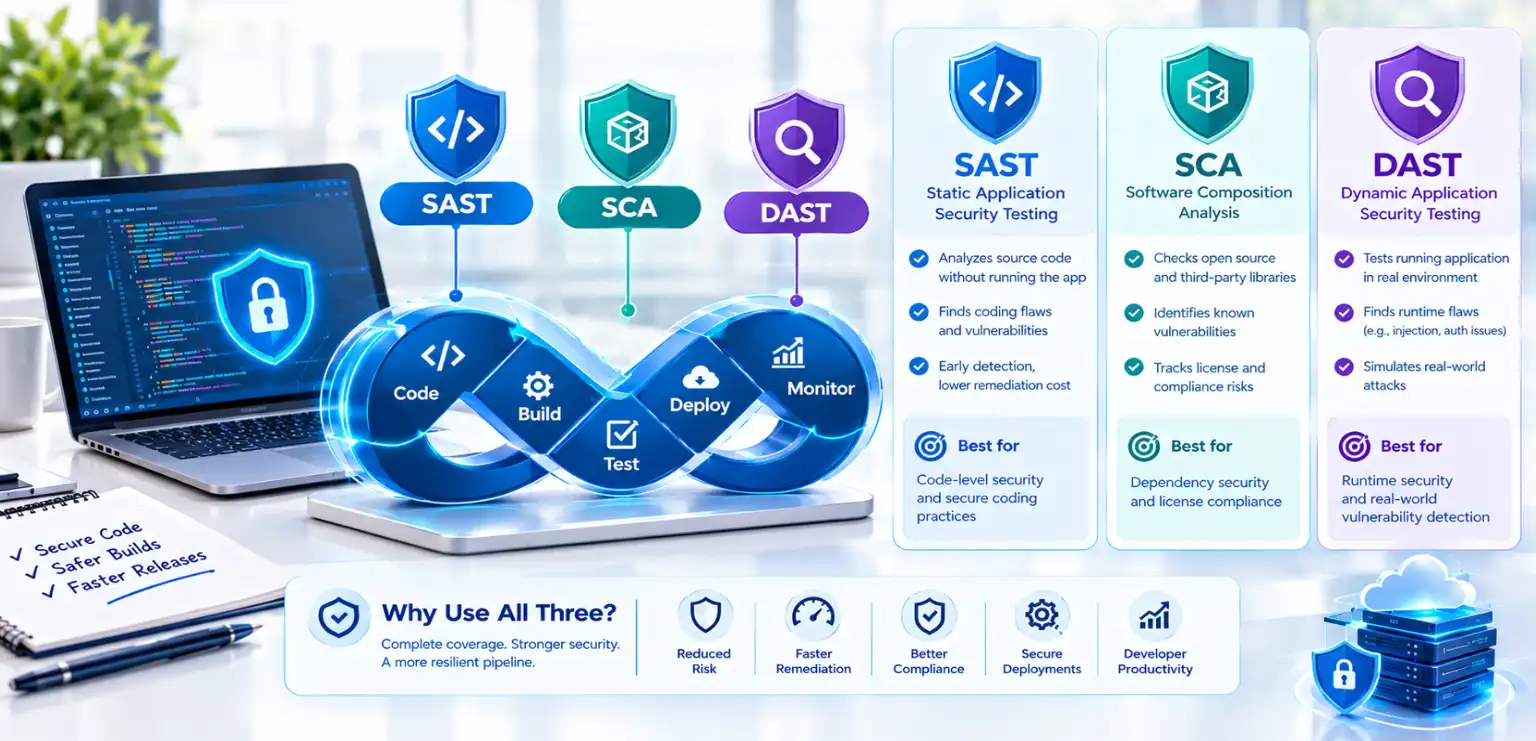
Static Application Security Testing (SAST) analyzes source code, bytecode, or supported binaries without executing the application. Dynamic Application Security Testing (DAST) tests a running application from the outside to identify runtime vulnerabilities. Software Composition Analysis (SCA) examines third-party and open-source dependencies for known vulnerabilities and other risks.
These three application security testing methods inspect different parts of software. They complement one another rather than replace one another.
Our recommendation is to select tools according to the risks they cover and integrate them at the right stages of the software development lifecycle (SDLC). Using more scanners does not automatically improve security if findings are not reviewed and fixed.
How SAST Tools Find Security Flaws in Source Code
Static Application Security Testing (SAST) analyzes source code without running the application. It helps identify hardcoded passwords, vulnerable database queries, insecure cryptography usage, and insecure data transfers via static code analysis.
GitHub CodeQL and SonarQube are examples of SAST tools. However, you should select your SAST based on the features and capabilities it offers.
| Practice tip Run SAST tools while developing and creating pull requests. Establish policies for high-risk vulnerabilities, provide remediation guidance for security concerns, and review any uncertain findings. |
How DAST Tools Test Running Applications and APIs
The dynamic application security testing (DAST) process evaluates an application by sending requests to its endpoints and examining its responses. It can assist in identifying any weaknesses during runtime, exposed endpoints, and injection vulnerabilities without the need for accessing the application’s source code.
OWASP ZAP and Burp Suite offer web application security testing, while API security testing can evaluate the endpoints, authentication, and access control measures.
| Best Practice Perform DAST in a staging environment configured appropriately with appropriate test accounts and authenticated scanning if required. Passing a clean DAST scan does not mean that the application is secure. |
What Is SCA in Security Testing and Why Does It Matter?
SCA identifies third-party libraries, frameworks, and packages and looks for information about vulnerabilities in the available data. SCA security assessments include direct dependencies and transitive dependencies – packages added through other packages.
OWASP Dependency-Check detects the dependencies that are vulnerable based on public vulnerability data, while Trivy scans dependencies, software artifacts, and container images.
A software bill of materials (SBOM) provides information about software components of the application and allows teams to find potentially vulnerable products in case new vulnerabilities appear. An SBOM is an inventory, not a security check. Software composition analysis tools allow assessing the security of the software components based on available vulnerability data and policies.
| Best Practice Combine dependency vulnerability scanning into builds and track important updates for improving software supply chain security. |
Dependencies are only part of the exposure. Our guide to cloud security threats covers the environment those components run in.
Best DevSecOps Tools in 2026: Comparing SAST, DAST, and SCA Solutions
The selection of the best DevSecOps tools is contingent upon the programming languages, software architecture, budgets, regulations, and the existing continuous integration / continuous deployment platform. Rather than selecting a tool on its popularity alone, compare its detection features, integration requirements, reporting quality, and workflow support.
Application Security Testing Tools: How to Choose by SDLC Stage
Application security testing tools identify, analyze and help prevent vulnerabilities in source code, software parts, APIs and apps that are running.
Modern DevSecOps tools can support different stages, from writing and checking code, to scanning software parts, testing apps that are live and keeping cloud systems safe. Cloud security checks, scanning infrastructure code and securing containers are extra features. They don’t come with every SAST, DAST or SCA tool by default.
We recommend matching each tool to a specific need:
| During development: Use SAST to identify potential weaknesses in custom code. | |
| During builds: Use SCA to check dependencies and scan relevant software artifacts. | |
| During application testing: Use DAST to assess running web applications and APIs. | |
| Before release: Review unresolved findings against agreed risk and release policies. | |
| During ongoing operations: Monitor dependency advisories and review newly disclosed vulnerabilities. |
This approach makes tool selection more practical. Rather than investing in overlapping scanners, teams can identify coverage gaps and choose products that address them.
SAST vs DAST: Which Is Better for Your Application Security Strategy?
Neither SAST nor DAST can be considered superior in every case. SAST will be helpful for developers who have to identify possible vulnerabilities in the code prior to deployment. DAST will help the security team to investigate the behavior of a running application. SCA deals with the other problem of examining dependencies.
Do you need both SAST and DAST? Most organizations will gain from combining them because they identify different kinds of flaws. The addition of SCA will bring another important component of the solution.
How to Integrate SAST, DAST, and SCA into a DevSecOps Pipeline
The implementation of CI/CD security practices should define which scans need to take place at different stages, what kind of issues need immediate attention, and at what point the release can go forward.
| During coding: Fast SAST checks are needed to detect bad code practices before they get checked in. | |
| During pull requests: Perform SAST and SCA checks. Do not allow a merge if there are any findings that violate your security policies. | |
| During builds: Check dependencies, containers, and artifacts and create/update your SBOM. | |
| In staging: Run DAST on the application and the related APIs, with authenticated scans being included as necessary. | |
| Prior to release: Look at all unresolved findings for high risks against the set security gates. | |
| Post deployment: Watch for dependency alerts and recheck vulnerable components if and when any new vulnerabilities come out. |
Set release-blocking thresholds in advance. This could be something like an exploitable vulnerability at a publicly accessible endpoint that would make blocking the release a legitimate requirement. An issue of lesser importance with low-level exposure would need documentation, review, and a deadline for fixing.
This is how automated security testing can be achieved without having all the scans executed in the highest level of detail on each code change. Quick scans deliver timely information, while more thorough ones are executed at the right point in the pipeline.
The same staging principle underpins shifting security left, and our guide to shift-left security in CI/CD pipelines goes deeper into gate design.
At Impressico, our DevOps and Cloud Services assist companies in automating processes based on their technological needs and business needs. This is how security testing should be done – based on the needs of a development team’s delivery process, not by making all projects the same.
How We Recommend Prioritizing Vulnerabilities Without Slowing Releases
A scanner can report dozens or hundreds of findings, but not all represent the same level of risk. Vulnerability prioritization should consider technical severity alongside practical exposure and business impact.
We recommend reviewing five factors:
| Severity: How serious could the weakness be if exploited? | |
| Exploitability: Is there evidence that the vulnerability can be exploited? | |
| Reachability: Can an attacker reach the affected code or component? | |
| Exposure: Is the application or endpoint publicly accessible? | |
| Business impact: Could exploitation expose sensitive data or disrupt a critical service? |
This creates a more useful form of risk-based security testing than treating every alert equally.
A Practical Finding-Correlation Example
Imagine SAST identifies a potentially unsafe database query, while DAST reports suspicious behavior on the related endpoint. If the affected code path is reachable in the deployed application, the combined evidence may justify faster investigation.
However, a DAST scan that does not reproduce the issue does not automatically invalidate the SAST finding. The endpoint may not have been tested, or the test may not have reached the vulnerable path. Combining scan results with code review and runtime evidence helps teams make better decisions and reduce unnecessary investigation.
We recommend tracking a small security scorecard to understand whether application security testing is reducing risk without creating unnecessary delivery delays.
Review these measures together rather than focusing on a single number. A shorter scan is not useful if it misses important risks, and a high finding count does not necessarily indicate better security. The aim is to improve detection and remediation while keeping the development workflow manageable.
Those last two measures are quality-engineering questions as much as security ones; our software quality assurance practice works to the same scorecard.
Frequently Asked Questions About SAST, DAST, and SCA
| What are the best SAST tools in 2026? Popular SAST tools include CodeQL, SonarQube, and Checkmarx. The best choice depends on language support, security coverage, CI/CD integration, and budget. |
| Is SonarQube a SAST or DAST Tool? SonarQube primarily supports static code analysis and security checks. It does not replace DAST tools that test running applications. |
| What Is the Difference Between SCA and an SBOM? SCA identifies known vulnerabilities and risks in software components, while an SBOM lists the components included in an application. Together, they improve software supply chain visibility and risk management. |
| Can SAST Detect Third-Party Dependency Vulnerabilities? SAST focuses on source code and code-level weaknesses. Software composition analysis (SCA) is designed to identify known vulnerabilities in third-party dependencies, although some platforms combine both capabilities. |
| What Are the Top Five Security Testing Tools? A practical shortlist includes CodeQL and SonarQube for code analysis, OWASP ZAP and Burp Suite for dynamic testing, and Trivy for dependency and artifact scanning. The best combination depends on security requirements and development workflows. |
| Which Security Testing Tool Should a Team Implement First? Start with the biggest security gap: SAST for code vulnerabilities, SCA for dependency risks, or DAST for running applications. Add the other methods as your application security testing process matures. |
Building a More Effective Application Security Strategy with Impressico
Selecting the application security testing tools is just one component of a process for secure software delivery.
Understanding SAST vs DAST helps organizations choose the right testing methods for their security requirements while ensuring that third-party dependency risks are also addressed.
At Impressico Business Solutions, we suggest the use of SAST, DAST, and SCA according to application risk and delivery requirements. With the incorporation of security into the DevSecOps delivery pipeline and prioritization of findings according to actual exposure, application security will be improved without impeding deliveries.
| Working out where the coverage gaps are? We start by mapping what each scanner already covers, because the gap is usually clearer than the overlap. |
Impressico Business Solutions — DevSecOps, application security testing and the CI/CD engineering that keeps security checks from slowing delivery.

IBS
Similar articles
Shift-Left Security in CI/CD Pipelines: A Practical Playbook
September 4, 2026
DevSecOps: Shifting Security Left Without Slowing Delivery
September 2, 2026
Is Your Engineering Team Ready for Platform Engineering? A Readiness Checklist
August 12, 2026
Measuring Platform Engineering ROI: DORA and SPACE Explained
July 31, 2026
Internal Developer Platforms: Building a Golden Path for Engineering Teams
July 22, 2026
AIOps in Practice: Using AI to Cut Incidents and MTTR
July 6, 2026