September 4, 2026
Shift-Left Security in CI/CD Pipelines: A Practical Playbook
Enjoying this article?
Share it with the world!


How to Implement Shift-Left Security in CI/CD Pipelines
Security cannot be viewed as the final verification step while developing and releasing software continuously. The moment vulnerability is found in production; the software may already be integrated into the existing infrastructure, deployed in different environments, or utilized by customers.
This is why knowing how to implement shift left security has become important for DevOps and security teams working with fast-moving software delivery. There is no need to include all available security scanners into the CI/CD pipeline to solve the issue. The key here is to put proper security checks in proper places, to make results actionable for developers, and to decide which vulnerabilities would stop the release.
The choice of the moment to conduct security tests may significantly influence the amount of effort required for addressing these issues. According to IBM, solving issues in production is 30 times more expensive than addressing them in the design phase.
| 30× more expensive to fix a security issue in production than in the design phase (IBM). Catching it early is the cheapest place to catch it. |
| BUILD ON A SOLID PIPELINE — Shift-left works best on a healthy pipeline. See DevOps pipeline readiness and how to automate your CI/CD pipeline for SaaS. |
What Is Shift Left Security in DevOps?
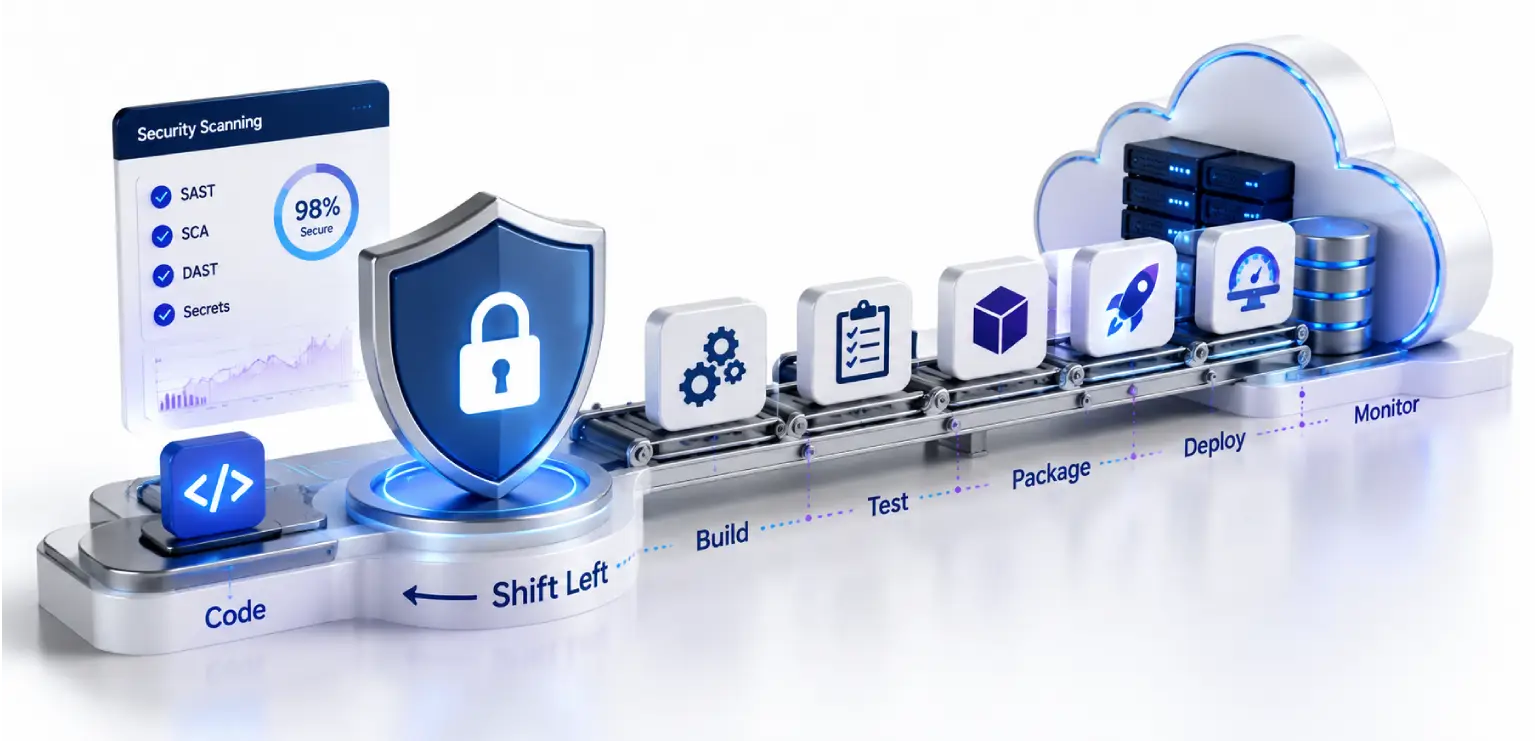
Shift-left security in DevOps means moving security activities closer to the point where code, dependencies, infrastructure, and configurations are created or changed (i.e; the earlier stage). Instead of waiting for a final security review, we introduce automated checks during development, pull requests, builds, testing, and release preparation.
If we look at how to implement shift left security effectively, the main principle is simple: detect a security problem at the earliest stage where it can be identified accurately and fixed efficiently.
This does not mean running every scan at every stage. A secret can be detected when code is committed, while a runtime authentication weakness may require a running application and therefore belongs later in the pipeline.
How Do We Shift Security Left in CI/CD?
To understand how to implement shift left security in a CI/CD environment, we should first map the existing delivery workflow. We need to know where developers write and review code, where dependencies enter the application, where infrastructure is defined, where containers are built, and where applications are tested before release.
Once those points are clear, security controls can be connected to the relevant stages.
| CI/CD Stage | Security Check | Main Purpose | Recommended Action |
| Pull request | SAST + secrets scanning | Find insecure code and exposed credentials | Block critical, high-confidence findings |
| Build | SCA / dependency scanning | Identify vulnerable components | Apply risk-based policy |
| Infrastructure build | IaC scanning | Detect insecure configurations | Block serious policy violations |
| Container build | Container scanning | Find vulnerable packages and images | Block critical exploitable issues |
| Staging | DAST | Test the running application | Stop releases for defined critical issues |
| Release | Policy as code | Enforce security requirements | Apply release policy |
| Production | Continuous monitoring | Detect new exposure | Alert and remediate |
OWASP (Open Worldwide Application Security Project) recommends several of these security testing categories for CI/CD, including SAST, DAST, IAST, SCA, infrastructure vulnerability scanning, and container vulnerability scanning.
Expert Advice: Start With the Pipeline, Not the Tool
Before selecting shift left security tools, we recommend drawing the existing delivery path from commit to production. This often reveals that security checks are being added in places where they provide little value while important areas remain uncovered.
The goal is not to create the longest pipeline. The goal is to create a pipeline where each security check has a clear purpose.
The Block, Warn, or Observe Rule
When deciding how to implement shift left security without slowing delivery, one of the biggest mistakes is assuming every security finding should fail the build.
That approach can quickly create security fatigue. A developer may receive hundreds of findings, many of which are low-risk or false positives. If every finding blocks delivery, teams may start treating security controls as obstacles rather than useful engineering feedback.
We recommend a simple Block, Warn, or Observe model:
Block
Stop the pipeline when a critical or high-confidence issue creates unacceptable risk.
Warn
Allow delivery but create a visible finding when the issue needs attention but does not justify stopping the release.
Observe
Record informational or low-confidence findings for trend analysis and future tuning.
This is an important part of how to implement shift left security because it connects pipeline decisions with business risk rather than simply measuring scan volume.
A critical hardcoded credential should not receive the same pipeline treatment as a low-confidence code-quality warning.
What Are the Best Shift Left Security Tools?
There is no single list of best shift left security tools for every organization. The right combination depends on the application architecture, programming languages, cloud environment, CI/CD platform, compliance requirements, and risk profile.
Common categories include:
| ▪ SAST: Static Application Security Testing examines source code or compiled code for potential security weaknesses. |
| ▪ SCA: Software Composition Analysis identifies vulnerabilities and other risks in open-source dependencies. |
| ▪ Secrets scanning: Detects credentials, API keys, tokens, and other sensitive information that may have entered repositories. |
| ▪ IaC scanning: Examines infrastructure-as-code files for insecure configurations and policy violations. |
| ▪ Container scanning: Checks container images and their components for known vulnerabilities and configuration problems. |
| ▪ DAST: Dynamic Application Security Testing examines a running application for vulnerabilities that may not be visible through source-code analysis alone. |
| ▪ Policy-as-code: Converts security requirements into repeatable rules that can be checked automatically. |
OWASP’s current DevSecOps guidance specifically includes SAST, SCA, container security, hardcoded secrets detection, DAST, IAST, and secure dependency management among its verification areas.
| CHOOSING TOOLS — The same discipline applies to your pipeline stack. See choosing CI/CD tools for SaaS and GitHub Actions vs. Jenkins. |
Choose Shift Left Security Tools by Feedback Quality, Not Tool Count
When evaluating shift left security tools, we should ask a more useful question than “How many security checks can this tool perform?”
We should ask whether the tool integrates with the existing workflow, produces useful findings, explains remediation clearly, supports appropriate policies, and provides results quickly enough for the relevant development stage.
A technically powerful scanner that takes too long, produces excessive false positives, or gives developers little remediation guidance may create less value than a smaller tool that fits naturally into the pipeline.
Shift Left Security Best Practices for DevOps Teams
The strongest shift left security best practices are usually less about adding technology and more about making security part of normal engineering work.
1. Start With High-Risk Areas
We should begin with applications, services, repositories, dependencies, and infrastructure that carry the greatest business or security risk. This creates a manageable starting point instead of trying to secure everything at once.
2. Scan at the Earliest Useful Point
A secret should be detected before it travels through multiple environments. A vulnerable dependency should ideally be identified during the build rather than after deployment. Runtime weaknesses can be tested when an application is available for dynamic testing.
3. Automate Repeatable Checks
Security teams should not spend human time repeatedly checking conditions that a pipeline can evaluate consistently. Automation is particularly useful for secrets, dependencies, infrastructure configurations, containers, and policy enforcement.
| AUTOMATE THE REPEATABLE — A strong automation base makes this practical. See our DevOps automation framework for SaaS. |
4. Keep Security Findings Close to Developers
Security findings become more useful when they appear where development work already happens, such as pull requests, build results, or integrated development environments.
5. Prioritize Risk Instead of Counting Findings
A backlog of 2,000 findings does not automatically mean an organization is less secure than one with 500. Severity, exploitability, exposure, business impact, and confidence matter more than raw finding counts.
6. Manage Exceptions
There will be cases where a finding cannot be fixed immediately. Instead of silently ignoring it, we should document the reason, assign ownership, set an expiration date, and review the exception.
7. Tune the Pipeline Continuously
Shift left security best practices should evolve as applications and threats change. New false positives, unnecessary checks, slow scans, and repeated developer complaints are signals that the pipeline needs tuning.
The Security Feedback Loop
A security scan is only the beginning. An important part of how to implement shift left security is building a complete feedback loop:
Find
→
Explain
→
Fix
→
Verify
First, the pipeline identifies a potential vulnerability. Second, the output needs to describe the detected vulnerability, its significance, and the location of the problem. Third, the developer fixes the problem in their regular development process. Lastly, the pipeline confirms that the problem has indeed been solved.
Why this is important is because the output of a security analysis that lacks meaningful guidance for remediation becomes just another piece of data on the already overloaded backlog.
| Expert advice: It is recommended to measure the period from detection to remediation verification, not just the quantity of detected vulnerabilities. A pipeline which detects 1,000 problems but cannot solve most of them might be less useful than the pipeline which detects fewer but more reliable problems and solves them efficiently. |
What Are the Benefits of Shift Left Security?
The main benefits of shift left security come from shortening the distance between introducing a security problem and discovering it.
When security checks are integrated into CI/CD, developers can receive feedback while the change is still fresh. This can reduce late-stage rework, improve visibility into dependencies and infrastructure, and make security validation more repeatable.
There is also a practical business reason to move earlier. IBM reported in 2026 that fixing issues in production can cost up to 30 times more than resolving them during design.
That does not mean every vulnerability can or should be eliminated during development. It means we should avoid discovering preventable problems at the most expensive point in the delivery lifecycle.
How Do We Measure Whether Shift-Left Security Is Working?
Knowing how to implement shift left security also means deciding how we will measure whether the approach is actually working.
Security teams can track metrics such as:
| ▪ Percentage of vulnerabilities detected before production |
| ▪ Mean time to remediate security findings |
| ▪ False-positive rate |
| ▪ Security-related pipeline delay |
| ▪ Number of vulnerabilities escaping into production |
| ▪ Age of security exceptions |
| ▪ Percentage of critical findings resolved within the required period |
| ▪ Developer time spent responding to security findings |
This gives us a better picture than simply counting the number of scans performed.
| MEASURE WHAT MATTERS — Tie these to delivery health with the DevOps metrics every CTO should track. |
A Simple Shift-Left Effectiveness Scorecard
We can also divide performance into four areas:
Detection
Are we finding meaningful issues early?
Decision
Are pipeline policies correctly separating blocking and non-blocking risks?
Remediation
Are developers fixing findings within reasonable timeframes?
Delivery
Are security controls operating without creating unnecessary pipeline friction?
This creates a useful connection between security outcomes and engineering performance.
Is Shift Left Security the Same as DevSecOps?
No. Shift-left security and DevSecOps share similarities but are not the same.
Shift-left security refers to the practice of conducting security-related actions earlier on in the software development life cycle. DevSecOps is a broader operating model that encompasses security in development, automation, and delivery. (We break this down further in the difference between DevOps and DevSecOps.)
In practical terms, shift-left security can be one important part of a DevSecOps program. The focus of this playbook is narrower: putting effective security controls into the CI/CD process without turning the pipeline into a collection of unnecessary gates.
| THE BIGGER PICTURE — Shift-left is one part of a wider program. Read DevSecOps: shifting security left without slowing delivery for the full operating model, and how to measure DevOps maturity. |
FAQs
Where Should Security Scanning Happen in a CI/CD Pipeline?
Security scanning should happen at different stages based on what each test can detect. Secrets and SAST can run early, SCA during builds, IaC and container scans during infrastructure and image creation, and DAST when a running application is available.
Should Every Security Finding Fail the CI/CD Pipeline?
No. A risk-based model is usually more practical. Critical, high-confidence and policy-defined findings can block delivery, while lower-risk findings can generate warnings or remain under observation.
Which Security Scan Should Run First?
There is no universal order, but fast checks such as secrets scanning and SAST are often suitable for early development or pull-request stages. Dependency, IaC, container, and dynamic testing can follow as the application progresses through the pipeline.
How Can We Reduce False Positives?
We can reduce false positives by tuning rules, reviewing recurring findings, setting appropriate severity thresholds, using application context, and creating controlled exceptions. Tool configuration should be treated as an ongoing engineering activity rather than a one-time setup.
How Do We Measure Shift-Left Security Effectiveness?
We can measure pre-production detection rates, remediation time, escaped vulnerabilities, false-positive rates, exception age, and security-related pipeline impact. These metrics show whether security is actually improving rather than simply increasing the number of scans.
Make Security Part of the Pipeline, Not a Final Gate
Understanding how to implement shift left security goes beyond adding scanners to a CI/CD pipeline. It involves applying appropriate controls at appropriate times, focusing on relevant risks and providing actionable information to developers. We at Impressico Business Solutions assist organizations in enhancing their CI/CD security without compromising the delivery process.
| IMPRESSICO · DEVOPS & CLOUD SERVICES Make security part of the pipeline, not a final gate Impressico Business Solutions helps organizations put the right security controls at the right CI/CD stages — actionable for developers, risk-based at the gate, and without slowing delivery. Whether you’re mapping your pipeline or tuning an existing one, our DevOps & Cloud Services team can help you design and measure it.
|
Impressico Business Solutions — Putting the right security check in the right place, without turning the pipeline into a collection of gates.

IBS
Similar articles
Compliance-as-Code: Automating SOC 2, HIPAA, and PCI-DSS in CI/CD Pipelines
September 9, 2026
DevSecOps: Shifting Security Left Without Slowing Delivery
September 2, 2026
Is Your Engineering Team Ready for Platform Engineering? A Readiness Checklist
August 12, 2026
Measuring Platform Engineering ROI: DORA and SPACE Explained
July 31, 2026
Internal Developer Platforms: Building a Golden Path for Engineering Teams
July 22, 2026
AIOps in Practice: Using AI to Cut Incidents and MTTR
July 6, 2026