October 28, 2026
Cloud Cost Optimization Services: What a Modern FinOps Engagement Actually Delivers
Enjoying this article?
Share it with the world!


What Cloud Cost Optimization Services Actually Deliver
| ⚡ Quick Answer Cloud cost optimization services find, prioritize and implement efficiency improvements across your cloud estate without sacrificing performance, security or reliability. A modern FinOps engagement covers five things: a cost assessment with a spending baseline and prioritized opportunities, infrastructure optimization through rightsizing and idle-resource cleanup, pricing analysis against commitment options, cost governance through budgets and alerts, and results reporting with verified savings. Pricing runs from a one-time assessment to a managed FinOps retainer. The number that matter is verified savings, not forecast savings – so agree up front who implements the changes and how the savings will be measured. |
Cloud cost optimization services allow companies to lower unnecessary cloud expenses, enhance the efficiency of cloud utilization and maximize the benefit of their technology investment. The growth of the cloud environment leads to such issues as growing cloud costs, unused infrastructure, oversized resources, and poor visibility into costs, which complicate spending management.
The modern FinOps engagement is much more than just an examination of invoices. It encompasses several aspects – technical, financial, implementation and monitoring of cloud investment.
What are Cloud Cost Optimization Services?
Cloud cost optimization services assist businesses in uncovering, prioritizing, and implementing cloud efficiency improvements that do not sacrifice performance, security, and reliability.
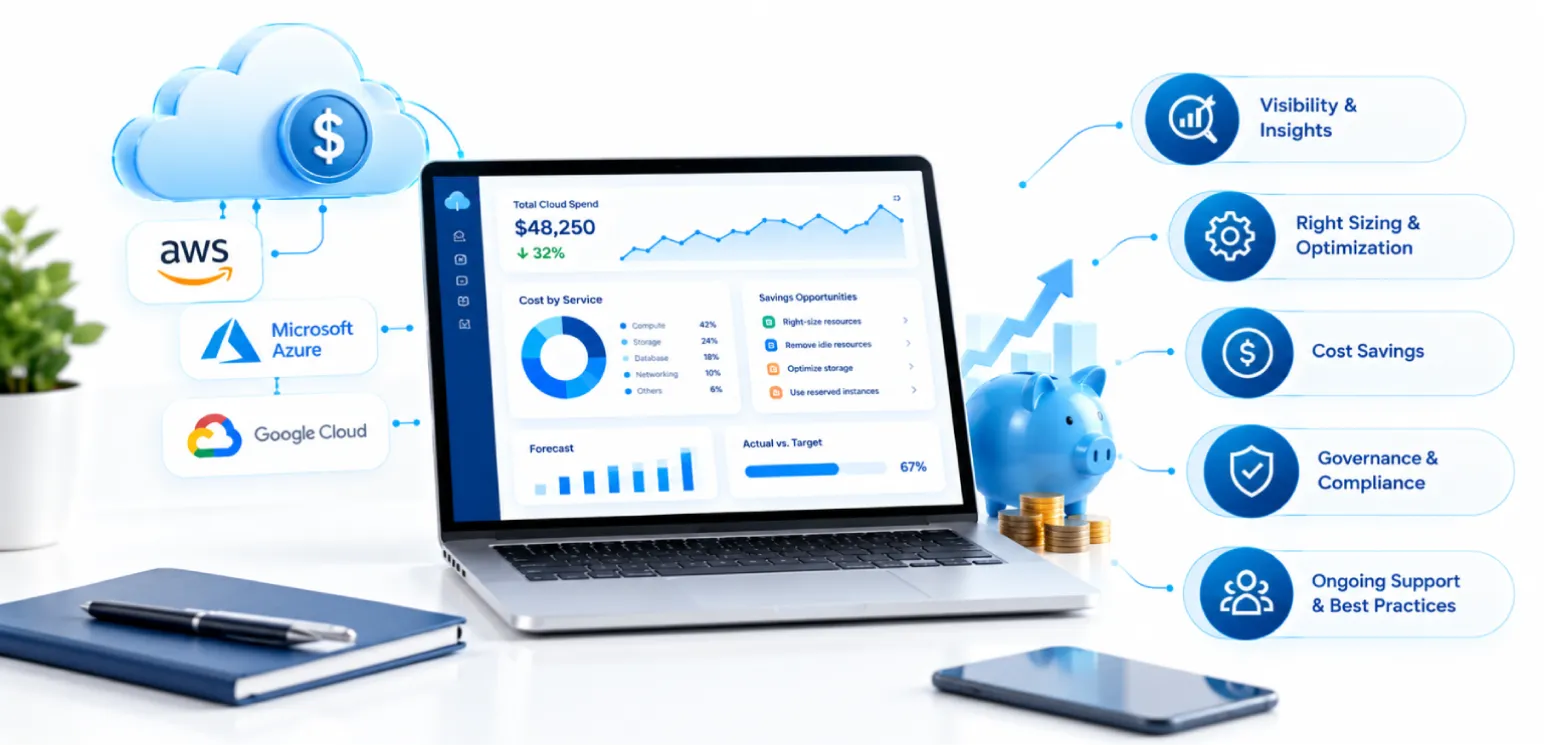
The above-mentioned services usually cover cloud billing analysis, rightsizing of resources, pricing analysis, cloud cost forecasting, cloud governance, and optimization services. A full-fledged cloud cost optimization solution bridges finance and engineering approaches to the problem.
Unlike basic reporting, cloud cost reduction services concentrate on the actions that follow the identification of the efficiency improvement opportunity.
What are FinOps Services for Cloud?
FinOps is a collaborative process that brings together Finance, Engineering, Operations and Business teams to manage cloud spend. This provides clarity around where you are spending money, who is responsible for this and if your infrastructure is driving value.
A good FinOps service will ensure you understand your costs, are accountable for your spend, can forecast spend and will help improve your processes. Engineering teams will be able to determine if they require additional compute whilst Finance will understand the impact on the budget.
What are the 3 FinOps Phases?
The FinOps process is often split into 3 parts:
| Inform — Provide insight into your costs using billing reports, allocation, budgets and forecasting. | |
| Optimize — Spot waste, rightsizing and suitable pricing. | |
| Operate — Define ownership, monitoring, policies and regular reviews. |
This creates a continuous improvement culture.
| A note on terminology Inform, Optimize and Operate are the FinOps Foundation’s three phases. The Foundation separately defines six principles – teams need to collaborate, business value drives technology decisions, everyone takes ownership of their usage, FinOps data should be accessible and timely, FinOps is enabled centrally, and take advantage of the variable cost model. The phases describe what the practice does; the principles describe why. The FinOps Framework. Checked October 2026. |
What are the 4 pillars of Cloud Cost Optimization?
Businesses can implement a practical approach to cloud cost optimization by focusing on these 4 pillars of cloud cost optimization:
1. Cost visibility: Understand spending across applications, teams, and services.
2. Resource efficiency: Match infrastructure capacity to actual demand.
3. Pricing efficiency: Evaluate suitable service tiers and commitment-based discounts.
4. Continuous governance: Maintain budgets, forecasts, alerts, and ownership.
This is a practical view and may vary depending on the cloud framework you are using. Some frameworks will have different optimizations.
| The FinOps Loop Inform Insight into your costs using billing reports, allocation, budgets and forecasting Optimize Spot waste, rightsizing and suitable pricing Operate Define ownership, monitoring, policies and regular reviews Acting on four pillars Cost visibility Spending across applications, teams and services Resource efficiency Capacity matched to actual demand Pricing efficiency Service tiers and commitment discounts Continuous governance Budgets, forecasts, alerts and ownership This creates a continuous improvement culture Teams cycle through all three – these are not stages you graduate from. The three FinOps phases, and the four pillars they act on. |
| Since the framework was written The FinOps Foundation rewrote its framework in 2026. It now spans the whole technology estate rather than cloud alone, with dedicated categories for AI, SaaS, data platforms and data-centre spend, and several capabilities renamed – “Architecting for Cloud” became “Architecting and Workload Placement”, and “Workload Optimization” became “Usage Optimization”, which applies across all scopes. The three phases above are unchanged. The FinOps Framework. Checked October 2026. |
What Does a Modern FinOps Engagement Deliver?
A modern FinOps engagement should provide recommendations, support with the agreed actions and show evidence of improvements.
Cloud Cost Audit & Infrastructure Optimization
A cloud cost audit will review your billing, resource usage, storage, databases and application architecture. This could identify areas of unused VMs, storage volumes, overallocated databases or unexpected data transfer costs.
The findings should be presented as a prioritized list. This should include expected savings, effort required, technical dependencies and potential risks.
For instance, AWS cost optimization consultants can review the configuration of computing, use of storage, costs related to databases, as well as alternatives like AWS Savings Plans or Reserved Instances. It is important that such arrangements be considered in the light of real demand.
If you have containerized applications, then Kubernetes optimization can help. This will include looking at node usage, pod requests, autoscaling and idle clusters. Any changes should be tested to ensure they do not affect the performance or reliability of the application.
Cloud Cost Governance and Continuous Optimization
To ensure continuous improvement, budgets should be set up, alerts for anomalies, resources tagged for ownership and regular reviews. This will help identify areas of unnecessary spend.
Automation can be put in place by scheduling environments to turn off, reviewing infrastructure policies and setting up alerts.
This means that cloud cost optimization services will be more valuable, as they will help to keep these improvements in place as workloads change.
Cloud Cost Optimization Examples: How Businesses Can Reduce Waste
The following are only some cloud cost optimization examples.
| Development environment idle time: Arrange for appropriate non-production systems to be turned off outside working hours, provided that all necessary background processes have been verified. | |
| Computing over-provisioning: Tailor virtual machine sizes and database settings based on real demand while tracking system performance. | |
| Storage and data transfers: Check storage lifecycle, required data retention, and any unneeded data transfers. | |
| Pricing plans: Assess pricing discounts for known workloads against the need for flexibility. |
It is a good idea to measure the implementation of every opportunity found from the point of discovery through implementation and validation. Otherwise, any savings forecast can end up being counted as actual savings.
| Where is your cloud spend actually going? Most teams can see the invoice total. Far fewer can say which application, team or environment drove the change month on month – which is the difference between reporting on cost and acting on it. We start with the baseline and a prioritized list, not a percentage promise. Talk to us about a cloud cost assessmentExplore our DevOps and cloud services |
How much do cloud cost optimization services cost?
The cost of a cloud cost optimization service will vary based on the complexity of the infrastructure, number of cloud providers, scope and requirements. There is no one-size-fits-all.
Common pricing models include:
| One-time assessment: A defined review with findings and recommendations. | |
| Fixed-scope project: Assessment and implementation of agreed improvements. | |
| Monthly retainer: Ongoing analysis, reporting, and optimization support. | |
| Managed FinOps services: Continuing monitoring, governance, and operational assistance. |
Before signing any agreements, make sure you understand what is included in the fee, who will act on the changes, how savings will be measured and if there are any additional costs for software or engineering.
How Much Can Businesses Save Through Cloud Cost Optimization?
Savings will vary according to the initial state of the organization, workloads, architecture, and implementation capability. Organizations with excess idle capacity might have different possibilities than organizations that have been doing optimizations for some time.
A good estimation will differentiate between potential and actual savings. Changes in workload volume, cloud prices, and implementation cost should be taken into consideration.
A basic ROI calculation would be:
ROI = (Verified Savings − Engagement Costs) / Engagement Costs × 100
For example, if an engagement generates $50,000 in verified savings and costs $10,000, the simplified ROI is 400%. This only takes into consideration the two figures. It is assumed they are within the same timeframe.
You should also consider other metrics such as cost per transaction or cost per customer. Total spend may increase as your business grows.
Cloud Cost Optimization SaaS vs Consultant
Cloud cost optimization SaaS solutions offer dashboards, spend reports, anomaly detection, and suggestions. This will be useful for teams to have visibility and detect anomalies in their spending patterns.
Architecture reviews, implementation plan, technical analysis, and governance bring value through consulting. It all depends on the expertise and requirements within an organization.
The tools will identify opportunities but the recommendations will need to be reviewed and actioned.
How to choose a cloud cost optimization partner
When choosing a cloud cost optimization partner, it is important to look at more than just potential savings. You should look at their technical knowledge, ability to act, reporting and risk.
Asking the below questions will help:
| How will you establish our cost baseline? | |
| Who will implement and approve recommended changes? | |
| How will you verify actual savings? | |
| How will performance, security, and reliability be protected? | |
| What reporting and ongoing support are included? |
| Key Takeaway A reliable partner will be able to clearly explain their approach. They should not guarantee a set percentage saving until they have reviewed your environment. |
A Cloud Cost Optimization Guide for the First 90 Days
Having a structured approach will help to identify opportunities and make improvements.
| Week 1-30 |
Baseline. Review your costs, identify key spend areas, baseline and identify opportunities.
| Week 31-60 |
Implement. Consider addressing high-priority problems, including idle resources, excessive infrastructure, and poor configuration. Do not forget to test your actions first.
| Week 61-90 |
Measure and Govern. Validate improvements, set up suitable budgets and alerts, identify cost ownership and plan for the next optimization.
Depending on the complexity of your environment, approvals and engineering capacity, this may take longer. Optimization should be an ongoing process.
| The First 90 Days Week 1–30 Baseline Review your costs, identify key spend areas, baseline and identify opportunities. Week 31–60 Implement Address high-priority problems: idle resources, excessive infrastructure, poor configuration. Test first. Week 61–90 Measure and Govern Validate improvements, set budgets and alerts, identify cost ownership, plan the next round. This may take longer Depending on the complexity of your environment, approvals and engineering capacity. Optimization is ongoing. The first 90 days, from baseline through to governance. |
Supporting Your Cloud Cost Optimization Strategy
At Impressico Business Solutions, our goal is to assist companies in optimizing their cloud costs in an organized manner. This means helping our clients to find areas of savings, analyze their resources, and suggest changes that will meet the needs of the business. Our focus lies in providing cost insights, prioritization, and outcomes.
We can assist you to determine how your cloud budget is being spent, ways of minimizing unnecessary expenses, and making proper decisions with respect to your infrastructure. Our emphasis is on cost insight and improvement.
FAQs
| What is the difference between cloud cost optimization and FinOps? Cloud cost optimization is about improving your efficiency. FinOps is the overall process to align the financial and technical teams around your cloud spend. |
| Can cloud cost optimization work across multiple cloud providers? Yes. Multi-cloud services can cover AWS, Azure & Google Cloud. Depending on the cloud provider’s knowledge and scope, there may be more work required to compare the billing and ensure consistent cost allocation. |
| Are cloud optimization tools enough without a consultant? They may work well for technically savvy teams that have simple needs. There are consultants who will assist in making architectural choices, implementing plans, and governing. |
| How often should cloud spending be reviewed? Anomalies in cloud spend need to be monitored continuously wherever possible. Major spend needs to be reviewed along with forecasts and ways to optimize regularly. |
Conclusion
Cloud optimization is a continuous business process and is not simply about reducing costs in infrastructure. Companies require visibility into their cost structures, tangible engineering changes, good implementation practices, and measurement capabilities.
Impressico Business Solutions can take this into consideration when talking to you about your cloud environment and what the next step will be.
| Key Takeaways
Inform, Optimize, Operate Three phases you cycle through, not stages you graduate from.
Four pillars Visibility, resource efficiency, pricing efficiency and governance.
Ninety days Baseline, implement, then measure and govern — and keep going.
Verified, not forecast Measure every opportunity from discovery through to validation. |
| Start with a baseline, not a percentage Impressico helps enterprises see where cloud spend is going, prioritize the changes worth making, implement them without putting performance or reliability at risk, and verify the savings afterwards – so what gets reported is what was actually banked. Request a cloud cost assessmentExplore our cloud and DevOps services |
Impressico Business Solutions – cloud cost optimization, FinOps and DevOps engineering for the enterprise.

IBS
Similar articles

Compliance-as-Code: Automating SOC 2, HIPAA, and PCI-DSS in CI/CD Pipelines
September 9, 2026
Shift-Left Security in CI/CD Pipelines: A Practical Playbook
September 4, 2026
DevSecOps: Shifting Security Left Without Slowing Delivery
September 2, 2026
Is Your Engineering Team Ready for Platform Engineering? A Readiness Checklist
August 12, 2026
Measuring Platform Engineering ROI: DORA and SPACE Explained
July 31, 2026
Internal Developer Platforms: Building a Golden Path for Engineering Teams
July 22, 2026